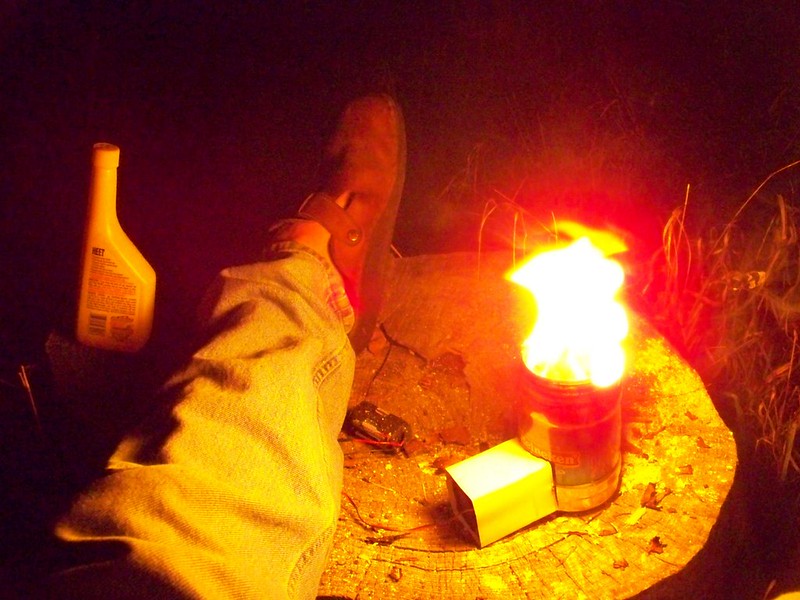
First, my stove is based as near to possible to the authors original design with a fosters can and bean can.
It's not a huge deal but the internal can fractured and fell off.
Ironically it fractured above the air holes I drilled in the bottom sides. Meaning they were not the week point.
Not sure if this will be a repeated problem but I'm going to continue to experiment with the design.
My big problem with this design is still the airflow problem. Since I'm not using it for cooking I'd like it to burn for prolonged periods of time with as little maintenance as possible.
When it's fairly newly lit and hasn't yet clogged with ash I can put quite large sticks in about the diameter of a quarter and it'll burn them surprisingly well. In fact better then small sticks. It only requires 3-4 of these larger sticks to produce a good flame for prolonged periods.
I suspect they burn well because of the focused heat of the stove design and large amounts of airflow around them which is impeded when you fill the can with smaller sticks.
What's more though I can't break these sticks down very small I can leave them hang out as much as six inches and they slowly settle as they burn.
The problem is it does start to clog eventually, airflow is restricted and the fire starts to smolder instead of burning hot and clean.
BTW, it's important to note that when you leave larger sticks poking out the top they are at least impeding the gasification process a little as they block the holes around the top. Thus they increase the smoke a little.
This is an acceptable trade off for me since I'm not using it as a cooking stove. Being able to use quite large sticks increases the burn time and lowers the maintenance a lot.
O ther things of note.
1) the bottom of the stove doesn't get to hot allowing the stove to be used on a picnic table with very minimal marking.
2) the stove is a little top heavy and tips over a little easy, though not disastrously. A few big rocks around it can help steady it. Obviously this is because I'm using larger sticks.
3) The stove doesn't radiate much heat out away from the can, just up. Meaning it's not great as a warming fire. Unfortunately the vertical structure is the key to getting air to flow up through the can.
4) The heat around the top of the can is pretty intense and focused… which is probably what makes it great for cooking. I find that placing a large stick or two across the top of the can that are to long to fit in it or break by hand works well. It actually seems to intensify the ossification process and quickly burns the stick through enough it can be easily snapped. This process of breaking down and burning larger sticks seems to be a great process for burning the stove long and hot… which is probably why the internal can cracked. It's possible to quickly produce an abundance of six inch sticks of 1" to 1.5" in diameter that can burn for hours and hours.
So, I think what I'm going to try next in no particular order.
1) experiment with a computer fan to increase airflow on this or another design.. Brush Buddy inspired
2) make the entire bottom half or 1/3 of the internal can absolutely full of holes to increase airflow
3) possibly leave a big gaping hole in the bottom of the internal can so that more ash falls through (if a tiny bit of still burning wood).
4) make the outer can out of a Heineken can so it's stronger.
P.S. It has occurred to me that I don't necessarily need a woodgas stove if I'm not using it for cooking. Am thinking I might try the Nimble Will Portable flat pack stove design for potentially better radiant heat… but not until I'm finished experimenting with this design.