Topic

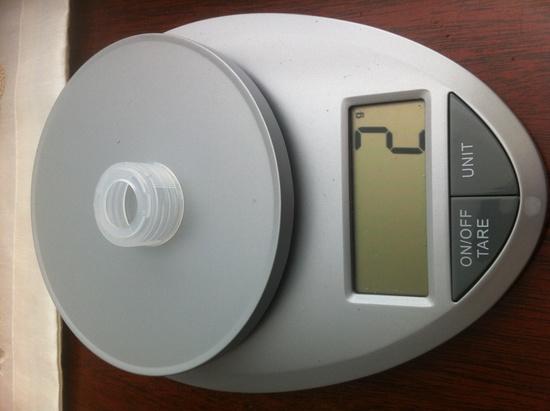
2 gram back flush for sawyer squeeze

  • This topic is empty.
Viewing 25 posts - 1 through 25 (of 36 total)
PostedJun 25, 2013 at 8:33 am

After having my filter clog up on me in the middle of a backpacking trip, I was determined to find a better solution than the syringe. This is what I've come up with. (FYI, I have the older squeeze without the nipple on the outlet side).

I've always used the flip-top sports cap from a smartwater bottle, as I don't have to worry about using the lid. This makes up half of the the back flush.
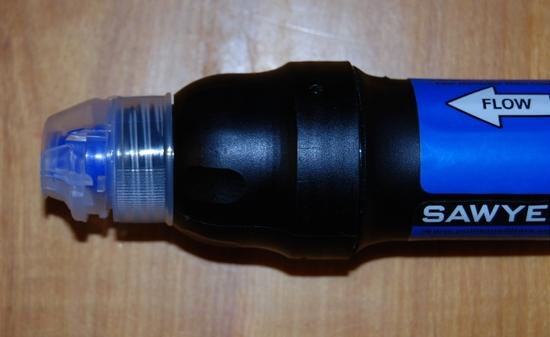
For the other half, you just need one more smart water sports cap. Tear of the flip-cap and 'pop out' the blue center spout…. That's it, your done. When connected as in the photos, it snaps together to make a secure fit back flush with.Filter as normally usedSet up for a back flushLocked in placeOnly additional piece taken

All for the cost of a bottle of water.
I now use a evernew bag to drink from, but it also worked when I used to use a smart water bottle.

PostedJun 25, 2013 at 9:27 am

Thanks Eric. This is a nice light setup that uses already on hand materials. Way to go!

Ian BPL Member
PostedJun 25, 2013 at 9:31 am

Just ordered my Sawyer yesterday. I was struggling with whether or not to bring the syringe but at 2grams this is a no brainer.

PostedJun 25, 2013 at 11:17 am

I believe if you have a newer sawyer squeeze with the nipple on it, the flip-top cap tip should fit/snap into place onto the nipple.

Piney BPL Member
PostedJun 26, 2013 at 7:40 pm

This works great. I added some teflon tape to the threads on my Sawyer and Evernew bladder as it was leaking a bit from the threads, not a big deal.

Piney BPL Member
PostedJun 27, 2013 at 4:28 am

I tried this on the new-style Squeeze as well. It works even better! The tip of the SmartWater cap snaps onto the nipple very tightly.

Piney BPL Member
PostedJun 27, 2013 at 10:12 pm

I was asked for explanation, so – screw the Smartwater cap (unmodified) onto an Evernew or Sawyer bladder after adding some teflon tape to the bladder threads. Then with the cap removed from the Sawyer Squeeze, push the tip of the Smartwater cap onto the Sawyer Squeeze nipple. It snaps tightly into place and you can really put some pressure through the filter with a full bag.

PostedJun 28, 2013 at 6:39 am

Drew,

Won't you need to carry a roll of teflon tape with you on the trail? That stuff wears out pretty quickly if you have to remove the cap to fill the bladder, then replace it to drink from, or back flush the Squeeze.

Piney BPL Member
PostedJun 28, 2013 at 7:43 am

I put about 8 wraps on mine and it seems to be holding up fine. You can backflush effectively without the tape, it just leaks a bit under pressure.

Ken Larson BPL Member
PostedJun 28, 2013 at 8:35 am

Drew….I am still confused as to the process you have tried to described.

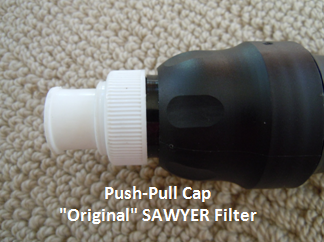
Being a visual learner a picture as I previously indicated would be of help to me to understand your method as I was unaware SAWYER made an update to the "push-pull" caps. I have one of the original SAWYER Squeeze Filters as Eric has and the "push-pull" nipple on our filter is larger than the Smartwater cap hole to fit and seat into.

When you mention Smartwater cap (unmodified) am I to assume you have not removed/pushed the BLUE spout out of the Smartwater cap?………YES

Smartwater Bottle Cap

Have included pictures of various item associated with this thread that might be of interest for clarification.

Push-Pull Cap

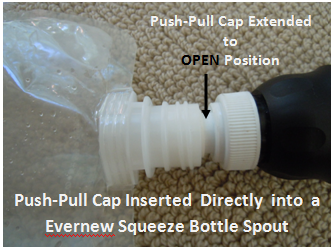
Original Sawyer Squeeze Filter owners, you can FORCE the original "push-pull" nipple INTO an Evernew bag spout with some effort and likewise black flush. This set up facilitated backflushing as good as Eric's Method and SAWYER Syringe Method that I have used in the past. How it works in the FIELD is unknown on filter needing maintenance is unknown.

Direct Insertion Push-Pull Cap

Smartwater Bottle Cap Back Flush Set Up

If you get a change I would appreciate a picture of your set up……Thanks

kenlarson40@chartermi.net

Piney BPL Member
PostedJun 28, 2013 at 11:05 am

Yes by intact I mean the blue spout is still in place on the SmartWater cap. If you remove the white push/pull cap from the (new model) Sawyer Squeeze there is a molded nipple (outlet) where you would normally fit the syringe. Just push the blue spout on the Smart water cap over that and it will snap into place. I will try and take a pic tonight.

Ken Thompson BPL Member
PostedJun 28, 2013 at 6:38 pm

I've tried this a few times now. The inside diameter of the blue tip fits over the nipple on the filter very snugly. It also bottoms out. I have no leaks using it this way.

Thanks again.

PostedJun 28, 2013 at 6:54 pm

Thanks for sharing this. I just tried it out at home and it works great. I've got a newer model Sawyer Squeeze filter and, as others have posted, the blue tip of the Smartwater cap fits over the nipple like it's made for it.

Piney BPL Member
PostedJun 28, 2013 at 7:57 pm

So a quick pictorial:

1) Replace the white push/pull cap on the new style Sawyer Squeeze with an unmodified SmartWater cap.

SmartWater backflush p1

2) Remove the cap from the Squeeze, screw it onto your bottle or bladder, and then push the blue spout over the nipple outlet on the Squeeze until it bottoms out. Done!

SmartWater backflush p2

Also, when testing this method a second time on the new Squeeze, I removed the teflon tape from the Evernew threads and there were no leaks. I'm not sure why the difference, perhaps I cinched the lid more, or the water pressure was less. But in any event, teflon tape isn't needed for the above method.

PostedJun 28, 2013 at 8:52 pm

Looks like the right one. I picked up a single bottle at a local Target. Just get the one with the flip-top lid and the blue nipple.

PostedJun 29, 2013 at 11:11 am

I don't believe this bag backflush method provides enough pressure to backflush and clear out the entire diameter of tubules, the syringe provided provides a huge amount more pressure, not sure if I'd recommend or use this idea, and I'm somewhat surprised nobody has mentioned this problem in this thread, you may end up creating the center channel with clogged outer channels that sawyer warns about. There's apparently a fair number of reports of filter slowdown over time, one has to wonder if methods like this are not partially to blame.

If you use an adapter and a short piece of hose and a syringe with a tip that fits into the hose, you can get far far higher pressure for backflush, simple physics, force per square cm, plunger has more force, and that's brought down the small opening.

while appealing to get rid of the syringe, I would say that this is probably not the way to do it. On the bright side, I've heard that sawyers can now be bought at walmart for $36 though of course I don't advocate buying from that place, you can probably find it online for that price too, so ruining a few filters over time isn't really going to be break the bank.

PostedJun 29, 2013 at 12:04 pm

Out of the box, and after priming, my PointOne had an initial flow rate of about 1 liter per minute.

I acquired significant degradation from microscopic algae in the BWAC.

After field backflushing with a bladder it had a flow rate of about 1 liter per minute.

When I got home I backflushed with house pressure and ran a bleach solution though it.

I checked again and I had a 1 liter per minute flow rate.

It's an easy thing to check.

And a leaning on a Platy provided enough pressure to get the job done, in this case.

PostedJun 29, 2013 at 12:54 pm

"If you use an adapter and a short piece of hose and a syringe with a tip that fits into the hose, you can get far far higher pressure for backflush, simple physics, force per square cm, plunger has more force, and that's brought down the small opening."

That is incorrect.

PostedJun 29, 2013 at 5:01 pm

Enlighten me please. So you're saying that if I hang a bag of air over my bike tire I can get up to 90psi? No more need for an awkward pump with a cylinder and a plunger? Awesome. I'll have to try that next time I get a flat, lol. If you're going to say something is 'wrong', at least make an effort to explain why it's wrong, particularly when it makes little sense to say so. Not saying you're not right, but you have said nothing at all beyond typing a few words, that's not meaningful. As Ricky said in the old Lucy show, "'splain, Lucy".

The other comment above however is more to the point, one can measure these things roughly, assuming you're using actual timers and actually measured quantities so that 3% degradations aren't missed, etc. So if you use a measured start quantity, and a real timer, and keep logs, avoiding 'about the same' type measurements, one certainly could make some good data points.

I'll look out for that in the future, though I won't test on my own filter. It's a good thing to track though.

Tom D. BPL Member
PostedJun 29, 2013 at 8:18 pm

Harold, you very well may be right. Sawyer recommends a strong backflush. But I think the cap method is still a viable way of field backflushing. Most of the reports of the Sawyer filters slowing to a crawl (my inline did this) are when the filter dries out in storage, not usually on a hike. If you need to backflush it to remove particulates that have accumulated during a hike, the cap method should provide enough pressure for this. Once flowing well, the filter generally does so for the duration of the hike unless it has a chance to dry out over several days. Once at home after the hike, the filter can be thoroughly backflushed with high pressure.

I'm just throwing out thoughts based on my experiences with the filters and as usual, I could be wrong. But I do think the cap method would do the job on a hike.

FWIW: The Squeeze filters are $29 right now with a single 32 oz bladder at Walmart. I couldn't find it cheaper online and I picked one up.

Viewing 25 posts - 1 through 25 (of 36 total)
Loading...