Topic

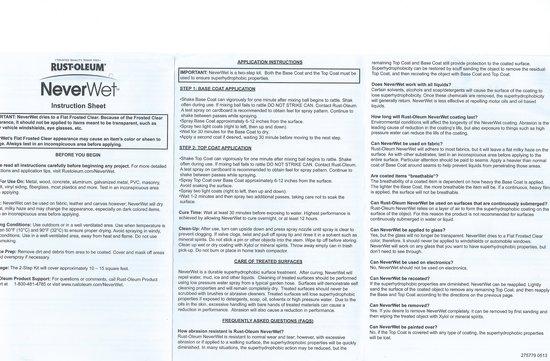
Rust-O-Leum NeverWet

  • This topic is empty.
Viewing 25 posts - 1 through 25 (of 41 total)
Troy Hawkins BPL Member
PostedJun 19, 2013 at 2:16 am

Can't wait to check this stuff out!

If Rust-O-Leum was willing to pick it up, I'm assuming it will live up to its potential.

PostedJun 19, 2013 at 4:29 am

"Magic liquid" sounds a bit like hype. If it does work, wow! I have some sealer in a can. Triples the fabric weight, but you can build a window screen boat with it.

Justin Baker BPL Member
PostedJun 19, 2013 at 8:54 am

Someone needs to apply this to a windshirt and go for a hike in heavy rain. I really want to know how well it works.

PostedJun 19, 2013 at 10:14 am

After a while you might as well just spray on clear coat. If it's truly waterproof it won't be breathable.

Jerry Adams BPL Member
PostedJun 19, 2013 at 10:20 am

Someone needs to apply this to 0.7 oz/yd2 fabric – nobul or M50 or whatever

PostedJun 19, 2013 at 10:25 am

I hope this stuff is as good as it's claimed.

If so, like carbon fiber poles, cuben fiber shelters and good WPBs (eg. eVent) we are getting less weight and more performance.

Who knows, it may supplant silicone in the treatment of nylon for tent material.

If we can apply this to our present gear with assurance that it is fairly permenant I see a huge market for it among all outdoor sports – and, of course, the military.

Maybe it has side benefits like being a bug repellant, curing arthritis and ED, increasing endorphine release, etc. :o)

Steven M BPL Member
PostedJun 19, 2013 at 1:46 pm

How much information do we have on this wonder-molecule?
Does this stuff wear off? If it does wear off, does it breakdown or does it bond to something else?

PostedJun 19, 2013 at 3:05 pm

I want to know how and what it will do, coating the fly on my tent. No more wet fly? Might be wonderful on my backpack, too.

PostedJun 20, 2013 at 3:34 am

"While the current Rust-Oleum NeverWet leaves a frosty haze, Hobson said a transparent application will "absolutely" be among the future versions"

That explains the white-only demo products…

PostedJun 20, 2013 at 8:39 am

I plan to use it around the house first, but I will treat a scrap of nylon (the stuff ray jardin uses for quilts) and see how it performs as a DWR.

Brett Peugh BPL Member
PostedJun 20, 2013 at 1:06 pm

It will be nice if it does work long term. Turn that $20 windshirt into a 5oz rain jacket.

Matt Dirksen BPL Member
PostedJun 22, 2013 at 6:26 am

Why am I reminded of the days when Scotchguard showed up on the market?

I can certainly see its utility, but I just can't seem to envision myself sleeping in a tent sprayed with this stuff, or sporting a jacket "field applied" with it. I just get the feeling like this is one of those "too good to be true" things, and it will eventually be recalled for something toxic-related. (Lest we forget "Bisphenol A"?)

Moreover, I'd be very curious what my companions in the greenbuilding industry think of it. "Low VOC" doesn't quite cut it, in my book.

… Time will tell….

PostedJun 23, 2013 at 8:51 am

Thanks, Jason. I'm looking forward to your observations of treated fabrics. In particular, I'm curious about fabrics that have been treated, then exposed to dirt, washed, etc.

PostedJun 23, 2013 at 9:42 am

yes. another + for Jason.

perhaps i am in one of "those" moods. but this thread seems quite the " but who will help me eat the bread ? ".

ie : much asking of questions and want of free information … and no effort.

Go Jason !

v.

Roger Caffin BPL Member
PostedJun 24, 2013 at 3:43 pm

Hi All

From what I can tell, this product works by trapping a film of air at the surface, with the water sitting on top of the air. The nano-scale details are the secret. This works OK for low-pressure water hitting the surface.

It will not work against high pressure water, against abrasion, or on a soft fabric. When you combine a soft fabric with rubbing against wet scrub you are going to get very rapid wetting through.

No magic here folks.

Cheers

PostedJun 24, 2013 at 3:44 pm

I'm inclined to agree with Roger. I don't think the water repellent properties of the coating will withstand soiling or abrasion, but as long as Jason has some, and is asking for testing suggestions…

I think it would be interesting to spray a windshirt or a piece of breathable nylon. I'd like to know if it improves the water resistance to such a degree that a windshirt could be used as a rain shell, or a treated sleeping bag/quilt could be used without a bivy under a small tarp. I'd also like to know how much the treatment reduces breathability. And it would be interesting to assess these parameters after soiling and one or more washings in a washing machine.

I think breathable, tighly woven nylon would be the substrate that most BPLers would use this product on. A few might want to use it on fleece, I guess.

It won't be useful to most of us if Jason's tests show that the coating rapidly becomes useless after abrasion or soiling, but it might still have a few narrow applications. For an ultramarathon, for example, it might be handy to have a windshirt that temporarily performs as a very breathable rain shell (until the coating is degraded).

Ken Thompson BPL Member
PostedJun 24, 2013 at 4:09 pm

but, but Roger is says fabric right on the label!

I wouldn't test it on anything I wasn't willing to throw away.

PostedJun 24, 2013 at 4:14 pm

They list fabric as an acceptable application and demonstrate it. Whether it will be durable enough to be a good DWR is still in question. A few of us (I'm waiting for my order to arrive) are going to test just that. I am going to coat a scrap piece of nylon and see how it holds up. I will "stuff" into something to simulate packing a piece of gear away many times and then test how well it still repels water.

It may or may not hold up. Since I bought it for use on a hard surface I'm not loosing much if it doesn't work on the nylon, but there is certainly something to gain. :)

James Marco BPL Member
PostedJun 24, 2013 at 4:42 pm

Well, my take is that this must be different from the origonal. This is because it is a two part spray, and, it has some disoloration when applied to fabrics. The original version was a single spray, capable of being used inside cell phones and did not cause dramatic color changes.

At any rate, it would be nice for Larry to do the testing. For me, I will wait for the origonal. It was never clear about durability, and, I am sure rain drops would cause sufficient force to penetrate the coating, I an not sure about the two coats. They are saying that it will remove breathability…usually associated with thicker coatings on nylon.

PostedJun 24, 2013 at 4:58 pm

I am in agreement with Roger. All it does is prevent water from sticking to the the fabric. Also note that when Roger said High pressure water that also has to include a good rain storm. A larg rain drop falling at terminal velocity could hit the fabric with enough force to generate the pressure needed to push the water right through the fabric.

A test that should be done is to take an untreated fabric and an identical treated fabric and measure the hydrostatic head of both samples. My guess is that never wet will not have a big impact on the hydrostatic head. If hydrostatic head remains unchanged Never wet treated fabric cannot replace a good rain jacket.

Some time ago I remember reading where people sent samples of fabric to a person and he measured the Hydrostatic head and posted the results. I don't know who it was.

Viewing 25 posts - 1 through 25 (of 41 total)
Loading...