Topic

Bushcrafting Gear!!!

  • This topic is empty.
Viewing 25 posts - 51 through 75 (of 83 total)
PostedFeb 3, 2013 at 10:35 pm

BTW…Isn't BPL a mindset? Not the website (though that slogan…), but the actual practice, you know?

I think we are all talking about "lightweight" or "UL" bushcraft here. Trad bushcraft is waxed-cotton Fjallraven-style jackets, Dachstein sweaters, hudson-bay axes strapped to your external frame, machetes/khukris, and the like…the OP mentions a belt hatchet, a sub-six ounce folding saw, and a Mora, and he gets lambasted‽

(Interrobang FTW!)

James holden BPL Member
PostedFeb 3, 2013 at 11:20 pm

how many here can start a fire and maintain a good fire in the pouring rain without a decent knife ;)

as the sad recent fatalities last month indicates … this is an absolutely essential skill

Justin Baker BPL Member
PostedFeb 3, 2013 at 11:39 pm

It can be difficult to be with just a knife. A folding saw REALLY helps.

I guess if you can find a bunch of birch bark, resin, or fatwood you could force a fire out of wet wood.

Dale Wambaugh BPL Member
PostedFeb 3, 2013 at 11:42 pm

"how many here can start a fire and maintain a good fire in the pouring rain without a decent knife"

By breaking off and splitting dead branches and feeding larger logs into a fire as they burn down. Any small knife will get down to dry stuff for tinder, but you should be carrying a bit of tinder anyway. A 3 ounce knife will make fuzz sticks all day and is more useful for precise tasks than some monster Rambo Special.

It is the axes and big knives that cross the line and aren't as useful for the weight as a simple folding saw. The older Gerber Sportsman's sliding/folding saws were only 3.4 ounces and I took down a 6" diameter cherry tree with one in a few minutes last summer. The current model has a more robust handle and is 4.8oz. These saws are far more efficient and safer than swinging a small axe around. The Gransfors Bruks axes are wonderful tools, but you can really injure yourself when one slides off a tree trunk and hits your thigh or shin– not what you want miles from a trailhead and especially in a crisis.

Even with the saws, I would only carry one when solo in extreme conditions and really remote areas. A road flare would be more useful for emergency fire starting and doubles as a signal device.

James holden BPL Member
PostedFeb 3, 2013 at 11:57 pm

a decent knife can weight 3 oz … a mora weights 4 or so …

but without a decent knife good luck starting and maintaining a fire under the coastal BC rain forest conditions in the winter where there has been freezing rain for weeks on end non stop …

all the wood will be absolutely soaked, youll need to split it to reach anything dry

the point simply is that many here are going apeshiet over some bushcraft … when in reality many here could learn and master some of those basic skills rather than pour over virtual gear list and looking for the latest shiny gear, which isnt what is going to save your life when the chips are down

Justin Baker BPL Member
PostedFeb 4, 2013 at 12:04 am

Under heavy tree cover, it's usually easy to find some dry stuff. In more open hardwood forests, it requires working a little more.

James holden BPL Member
PostedFeb 4, 2013 at 12:12 am

well you gotta remember that when its winter here there is often wet snow and slush on the ground as well … and in rainy season EVERYTHING is soaked here …

the other nasty point is that when you need the fire, you may well be borderline hypothermic …

there have been enough rescues out here that the knowledge and skills on how to survive would go have reduced deaths, and the risk to rescuers

i am often reminded of people i see climbing who carry the latest and greatest gear (which i happen to use to) … i ask them what they would do if they dropped it or they ended up in that situation, i often get a blank look … you should be able to make do with minimal gear if needed, and practice these basic skills over and over again

the thing which impresses me about the crazy, wild, militia, hick town, government hating survivalist … is that they emphasize skill …

BPLers emphasize GEAR

;)

PostedFeb 4, 2013 at 5:27 am

Like in any sport, there are major differences between the individual players.

Everyone that enjoys Bushcraft does not destroy the forest, or leave scars on the landscaoe everywhere they walk, nor do they all make giant fire pits.

Granted, there are some who have no regards for LNT practices, but i find this is far and few from those Bushcrafters I have met.

Personally i really like Bushcraft, and practice many different skills often. Building a fire with primitive methods doesn't destroy the landscape or scar the forest anymore than building a fire with any other method. Making a fuzz stick does not either, whitiling downed wood to make something does not either. Flint knapping small rocks into arrow heads or into cutting utilsils also has very limited impact. Making arrows out of bamboo or river cane has very little impact as well, as these "grasses" grow back VERY fast. Foraging for wild edibles in moderation is also ok in my book.

However,I think the big line with bushcraft comes with making shelters. I agree 100% there is no need to make debris huts etc that utilizes parts from living trees. I am "ok" with someone making a debris hut etc out of downed trees/dead materials, but they should be dismantled and disbursed when you leave the area. IF someone wants to make such a structure/shelter on private property for fun or practice then have at it to your hearts content, but feel they should not do so on public land. Because it is indeed an eyesore and far from LNT.

I can do all of the Bushcrafty things I want with my small Karbar becker necker 3oz knife, and a small folding saw. While I like and appreciate the quality of a good axe, i don't see a need for one in the backcountry. I mean we arn't out there to build a log cabin by hand, or chop down trees to use to make shelters, or split cords of firewood.

I love to have a fire when I am out there, but do so in established fire rings, or at a minimum completely dismantle the fire pit i made and disburse the materials so that it would be very difficult to ever tell someone had a fire there. You don't need an axe, though i don't fault anyone for carrying one if that is would you like. But with a small knife and a little folding saw i can process any wood that i need to. It doesn't matter the time of year, or the conditions be it completely soaked or dry, you can accomplish the same thing without a large heavy axe.

I think Bushcrafters and Backpackers can coexist, and many appreciate aspects of both styles.

Jake D BPL Member
PostedFeb 4, 2013 at 7:52 am

I find heavy tools like a hatchet bring too much potential for damage. If people carry it they are going to want to use it. And when you start processing large pieces then you are going to leave scars that people will notice.

a small fire with a bushbuddy is one thing for cooking. It is a whole other thing when you are starting to throw on 6" diameter logs. for one the ash production goes way up and the potential to leave half burned things and a ugly fire pit goes up.

PostedFeb 4, 2013 at 1:31 pm

I took 25 boy scouts on a survival/bushcraft hike. I introduced quite a few to the woods for the first time. They had a blast building fires, cooking squirrels (I shot), sleeping in shelters and practicing bow/spindle fire tecniques. After we were done we did the best we could to clean up the site. With four fire rings it was tough but we managed. We also left on wikiup for a reference for the next time. This was on private land. Would I do this on park or forest property? No.

Again I introduced them to the woods. The LNT message will be delivered from now on, and maybe later to "Stealth Camping". In a world where the kids have their heads focused on electronic media this got their attention like nothing else.

And Lord please forgive me,…..I had fun too!

BK

Justin Baker BPL Member
PostedFeb 4, 2013 at 3:11 pm

Jake, that's not true. You can make a big fire and not scar everything. I have made huge fires that you could use to forge a greatsword and managed to not leave a significant trace for others. I realize that many places have issues with fuel depletion. In most of the areas that I go to, there is so much dead wood that it's cluttering the ground and preventing new growth. It's also a fuel danger. There is really no reason not to build as big of a fire as we want in these places. Any chopped/cut wood gets burned.

When I am done with a fire, despite how much ash is left, I am able to clean up. What I will do first is start stomping the big coals. I will make sure that everything is smashed into a powder. Then I will start scattering everything. Just kicking ash everywhere. When I am done scattering, the ground around all around me will have scattered ash everywhere. Then once the rains come, all that ash will wash into the ground and any trace will disappear. I have been back to these places and it really works. As long as you don't leave a huge pile of coals and ash, it will wash away easily. Sometimes I will also throw a bunch of twigs and duff over the scattered ashes to conceal it.

I realize that this isn't 100% leave no trace because it takes a little time for it to clean itself, but we make these big fires in places off trail. The chances of someone walking by before the rains have washed away the ashes or before tree litter has fallen and covered it up are very unlikely.

If you have half burned things, you can just scatter the pieces. At least in California, almost every forest has wildfire damage and seeing a have burnt piece of wood isn't out of place. Or you can make sure that all your wood is fully burned, which is easy to do.

A big problem is when people camp away from camp areas and build fire rings out of rocks. There is absolutely no reason to make a fire ring, but people seem to do it compulsively. I have hiked up seemingly remote areas and found old fire rings. There were no signs of fire or coals in them. Despite how old they are, they are going to remain as a pit forever or until someone dismantles it.

PostedFeb 4, 2013 at 5:02 pm

Why the arguments guys?

Isn’t “bushcraft” sorta just basic outdoor skills, and doesn’t everyone already know this stuff, and isn’t it fun and wise to practice these skills now and then??
Well, that’s what I think anyway. But it is surprising how many backpackers I meet who couldn’t build a fire without a Bic and a bottle of gasoline, who couldn’t trap, clean and cook an animal or make a shelter if their lives depended upon it.
Oh, it’s not that such things are usually needful when backpacking these days, I just thought folks that well, hang out in the wilds, would naturally know these things.

To me, the “bushcrafting” skill set has allot to do with my lifestyle and also forms a solid “backbone”, if you will, upon which much of my backpacking skills are based.
I mean, I’ve see folks set up camp right on the shore of a large northern lake on the gravel delta of a dry river bed, when rain was expected that night!

I’ve read a horror story right here on BPL of a guy who, because of a single failed knot, inadvertently got his quilt and what minimal clothing he had wet, and was forced to simply shiver away the remaining hours of night till dawn, and was “forced” to spend the reminder of his trip courting hypothermia with wet gear because apparently the very idea of making a little fire to dry things out a bit never occurred to him, or perhaps because the skills needed are beyond him. And of course, a 2 oz. “space blanket” is just to heavy to carry –

Well, in my day kids joined the Boy Scouts, and were taught basic skill sets not because we figured we were gonna be modern day cave men but rather because such skills were considered important enough that most men should know them. Useful skills If the kids chose to continue backpacking and camping, as a sound basis that may well serve the individual in the event of disaster, or in the event of military service and so on.

Of course when I go backpacking my pack contains all the kit I’ll likely be needing for shelter, food and what-not, and I have recently been learning all about this newfangled thing that is lightweight backpacking and have even gotten my “base weight” down to about twelve or thirteen pounds now. Heh, I do usually still wear my trusty cammo BDU trousers though…

Knives? Who cares how big my knife is. I mean, that sounds sorta like a personal question, isn’t it?
But I guess I will indeed be judged here at BPL by this criteria, so here goes – When backpacking I traditionally carry a Gerber LST. ( Heh, but in grizz country I sometimes also carry a .44 magnum. Does that count? ).

So anyway, as far as bushcrafting tools go, I like my Estwing hatchet. These things can’t be beat if you ask me because of the solid steel handle. You’ll never break or work that handle loose.
Great steel, and lovely slender blade that bites deep.

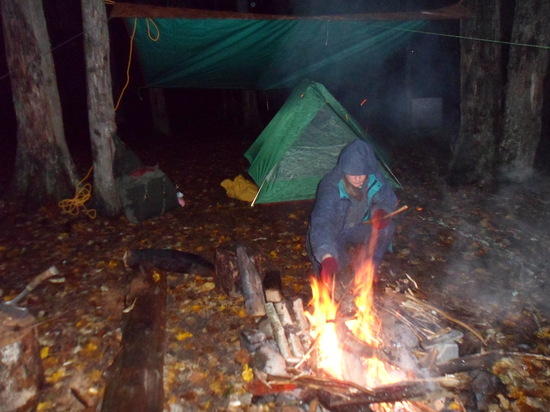
You can seemy hatchet here on the last trip we took it on, a late October canoe trip.
It rained all day, rained and snowed all night, and rained all day the next day, so yeah, we appreciated the fire ( in a metal grate at an established camp ).

Wet Night

Yeah yeah I know, The Timberline tent and poly tarp ain't "ultralightweighthighspeedlowdrag" but we were traveling by canoe and we did have a nice warm and dry camp that night.

Lets see –
You can also see my hatchet here, in a real "bushcrafty" sorta setting.
Relax guys, this is on my property.

src="/backpackinglight/user_uploads/1360024982_75378.jpg" alt="Home away from home" width="550" height="413">

Anyway, I do my best to teach a good basic outdoors skill set to my nephews, and yes this includes fire making, shelters, hunting as well as lightweight backpacking.
On my last trip with my nephews brought enough implements of mass destruction to clear cut half the forest – Each had huge survival knives as well as massive folding knives weighting at least a pound, smaller pocket knives with disposable blades, and a hatchet. I told them all they needed were decent, sharp pocket knives, but I remember when I was that age, and was inseparable from my favorite bowies, daggers and machetes!
Even with the extra weight they can outhike ‘ol Bawana…And that’s depressing…

Some of my favorite bushcrafting knives are the inexpensive Cold Steel Finn Bear and Roach Belly, and the Mora.
I have a Mora Clipper and two similar knives with solid plastic handles, not listed in the current Mora lineup.

These are all on the order of three ounces and about four inches long, and all are under twenty bucks. To me, these are “survival” knives!
I even have one on my belt as I type this. The Mora blades have that Scandinavian grind, you either like that kinda thing or not.
I think the double bevel grind of the Cold Steel blades better for much bushcraft because the edge holds up better, but boy, when it comes time to take apart game, give me a Mora!

My wife and don’t eat store-bought meat, we raise or hunt everything we eat and we do all our own butchering. I have taken apart more than a hundred animals, so you can take my word on that…
Came a time I always seemed to have my hands inside the body cavity of something-or-other, so I figured it was time to find the best blades for the chore. The stainless Moras are them.

For saws, I have a tiny Coghalans with a 3.5 inch blade that weighs 1.4 ounces. You want a UL folding saw, this is it!
It’s a bit of a delicate toy, but it does out cut the saw on any swiss army knife I’ve ever had. Just remember to only cut on the pull stroke!
It cuts as good as or better than the saw on my Leatherman super tool, it is in no way as rugged as the leathernan saw, but it is light and I haven’t broken it yet.
This isn’t a bad tool to have stashed in a pack if you think you may need to cut dry limbs to baton the dry inner stuff out.

Now we did have one of the Gerber slide-out saws. Lasted all of a month on our homestead before we busted it. Brittle blade, can’t recommend them.

Now we use the Fiskars folding saw, and that is a champ. In heavy use over a year, and haven’t busted it yet.

Ken Thompson BPL Member
PostedFeb 4, 2013 at 5:07 pm

I agree. Skills any "outdoorsy" person should have. Also the knowledge and common sense when and where to practice their primitive skills goes along with that.

I may never clean another rabbit, but I appreciate that I know how.

PostedFeb 4, 2013 at 5:21 pm

I’ve already posted up a storm, but I guess I still got something to say –

I first learned about lightweight backpacking by reading Ray Jardines books.
Seems to me that feller knows his bushcraft, and hey, didn’t that feller sorta invent this whole quilt-carrying-tarp-loving-mesh-pockets-on-the-backpack-sneaker-wearing-walk-30-miles-a-day thing in the first place anyway?
Yet he sure does know his way around a fire drill! And he also sells Mora knives right there along with his tarp and quilt kits ‘n stuff.
And he likes to cook over little camp fires, and writes in his book on how carrying a little sheath knife is important for fire making when everything is wet.

Seems to me this guy invented “stealth camping” and that it took a mighty fine bush-craft-person to do that, taking advantage of naturally sheltered terrain, staying out of low lying catablatic air, looking for softer, warmer ground to sleep on instead of carrying that inflatable pad. Yep, that guy knows his way around the forest, and buchcraft skills go hand in hand with UL backpacking.

Edit – Or maybe "bushcraft" means different things to me –
To some it seems to imply the automatic destruction of the forest!

Kattt BPL Member
PostedFeb 4, 2013 at 5:48 pm

I have been reading so many posts lately that have me wondering about folks that preach inclusiveness in one thread yet have no problem discriminating in another. Looks like it's ok to discriminate, as long as I really, really believe I am on the right side.
Along similar lines, it's ok to give away some personal rights and freedoms to one administration, just because we like the guy that's there right now. ( both sides doing this over and over).
This seems to get by too many smart and educated people.

Edited to add that I could have posted this in any number of threads, as so many reflect the same thing to me.

Nick Gatel BPL Member
PostedFeb 4, 2013 at 6:11 pm

Maybe the bushcraft people should practice at home?

If it is legal somewhere, then it is legal — supposedly the land managers know what is best. But if someone breaks the rules, then fine them big-time and make them restore the damage they did.

But I see no need to do any of this stuff. I was trained by the military in survival, escape, resistance, and evasion so I know what to do and how to do it in an emergency. But I was also taught to avoid survival situations too. So I have not needed to practice my survival skills on any backpacking trip — ever.

Plus, we had a lot less gear when we I went through survival school — just a knife, map, and compass. And we had to deal with snow for several days above 11,000 feet. Not to mention a single serving of C-rations to last a week.

CW BPL Member
PostedFeb 4, 2013 at 7:04 pm

FWIW, Jardine came on the scene about a century after the true pioneers of lightweight backcountry travel, but they too practiced bushcraft. Of course they mostly did it when at stationary camps and that is something most of us rarely use.

PostedFeb 5, 2013 at 2:48 pm

As a Boy Scout in the '50s we were taugh "Pioneering", which meant using large saplings and various lashing techniques to make "structures", like semaphore towers. (YES!!)

Well, thankfully that era is past but I'm sometimes glad I know several lashing techniques.

My point is that one CAN live comfortably with a plastic sheet as a roof for a lean-to. Been decades since I did that but a nice hardwood reflecting fire and the CLEAR plastic sheet over the lean-to and coming down, covering the front of our lean-to made us very cozy inside with the radiant heat.

The snow coming down actually melted on the front sheet. Getting up to pee was also the time to lean a few more large logs against the fire's log and rock reflector. By morning the large coal bed was still giving us plenty of heat.

Breaking camp meant taking the lean-to down and scattering the sticks and evidence of the doused fire.

So "bushcrafting" skills can have their usefuleness. Ya just have to balance their use with as much LNT as possible.

PostedFeb 6, 2013 at 12:48 am

Backpacking relies on bringing along thermal insulation. Since the only heat source is your body. There is no external heat source. So I pack merino, synthetic high-loft, pile and down to keep me warm.

However being able to build a fire in cold and wet conditions – those conditions being no sun at all in say the last 2 weeks – is a game changer. A nice small fire will keep you warm no matter what is the outside temperature. It allows you to dry out gear when things made a turn for the worse.

Starting a fire is difficult though in the rainy season. All the clichés about finding dry wood simply don't apply. It's a full time occupation as well, extremely labor intensive, and doesn't look nowhere near what you see on televison.

Starting a fire in the worst of conditions, ironically those are the exact conditions you need it the most, is extremely difficult. Considering this, it is worthwhile to practise this core skill. If you never get to use it in anger, the better, that means two things: you knew what you were doing, and you were lucky enough throughout your entire outdoor career.

I've got all the latest and greatest gear, but just like in mountaineering, it's imperative that you know your classics. You drop that ATC or Reverso and you should still know how to belay from that carabiner using a half clove hitch.

Know your classics and take advantage of the new technologies.

Justin Baker BPL Member
PostedFeb 6, 2013 at 1:01 am

Yeah, building a fire in the rain can be difficult. But it can be so worth it. If you have a partner with you, it can be easier. I usually split the kindling and make a pile of curls for tinder to get it started. My hiking partner Kyle finds pieces of vertical standing wood to cut as fuel.

CW BPL Member
PostedFeb 6, 2013 at 4:32 am

It's definitely a learned skill, but I've seen Ryan Jordan start a fire several days into blizzard conditions with no knife, axe, or saw. He used a few tenderquick tabs and the firesteel mini BPL used to sell and had it going in less than 5 minutes.

brent driggers BPL Member
PostedFeb 6, 2013 at 8:42 am

A small backpacking woodstove can provide a surprising amount of heat for its size. You also dont need to collect a lot of wood for the job.
This past winter i cooked inside the SL5 on one of my woodstoves almost every night and it was a lot warmer inside than out. Just light it from the top so there is no smoke and after boiling add wood as long as you are awake. The coals will last a good while…

Dale Wambaugh BPL Member
PostedFeb 6, 2013 at 8:44 am

Ryan Jordan grew up in the PNW and is an Eagle Scout. He should know how to start a fire!

I think everyone should know how to tie a few basic knots, build a fire, compass navigation, emergency signaling and first aid. Not only are those skills part and parcel of backcountry travel, they are useful if you car breaks down or in a natural disaster.

PostedFeb 6, 2013 at 9:11 am

"As a Boy Scout in the '50s we were taugh "Pioneering", which meant using large saplings ans various lashing techniques to make "structures", like semaphore towers. (YES!!)"

The Boy Scouts here still do that, but they use poles cut in the 60's by their fathers and grandfathers. Only the twine is new.

I happily make large fires, even for lunch when it is snowy, in a few of my hiking areas, but it is on land scheduled for prescribed burns.

PostedFeb 6, 2013 at 10:00 am

hahha. that was an interesting read. i wonder how many of the anti-bushcraft posters are typing from a condo/townhouse that bulldozed pristine woodland 5/10 years ago, displacing and killing thousands of small mammals/birds. people really need to get a grip…

here's a cool documentary:

http://www.youtube.com/watch?v=RuPKjH4q9lk

watch how quickly the earth erases any trace of our existence…

on the other hand. i do understand the responsibility of lnt.

Viewing 25 posts - 51 through 75 (of 83 total)
Loading...