


I would expect that a titanium wind screen would hold the heat better than aluminum, due to its poor heat conductivity.
Topic
Become a member to post in the forums.
I would expect that a titanium wind screen would hold the heat better than aluminum, due to its poor heat conductivity.

Will Reitveld, a contributor here on BPL, uses a digital thermometer and digital scale to calculate degrees/minute. His typical test protocol is 500 ml of water and 14 grams of fuel, with water, fuel and air temp all the same and usually cool(40* F – 50* F) to simulate real world conditions. Don't know if he stirs too.
Figured out a way to blacken the outsides of the cans without using any chemicals or paint. Will try some test boils later. I use a meat thermometer and measuring cup, so it's not as accurate as digital, but close enough I think for comparisons and reasonably accurate calculations.
"I would expect that a titanium wind screen would hold the heat better than aluminum, due to its poor heat conductivity."
Gary, why can't you make a windscreen out of titanium wire with a cover of aluminum foil?
–B.G.–

Here is an older post I referenced above that dealt with some of the same issues:
I thought it had some pretty good info.
Ok, we're back to the titanium windscreen guys.
I added some 1/2" holes and burned some wood in it. I put about 2 hous of actual burn time in to test for strength and it's ability to retain it's shape. All went well.
After the wood test I went ahead and turned it upside down and tested a few esbit cubes in my esbit burner (esbitmizer). I'm able to place the pot onto the support and then put the windscreen in place. Once they are ready I put the cube into the esbitmizer, light it and slide it under the windscreen into place. The lid of the burner stays attached and I'm able to slide it out if I want to reduce the flame height to simmer or snuff it out. If I snuff it out I can let the pot sit on the support with windscreen around it till I'm ready to use the water.

So I read the prior threads regarding painting the can pot bottoms black and putting fins on. I blackened a couple of pots by boiling them – whatever is in the tap water here reacts with the bare aluminum and blackens the cans very effectively.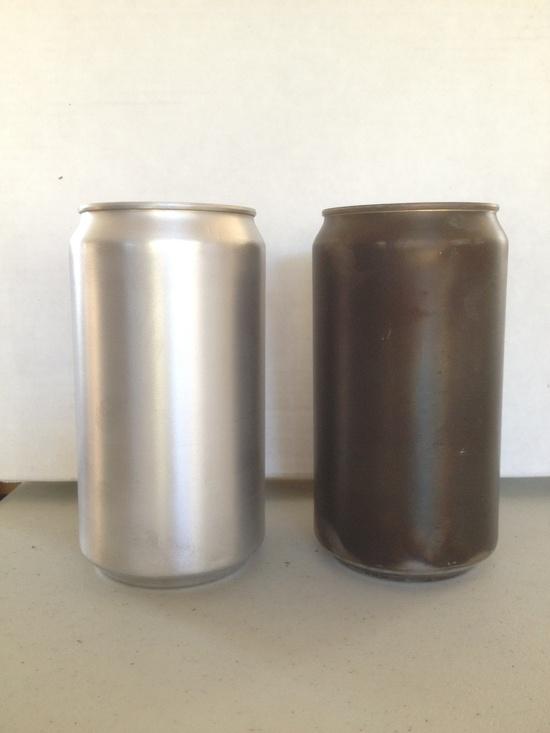
Boil tests did not reveal any improvement from blackening the cans. Did three test boils using 500 ml of water and 17 ml of fuel with air, fuel and water all at 60* F. Average time to boil plain brushed can = 4:26 min. Average time for blackened cans = 4:35 min.
Tried adding fins at the can base, angled at about 30 degrees to the vertical axis.
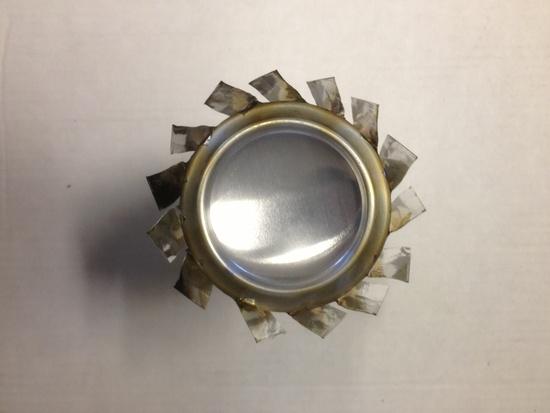
Surprisingly, the boil times were measurably longer with the fins. Average of 3 boils under the same conditions was 4:53 min. Messy as heck too. The adhesive on all of the fins burned off.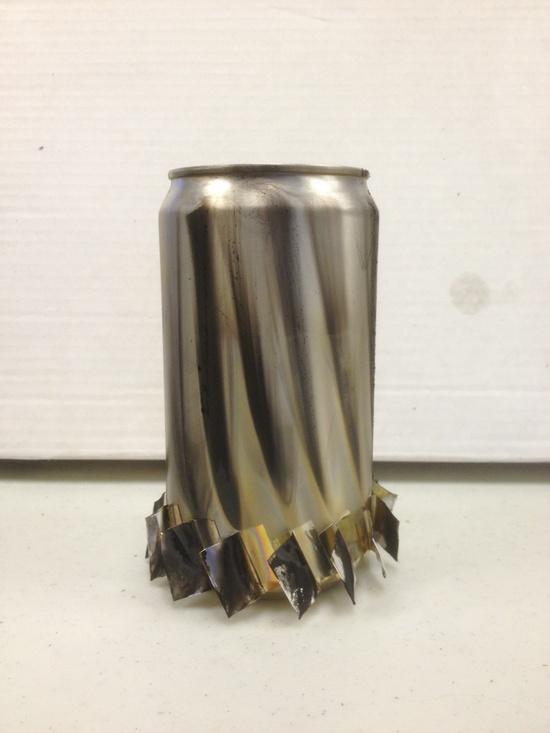
I'm going to stick with plain, brushed pots. Seems to work the best and certainly is a lot less work than blackening and finning.
I added some 1/2" holes and burned some wood in it. I put about 2 hous of actual burn time in to test for strength and it's ability to retain it's shape. All went well.
After the wood test I went ahead and turned it upside down and tested a few esbit cubes in my esbit burner (esbitmizer). I'm able to place the pot onto the support and then put the windscreen in place. Once they are ready I put the cube into the esbitmizer, light it and slide it under the windscreen into place. The lid of the burner stays attached and I'm able to slide it out if I want to reduce the flame height to simmer or snuff it out. If I snuff it out I can let the pot sit on the support with windscreen around it till I'm ready to use the water.
DavidG:
If you need something for your late Christmas list, add an IR thermometer. My first one was $150, but they are $30-ish now. Look at ebay, J C Whitney, etc.
Here's the take-home message (I learned this from the first human to (1) quantum-entangle more than 2 photons and (2) find an exception to the Heisenberg Uncertainty Principle – my wife and I each have brothers smarter than ourselves): clean metal surfaces are MIRRORS to infrared radiation. That is bad, because heat your pot could absorb will be be reflected away.
With your spiffy, new, IR thermometer in hand: fill your pot with hot water. Check its "temperature" with the IR thermometer. If it is a "blackbody" (good), then it will read the water temp. If it is reflective of IR radiation (bad), it will read room temp. Maybe your treatment made it "black" in the infrared. But maybe not. Test it compared to actual black paint (BBQ grill paint or auto-parts-store paint for an engine block are both high-temp paints). Look at my tests from 13 months ago and I found that white, black and red paint were all "black" in the infrared.
The tabs seemed too big and too low. Big because you're trying to energize only the air film very close to the pot. Low because they were in the very hot gases. You want to "stir up" the somewhat cooler air. I'm guessing there was still a visible flame at that point (most HX was visible+IR radiant transfer) and therefore, the IR radiant HX continued further up the pot. Also, if those tabs fit within your windscreen, your windscreen could be a fair bit smaller. I'd guess you are diluting the flue gas temps with excess ambient air and that will definitely hurt HX.
One approach is "time to boil". That's good but subject to a lot of variables (room temp, stove temp, water temp, etc). Exhaust gas heat is another thing to monitor. If exhaust gases are small in flow rate and cool in temperature, you have captured more heat from them.
But a few careful experiments can often blow the best theories right out of the water.
-David
Who cares about boil times in a beer can: tell us more about the exception to the Heisenberg Uncertainty Principle!
David Thomas,
Groan. I'm not even done paying for the holidays yet, but I can see I've still got shopping to do.
Thanks for the thought-provoking comments.
I'm empirical and Edisonian in my approach. I studied hard sciences in college and have an engineering background so am generally familiar with the theoretical side of things. But I test and verify because practice/reality has an uncomfortable way of throwing unknown variables into the mix.
I've tried the BBQ and black engine block paint, but dozens of test boils did not reveal any advantage to it in terms of faster HX or greater fuel efficiency, at least not with the paint I used. Perhaps the paint acts as an insulating layer, perhaps the top part of the can radiates heat more rapidly than when it is shiny, perhaps it's something else. The IR thermometer will help sort that out. What I can say for sure is that the brushed cans I tested heated more rapidly from the same heat source than unbrushed cans, painted cans, or water-blackened cans I tested.
I use frustum windscreens, so the base is wider than the top. At the top the windscreen is about 1/4" from the can. I will try smaller and higher fins.
I will also try polishing the inside surface of a windscreen, to see if it reflects a measurable amount more heat back into the can.
I'd really like to try putting a ridge like Zelph's cans about 1/2" above the top of the windscreen to see if the ridge jutting into the stream of exhaust gases captures more heat, but I don't have the tools yet. More items for the shopping list.
At the end of the day and we put all our boy toys away we can look back and say we've tried out best for today. Tomorrow will be better. :-)
I'm completely happy when I can get an alcohol stove to boil 2 cups of 65-70 degree water using 1/2 ounce of denatured alcohol.
David Gardners' brushed cans have been brutally stripped of their protective coating allowing them to be exposed to the harshness of exhaust gases, the elements and greasy grimey hands. The brushing also removes aluminum from the very thin wall. Life of the can is diminished.
Way back when, in the days of "radiators" to heat our homes with water it was said not to paint the surface of them. Painting reduced their emisivity or ability to radiate heat. So if it prevented heat from going out I would also think it prevents heat from coming in. Let your cans be as is.
We should keep in mind how small of an item we are working with in terms of heating. Gee whiz, you guys are extreme. Be happy with your stoves that boil 2 cups with 1/2 ounce of fuel. There are so many DIYselfers out there that get freaked out when they read all this stuff about the quantum theory of alcohol stoves and the miricals of Titanium.
The Modified StarLyte burner has a lot of merit when it comes to heating in a confined space, controling the release of vapors. David Gardners' stove on the hand has a lot of open space and the fuel burns in a radical fashion just like a Supercat stove made with a Fancey Feast cat food can. As we know, the Supercat stove can heat 2 cups of water with 1/2 ounce of fuel in 4-5 min.
>Who cares about boil times in a beer can: tell us more about the exception to the Heisenberg Uncertainty Principle!
Jeff: While at UC Berkeley I caved with a physics grad student. He later brought his sister along on our annual gourmet BPing trip. I brought ice cream sundaes and a hot tub 6 miles in on that trip (had some Sherpas to help). He went on to a professorship at Spain National Physics Institute. His sister graduated med school, we married, and moved to Alaska.
An overview: http://physicsworld.com/cws/article/news/2011/mar/24/quantum-probe-beats-heisenberg-limit
An excerpt: . . predicted that the Heisenberg limit could be beaten by introducing nonlinear interactions between the measuring particles. That prediction has now been shown to be true, thanks to an experiment carried out by Morgan Mitchell and colleagues at the Institute of Photonic Sciences at Barcelona. Mitchell's group fired laser pulses into a sample of ultracold rubidium atoms held in an optical trap and measured how the atoms' spin angular momentum caused the polarization axis of the photons to rotate.
Well thank God that's cleared up! I was betting on death or taxes, or both. I'm glad that no imaginary cats were harmed in these experiments. I work near Cal, so here's a shout out from your old digs.
And we thought that The Quest for Fire was complicated.
Whew!
Does anyone remember the KISS principle? Keep It Sublimly Simple.
Fuel goes into stove. Stove is lit. Water goes in pot. Put lid on pot. Pot goes above flame. Windscreen goes around stove and pot. Water boils a little later.
Hint: Do not watch the pot. ;-)
What have we learned from all of this discussion? Raise the windscreen 1/2" to 3/4" or use either large draft holes or rectangular draft vents on the bottom of the windscreen to keep the stove's flame stable and under the cook pot.
30 seconds here or there won't really matter. If it does carry a canister stove and be done in half the time or less.
@Dan,
You have burned more alcohol, wood and Esbit tabs than any 100 people I know. You're always looking for new, lighter and more efficient ways for us to boil water. I am impressed by the way you share your knowledge with do it yourselfers. Thanks for the continued experimentation. Please don't stop.
Party On,
Newton
>"no imaginary cats were harmed"
LOL.
His research group has adopted a logo of a kitten and a rubidium atom. Playing on the same joke.
It seems clear from the smoke trails off the fins that the fins sapped heat out of as-yet-uncombusted gasses which then condensed on the can. In a jetboil, the gas is all burned before it gets to the fins, or at least is not cooled enough to prevent full combustion. I think you definitely do not want the fins in the flame.
One thing I've thought about is how in the jetboil burner there is a screen which gets white hot. I think this screen may serve to ensure any poorly mixed or cooler gasses do reach ignition conditions. I wonder if such a device would help pressurized stoves light more easily – my biggest beef with the penny. I'll be trying tonight…
Complete burning of the fuel is the first step to efficiency, followed by transference to the pot/water.
The smoke trails on the finned cans are from the burned aluminum duct tape adhesive.
Will definitely try fins higher up, out of the alcohol flames. Will try one with fins at an angle and another with fins vertical.
I think I have the right pot with many ridges on it that could muster up lots of turbulance with the gases traveling upward between the windscreen and the pot. Take a look:
photobucket video, click on it.
<center>
</center>
I was able to do a video today to kinda recap how I can use the windscreen in the wood, alcohol and esbit modes. I had to divide the video into 2 parts.
http://www.youtube.com/watch?v=9sVimCy5Rmg (1st part)
http://www.youtube.com/watch?v=2j7Rz59l9eA
The windscreen held up very well under the high heat of the wood fires. The stainless steel clips did also as did the three pot support extensions.
Tomorrow I’ll do some tests with Esbitmizer in the alcohol mode to see how well it does with 1/2 ounce of fuel. I’ll also do more wood burning with the windscreen to test an idea that I have for an integrated clip system to keep the screen closed so I can eliminate the stainless clips. I’m partial to the Keep it Sublimely Simple principle of John D.
John, I’m always glad to share ideas. Stove designing is really an interesting hobby and science. Stoves are fun. I saw some of my photos of how I roasted hot dogs using the Venom Super Stove. I wrapped some hot dogs with non stick aluminum foil and stuck them into the center of the stove and lit it. The flames went up the side of the foiled hot dogs and they roasted really nice using 1/2 ounce of fuel.
I’m on the right track ;)
"non stick aluminum foil"
What the heck is that? Or, where do you get it?
I've never seen anything called that.
–B.G.–
Bob, your local grocery store should have it. Ask an associate for help.
<center>
</center>
"Ask an associate for help."
Can't do it, Dan.
I am fluent only in English. They aren't.
–B.G.–
Zelph – I like the ribs. I bought some nylon sliding shower door wheels with bearings today to make a bead roller. Two flats and one rounded. Will post if they work. The video with the peen-beanie everyone refers to looks ok, but I wanted something I could expand to making my own rolled edges. It would be keen to double roll a new edge instead of needing a machined ring, no?
Still waiting for Ti foil to arrive. Cutting up a turkey pan for tonight's lab work.
Has anyone tried to re-form polyethylene containers? I'm looking to stretch out a ziplock screw top to accommodate a full length fosters pot.
Bob, wing it!!! or you're SOL
Nathan, get the wheels rollin and go for it. Everybody and their uncle wants to make the ridges. Local grocery stores have nice plastic containers for full size foster cans. Look in the canning section for Kosher Pickling Salt or in the cleaning supply dept. for mr Clean or Klorox wipes.
Nathan,
I haven't tried re-forming polyethylene. However, 16 oz and 8 oz "Delitainers" (available through Amazon or at your local deli) press fit very snugly and securely to the 1 qt Ziploc food containers. Light and inexpensive too. 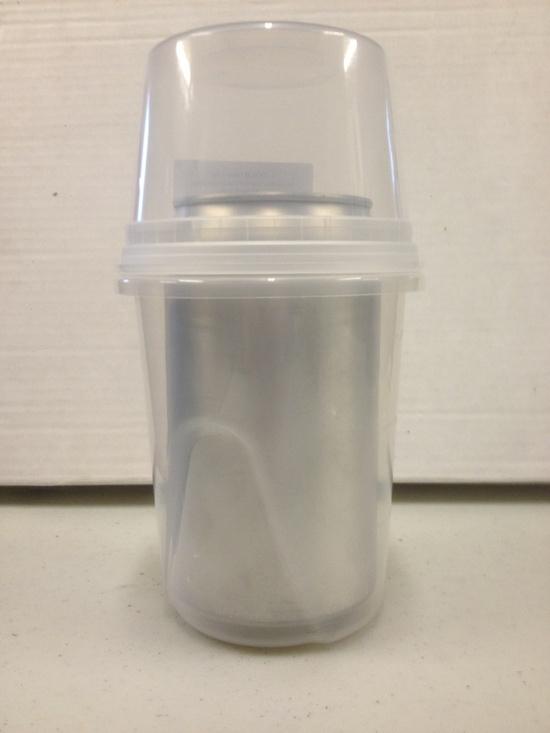

The question came up on another forum on how to have a small wood fire on snow or ice and wet ground. What would I use to insulate under the stove.
I've never had to do this so I gave it some thought and decided I would first gather some 1" diameter branches of 12" long and lay them flat on the above the surfaces to make as flat a surface for the stove as I could. I would then lay down a 1/8" sheet of Viton onto the branches to form a stable surfac On top of the viton I woul lay a sheet of .002 Titanium or stainless steel. On top of the aI would put my wood burner.
I did one test burn of the above procedure and it worked well. The Viton scorched but did not burn. It warped in the center but flattened when it cooled. The stove I used had a steel grate 1/2" away from the stainless sheet thet the stove rested on. I burned enough wood in the stove equivelant in quantity to boil 6-8 cups of water.
What would you use under the same scenario of winter wood stove use?
Become a member to post in the forums.
 New Gear with Aluula FabricsLighter, stronger, more abrasion-resistant, and highly water-resistant - explore ultralight backpacking gear made with ALUULA Graflyte fabrics. Engineered for exceptional strength, durability, and lightweight performance, ALUULA Graflyte helps reduce pack weight without sacrificing reliability, making it ideal for demanding backcountry adventures.
 © Beartooth Media Group Inc.
 Loading...