Topic

Project: 4oz 1A USB Charger

  • This topic is empty.
Viewing 15 posts - 126 through 140 (of 140 total)
PostedDec 4, 2012 at 12:50 pm

Aren't you supposed to be in 'sunny' california :)

Fake Suggestion: Downgrade to an iPhone 3G…I think they take less power

Real Suggestions:
1. So I wonder if you have a bad panel in your 6 panel powerfilm, cause I would think at your latitude, that if I can charge in AZ with the same panel, you should be fine. You've probably already done this, but to check it. Clip a voltmeter onto the panel leads that go to the board (you can leave it connected to the board, just don't plug you're phone in. So you should get the green light. Measure the voltage to the board, it should be just under 20V! Then take a strategically cut piece of plane white paper, and cover just one of the 6 power film panels. You should see the voltage drop to the board, record that change for that panel. Remove the paper, see that the voltage goes back up, put the paper on the next panel, see that it goes back down about the same amount, and repeat. You might find that your total voltage out of the unloaded panels is low, and/or that covering one of your panels does not change the output voltage to the board by as much as other ones indicating a poorly performing panel or panels.
*****Most solar panels will drain energy from the system if they are damaged, so it's very important to know! With the same 5W powerfilm, my setup would NOT charge my iPhone 4S at .5A when any single one of the panels were covered! A bad or covered panel not only doesn't produce power, but sucks power, so it's a double hit.

2. The angle of the panel to the sun is VERY important. I'm sure you tried many placements, but I found in the canyon that 10AM to noon sun was the best even though I had to have the panel at a steep angle to catch the low sun.
*****The easiest way to gauge if your angle is right is to make sure that SHADOW it makes on the ground is a perfect rectangle or is is a trapezoid! I always held it up to see the shadow and get the angel in my head, I made sure the phone would charge at that ideal positioning, then I looked for a place to leave it in the same orientation for a while.

3. I haven't tried it, but I've heard of some guys using mylar or tinfoil wrapped cardboard to make a lightweight reflector to direct additional sun to the panel! If you try this, let us know how it works! It's probably not a permanent solution for you, but might give you some insight if the above stuff doesn't help.

Keep us posted!
Jay
PostedDec 4, 2012 at 2:50 pm

Thanks for the troubleshooting tips, Jay.

I did manage to measure the total voltage on my PowerFilm unit, before the clouds rolled in this afternoon, and it came in ranging btwn 18.0V and 18.8V, depending on the angle with the sun. Didn't have the opportunity to test individual panels but I should be able to, weather permitting, take that step tomorrow. Currently it looks like my panel is not only a bit heavier (by an ounce) than yours but it may also be under powered. (Frownie Face icon goes here)

George Geist BPL Member
PostedDec 4, 2012 at 9:46 pm

Hi Richard,

Given that your and my 5W PowerFilms have the same behavior, I'm inclined to say that ours are not underpowered. Our's are probably normal and Jay's PowerFilm is a bit more powerful. In strong noontime sun my panel produces a little over 19V, but it won't charge my RAZR MAXX smart phone. I plug it in and I just get oscillation and battery discharge.

I'm going out with the scouts this weekend and I'm going to take my StrongVolt Solar 6 panel with me and see if I can keep my RAZR MAXX charged.

PostedDec 6, 2012 at 10:01 pm

I have not yet been successful charging my iPhone 5 with my 5W PowerFilm Solar Panel and Jay's nifty little circuit board. This has led me to wandering around cyberspace reading lots of info on charging an iPhone 5. I have not yet reached the end of the Internet but I think I'm close. As best I can tell, Apple changed something in the iPhone 5 (or maybe in the new 9-pin lightning connector the iPhone 5 uses). The change renders useless some chargers that would charge an iPhone 4. I wish I could find the details on the change but reliable info has been hard to find. There's some speculation that the iPhone 5 requires 1A to charge. Other speculation is centered on the idea that an iPhone 5 talks to a charger differently than an iPhone 4 and is more stringent about accepting chargers than the iPhone 4 was. Wish I had an iPhone 4 to plug into my PowerFilm/Jay's charging circuit board to see if my setup will charge an iPhone 4.

PostedDec 11, 2012 at 5:55 am

I'm trying to catch a friend of mine with an Iphone 5 to run that test to see if the switch works with the new Iphone and cable or not, to adjust from .5 to 1A modes. I'll let you know!

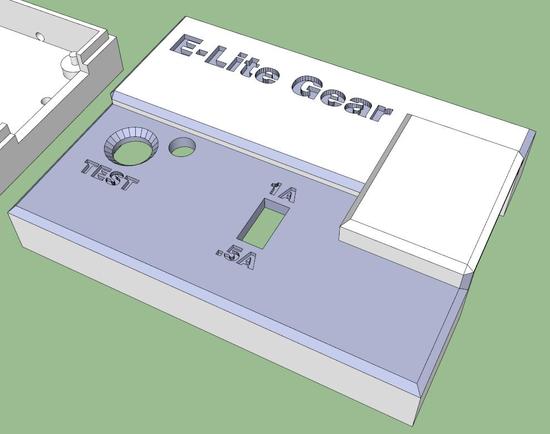
Some folks wanted the case that I made for the Canyon, and taking some lessons that I learned, I've updated the orignal case design to slim it down a little and give better access for the buttons and switches. I think it looks sweet! I'll post real pics when it comes in!

Updated case

Jay

PostedDec 11, 2012 at 7:40 am

Jay, I'm trying to run down an iPhone 4 to borrow for a sunny hour or so to test my panels/circuit board setup. I'm still wondering if the new iPhone 5 Lightning connection is doing something your circuit board doesn't like (e.g. draw enough current at handshake that your board drops below the 7-8 volts and shuts off) or if there's something funny about my solar panel. I'm getting ready to sacrifice a short USB extension cable to allow me to measure the current being drwan by my iPhone 5 as it get plugged in. However, I'm not sure my simple (cheap) multimeter and electrical skills are up to that task.

BTW – nice looking design on that case.

PostedDec 26, 2012 at 10:57 pm

Wiz,

Awesome project you took on. I'm not too good at the electronics. Would this work for a Samsung Galaxy note 1? Wondering if you are interested in selling one that works on a Galaxy note and iPhone? I have some ultra light stuff for trade and/or cash – titanium MYOG caldera cone keg and stuff like that. If you are still tinkering with this and interested please drop me a note.

Thanks

PostedDec 30, 2012 at 3:11 pm

Yea Definitely! It looks like the Galaxy Note 1 charges off of a micro-USB, so as long as you have the cable that plugs into your computer's USB to charge it, than it'll work! The key is to take a look at your phone, car, and wall charger and get an idea of how much current it draws. This board can control a max of 1.3A which is good for most phones, and some tablets like the iPad, BUT YOUR SOLAR PANEL HAS TO MEET THE PHONE'S CURRENT REQUIREMENT. For an iPhone, it can be set by the board for a .5A mode, but folks still find that a 10W panel is good idea if you're not in max bright sun (which can be hard to find!)

I'm working on getting a website together, but it's slow working out all the details! hopefully it'll be up the next week or so. But we can talk over PM and figure it out. I've got a couple board ready to go!

Bob Gross BPL Member
PostedDec 30, 2012 at 3:19 pm

"I'm not sure my simple (cheap) multimeter"

As a general rule, the really cheap multimeters are operated by those with poor multimeter skills, and those can get toasted in a hurry. As you move up to a slightly better multimeter, it will likely have some better scales for amperage (current). That is pretty handy once you start experimenting with solar panels.

You can troubleshoot a lot with just a voltmeter, but the current scales are much more useful for measuring just how perfectly the panel is working.

–B.G.–

PostedDec 30, 2012 at 3:31 pm

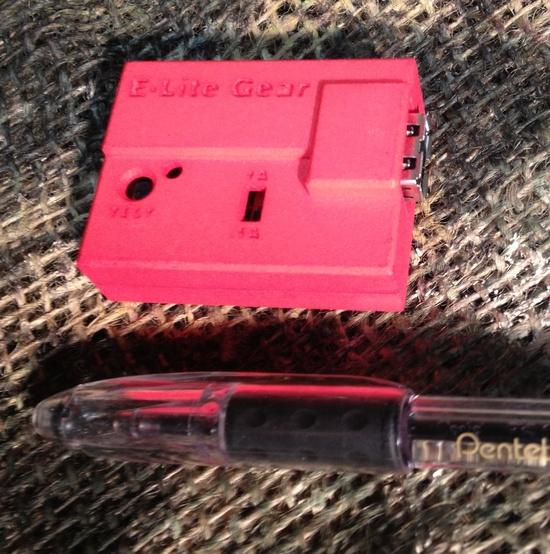
Got two colors of the new case in. It's just a bit slimmer, much nicer finish than the original case, and allows for easier access to the switches without having them stick out and get caught on gear. The lettering is no longer extruded so it's easier to get in and out of the pack too. It doesn't snap shut, so I expect to use a small bit of silicon to seal it up and am contemplating looking for some really flexible clear silicon to really make it water resistant!

I've got 6 colors available to me but got two colors to start. Here's the red, this is a laser sintered material and is strong but still a bit flexible. It's got a nice matte finish.

Red Case

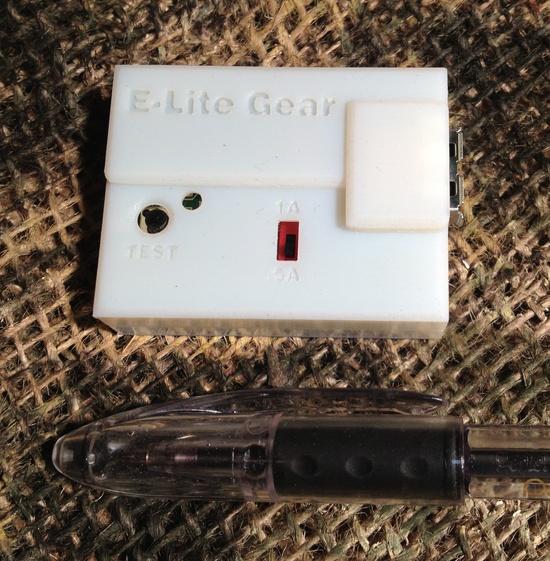
same in white but this is a very smooth, shiny material. The detail is really nice, but it's more expensive and heavier.

white

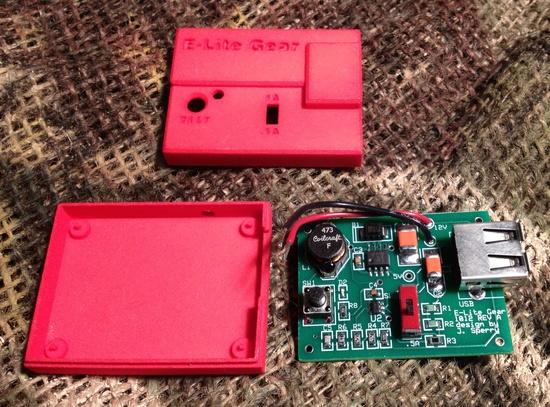
This gives you a feel for the 2 parts of the case, and the size relative to the board.

2 parts and board

Stuart R BPL Member
PostedDec 31, 2012 at 4:23 am

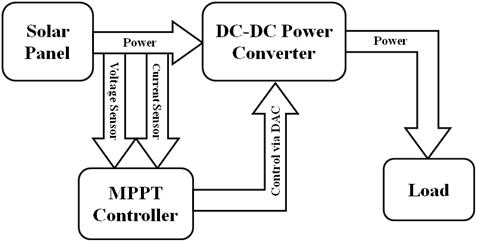
As I mentioned on page 2 of this thread, the big problem with a standard voltage converter is that there is no limit to the amount of current it will try to draw from the solar panel. If the combination of panel area and incident sunlight is insufficient to provide the power demanded by the load, the voltage converter will short circuit the solar panel and almost no power will be delivered.
Large commercial instalations avoid this problem by incorporating an electronic circuit (usually a microcontroller) which performs Maximum Power Point Tracking – so the panel output is always maintained at the voltage/current that provides maxumum power from the available light.

MPPT diagram

I have designed a simple modification to a standard LM2596 regulator circuit that will perform a simple form of Maximum Power Point Tracking. Parts are on order and I'll start a new thread when I have something to show.

PostedDec 31, 2012 at 5:23 am

Definitely post the thread link here, I've very curious to see what you come up with. MPPTs are usually used in very large arrays and require a secondary conditioning step because they inherently vary the output voltage, and we obviously need a fixed 5V output for USB devices.

"If the combination of panel area and incident sunlight is insufficient to provide the power demanded by the load, the voltage converter will short circuit the solar panel and almost no power will be delivered" So if the panel and sunlight is insufficient for the load, how will the MPPT find the missing power? The problem in this case is lack of panel surface, right?

I've looked at this option (such as the SPV1040), but found greater efficiency with a step-down converter.

Keep us posted on your progress!!

Stuart R BPL Member
PostedDec 31, 2012 at 6:23 am

"So if the panel and sunlight is insufficient for the load, how will the MPPT find the missing power? The problem in this case is lack of panel surface, right?"

Yes, MPPT can't find power that isn't there, it can only deliver the maximum power that is available. It does this by controlling the output voltage/current, so in the case of a USB output, the voltage will drop below 5V. From wikpedia: "A USB charging port supplies up to 500 mA at 5 V, up to the rated current at 3.6 V or more, and drop its output voltage if the portable device attempts to draw more than the rated current." so dropping the output voltage is permissable. Whether an i-phone will accept that is another matter. However, I was thinking more in terms of charging AA NiMh directly and MPPT would simply have the effect of varying the charge current.

Bob Gross BPL Member
PostedDec 31, 2012 at 12:56 pm

"charging AA NiMh directly"

That also gets a little complicated since different NiMH cells require or tolerate different charging voltages, currents, and time. You want to consult the manufacturer's specifications for cells of this type, but in general you want to get a charging current that is approximately 5% to 10% of the cell's maximum output current. In other words, you charge the cell at 10 times or 20 times slower than you can use up the charge. Some people try to charge the cell much faster than that, and they toast the cell chemistry. Not recommended.

–B.G.–

PostedJan 8, 2013 at 12:46 pm

As best I can tell, my first PowerFilm panel was underpowered and wouldn't charge my iPhone5. I was curious enough to find out why, so I bought another PowerFilm panel and this one works. Wired up to Jay's neat little circuit board, this new panel has enough power to charge my iPhone5. Today, in the noontime bright winter sun in San Diego, my iPhone5 went from 89% charge to 99% charge in 30 minutes with no problems. It never went thru the low voltage shut-down cycle that plagued my first setup.

The big difference in the two panels is that the first (bad) panel has 17.65 volts with no load. The second (good) panel has 20.5 volts with no load.

During testing, the good PowerFilm panel and Jay's circuit board had 4.95 volts and .471 amps thru a 10ohm resistor and 4.95 volts and .097 amps thru a 50ohm resistor.

Viewing 15 posts - 126 through 140 (of 140 total)
Loading...