My experience working in retail some years ago (REI and 2 small shops) was that most people would come in wanting a bag that was warmer than they needed (just in case) and a tent that was 1)roomy and 2)easy to set up and 3)storm worthy. They wanted a stove that was easy to use and would simmer nicely, boots that were comfortable and would last a long time, and a pack that had plenty of room (just in case). For clothing, they wanted to be plenty warm and didn't mind taking another layer (just in case). Gadgets, accessories and doodads sold like hotcakes.
You will notice that they did not often mention weight. Usually, I had to bring that up.
I don't know if today's backpacker has a different attitude than what I encountered in my selling days, but what I see on the trail suggests not much different. I do see some lighter gear, but mostly I still see the full complement of stuff. The multiple cooking pots, the "extra" clothes, the plate & bowl to eat out of, etc. I wonder if a lot of people are thinking that the first step to a lighter pack is lighter versions of all the stuff they have always taken, rather than starting by eliminating redundant and unneeded items. You don't get down to the UL range by taking a lighter 3-pot cookset and lighter extra clothing.
Which ties into the money thing. If you start by taking stuff out of your pack, you don't spend a dime. And if you start out with a lightweight set of gear, it doesn't need to cost more. Sure, if you want to gt your baseweight down really low, you have to get into some pretty specialized stuff that cost more. But a 15 lb baseweight can be reached with nothing fancy, just keeping it simple.
As for the "one set of gear for all trips, that doesn't have to be a big load either. Start with a 15 degree sleeping bag. Get a 3-season tent, fairly robust, and just take the fly in the summer, and set up in sheltered spots in the winter. A little ingenuity will make your gear handle a pretty wide range. But I don't think that wanting to cover all the conditions they might go out in is why most backpackers have gear heavier than they need – most of the folks who only get out occasionally are not planning any winter trips. Much more likely, in my opinion, that they are just playing it safe. They'd like to have a larger margin for error than some of us are comfortable with. Which is not a bad thing if your experience is limited. If one person has lots and lots of experience in the mountains in all seasons, and another has very little, the person with little experience should have gear that gives them a bigger margin for error than the guy who's seen it all.
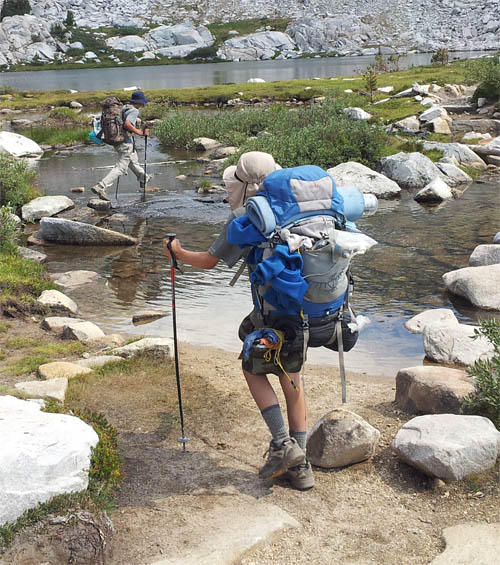
The other thing to consider is that,broadly speaking, there are two kinds of backpackers – I think of the two types as "campers" and "hikers". The campers are more concerned with comfort in camp – they'll go a few miles to a nice spot, set up camp and stay there, enjoying that place. The hikers are more interested in the walking than the camping, and are more likely to be happy with minimal camp comforts so as to enjoy more miles on the trail. fo course it's not as simple as this, and there are folks all over the spectrum, but the "campers" are a lot less likely to be concerned about pack weight, since they have no interest in going further or faster most of the time anyway. And then the campers get that once-in-a-lifetime urge to do a longer trip, and they do it with all their creature comforts along, and that's one reason you see some really big loads on the JMT.