Topic

Alcohol cookers…please be careful out there

  • This topic is empty.
Viewing 25 posts - 26 through 50 (of 51 total)
PostedMay 21, 2012 at 10:30 am

"Now, if you really kicked that alky stove and sent flaming alcohol flying over a hundred square yards of dried tinder then, yes, I would agree that might pose a bit more of a problem than if you'd tried to send the canister stove through the goalposts."
I'm not proposing that one needs to give it a solid boot. Just tap it over with your foot. The alcohol does go running in a flaming stream.

It's far from a clever comment about the shoes. Perhaps you did this in daylight so didn't realize it (clear-ish flames from alcohol), but stomping with your feet doesn't put out an alcky fire. How do I know? When I was in high school (and substantially stupider than now), we used to light our shoes on fire with rubbing alcohol and run around at night. Great fun in a parking lot. Recipe for disaster in the backcountry.

"…we're talking about all of an ounce of alcohol spread on the dirt…"
Again a dangerous assumption – what about the 16oz of water that was sitting above that stove? If that water spills into the alcohol fire, you now have a substantially larger fire transportation system. So what's a big enough fire ring for 16oz of fire? 8 feet? 10 feet? What if you only have 4 feet of perfectly flat area? Do you need to clear an extra 10 feet in the potential runoff direction? Do you know for certain what direction the runoff will happen?

I simply can't trust an alchy stove. Mistakes happen to everyone. If I tip over my canister stove, I do have 10K BTU's to contend with, but at least it's staying in one place and has a dial to turn it off. With alchy you have to trust that your ring was big enough, and you considered all the contours of the ground to make sure you're not going to send a stream in some direction.

Randy Nelson BPL Member
PostedMay 21, 2012 at 10:39 am

@Mary
"Not only alcohol cookers!!!

When campfire bans are in place, you need to check carefully by jurisdiction. Many jurisdictions include wood-burning stoves in the ban. Some jurisdictions prohibit any stove that doesn't have a shutoff valve, which would include alcohol and esbit."

You're correct. This is the wording:
PROHIBITIONS:
1. Building, maintaining, attending or using a fire or campfire, charcoal, coal, or wood stove, except within a developed
recreation site in Restricted Area #1. 36 C.F.R. § 261.52(a). The use of petroleum-fueled stoves, lanterns or heating
devices, provided that these devices meet the fire underwriter’s specifications for safety, is allowed.

I think Esbit stoves are the safest of all. No liquids to spill. You'd have to literally kick it into flammable material to start a fire with it. It's no where as hot as Isobutane. Not sure how you could get safer than that.


@Harald

"So this type of discussion worries me a bit, especially the comments that full contained stoves that are virtually impossible to tip over are just as risky as an alcohol stove which weighs a few grams and has no triangulation on the legs at all to stabilize it."

Different types of stoves, different issues. With white gas stoves it's the leaks from bad seals, flare ups, fuel spray, etc. These can all be minimized, of course, but we all know how common user error is with any technology. But when a problem occurs with a white gas stove and it's on fire with a full fuel bottle attached AND the person panics. That's a recipe for disaster.

Of course, it sounds like user error is what cause the alky stove to start the Hewlett fire. When you are cooking with .5 or 1 oz of alcohol, it doesn't take much clear ground to contain that much liquid from flammable material. In fact, if somebody is using any stove in an area that could catch fire if a problem occurred, I'd say the shouldn't be out backpacking at all. They don't have the requisite skill set to safely do so.

Dean F. BPL Member
PostedMay 21, 2012 at 12:06 pm

>>> …what about the 16oz of water that was sitting above that stove? If that water spills into the alcohol fire, you now have a substantially larger fire transportation system….

Ah, now I think I get where you're coming from, and I suspect that you are making an error in concept. (Or, heck, maybe I'M making an error in concept…) You're thinking that alcohol is immiscible, like a burning gasoline slick. But water and alcohol mix- water is not a "fire transportation system" for alcohol. 16oz of water would dilute the 1oz alcohol to the point that it wouldn't burn; ethanol has to be 170 proof before it will burn. All the safety missives you've heard about not dousing a liquid fire with water were referring to grease or petrochemicals or other such non-water-soluble stuff that floats. Those are after all the most common source of liquid fires in modern experience.

In most environments I'm even sure it isn't a good idea to toss a bucket of water on an alcohol fire for fear of splashing burning droplets. If you turned a fire hose on a swimming pool full of burning alcohol, yes- I suspect that burning alcohol droplets would fly everywhere. But that's not what we're talking about- we're talking about 25mL of alcohol.

Any of the chemical engineers whom I know lurk here- please correct me if I'm wrong. I'm sure some alcohol droplets still would splash, but if mixed with a large amount of water the alcohol wouldn't burn, right? Maybe I'll try some experimentation tonight. Hmm… I'd need to try various alcohols… stop and get some HEET… I already have a decent Everclear stock… hmm…

If you "tap it with your boot" then the spill is small, and the resultant fire easy to control by stomping or, preferably, smothering with a handful of dirt. Where the alky stove becomes a real hazard is only the spill I described- a firm blow sending droplets over a wide area. Well, that and the inherent hazards of invisible flames, which I have admitted is a much more valid criticism. That's why I would recommend against them for anyone who is not familiar with alky stoves.

Also, I would propose that a shoe that has been doused with alcohol and set alight is different than one that has stomped on some burning dirt (i.e. using just the sole). Again, I've done this. The stopming out spilled alcohol that is, not the juvenile antics with burning shoes. I'm sure I've done things that were equally harebrained, but not that in particular. :) I have definitely spilled alcohol then set it alight before I really got my stove-fueling technique down, and always easily doused it. Also, while I have certainly bumped my alky stoves I have never actually tipped one over- they kind of have a low center of gravity.

And, Brother, I definitely put those fires out. Gimme a little credit, here… :)

To repeat- I'm not saying that alky stoves don't have their safety issues. I'm just saying that if they are any more dangerous than canister stoves that it is a trivial difference for anyone who takes the most rudimentary and widely-known common-sense precautions, so decrying alky stoves as "too dangerous" is disingenuous. If you personally have had a bad experience and thus tend to avoid them- fine- more power to you. I can hardly be critical- I don't do bariatric surgery because of one empiric bad outcome that I had in the past, even though I can look at the data and explain why bariatrics is nonetheless a Good Thing. I've just been emotionally scarred and can't do it. So I understand. For similar reasons I never want to touch a pressurized white-gas stove again. Those things terrify me- a buddy of mine once lost his eyebrows to one. Hmm, for that matter the idea of carrying around a pressurized canister of isobutane kind of gives me the willies, too, as irrational as that is. I just prefer my nice, simple puddle of flammable liquid- I don't have to trust whoever made the canister and the burner.

But I'm more concerned about what you do with your cigarette butts (if you smoke). They seem to be responsible for an inordinate fraction of accidental wildfires.

Mary D BPL Member
PostedMay 21, 2012 at 12:43 pm

Any stove can and will set vegetation alight. Always use it on bare ground; clear a good-sized circle! Always watch your stove closely. And yes, an alcohol stove does heat the ground underneath. If said ground contains organic matter, it will smolder and may eventually catch fire. A piece of foil under the stove is not enough to block the heat; some insulation is needed. In times of high fire danger, it behooves all of us to be paranoid.

While I agree that a properly used alcohol stove is no more dangerous than my canister stove, it appears that quite a few folks who write regulations are concerned about shutoff valves. Considering the loss of life and property from wildfires, I can't blame them.

In many years of use (since the late 1980's), I've never had a canister stove tip over, although my pot has fallen/been knocked off the thing a few times. Of course this only happens just as the water starts boiling! :-)

After trying both systems, I personally prefer the convenience of the canister stove. For trips of a week or more, the weight for the two systems is about the same. Of course, Your Mileage May and probably will Vary.

Jon Leibowitz BPL Member
PostedMay 21, 2012 at 5:45 pm

"To ignore the fact that alcohol may be a bit more hazardous and have a greater possibility of being spilled or knocked over and spread uncontrolled fire is like sticking your head in the sand."

100% agree. I use an alcohol stove, but I am totally aware that it comes with much more fire danger. I switched from an MSR Whisperlite to this. How is it more dangerous? WIND. Simple as that. Nothing could knock over a Whisperlite. It's heavy, clunky, and connected to an even heavier and clunkier fuel bottle. On the other hand, even with a windscreen, a simple 20 mph gust of wind could easily send an alcohol stove flying, even with a pot of water on it. Point being, alcohol stoves are inherently more dangerous, in my opinion, and just use extreme caution when using them. This could have happened to anybody.

PostedMay 21, 2012 at 6:23 pm

So for last 20 years millions of people have used alcohol stoves some, like thru hikers used them daily for up to 6 months. Now one guy has an accident and people are sounding the alarm?
Some people on here missed their true vocation in local news.

d k BPL Member
PostedMay 21, 2012 at 7:33 pm

I see what you're saying but I didn't read this as sounding the alarm – nobody's telling us to stop using our alcohol stoves. Rather it's a reminder that we need to be careful and not ignore a lit stove. What's important to take home from this incident is that a moment of inattention can lead to massive destruction of habitat for flora and fauna; never a bad thing to be reminded of that, even if you already know it.

Gerry B. BPL Member
PostedMay 21, 2012 at 7:49 pm

One of the reasons I like my Zelph SS Starlyte Stove is because it is spill proof. It can be tipped over but from experience I can verify that no alcohol has ever spilled out due to the fiberglass insulation. I think I have only tipped the stove over once; usually it is my pot of boiling water that spills out. I noticed tonight that Zelph no longer makes this stove, which I bought from the BPL store a few years ago.

If I were to consider any other alcohol stove, it would have to have fiberglass insulation to guarantee against spilling any alcohol. By the way, I do use a couple layers of heavy duty aluminum foil as a base for my Zelph stove.

Chris C BPL Member
PostedMay 21, 2012 at 9:32 pm

Brian many thru's have used alky stoves and several fires have been started on the PCT using them.
The problem is people without sufficient knowledge and understanding of their stoves, they get an alcohol stove because that's what they are told they need.

They are not as forgiving of error as other styles of stove, some people don't even realize they kicked flaming liquid out onto the ground until it is too late.

Below is just one example from 2004

http://www.trailjournals.com/entry.cfm?id=66725

PostedMay 21, 2012 at 10:13 pm

"You're thinking that alcohol is immiscible, like a burning gasoline slick."

That's the thing – in my situation that I mentioned on my first test trip with an alchy stove – it had been raining (I'm in Seattle after all), and I had 8oz of water on top of the stove. When the accident happened, I watched fire spread across much of the 2' fire ring. The water I was heating, nor the very well saturated ground in the fire ring, had zero effect on the denatured alcohol (SLX to be exact).

I agree that alcohol stoves can be used safely by considerate people. But I disagree with your original point that "I'm not sure I'm buying the argument that canister stoves are inherently so much safer than alky stoves."

Me – I'm a clutz, so alchy stoves are just a big no-no :-)

"Now one guy has an accident and people are sounding the alarm?"

…if you believe only one guy has had an accident. As another poster pointed out, there have been others reported. And how many were not reported? How many near-forest fires? How many lucked out by enough rain and the only lasting effects were a night of pucker-factor?

Dondo . BPL Member
PostedMay 22, 2012 at 5:42 am

Wow! That's a sobering journal entry, Chris. Thanks for the link.

PostedMay 22, 2012 at 6:35 am

If a canister stove were to tip over, it can be recovered quickly n flame turned off.

Tip an alchy n you have invisable blue flames spreding fast as it runs everywhere n perhaps splashed the user as well.

safe?

Mina Loomis BPL Member
PostedMay 22, 2012 at 7:27 am

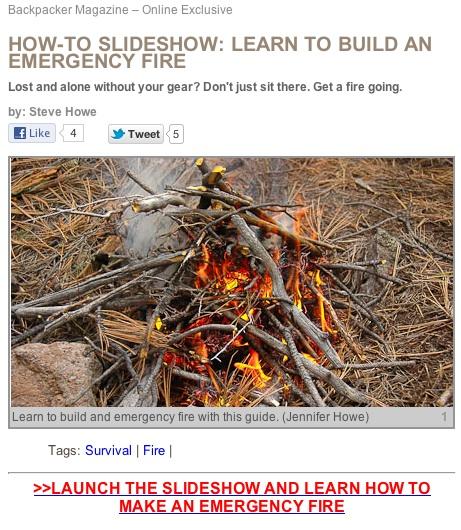
… I am surprised the whole backcountry isn't up in flames. This is a screen shot of a "tutorial" on the Backpacker Magazine web site. It isn't about an alcohol stove, it's about and emergency fire, but if the "experts" (does BM have editors?) can't do better than this in their education materials, there will be a significant portion of backcountry users that won't have the skills to handle fire (of any kind) safely.

fire emergency

Rather than an "emergency fire" I think we are looking at a "fire emergency" here!

Mina

David Drake BPL Member
PostedMay 22, 2012 at 9:46 am

Hi Kier,
I use an alcohol stove frequently, both penny-style and Super Cat. I accept that they are "less forgiving of error" as the poster above you points out, and also that using my canister stove would be a better choice with increased fire danger, even if the alky stove is still allowed.

Like Dean Fellabaum, I was surprised by your contention that water would spread and alcohol flame, so yesterday I tried a quick backyard test (I have a big patch of bare ground that's just cleared for a pumpkin patch). Of course, the one-time results I got don't invalidate your experience.

I filled a Super Cat with alcohol and lit it, then tipped it over (using a long stick to stay clear). The burning alcohol made a pool not much larger than the diameter of the stove, and burned for about 30 seconds before soaking into the soil and going out. This was loose, damp ground. Obviously, results could have been much different on dry hardpan covered with combustibles.

I did the same thing again, this time with the stove on an impermeable surface (a sheet of aluminum). The burning alcohol spread very rapidly to a large diameter pool. If this had been the top of a rock, I can imagine burning alcohol dripping to the ground (and potential combustibles) below.

However, pouring a pint of water on the flame put it out immediately, with no sign that the water was spreading the flame further.

Obviously, I'd likely get different results doing this more than once. Repeating near dark when I could really see the flame pattern would be helpful, too.

It's always recommended people spend plenty of time learning to use a stove before relying on it in the field. Maybe spending some time experimenting with what can go wrong and how to react quickly (and appropriately) to prevent disaster could be useful, too. I'll be practicing more with this now, including with a pot of water on top as in your scenario.

Dean F. BPL Member
PostedMay 22, 2012 at 10:54 am

>> When the accident happened, I watched fire spread across much of the 2' fire ring. The water I was heating, nor the very well saturated ground in the fire ring, had zero effect on the denatured alcohol

So, you're seriously trying to tell me that you mixed 16oz of water and 1oz of alcohol and it continued to burn?

BS.

I mean, seriously, no.

Your water went somewhere else- it didn't mix with the alcohol. I also doubt that 1oz of alcohol would spread over a 2' diameter, unless it was on a totally nonporous surface like sheet metal or rock or something. Was it on a rock? Either that or you spilled a LOT of alcohol trying to fill your stove with those frozen fingers you mentioned.

I also did a bit of experimenting in the back yard last night- only Everclear, no HEET, sorry. A) I had no trouble stomping out a 1oz Everclear fire. There was no shoe combustion. B) Dumping water on a 1oz Everclear fire doused it immediately (500mL water). No alcohol floated. This was, admittedly, on a bare patch of my lawn not on pine duff. But you shouldn't have pine duff anyway if you have an adequate fire ring.

I would propose that the rain prior to your spill only dampened whatever surface you had it on- THAT I will agree wouldn't be enough to douse it. I think you left something important out of the description of your incident. Was it on rock, or was it dirt or old ashes or something? Or maybe frozen?- that would also be a pretty nonporous surface. (But on the other hand not much of a fire hazard.)

And it STILL wasn't an issue because you (apparently) were acting responsibly in choosing or preparing your cooking area. THAT'S my point.

Look, all I'm saying is that suddenly getting all alarmist about alcohol stoves is kind of ludicrous. They are no particular fire danger if you just take all of the precautions we have all had beaten into us, like fire rings. Jim's original post title was somewhat alarmist- "Alcohol cookers…please be careful out there". It sort of presupposes some inordinate danger with alcohol stoves, like saying "motorcyclists who don't use helmets…please be careful out there." Which is RIDICULOUS.

"Tarp campers…please be careful out there!"
"Quilt users…please be careful out there!"
"Steripen users…please be careful out there!"
"Californians…please be careful out there!"

Is ANYONE getting my point about this alarmism?

Stephen Barber BPL Member
PostedMay 22, 2012 at 11:19 am

Alcohol stoves have been used in Europe and England (and elsewhere) for decades, if not longer.

So far Europe and England have not burned to the ground, nor do we hear reports of alcohol stoves causing major fires over there.

I have to think the alarmism in this thread is overblown.

Dean F. BPL Member
PostedMay 22, 2012 at 1:09 pm

Well, European forests ARE different than western U.S. forests. So I'm not sure how strong an argument that is, but I get your point.

I can't find any data that splits out causes of wildfires finely enough to compare what kinds of stoves may have caused them. The best I can find are references to "campfires", the descriptions of which universally imply wood-burning fires. Admittedly, several agencies that institute fire bans will say something like "propane stoves only." (Presumably they don't mean to ban isobutane stoves- they are just ignorant.) But there are a LOT of places in the southwest for instance that ban smoking, or only allow it inside of an automobile.

Mary D BPL Member
PostedMay 22, 2012 at 1:37 pm

Northern European forests are pretty damp. Forests in the Mediterranean areas, though, such as Provence, actually reminded me a lot of Colorado west of the Continental Divide. No sagebrush, but lots of scrub oak, evergreens and other flammable brush such as broom. Those areas are normally tinder-dry by mid to late summer, and wildfires are common.

Colorado's conditions are unusual right now due to extremely low winter snowpack and a very dry late winter and spring. They have really severe drought conditions! If current conditions persist, I wouldn't be surprised if they ban all stoves pretty soon.

Here in the Pacific NW, we always expect a ban on campfires by late July or early August, especially on the east slopes of the Cascades. Even last year, one of the wettest on record, the Wenatchee-Okanogan National Forest instituted a ban that included even concrete fireplaces in front-country campgrounds. Any stove users need to be very careful when the forests are tinder dry. In some states, if you set a fire, even accidentally, you are liable for the costs of putting it out!

However, I never have understood why the fire ban is always lifted just before the start of the general hunting season, even if fall rains have not yet started!

PostedMay 22, 2012 at 2:30 pm

" I am surprised the whole backcountry isn't up in flames."

+1 That picture looks like a forest fire in the making.

Ken Thompson BPL Member
PostedMay 22, 2012 at 6:13 pm

Klutzes are roaming the nations forests and trails. The roads to the trailheads,churches and shops, around every corner. Anyone could be one. Beware.

Be careful out there.

I almost set fire to Point Reyes… White gas.

Stephen Barber BPL Member
PostedMay 22, 2012 at 8:05 pm

A week or two ago, Al Qaeda was informing terrorists how to set fire to forests.

No doubt this week they will be telling there agents to use alcohol stoves for the conflagration.

PostedMay 23, 2012 at 1:01 pm

"So, you're seriously trying to tell me that you mixed 16oz of water and 1oz of alcohol and it continued to burn?"
No, that's not what I'm trying to say – that would be complete BS. What I'm saying is that the water acted as a carrier within the small contained fire ring.

I don't want to lose context here – I'm not trying to say that forests across the globe are going to burn to the ground from alchy stoves. That definitely would be ridiculous and alarmist. What I disagree with is the contention that alchy stoves are just as safe as canister stoves.

The surface I was using could be described as hard-pan, non-porous clay surface. And I agree, I was acting responsibly to contain my mistake.

I agree – no need to be alarmist. But I disagree that alchy is as safe as a canister stove. Nothing more, nothing less.

From your's and David's diligent carrying out of the experiment (thanks!), it's clear that what I wasn't taking into consideration was more porous surfaces, so in many (most?) situations, the kind of spread I saw would be unlikely.

Dean F. BPL Member
PostedMay 24, 2012 at 10:54 am

Ok, noted. No hurt feelings, here, Kier. Obviously I have trouble expressing myself at times.

As (I hope) I've made more clear- I'm just taking umbrage with what I was interpreting as alarmism about alky stoves. Interpret this as a concession if you wish: clearly alky stoves have safety issues that canister stoves do not, but I don't believe that they are significantly more dangerous than other stoves if used with proper precautions. "Significantly" being my operative word. I would never tell a novice to go camping using an alky stove in the Colorado back country right now.

No.

For that matter I wouldn't have recommended it to MYSELF of just three or four years ago!

But, heck, if you are stupid enough you can cause a fireball or even an explosion with a canister or white gas stove. You just have to be rather more stupid than it would take to screw up with an alky stove. :)

I hate to sound elitist but most of the people on this forum tend to be much more enthusiastic, experienced, and educated (in the loose meaning of the word) when compared to their hiking peers, as well as being possessed of a certain elan about back country etiquette and safety. (How's THAT for alliteration?) IMHO almost anyone here can operate an alky stove more safely than any novice can operate a canister stove.

Unfortunately, the world is full of amateurs…

PostedMay 24, 2012 at 10:59 am

The real problem is with the unprepared and those that do not know how to properly and safely use an opwn flame. Those that do could do so safely even when bans are in place. The rest might cause problems even when there is not.

PostedMay 24, 2012 at 5:59 pm

"No hurt feelings, here, Kier. Obviously I have trouble expressing myself at times."
No worries brother. I had a feeling we were simply at the edge of the internet's ability to clearly express a position.

And I don't think it's elitist. Every website has it's audience. BPL is clearly for the more serious hiker.

Viewing 25 posts - 26 through 50 (of 51 total)
Loading...