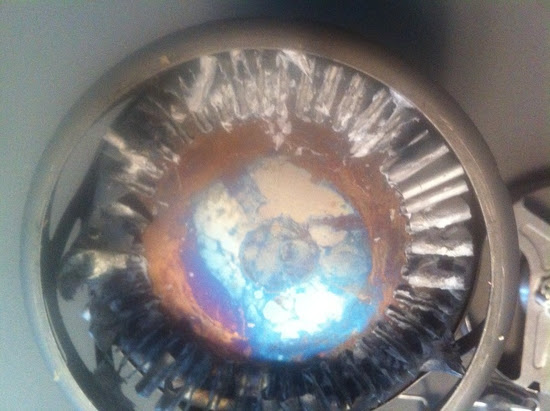
Dustin Short wrote: > That video you posted on your site seems to be caused by a poor weld/soldering job and has little to do with the issue of exploding canisters. The air temp was 10degrees (I’m assuming F, not C???). If so then the aluminum would cool rapidly and shrink in size. If the fin attachments to the pot were weak then they could crack and cause the failure seen in the video. There was no melting of fins from what I could see.
Hi, Dustin,
Well, actually I think it is related. Here’s what I think is happening:
In order to conduct heat, they attach an aluminum heat exchanger to the bottom of the titanium pot. Hmm. Two different metals. Two different rates of expansion. Every time the pot is heated, the two different metals will be “pulling” at one another.
Now say a weld fails or somehow pulls apart. The aluminum heat exchanger, the one that’s absorbing all that heat, is now separated from the pot. Where does all that heat go? Nowhere. In other words, all that heat has got nowhere to go and that thin aluminum heat exchanger is going to get hot, really hot.
So you’ve got this very hot metal underneath the pot and surrounded by the bracket that connects the burner to the pot. That’s a lot of heat confined to a fairly small space. Some of that heat is radiated back to the canister. As the canister heats, the pressure inside the canister increases, as the pressure increases, the flame increases. As the flame increases, the temperature under the pot increases, and yet more heat is funneled back to the canister of gas. What you’ve got (I think; admittedly this is somewhat speculative) is a runaway feedback loop. One would hope that the regulator valve would compensate some for the pressure increase, but judging by what has happened, the pressure becomes so great that the regulator valve does not impede the pressure and the runaway feedback loop continues. Things get really hot. Hot enough apparently to melt aluminum.
So, I suspect the underlying issue in both is in fact related. Given the severity of what happened to the one stove (three foot flames), I think saying something is worthwhile.
The thing that nags at me is David Ure’s question about how many time something along these lines has happened. I’ve got five cases that I’ve seen. That’s actually not all that many.
Perhaps I am guilty of “knee-jerk reporting” (sigh). I’m going to re-word things, but I think it’s still worth keeping an eye on. My own personal opinion of what I will do for me remains unchanged: I’m going to wait and see on the Sol Ti. If there’s a pattern of problems with the welds in the Sol Ti, then we’ll know soon enough.
HJ
Adventures In Stoving