Mysterious indeed!
As I follow this thread in bewilderment, bemusement, and horror, an entirely new level of personal involvement has emerged…
I arrive home from work today to find a package on the porch.
Funny, I'm not expecting anything. Stranger still, the return address is my own, yet it had been postmarked from the other side of the country. Last I checked, I haven't been on the other side of the country. Curious indeed.
I open the box carefully; I am a teacher…you never know when an anthrax bomb from a disgruntled ex-student might arrive. The contents are wrapped in paper, pretty lightweight. My first thought is that it's a commuter mug of some sort…
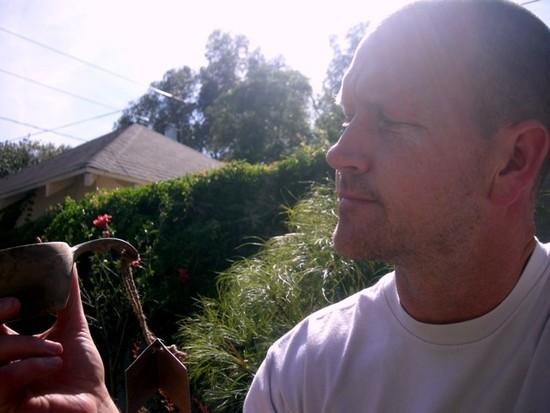
Behold!
Mysterious Kupilka!
A smile has been brought to my face.
I suspect I know who could be behind this, but as this person has chosen to mail it anonymously, I suppose I'll end my inquiry there and revel in not knowing for certain and simply take joy in the mysterious ways of this world.
Now, being a potter and full-time ceramics teacher, I have a keen appreciation for form and tradition, especially in utilitarian vessels of all sorts. I've spent countless hours of my life drooling over and trying to recreate the rustic simplicity of, say, an ancient Japanese chawan (rice bowl). So when I discover a new form, I'm pretty excited. I'm fairly new to Finnish designs, though I have seen the kuksa before. As this Kupilka thread has come up, I've been looking into these traditional forms and their history a bit more.
Rudimentary searching has told me that the kuksa traditionally needs to be carved by oneself or given as a gift, but not purchased.
Whether this is true or not, I believe there's an important point here, a point familiar to artists and touched upon by other cultures as well: that an object made by hand or given as a gift carries- if the recipient chooses to acknowledge it- meaning and life beyond the object itself. It signifies training, skill, a time and place, a relationship. It commemorates an occasion or the person that gave it.
Without context, objects are just objects; dumb, lifeless things that serve a purpose. But with history, when given as gifts or when made by a human hand, objects can take on entirely new meaning, elevating them, making them more than the mere materials they're composed of. Sentimental? Maybe.
But try living the unsentimental life, the life without art and metaphor and symbol, the life in which no meaning is ascribed to any event or object, and see how devoid of meaning that life becomes.
This Kupilka I'm holding here, regardless of it being made in a factory in Finland, was given as a gift. That means something, it has a life and a history now.
So now I'll faithfully be filling my Kupilka with my coffee and whiskey and wine. I have to honestly say, for something made out of plastic and wood by a machine, it's a pretty darn cool little cup. And you can't break it on the trail. And it sure feels light enough to me. The Mysterious Kupilka will gladly receive a place in my kit.
And it matches my pEnis gourd.
Thank you.