Topic

Want To Do A MYOG Winter Tent

  • This topic is empty.
Viewing 25 posts - 1 through 25 (of 57 total)
John Donewar BPL Member
PostedJan 23, 2011 at 6:22 pm

I did a shakedown hike (24 hours in a state park) this past weekend to check out my gear.

I determined that my Crux canister stove, Terramar base layer, Wigwam socks, Polar Edge mittens, merino wool Buff and full length Ridgerest pad are all worthy of a trip on the AT in September / October of this year.

I was made painfully aware however that my shelter (tarp) and sleep system (bivy & top quilt)were not up to the 32 degree weather encountered during my 24 hour gear shakedown.

I need to make another quilt with a sewn in footbox and heavier insulation.

What I need in the way of help from this forum is your suggestions, plans, patterns and pictures of MYOG winter tents.

My requirements would be set up with trekking poles, 48" to 54" front height (I don't bend so well anymore ;-> ), 24" or more rear height, 6 to 8 stake setup, enough ventilation to avoid condensation, sewn in floor (bathtub style would be nice), 1.5 pounds max weight and be able to pack down to the diameter and shape of a one liter bottle and a length/height of 18" or less.

I've been looking at the Bilgy Tarp Tent kit at Quest. Any opinions, experience or observations of this kit are welcome. It is the closest thing that I have found fitting my requirements so far.

Thanks in advance for all input, pictures and suggestions.

Party On,

Newton
PostedJan 23, 2011 at 6:50 pm

What material/dimensions was your tarp? In what ways was it inadequate?

From your stated dimensions of your prospective shelter, it seems you'd like a two-peak, tapered design (rather than a pyramid). Or are you open to other configurations?

PostedJan 23, 2011 at 6:54 pm

I don't think you need a winter tent for early fall on the AT… plus, you can stay in shetlers, ya know?

But if you're really looking.. a pyramid would be a decent design.

John Donewar BPL Member
PostedJan 23, 2011 at 7:10 pm

Ryan,

My tarp was used with a bivy and a drawstring footbox style top qulit.

My tarp is basically Jay Ham's 5 yard to SUL style and dimensions. It is made of silnylon. Approximate dimensions are width 100" in front, 60" in rear, 120" ridgeline and 18" of front beak.

Yes I'm open to other designs.

I am very practical about what works. Form follows function. I am partial to open floor plans without a pole in the middle to work around.

The main design element I found lacking in the tarp was the lack of a rear wall blocking the wind during a 32 degree night. I had the tarp pitched with the foot end into the wind and down as low as it could be pitched. I actually had the sides staked down to the ground.

Party On,

Newton

Jason Delso BPL Member
PostedJan 23, 2011 at 7:15 pm

What about just adding a removable flap to the existing tarp to seal up the foot end? Something like the beak on the HMG Echo, though it need not be nearly so elaborate. Or, could you use something already in the pack, like a poncho or rain jacket?

John Donewar BPL Member
PostedJan 23, 2011 at 7:19 pm

Hi Jack,

>>I don't think you need a winter tent for early fall on the AT… plus, you can stay in shetlers, ya know?<<

I have used the shelters in the past with some success. Sometimes the shelters are full when I arrive or depending on pace/mileage I may be camping away from a shelter.

I need to add to this thread that I am from SE Louisiana and don't do cold all that well. ;-)

>>a pyramid would be a decent design.<<

Is there a way of doing a pyramid design minus the center pole?

Party On,

Newton

John Donewar BPL Member
PostedJan 23, 2011 at 7:41 pm

Jason,

I like it. Don't re-invent the wheel just put a hubcap on it. ;-)

I could add a coil zipper to the foot end and sew a zip on / zip off wind break to my tarp. I could then stake the foot end and its "wind break" down to the ground on the windward side and pitch the rest of my tarp normally. I had it pitched so low it was actually impossible to sit up without "raising the roof". ;-)

I still need to do a closed footbox on a heavier top quilt though. We were only down to 32 degrees and I was in a base layer of wool, SS and LS polyester shirts, nylon pants, wool socks & cool max liners, quarter zip fleece, mittens, merino buff, in a homemade Meteor bivy under my top quilt and I was still shivering.

Did I mention that I don't do cold very well? ;-)

Party On,

Newton

John Donewar BPL Member
PostedJan 23, 2011 at 7:51 pm

Nancy,

Thanks for opening my eyes to the obvious. ;-)

I could get by with as little as four stakes and some throw line to tie up the peak.

Party On,

Newton

PostedJan 23, 2011 at 8:19 pm

On adding a foot piece to your existing tarp: I think a zipper might be more hassle and weight than it's worth. You might break some of the teeth using the tarp without the foot panel (open zippers are fragile). It might be lighter just to use a very small tarp on its own (or poncho/jacket or anything else to close that little gap), and easy if you put in a cord loop along the ridgeline of your tarp to attach it to.

On the pyramid: You should check out 1/2 pyramids as made by Oware and others. You could add a zipper or flap door on the front, and this shape is easier to tie to a tree that isn't directly overhead.

Alternatively, and I don't know how big you are or if this will work, but you could futz around with trying a 1/2 pyramid style pitch for your tarp up against a tree. Leaves a side open and may be hard to do with a tapered tarp but might be worth some tinkering.

Ultimately I'm wondering if you might benefit most either with a large flat tarp that can be pitched closed-up around you (and can use for more people in fairer weather) or adding a small tarp to supplement your existing one. A third option would be to create an inner tent for yourself with at least the foot box made of ripstop or sil. Lots of options!

Ben Smith BPL Member
PostedJan 23, 2011 at 8:23 pm

John,

I think with all of your MYOG experience so far, that you are ready for a baffled down quilt. You should be able to make one for a pound or less that will go down to 32F.

You also might have needed more on your head than a buff. I have a merino buff, and I will wear that around my neck with a BlackRock hat or a MYOG down balaclava over it for freezing or below.

John Donewar BPL Member
PostedJan 23, 2011 at 8:59 pm

@Ryan,

All good suggestions and I do have a large 8 x 10 flat tarp that I could experiment with in different setups.

BTW 5' 9" and 225#. It ain't only my pack that needs to be lighter! ;-)

Thanks again.


@Ben
,

I've considered down but if it gets wet on the trail ….. ?
That BlackRock hat is "cool". Pun intended, I couldn't resist. ;-)

Where I felt the cold the most was on my feet. That is why I want to close up the footbox and the footend of the tarp or tent.

Thanks,

Party On,

Newton

PostedJan 23, 2011 at 9:20 pm

John: Cold head == cold feet.

Although I'm not a big fan of draw-cord footboxes for anything under 35deg or so.

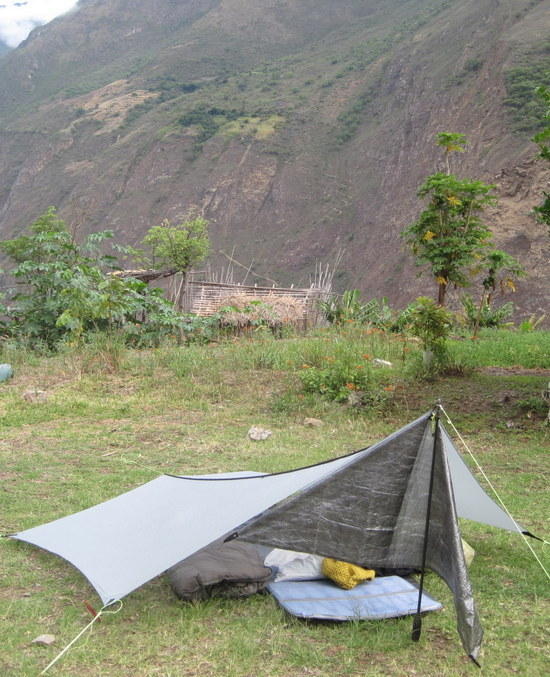
Did you try pitching your tarp like this?:
peru

Tends to work well with low driving wind kicking cold up your rear. Although obviously it cant handle snow-load. You can then shove any extras at the foot end as further wind blocks.

John Donewar BPL Member
PostedJan 24, 2011 at 3:40 am

Javan,

Good point about the cold head equaling cold feet. My hat size is 7 3/4. ;-)

The tarp pitch in your pic pretty much resembles mine. I had it pitched so low it was actually impossible to sit up in the front end without "raising the roof". ;-)

>>You can then shove any extras at the foot end as further wind blocks.<<

Blocking the wind with any extras or an added wind block / curtain on the foot end would be easier than sew up a complete new tent with even more surprises left to discover.

Maybe a combination of a little more insulation for my head, sewing up an enclosed footbox on my quilt and the wind block idea would solve my problem.

One strange observation that I made was that even before I got into my bivy and under the tarp there was condensation built up on the underside of the tarp. I was set up on a tent pad of builder's type sand. It was the park's idea not mine. :-(

It had rained the night before and the sand was still damp. When we arrived it was still well above freezing as we set up camp. Any ideas where the condensation came from? Rising ground moisture?

Thanks again,

Party On,

Newton

Tim Marshall BPL Member
PostedJan 24, 2011 at 6:01 am

you may not need to sew that footbox up. what type of cord are you using to close it? I have found that though i like small cords for their weight 3/32" shock cord is the ticket for holding footboxes shut. I like that when you pull it tight it then tried to shrink back to it's relaxed length which means all night it is pulling on the hole to close it. 3/32 shock cord is also less likely to open when kicking about down there like the small cords i used to use on my personal quilts have proven to do. If you must go small at least use a small elastic or shock cord as they seal better than static cords. That said you might prefer a sewn footbox but these are my little drawcord tips. I love being able to open that foot up when it gets hot. Everything in gear making is about compromise, everything.

-Tim

PostedJan 24, 2011 at 7:59 am

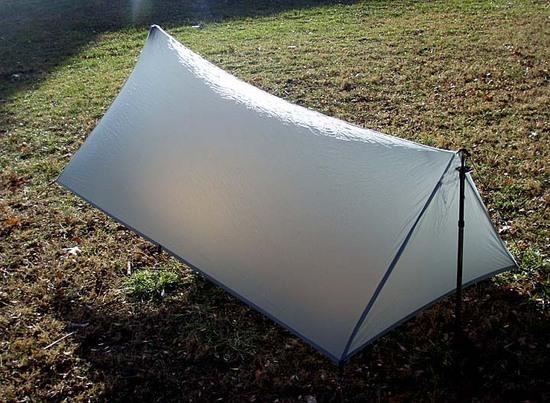
It sounds like you’re looking for something similar to the MLD Patrol Shelter ( found HERE )

It has a completely closed end, and would be a fairly easy mod to an existing tarp. A couple of constraints that I see this shelter having are:
>limited pitching options (you can only pitch the end so wide)
>possible air circulation issues?

BUT, pitching the foot-end into the wind could completely eliminate potential drafts.

MLD patrol shelter- rear view

-Clint

John Donewar BPL Member
PostedJan 24, 2011 at 8:13 am

Hey Tim,

My draw cord is the 3/32" round nylon yellow /w/ purple tracing drawcord from Quest Outfitters.

>>If you must go small at least use a small elastic or shock cord as they seal better than static cords. That said you might prefer a sewn footbox but these are my little drawcord tips. I love being able to open that foot up when it gets hot. Everything in gear making is about compromise, everything.<<

An idea popped into my head that I may sew in an insulated footbox pad and add a zipper to vent the top of the footbox where it joins to the foot edge of the quilt for when things heat up. This would definitely be a compromise. ;-)

Retired Jerry suggested that I add a layer of insulation to the quilt. That is an option I am considering while modding the footbox drawcord as you suggested.

Any ideas of a source of insulation right now? The market availability of insulation seems to have dried up as of late.

Thanks Tim,

Party On,

Newton

PostedJan 24, 2011 at 9:47 am

Hey Newton,

It seems you've gotten lots of options for solving the "cold feet" problem outside of the original request for tent designs. I'll throw in my 2 cents as someone who camps in very sub freezing temps regularly and has a ladyfriend to try to keep warm:
-Ray-Way style beaks or the new "Bat wing" (see his site)
-what if you add hang loops to the tarp that would allow suspension and positioning of the backpack as a windbreak?
-down or synthetic balaclava for head warmth (this is high on my list of upcoming projects) (I've got a 1 oz Ray Way bomber hat which is very warm, but the balaclava would be warmer)
-down or synthetic booties, or get goosefeet
-My ladyfriend and I have a modular quilt setup – 1 quilt that is 1" thick and 1 that is 2" thick. We can stack them and attach them when it's supercold for a toasty 3". Slightly heavier in the pack than a dedicated supercold quilt (by the weight of the two extra liner layers), but lighter on the wallet.
-an insulated "foot bucket" that's somewhere in design between booties and the bottom of a sleeping bag. Kind of like a mitten for your two feet together.
-is there enough insulation under your feet?

Cheers,
Andy

John Donewar BPL Member
PostedJan 24, 2011 at 9:50 am

Clint,

The MLD Patrol Shelter in the picture you included in your post illustrates exactly what others have suggested to me as a solution to my cold feet problem.

I need to pitch my tarp in the back yard at a comfortable level in the front and the rear or foot end staked down to the ground to get a measurement of the “triangle” of fabric that I’ll need to close off that end. Right now I’m thinking of attaching it via velcro, omni tape, Kamsnaps or a zipper. I’d rather not make it permanent so that it is still “airy” during the summer.

Javan Dempsey also suggested that it was quite possibly a lack of insulation on my head that lead to my cold feet. I’m investigating an insulated hood similar to the one at Ray Jardine’s website.

Thanks,

Party On,

Newton

Jerry Adams BPL Member
PostedJan 24, 2011 at 10:02 am

When it gets below 32F or so my feet get cold

so I made some insulated booties which keep them warm down to 20F or so

down would be good, or polyester

I made them to cover my calf which helps

John Donewar BPL Member
PostedJan 24, 2011 at 10:15 am

Hi Andy,

I'm already looking at the Ray Way bomber hat/hood as an addition to my cold weather gear. I have a polypro balaclava that I can add into the mix. I could also use my merino buff as a neck gaiter / balaclava if I put it on around my neck and them pull up the top end around my face so that only my eyes are exposed.

What do you think of the last option in the above paragraph?

>>add hang loops to the tarp that would allow suspension and positioning of the backpack as a windbreak?<<

I like this idea. It reminds me of the saying, "Dance with the one that brought you". ;-)

>>-is there enough insulation under your feet?<<

Probably not since my feet were cold and I was using a drawstring footbox next to the "barely open" but open none-the-less foot end of the tarp. {:-0

I never really felt the cold on my head. I was wearing a doubled over and twisted merino wool buff doubled over again at my ears. (2 layers on the head and 4 layers over the ears).

From my above post:

An idea popped into my head that I may sew in an insulated footbox pad and add a zipper to vent the top of the footbox where it joins to the foot edge of the quilt for when things heat up.

Retired Jerry suggested that I add a layer of insulation to the quilt. That is an option I am considering while modding the footbox.

Thanks Andy,

Party On,

Newton

John Donewar BPL Member
PostedJan 24, 2011 at 10:21 am

Jerry,

Could you, would you, be so kind as to post some pictures of those booties and a small description of the how to do it "instructions".

Please and thank you in advance. ;-)

Party On,

Newton

PostedJan 24, 2011 at 10:54 am

Newton,

When I asked about under your feet I meant incompressible padding, like a CCF pad or inflatable and insulated pad.

As for booties, if you check out this thread I've got a picture of some I made, with instructions and the basic pattern idea:
http://www.backpackinglight.com/cgi-bin/backpackinglight/forums/thread_display.html?forum_thread_id=41045&skip_to_post=349763#349763

Also if you go the bomber hat route, be warned that they are LOUD. Any little movement of that shell fabric against your ears is like thunder all around your head.

Cheers,
Andy

PostedJan 24, 2011 at 11:14 am

Sorry I missed your question Newton:
>>What do you think of the last option in the above paragraph?

Anything you do to warm your head up is good. I think the bomber hat would be more warmth for the weight (or better, a balaclava design with more coverage), just like a puffy jacket is more warmth per weight than a fleece jacket or polypro baselayer.

Personally when it is really cold I bring a fleece beanie that is not hemmed at the bottom and is really long, so during the day it is folded up like a knit hat and at night I pull the fleece down over my face to the tip of my nose (for some reason if the tip of my nose is cold, I can't sleep). I then wear the bomber hat over that.

Happy winter camping!

Jerry Adams BPL Member
PostedJan 24, 2011 at 11:21 am

On foot:

on foot

Obviously not good for walking around on.

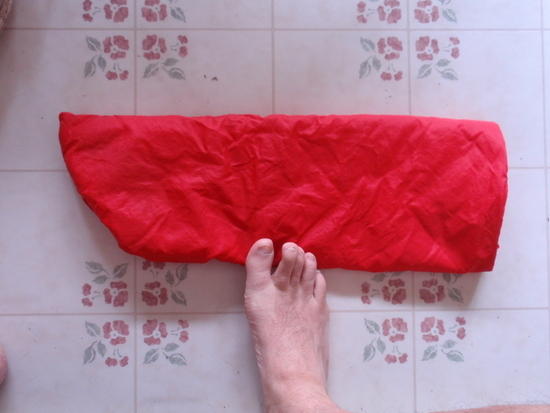
On floor:

on floor

2 pieces of light nylon 23 inches (in the up the leg direction) by 18 inches (in the around the leg direction), one piece of insulation same size.

Make a tube: Place nylon on insulation on nylon. Fold over so it's 23 inches by 9 inches. Sew through all layers (4 nylon and 2 insulation) to make a tube. Cut all layers so it's close to the row of stitches. Turn inside out and sew another row of stitches capturing the previous row of stitches and the raw edges. This is known as a French seam.

Do the same on the bottom to close it off. Cut it as a curve or at an angle if you want to get fancy but a square bottom works fine too.

Finish the top – fold outer nylon in and inner nylon out to hide raw edges. Make sure you're also sewing through the insulation so it stays in place.

I thought about putting in elastic but never bothered because not necesary.

Viewing 25 posts - 1 through 25 (of 57 total)
Loading...