Today I spent I an hour or so setting up and playing with my new HMG Echo I shelter. Since there isn't a lot of info out there on this product (or company) I thought I'd share my impressions.
ECHO I TARP
The Echo I tarp is similar in dimensions (8.5' x 7' x 5') to other solo tarps out there (ie. MLD Grace Solo). It has catenery cuts on all the edges which makes a taut pitch easy.


I went with 46" for the front pole and a foot shorter than that for the rear pole as suggested by Mike from HMG. The shelter did not come with any setup instructions. Maybe a pdf on their website would be helpful for first time users.
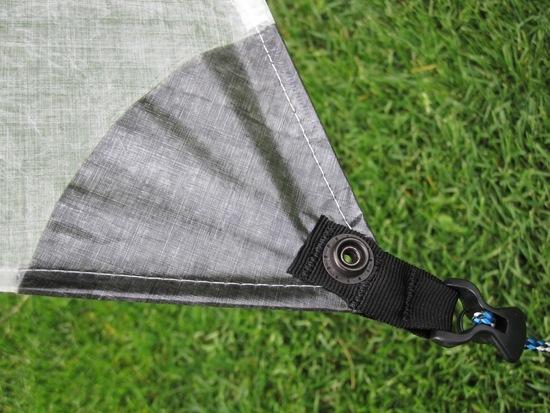
The whole thing seems well made and well reinforced with bonded reinforcements at the tie outs, sewn edges and a really nice ridgeline. The ridgeline is some sort of a 'multi step bonded' flat felled seam which seems very well done. Perhaps the best cuben seam there is? The reinforcements are very thick cuben and feel quite robust.

Detail shot of corner tie outs:
I don't have much else to add about the tarp. It's an excellently made tarp and I can't think of any complaints or suggestions for improvement, although if you are looking for just a stand alone tarp and don't want any other of the Echo components then the MLD Grace Solo is $5 cheaper, 3" longer, 0.4oz lighter and you can pay more for colors. The BPL Stealth Nano tarp is larger and lighter while using the same cuben but it costs a lot more ($320 for members). It appears to be lighter due to less use of heavier reinforcement patches but I don't really know. The material is the same so the weight difference must come from the reinforcements & hardware (LineLocs) . I did not measure this tarp to confirm the dimensions.
ECHO I BEAK
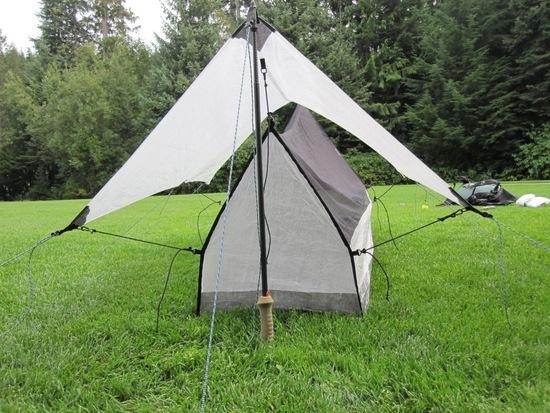
Attaching the beak is straight forward. You've got 2 snaps, velcro at the top and a few clips. I bet you could get it on in 30 seconds…maybe 15 seconds to win a bet. The key to a good beak pitch is to have the tarp set up in the proper 'A' shape.
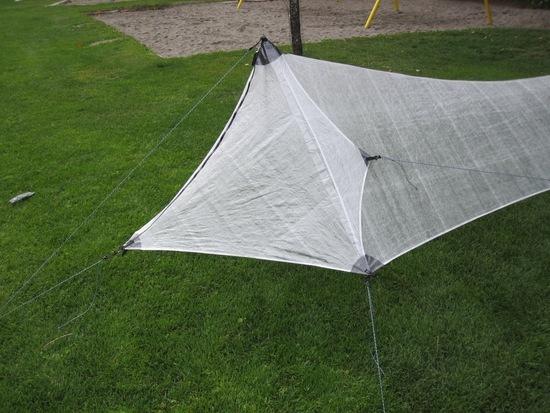
If it's too splayed out then it will pull the front of the vestibule in. If the tarp walls are too steep then it creates slack in the beak sides like this:

The above picture is an example of a radically bad pitch that I did intentionally to illustrate the variables at play. Any reasonable tarp pitch will provide a functional beak and any fine tuning you do is mostly just that…fine tuning. I imagine I will eventually use pretty much the same pole height and guy line lengths once I'm done experimenting with it. I'll probably use a dab of white out on my adjustable poles to mark the pole height I prefer and trim the guylines to have a narrower range of adjustment.
I didn't observe the beak altering the pitch of my tarp as Rakesh did. A taut tarp pitch stayed taut when the beak was added.
Beak detail:
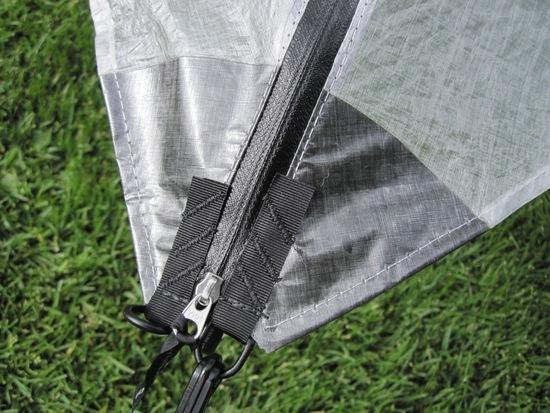
A double slider zipper is an appreciated feature for having a peek outside, pepper spraying that pesky bear or maybe for simulating a top vent:

I'm not sure what the best practice is for keeping the beak door open. You can tuck it under the guyline as shown below, but it seems like a gust of wind could pull it out of there pretty easily:
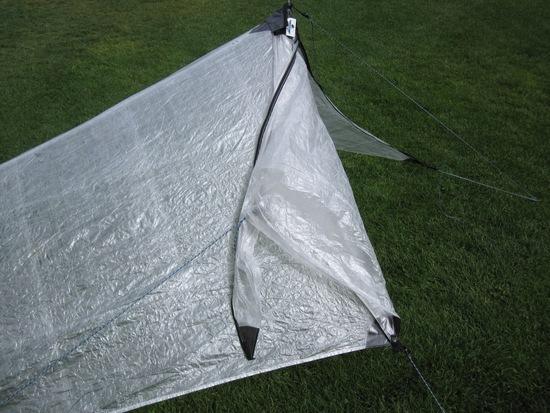
The only ideas for improvement of the beak that I can think of are:
1) A more secure way to hold the door open.
2) Devise some way to leave the beak attached, like using more snaps and less clips/velcro. If I know I'm going on a trip where I'll always be using it (ie. cold conditions or a rainy forecast) then it would be nice to leave it on and save a little time. I don't know if this would work, but maybe the guyouts along the side of the beak could be replaced with snaps (or just eliminated?). This would save the weight of the two ~5 foot guylines and 2 clips and 2 LineLoc's. It might not get the beak as tight though. Add 2 more snaps at the ridgeline instead of the velcro wrap and you might have a way to leave the beak on and save weight. I don't know if this would compromise the pitch of the beak though. The small potential savings in weight and time aren't worth a poorly fitting beak.
ECHO I INNER:
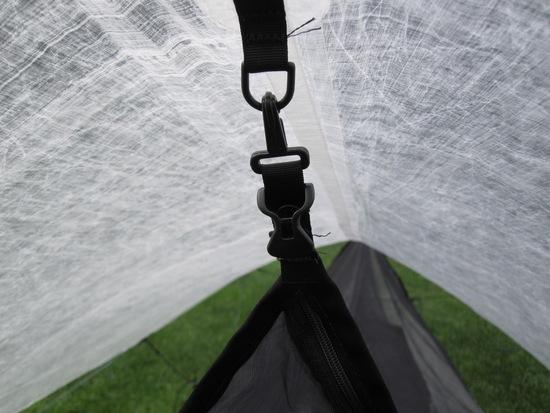
The inner clips to the tarp at 8 locations. 3 along each side plus 1 at each end. All of these use LineLoc3's and bungie cordage (1/8"?) except for the front attachment above the door which clips directly on.
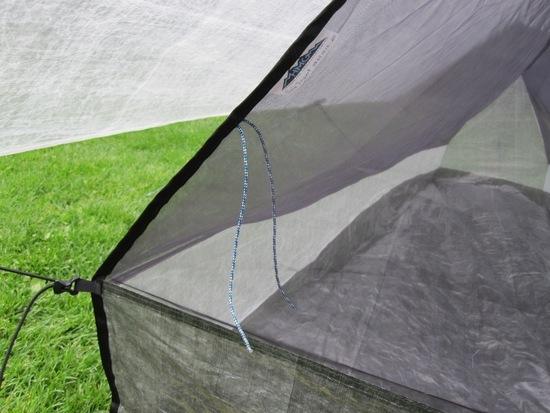
Front attachment above the door. I'm not totally clear why this LineLoc3 is hanging there. I imagine it's for pitching the inner by itself without the tarp and the user needs to supply some sort of cordage and way of attaching the trekking pole. Maybe you attach a ring to that clip to go around the trekking pole point and then you can grab the guyline off of the tarp and run it through the LineLoc3 to stake it down?
The mesh door is held open by tying it open with the cord. Light & simple:
A look inside:
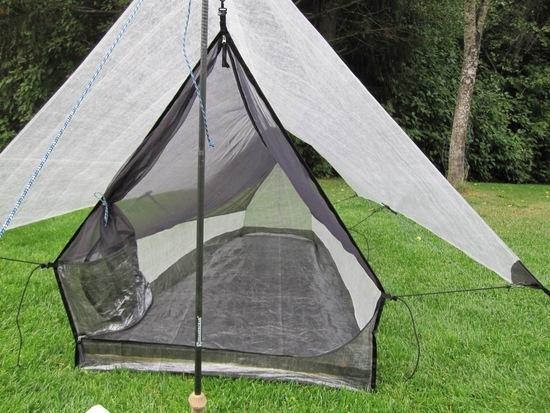
A full length NeoAir:

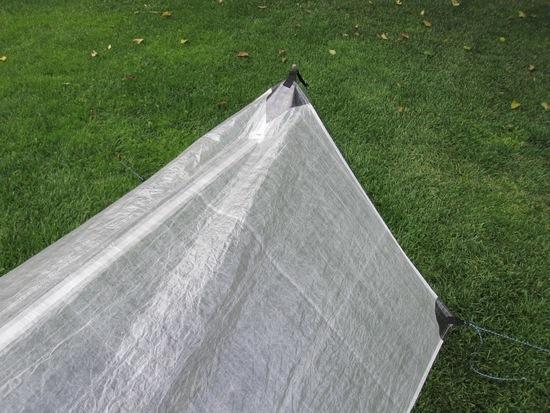
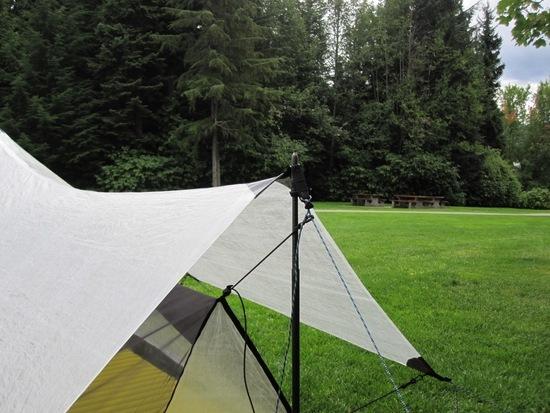
When you clip the inner into place it attaches along the ridgeline about 6" in front the ends. If you pull it taut, this yanks down on the ridgeline a bit and creates this wrinkle at both ends. This doesn't really affect anything but it does tarnish the look of your formerly perfectly taut tarp:
 :
:
You can avoid this by clipping the inner to the guyline instead of the clip along the ridgeline. You can also minimize this by using less tension for the inner, but doing so decreases the volume inside the inner and I'd prefer to keep my space.
Some ideas for improvement are:
1) A bit more headroom would be nice so one can sit up in the middle. The floor area is fine.
2) Use 3/32" shockcord instead of 1/8 (EDIT: This works well with this existing guylines and saves ~0.5oz).
3) The new 1.2oz/yd cuben uses the same thick membrane as 1.5oz/yd cuben but with less spectra. This might a way to save an ounce or so off of the shelter with no ill effects.
ECHO I DIMENSIONS
The Echo I Inner is claimed at 7' (length) x 3' (front width) x 2' (rear width) x 38" tall at the front.
I measured the height of mine at the door at 37". This height drops pretty quick as you can see. You can really only situp inside right at the door way. This is what I expected and I am fine with this (I was considering a MLD Bug Bivy or Serenity Inner) but other should be aware that it's not huge inside.
37" at front:
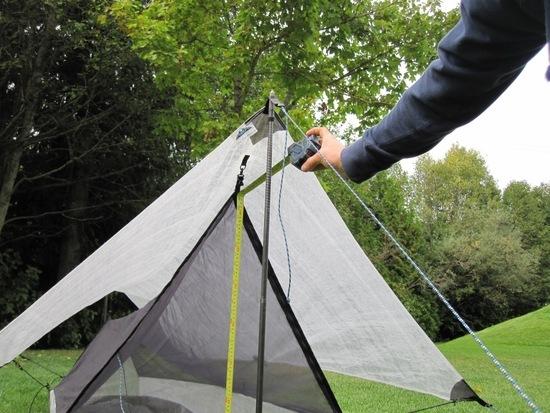
The front width is claimed at 36" and I measured 32" (the tape measure body is 3"). That's a >10% discrepency.

The rear is claimed at 24" and I measured 20". As you can see a few photos up, the rear is no wider than a standard width NeoAir (EDIT: HMG's Specs have Changed).
Length is claimed at 84" and I measured 82". The front and rear walls are vertical so all of this length is usable. Length is not a concern for my 6' self:

Overall, the interior size is adequate for my needs but I am a bit disappointed that the width is >10% smaller than specified (EDIT: HMG's Specs have Changed). This puts the floor area at basically the same size as the MLD Serenity Shelter (82" x 32" x 23"). The height is the same too, but the Echo I does have more room inside because the lower part of the walls are vertical or past vertical thanks to the bungie side tie outs.
As a counterpoint, the shelter is not the widest at the floor where I measured. The widest point is about 10-12" above the floor where the bungie cords connect and pull the inner wider (as you can see in some above photos). Perhaps HMG will say they measured at the 'widest point' which is a bit of stretch IMO, but it could be their explanation. If you measured the width of the inner at this height then you'd likely get results close to the specs. This width 10-12" above the floor actually adds a lot of volume inside where you need it (compared to sloping walls of the Serenity Shelter) because this is where your shoulders etc are. Despite having similar floor area dimensions as the MLD Serenity Shelter I believe the Echo I insert has significantly more usable interior volume. I guess it had better since the Serenity shelter is 2-3oz lighter. I definately prefer the Echo's 1.5oz cuben floor over a slippery and less waterproof silnylon floor.
ECHO I WEIGHT
Ahh yes…the exciting part and I've saved it for last. To cut right to it, here's what the Echo I is claimed at:
Tarp: 6.1oz (8.0oz with guylines)
Inner: 10.9oz
Beak: 2.8oz (3.5oz with guylines)
Full Echo System: 19.8oz (21.8oz w guylines)
Of note, the 3 claimed component weights add to 22.4oz with guylines, not 21.8oz.
According to my scale I observed:
Tarp: 6.21oz (8.08oz with guylines)
Inner: 11.49oz
Beak: 3.42oz (4.14oz with guylines)
Full Echo System: 21.2oz (23.7oz w guylines)
Also, the supplied stuff sack weighs 0.51oz.
My intention is to pair this shelter with six 8g stakes (ridgeline & corners) and six 2g stakes (sides of tarp, 4 corners of inner). That brings the total to 26.3oz with guylines, stuff sack & stakes.
In just tarp + inner mode I'm looking at 22.2oz with stakes and the stuff sack.
In tarp + beak mode I'm looking at 15.8oz with stakes and stuff sack but I'd want to add a groundsheet too.
Overall, my Echo I system comes in 1.4oz overweight due to the tarp being fairly accurate (+2%) but the inner (+6%) and the beak (+22%) being overweight.
Perhaps the reason why the inner is 0.6oz overweight is because HMG may have made some changes since the website was created. On the website the photos of the inner show only 4 perimeter bungie guyout points (at the 4 corners) and there is not a guy out point along the sides like there is on mine. This extra 2 guyouts is likely the cause of the most of the 0.6oz. This extra guyout is appreciated for maximizing internal space.
DISCUSSION
Overall I really like the shelter. The quality is great and that's a really important thing. I would have liked to see some of the specifications match a little closer to what I measured (EDIT: HMG has revised the specs). It's not a huge deal and most of the specs aren't way off, but it would instill more confidence in buying future products if the specs were a bit closer.
It does seem possible to save a significant amount of weight off of this shelter by replacing the guylines and bungie cordage. The guylines total 2.6oz and the bungie cord is 1.4oz.
I haven't measured the included bungie cord but it's pretty thick (edit: it's 1/8"). My guess is that it's this thickness to work with the LineLoc3 adjusters. Using 1/16" bungie cord with the LineLoc 3's removed would likely save an ounce. I may do this.
For the guylines I may partially replace them with thinner pure spectra cord and just leave enough of the original guylines to work with the LineLoc3 tensioners. Most of the beak guylines in particular could be changed to about 10" of the original guyline to allow for adjustment and then attach that to lighter cordage. By replacing the cord where possible I would estimate another ounce could be saved.