Topic

2-3 oz fixed blade

  • This topic is empty.
Viewing 25 posts - 1 through 25 (of 53 total)
Konrad . BPL Member
PostedMay 22, 2010 at 2:10 pm

I'm getting ready to pick up a light weight fixed blade, and im pretty sure im going to get a bark river bravo necker 2, with scales. I already looked at the RAT cutlery/ESEE Izula, but I'm going with the Bark River.

http://tinyurl.com/2a2j7am

Before I pull the trigger, anyone else have any suggestions for a fixed blade, that is 2-3oz, preferably with scales? It can be a skeleton tang, or any style tang that extends into the hande.

I dont want to hear about another knife that you think is superior but weighs 6 oz. I'm selling some knives that are in that weight range so that I can go lighter. Plus I already see all those other threads about what knife people bring backpacking…i'm just hoping to narrow the scope with this thread

But yeah, anything else out there that's a FIXED blade, capable of batoning and basic bushcraft that weighs in the 2-3 oz range?

PostedMay 22, 2010 at 3:17 pm

people don't talk about it, but i really pleased with my 2.5oz buck paklite skinner. didn't want to spend the $ on some high carbon blade like a RAT, etc at the time and paid $15 locally. However, I like my edc work and hiking knife stainless. So far it is good for everyday workin during the day and preping dinner at night. Batons, filets and skins fine. with some paracord fits great.
if too heavy their caper is 1.1oz, never held it though

PostedMay 22, 2010 at 4:13 pm

It's my choice, 2.5oz just the knife, with sheath it's more. VG-10, convex grind, full tang with thermorun handle. 2.8" blade, 7" overall. Can be worn as a neck knife.

PostedMay 22, 2010 at 9:06 pm

A basic #1 or #2 Mora with plastic sheath and carbon steel blade is about 3 oz and $10-15. At the top of that price range, you can get a laminated steel blade with an unfinished wood handle. I've used a basic #1 and a similar plastic-handled model (which I prefer) for years.

PostedMay 22, 2010 at 10:23 pm

Konrad, there is absolutely no other fixed blade in the same class as the BR BN or BN-2, of the same weight, function, size, and ease of field maintenance that I'm aware of. Although, the general disclaimer is: "Excluding custom."

There are a few other possibilities in carbon steel, but the reality is, they're all a) customs, and b) made by knife-heads, that don't care enough about ounces, let alone grams enough to even have a serious idea what the actual weight of their blades are. (If you follow knifeforums, I'm the first person to weight the BN-2 on a gram scale with all it's individual parts (username: Dissimilation))

The Esee Izula is a great blade with a great price for a great warranty. If you want a small "bomber blade" in the sense that you can beat it to hell, and get it replaced, buy it.

If you want a blade that you can field sharpen (without having to re-profile in the first place), to hair cutting capacity, that will hold a cutting edge for twice as long as you could imagine, buy the BR.

If you buy the Izula, send it to bark river to convex the entire blade, if you can't do that, convex the edge.

Lastly, I'll say, that the 12c27 steel is the only stainless I've been impressed with.

If you're serious about other possibilities, or getting blade crazy, send me an email, and I'll point you in some directions, but I'd say go ahead and buy the BN-2, and set aside funds for others also.. ;)

D S BPL Member
PostedMay 22, 2010 at 10:28 pm

BECKER-NECKER-BK11-NECK-KNIFE-KA-BAR-USA-FIXED-BLADE

excellent feel in hand without scales, nice touch at the end with bottle opener. A lot less money, out of the box sharp…about the same dims as the Bark River but better balance and a bit thicker overall. If you have small hands, the Bark River may work or spend the $60.00 to add scales.

Great knife for around $40.00 w/sheath.

couch

PostedMay 22, 2010 at 10:28 pm

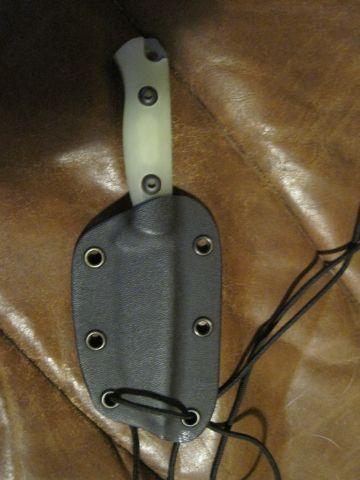
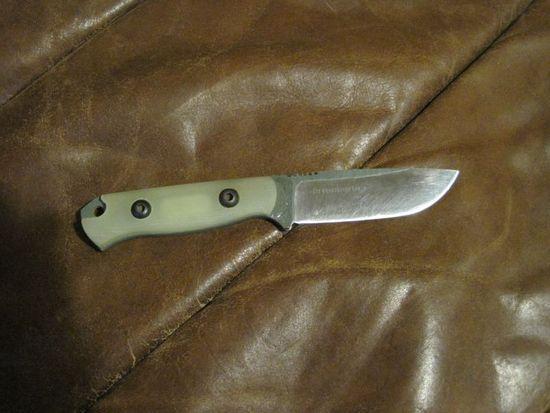
Just to drive it home, here's some pics of the knife every serious UL knife-head (IMHO only of course), should be carrying:bn-2 in sheathbn-2 ghost green jade

That's the green Bravo Necker 2, with Ghost Green Jade G-10 scales.

This is my current EDC, and I use it dozens of times a day, with zero reservation. I've only maintained the edge with 1400grit silica sand paper and my GG Gorilla hip belt padding. I have almost zero arm hair on my left arm, from testing sharpness daily.

PostedMay 22, 2010 at 10:29 pm

I second the Mora. I have the bushcraft model, I think it was $11 from Bushcraft Northwest (great company).

The beauty of a Mora is that you can COMPLETELY wear it out doing whatever you want as opposed to always babying a $100 knife.

PostedMay 22, 2010 at 10:44 pm

Mora's are good knives (depending on manufacturer to some degree, which btw, for those that don't know this, Mora isn't a brand it's a style), and yes you can abuse them.. Just as you can about a dozen other European knives of simillar quality.

BR's are in a different class, along with the Fallknivens that Tohru mentioned, and a few others.

If you're a knife novice, buy the Mora, you'll likely break a few. If you're not, buy the Bark River. If it breaks from anything other than "Operator Error", Bark River will replace it.

It's not quite as "Fool Proof" as Esee, but here's their warranty info:

"Lifetime Warranty
All Bark River knives and axes are guaranteed against manufacturing defects for life. If you have any problem with our product, just return it to us and we will repair or replace it. If you would like us to refurbish or re-sharpen the product please enclose shipping and handling fees — $12 Lower 48 States, $25 Alaska, Hawaii and Canada, $30 All other Countries. Mutliple knives may add to charges."

P.S. You can't "Wear Out" one of these knives.

PostedMay 23, 2010 at 12:03 am

I could probably make what you guys are after and drill out the tang so it'll be lighter. It'll still be a full tang rather than rat-tail. Keep in mind that no scales will be lighter than paracord wrap. That's because any good scales that won't crack on you will be stabilized–which makes it much heavier. One alternative to that is maybe a plastic/resin type of material like micarta…still heavier than paracord. Maybe we'll throw in all the ideas and call it the BPL knife :P

PostedMay 23, 2010 at 12:32 am

Jeff, the knife Konrad mentioned he's primed on, and which I'm a major proponent of, is a skeletonized tang. The scales come in a variety of color options, most in Micarta or G-10..

Mine are G-10, and weigh in at a little less than 1oz. Which makes my total knife weight, for a beast a 3.5" blade, fully convexed, with scales. 2.8oz.

The micarta scales are slightly lighter, I think closer to 3/4 oz.

The Izula weighs 2oz without scales, and is about 2.75" blade length.

PostedMay 23, 2010 at 1:16 am

The advantage of a production vs. a custom knife is that they can do skeleton tangs.

I would much rather go with the Bark River knife in the link than the Izula as a backpacking knife. 1095 is only great when corrosion is absolutely not a deciding factor.

I have some carbon fiber that I could use to make the scales and it'll be a bit lighter. The only problem is that carbon fiber is about 4x more expensive than micarta and G10.

What I'm more concerned with is what would be the ideal blade thickness, length, and width? I'm thinking of something along the lines of 1/8" thick, 3" long, and 7/8" wide.

Essentially, if we were to have a blade with minimal thickness and width, it would be extremely light. But then, it wouldn't be able to baton.

PostedMay 23, 2010 at 8:08 am

I own several Bark River knives and ESEE (They where RAT cutlery when I bought them) and I FAR prefer the Bark River knives in every respect.

Dale Wambaugh BPL Member
PostedMay 23, 2010 at 10:44 am

I've never broken a knife and have broken very few other tools and I've done a lot of mechanical repairs and wood working. I don't get the "bash your tools" thing at all. IMHO, knives are made for cutting, which really isn't a demanding task. The heaviest normal use for a trail knife would be making fuzz sticks and you can do that with any knife in your kitchen without breaking it. Knives are not pry bars, axes, pitons, etc.

I think the pseudo-military-mountain-man-survival stuff feeds a lot of "needs" in knife construction that just doesn't pan out in everyday use. A reasonably stiff blade and a handle that will allow a good grip and control of the blade is all that it needed. A mora or a pocket knife with a locking blade will do that. You will find a lot of outdoor knives made for hunting— designed for butchering large game and that is a completely different set of needs than hiking and camping. Quartering a bull elk or an apple call for different tools :)

In a survival situation you could still fulfill most of your needs with such a knife. If you want higher quality (and more weight), go for it, but recognize it for what it is.

One of the best principles that Ray Jardine identified is that many of our issues with selecting equipment revolve around fear of nature. I have issues with people going out with nothing more than a single-edge razor blade or a Swiss Army Classic, and I have to admit that wanting a bigger knife is centered on perceived fears rather than actual needs– opening a meal package, food prep and minor repairs.

I like a bigger compass and first aid kit for the same reasons as a "real" knife: I want to take reasonable precautions to take care of myself due to injury or loss of my shelter and other gear. That doesn't mean I need a 9", 2 pound chopper. A good 3.5" folding knife with a locking blade or a mora are very adequate for my needs, and assuaging my fears.

I have tried several small fixed blade knives and my falling out with them is the small handle. If you can't get a good grip on a knife, you can't use it to full potential. Even a knife with a 2" blade needs a good grip and in fact, needs every bit of control possible to maximize the use of the small blade. Designers shrink the handle in an attempt to make a smaller lighter tool overall and I think that is a mistake.

Wrap your hand around a ruler and see what you get. My hand is 3.5" wide doing that, so a knife with a handle that is about 3.75" is going to give good control. I'm not a fan of the moras with traditional wood barrel-shaped handles and no guard. If you are using a knife properly, this shouldn't be a problem, but a deep cut in your dominant hand two days out wouldn't be a lot of fun. Stuff happens when you are hungry, dehydrated and tired, so a little extra help is a good thing here. The Mora Craftline models have a small guard that makes for safer use.

If you are going to use a knife for extensive work, you need a handle that isn't going to make a mess of your hands. Many of the Swiss Army and other folders fail on this aspect too. If you can't use the knife for a half hour or so without tearing up your hands, its real usefulness as a survival tool is limited. I am thinking of situations where you might use a knife for constructing shelter and fire building. Many survival techniques and skills involve woodworking on the order of whittling— making figure-4 traps, fire bows, etc. A large knife is actually a hindrance for those tasks, but a good handle adds control and is kinder to the user.

The most extreme use I can think of is batoning wood for fire making and that should be a last-ditch use of a knife and the one most prone to breaking one. Even there, the wood shouldn't be any thicker than about half the blade length. I've been able to find dead branches for any small cook fires I wanted to make and never had the urge to break up bigger stuff. The smaller wood can be broken over your shin or thigh, between big rocks, or the fork of a tree to get to drier inner wood. The only times I have split wood for outdoor fires is when car camping and I used a small axe on cut firewood I brought with.

There is a lot of discussion about full tang knives. I agree that a full tang design is stronger, but I'll hazard to guess that most would break or otherwise damage the blade edge before breaking the tang with any design. I have tried to remove the molded handle from a mora style knife, and it simply isn't going to happen in the field. I had to mount the blade in a vise and literally cut and peel the handle material from the tang. The delicate part of a knife is the area near the blade where it is hardest and thinnest and can be chipped or cracked. All this business about breaking a knife tang in normal use is just shop talk. I do think full tang knives tend to look better and have good flowing lines, but the apple can't tell the difference.

BTW, I like Bark River's designs and materials very much. The Bravo Necker looks like a great small knife design and pretty much makes my point for handle designs– a 2.5" blade with a 3.75" handle and the handle design forms a self-guard. I will make a note that the tang design is not as strong as a true full tang model and I would expect the knife to break at the junction of the blade and the handle, but only where someone might try to pry with it, and that isn't what it is made for— I just can't imagine any cutting chores that could beak that knife.

PostedMay 23, 2010 at 12:25 pm

The only issue batoning firewood with a knife like these, or with any knife of quality construction for that matter is improper technique. Almost all examples of breakage I've seen are from levering an unlevel knife over the wood when striking the spine.

In fact, BR knives are built to be used for alot of the abusive practices you mention.

I do pry, cut, chop and chisel with mine.

As to handle length, there's alot of confusion amongst people on how big a handle should be. Alot of people think you should be able to get a full on 5 finger hammer grip on a handle. Mike Stewart at Bark River will be happy to argue with this. Here's a quote to someone who said they were disappointed with the length of the Woodland Special handle, a very highly regarded knife for it's outdoor utility:

"Stop posing with it in your hand and start using it.

You might find that it is made for using and not idle holding.

The Fox River has been made in the thousands and thousands and is the Official Knife of a couple of Wilderness Survival Schools.

If You use it and still don't like it you can send it in and we will make it look like new and you can sell it here on the forum and get a knife with a larger handle.

Please don't just assume that it does not work.

Holding a knife in you idle hand is not the same as how you would hold it in field use."

and another:

"People pick up knives and hold them in a hammer Grip.

You rarely use them in a hammer grip so it usually is not an indicator of how the knife will act in actual use..

Once you are skilled in using knives you can tell right away by NOT holding it in a hammer grip."

Can't give a ton of context without reposting a ton of info, but you get the idea..

Interesting stuff…f

Dale Wambaugh BPL Member
PostedMay 23, 2010 at 1:19 pm

My point in using knives with smaller handles is that you cannot put as full a pressure on the blade as you can with one that you can get more fingers on. If doing lighter chores, like cutting a small line or slicing an apple, then you can get by with much less. You can do all kinds of fine work with a single edge razor blade and no more than a two-fingers-and-thumb pinch. Adding a loop of line to go around whatever fingers aren't on the handle a la Buck Hartsook and Smidgen models is a simple aid to using these small blades.

I typically use my thumb on the spine for heavier downward pressure or my forefinger on the spine for finer control. I can't think of a situation where I would want to wrap fingers and thumb around the handle as I would with a hammer. While it is possible to do many tasks with a handle that covers two or three fingers, I think is is apparent that getting all four fingers on the handle is going to aid slipping and control. About the only time I want to get that rough is to remove larger amounts of wood.

Batoning. It is a nasty thing to do to a knife. Nice to know in a pinch, but not much use in light of leave no trace philosophy and a good carpenter would look for other tools. Note that I said that you shouldn't baton wood that is more than 1/2 the blade length. I'll stand by that. Batoning a nice block of dry straight grained wood is little challenge. Try some wet stuff with a few knots and rough grain and there's a good chance of getting the blade stuck or even chipping a blade. And there's little point in this activity while hiking. The heaviest use I can think of using a knife for on a hike would be cutting a tent pole or stake.

Is a mora as tough as a full tang knife? Nope. Would I choose one for batoning? Not really, but going after some 2" stuff wouldn't scare me. Is it adequate for general cutting chores? Of course. They are light, very sharp, and very inexpensive. Is see it as a step up from a paring knife. I've had one mora for 25 years and subjected it to all kinds of abuse and it still does the job. Like I said, if you like having a high quality knife with the price attached, go for it.

Stephen Barber BPL Member
PostedMay 23, 2010 at 1:53 pm

You can confidently take the BRK Bravo Necker (1 or 2)out, knowing that it will stand up to any real use you might put it to in the outdoors.

It won't chop through concrete, and it's a bit short for killing grizzly bears!

FWIW, I prefer the BN with the grips – much more comfortable in my hand.

If you want a full size knife that is reasonably lightweight, look at the BR Aurora or Northstar – both can be had with bamboo handles, both have a full skeleton tang (which is just as strong as a full tang in any real world use), and will be a great knife to give your grandkids when they take to the woods!

PostedMay 23, 2010 at 2:15 pm

I believe the Spyderco Moran FB01 fits your criteria. I've got an older model with the upswept blade but no hole; it'll baton wood very well, and slice with the best of 'em. The polished blade doubles as a signal mirror, but best of all, the handle has a very ergonomic shape, with good volume. Great for all my camp chores and woodworking needs.

PostedMay 23, 2010 at 2:24 pm

Checkout this link to see a top quality tool knife that's been taking about 2 years of serious abuse and still kicking(scroll down a lil to the pictures:

http://www.swampratknifeworks.com/cgi-bin/ultimatebb.cgi?ubb=get_topic;f=10;t=007170

As far as batoning size goes, checkout point first batoning techniques (there's actually a decent video of a Bravo Necker on youtube), you can baton stuff upto a little over 2x blade length using this method.

Dale Wambaugh BPL Member
PostedMay 23, 2010 at 2:55 pm

Jeffery,

Geez, we all have our opinions. You can buy or build a knife and use it any way you want. And I'll have my opinions too.

My qualifications? A lifetime of using knives at home, in the woods and at work. A lifetime of using cutting tools for metal and wood. I was raised by a journeyman machinist and electrician, with a full shop available at the house with every power tool known to man, a forge, welders, etc, etc, etc. I have built houses and boats, made sculptures, done machine work, repaired automobiles, light trucks and motorcycles (for a living) and made musical instruments. I am a very experienced photographer, shooting everything from 35mm to 8×10. I repair computers (desktops, laptops and servers) for a living at the moment. So I do think I've seen my way around a toolbox or two. I have sold tools for a living as well. During that time, I picked up a few opinions on what I think is the proper (and safe) way to use and keep tools. I have a few scars, but still have all my body parts intact.

Am I the Final Word in knife use? I think not. Am I an expert on survival? Not really, but then I've worked really hard to make sure I didn't get in a survival situation. Can I make shelter and fire from scratch? Yep, and I have. If you read some of my older posts, you may note that I have cautioned my fellow readers about going too light on survival items.

So what was so bad? I said that I think knives should be used as cutting tools. I said that botoning wood can damage a knife and cutting smaller diameter stuff makes for less chance of damaging the blade. I questioned why batoning is even necessary in light of Leave No Trace principles. I have seen a lot of damage done by folk bashing about in the woods with cutting tools with little regard for others or the environment. I have BIG opinions on that. If that makes you mad, tough!

I said that I don't think that people need big or expensive knives to take care of routine tasks while hiking. I contrasted hiking with hunting, which have different needs in cutting tools (note that I did not say anything negative about hunting). Indeed, butchering an elk carcass is a little different than cleaning a trout or cutting up an apple. And I had the audacity to say that I prefer a knife with a full handle— what a terrible thing to say!

What IS your problem?

John Brochu BPL Member
PostedMay 23, 2010 at 3:07 pm

>>>Many of them would not have been critical if they had a good knife to make a fire.<<<

Why would they need a knife to make a fire. I've made hundreds of fires in the woods in my life and not a single one required a knife.

I think some folks just enjoy having a big honking blade on their hip – which is fine by me hyoh. But to suggest a knife is required to build a fire is a little silly imo.

PostedMay 23, 2010 at 4:50 pm

Hey Dale, just want to say that for my part, I wasn't trying to call you out, or even disagree with you on the handle front, just wanted to expound on the info and add some interesting points that I think some of the less savvy knife interested people might like to know.

I took from your first post that you appreciated a medium to larger handle, nothing wrong with that, I agree. The BN-2 has a great sized handle for size of knife IMHO. I think you mentioned that you agree.

As to the batoning thing, I disagree, but to each their own. I like to beat a knife up, and view it as an all around tool, but as the last poster said, HYOH.

I am by no means an expert, just an enthusiast.

Viewing 25 posts - 1 through 25 (of 53 total)
Loading...