


What's a UL solution for how to chop down and then cut up standing deadwood for campfires?
Topic
Become a member to post in the forums.
What's a UL solution for how to chop down and then cut up standing deadwood for campfires?
Not to put a thorn in this thread, but chopping down even the dead wood is not very common practice because it violates the LNT principals. In many places you're not allowed to chop down standing dead wood. Most rules state that "downed and dead" wood is the only thing acceptable for fires. Please make sure of the rules in places where you camp, and maybe rethink taking saws and hatchets to the backcountry.
The rules in PA are the same – you’re not allowed to cut or knock down anything standing.
Usually when we backpack in PA we can find plenty of firewood but breaking branches over 1″ typically involves one of the following techniques:
– Prop against a rock or log and stomp
– Break using your knee as the breakpoint
– Whacking the branch against a rock or stump
I’ve found the first two to be rather unpleasant due to sore feet and knees before you even start and the third option results in pieces of wood flying all over the place.
For our hike next weekend one of our guys is carrying my 15″ Sven Saw – It weighs 10.6 ounces but it’s a real saw.

I’ve carried my japanese pull saw on a couple of trips, and it works great. Went through 3-4″ logs with minimal effort. I didn’t bother cutting down the handle or anything to reduce the weight, but it would be easy to do so. It weighs 6.25 oz on my scale (not the half a pound the website says). And it’s only $7.
My LNT warning aside, here's an option, but I don't know how well they work

They're about $8, and I don't know actual weight, but I picked one up in a store. It couldn't be more than 2-3 ounces. Probably less.
It's gotta be down and dead, not standing.
Say you find some down and dead. The wire saws aren't a lot of good IME (sorry, Travis). You want to make sure you're cutting small stuff, stuff that will burn completely in the course of one fire. No big logs; just a few inches. The most practical, lightest thing I've found is a retractable pruning-style saw. Gerber has a sliding "camp saw" (blade stows in handle) that weighs ~3.5oz. If you need to split the wood to get to the dry inside, carry a dual-purpose knife instead of an axe/hatchet. Probably something like a 4-inch Mora.
Cheers-
Those wire saws can be a bit rough on your hands.
Cheers
Good to know guys. I guess my instinct telling me not to buy one while milling around a camping store was correct.
Well as far as saws, Ultimate Survival makes a manual chain saw. Its like a wire saw but has actual chainsaw teeth set opposing each other, so it cuts in both directions. It has grosgrain straps for your hands and is not too uncomfortable. It cuts well.
But for firewood you may want a hatchet. Gerber makes some pretty light hatchets
But for firewood you may want a hatchet. Gerber makes some pretty light hatchets
Hatchets and LNT are simply not compatible, unless (perhaps) you limit the hatchet to splitting wood.
Just break the wood — see the ideas in an earlier post. If the wood is too big to break, find a different piece of wood.
–MV
>Just break the wood — see the ideas in an earlier post. If the wood is too big to break, find a different piece of wood.
+1
I like this method
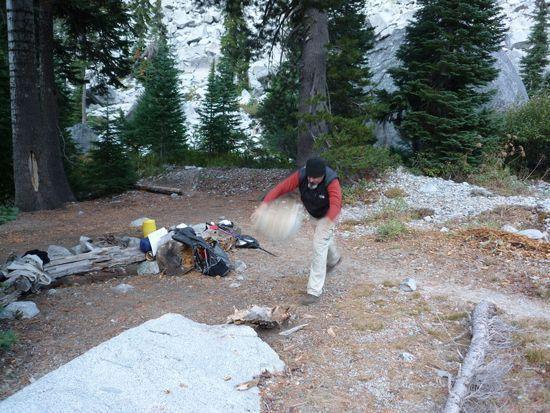
I did that once. The wood was extremely hard and the large rock I threw at it bounced right back at me!
Man, have been to so many high country campsites where every branch w/in a half mile has been sawed or hacked off, every fallen log stripped of branches, ground bare. Bummer. W/o telling other folks what to do, I'd just ask that you look around and think real hard about the impact you're making before you start sawing/hacking. Maybe there's places that are far off the beaten track where it can be done without degrading the experience for those who come next…
So the argument is that finding and chopping a log with a hatchet is less LNT than finding and throwing a big rock, splintering wood everywhere and probably gouging out the ground?
I mean, the OP was asking about firewood. Already he is leaving a trace. (fire) I wasn't suggesting cutting down a tree with a hatchet. They are not made for that. I'm saying is use a saw to cut to length, then hatchet, if you want, to split it.
He's leaving a trace, so LNT shouldn't have come up. But since it did, dragging a big limb through the woods and finding a big rock to bust it up leaves more of a trace than a small saw and a hatchet.
EDIT- as for the high country sites, don't make a fire no matter what (i guess if your life is on the line its ok…)
I brought up LNT because OP was asking about how to cut down a dead tree. That's an obvious No-No.
If the only wood around needs to be cut down. Don't have a fire there. Move on. A small folding saw is probably the most effective. But, if you need to saw it, the wood might not be small enough to burn up completely in a small fire. IME a saw is dead weight. If you can't break it by hand, it's too large. Yeah, a fire is nice,but….
It seems I've opened Pandora's box. This was not the intention. I had heard, saw, or read somewhere that standing wood was the way to go. I guess the source was unreliable.
If you are looking for dry wood in an emergency, a standing
stump may well have what you need. A sturdy knife or folding
saw should get you enough to get a fire started. You may need
pine pitch or vaseline soaked cotton balls for tinder.
Search for starting a fire in wet weather.
As for LNT, there are still some places where there is so much
dead wood on the ground that wood for a campfire will not
be missed. Of course a forest fire started by that campfire or the
soil that is sterilized by that campfire is another issue.
A fire in the Krummholz zone (http://en.wikipedia.org/wiki/Krummholz)is a no no. Anyway if you are in danger of
cold injury, you would be better descending to a more
sheltered spot anyway.
"I guess the source was unreliable."
The people who advocate cutting up standing trees tend to be the same people who are in the business of selling large knives and hachets.
–B.G.–
I had heard, saw, or read somewhere that standing wood was the way to go. I guess the source was unreliable.
Perhaps just out of date. There are two issues here:
*) What makes the best fuel?
*) What is acceptable behavior, both individually and collectively?
Frankly, standing dead wood and the dead branches of trees make the best fuel. They will probably be dry and not rotten. Push over one dead snag, cut it up and split it, and your fuel needs are taken care of. Break of some dead dry lower branches and you'll have a nice cheery fire going in no time. "Dead and down" may well be the poorest quality fuel, because it is apt to be damp and/or rotten.
The more important thing to consider, however, is acceptable behavior. That is affected by several things, such as:
*) What impact, including visual, would you have on others?
*) What impact would there be if everyone who came here did that?
*) What proportion of the dead wood nature produces in a year would you (or everyone collectively) be burning?
When I was growing up I was taught to use standing dead fuel, and that is what I did. A lot fewer people then, and I was in heavily wooded less traveled areas.
Today, most people are traveling in areas where a lot of others also travel — and if everyone did that the result would be (at best) ugly. We have all seen campsites where every lower branch within visual range has been stripped from the trees. We have also seen areas where there are no longer any scenic snags.
Furthermore, much of the travel is in areas where people doing that would overwhelm nature's ability to generate more dead wood. (As one example, that is why fire bans above treeline, regardless of how wet/dry it may be.)
Hence LNT, and the "dead and down" rules — that would have made no sense where/when I grew up, but that make a great deal of sense in the areas many people go today (especially our mountain parks).
The chances are you are not the only person in a huge wilderness, and in an area where nature is producing lots of dead wood every year, so it would be wrong to behave as if you were.
–MV
If you really want a fire, why not use a wood burning stove like the BushBuddy, Bushcooker LT or the Ti-Tri Inferno? The Inferno makes for the best “Campfire” experience in my opinion, while the Bushcooker is Multifuel and the BB is the most fuel efficient.
Using one of these also means you don’t need to carry a hatchet or saw into the outdoors and can use the small dead twigs found on the trail.
Another very light saw (Japanese Flush Cut Saw at 2.6 oz):
http://www.harborfreight.com/japanese-flush-cut-saw-39273.html
I find the best dead wood pieces for my wood-fired Ti-Tri are the diameter of a pencil up to the diameter of my thumb. If those are dead and dry, I can normally break up the lengths by stomping on a stick set against a rock, because I am striving for chunks 2-4 inches long. If the stick is too large or too strong to be broken that way, it isn't going to work so good in the stove.
If no wood is available, I will fire it on alcohol or Esbit.
–B.G.–
I have one similar to this-
http://www.amazon.com/Coghlans-562-Sierra-Saw/dp/B000E3FNB4 mine weighs 1.4 oz. It works really well, especially when you manage to find some good solid dry wood.
I only take it when I'm going somewhere I know they have designated fire pits. I used to carry a fixed blade knife with a full tang which was really good for splitting wood but I let my light side win and have swapped it out for a lighter knife. I'm not willing to give up having a knife(yet).
Become a member to post in the forums.
 A Cult-Classic GMT Reimagined for Everyday WearInspired by the famously bezel-stripped Rolex GMT-Master worn by Marlon Brando in Apocalypse Now, the G2 Apocalypse turns a piece of 1970s film and watch history into a practical everyday GMT. Its restrained 39mm design pairs a Swiss Ronda quartz GMT movement with sapphire crystal, 150 meters of water resistance, strong BGW9 lume, and USA assembly. The result is an accurate, low-maintenance travel watch with a story collectors will immediately recognize.
 © Beartooth Media Group Inc.
 Loading...