I got home on Friday night and, rather than blob in front of the TV, I decided to have a play with the Skins idea. So I rummaged in my pile of recycled plastic bags, and pulled out a large, sturdy shipping (not shopping) bag, and retrieved a cheap foam mat from the attic; conveniently, already chopped to just over half length.
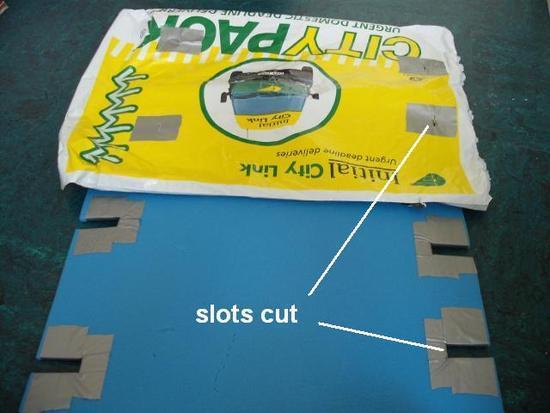
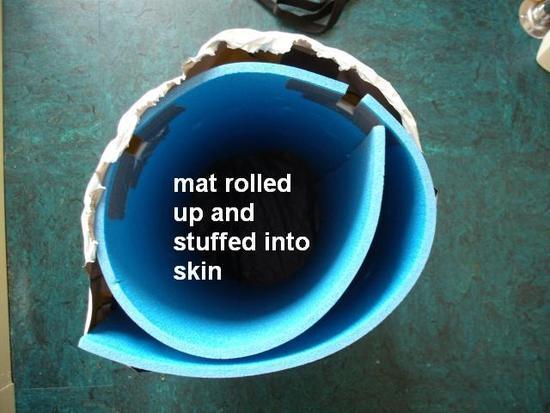
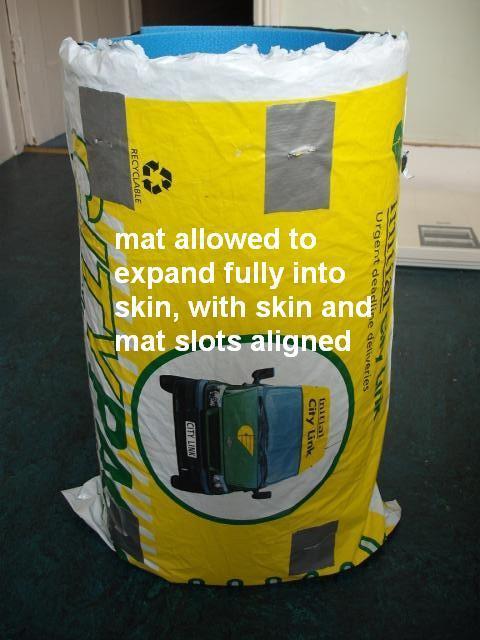
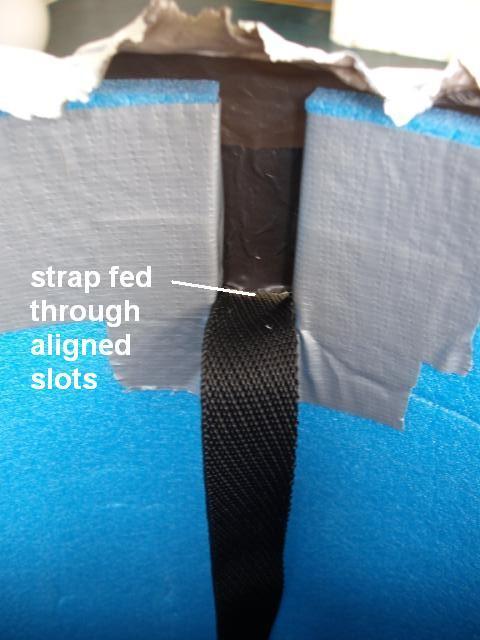
I rolled up the mat and slid it into the bag, and allowed the mat to expand until the bag was tight. I then marked what looked like suitable strap points at top and bottom of the mat (14cm apart at the top, 20cm apart at the bottom). Slots were simply cut with kitchen scissors, and I reinforced the edges with duck tape.
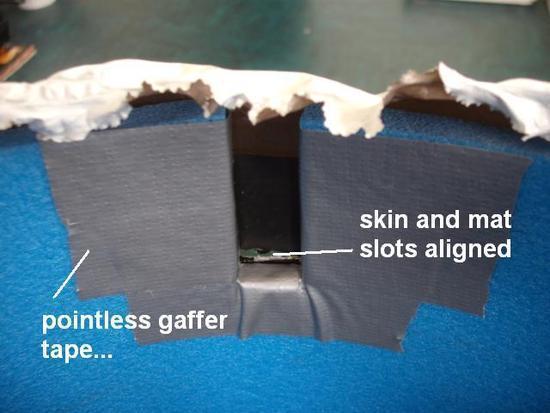
I put the mat back in the bag, and cut simple horizontal slot holes in the bag, that aligned with the inner edge of the slots in the mat.
I dug out some webbing and buckles, and threaded the webbing through the slot in the bag, through the foam slot, up the mat, and out of the other slots. I tied a buckle to the top end of the webbing, and fed the lower end into ladderlock part of the buckle. This is a reasonable approximation to Colin's system, only I didn't use the CF rods.
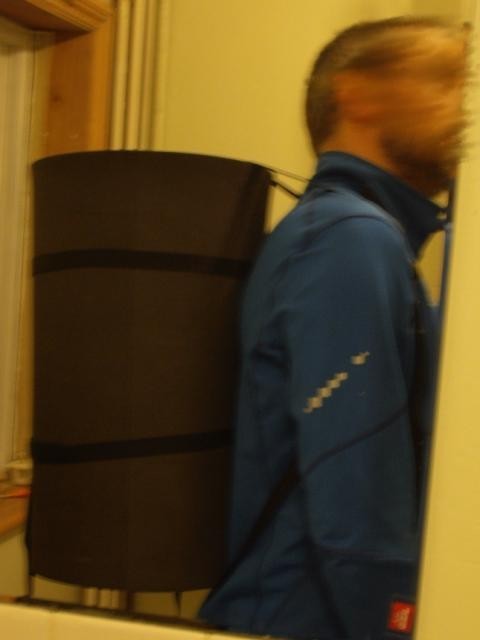
I then put the pack on, and, although it had no load in it, it seemed to sit quite comfortably on my back, with the mat width (50cm) being about the right length for a padded back.
I didn't load it up because it had no load suspension system, and I was simply experimenting with how the Skin and webbing worked.
I think I have the pack assembly figured out:
– Slide the CF rods into the fabric retaining loops, with the load suspension strap in the middle of the top.
– Roll up the mat and slide it into the Skin.
– Allow the mat to expand into the Skin, ensuring that the Skin and mat slots are aligned.
– Slide the CF rod away from one slot, and feed the end of the strap through the Skin and mat slots, and then slide the CF rod through the loop in the end of the strap (far enough to free the slot at the other end.
– Repeat this for the other three strap ends, and ensure the CF rods end up in the centre, so all strap ends are locked.
– Fill your pack as normal, ensuring the suspension strap goes around the load. Fasten & tighten the suspension strap, and close the pack.
– Job done.
I'm now certain that the Skin has four slots in it to allow the straps to reach the CF rods.
The lower end of the strap could use a bandolier-style stitching to create multiple length settings, either for bigger sacks, or to accommodate thicker clothing.
I'm also confident that a top-loading version would work. It might need drain holes…
I don't see why the foam slots need to be cut up to the edge; as far as I can see, they need only be a small slot within the body of the mat, big enough to allow the strap to be threaded through (and be angled to the body suspension points). I think this might ease the problems of mat tearing that Colin encountered.
I thought about reinforcing the mat with a sheet of PET, cut from a large soda bottle. Either permanently fastened to the mat, or as a 'floating element' held in place by the CF rods. This is intended to act as a load spreader.
A cheap polythene bag (e.g. rubble sack) could just about be pressed into service as a Skin, if suitably reinforced with duck tape at the slots. I can envisage making a roll-top closure using a piece of duck tape folded over each side of the bag opening, and a snaplock buckle half attached to each end. Some duck tape could be carried for repairs (but thick polythene bags are pretty robust, and ripstop).
Anyone seen Tyvek bags…?