Topic

Laboratory Grade Ethanol

  • This topic is empty.
Viewing 25 posts - 1 through 25 (of 52 total)
PostedJan 24, 2010 at 6:33 pm

This is my first post…

First, thanks for all the great info everyone has posted: I read pretty much every thread on alcohol stoves and have recently picked up a couple. I'm making the switch from white gas to this.

I just finished a bunch of research on fuels. I, like others, get headaches from Heet. So to me, the whole methanol thing is worrisome…

I can't get Everclear or other types of grain alcohol here in NH. And, there's no one around that sells Sunnyside Denatured Alcohol, so I went looking for lab grade ethanol.

I did find a source and, in the spirit of giving back, I thought I'd share a source.

At Carolina.com, Ethanol 95% is available and right now, at a screaming price compared to other competitors. 500mL (~17oz.) goes for $5.75. I picked up a couple and shipping was quite reasonable at $6.95 to get it to NH.

Looking at the MSDS, it's 95% Ethanol and Methyl Isobutyl Ketone 4%. So, the numbers are similar to SunnySide Denatured Alcohol (95% and 3.6%). It's better than anything I can get locally which is Klean Strip Green (90-100%, <10% Methyl Isobutyl Ketone and <5% Acetic Acid) at Lowe's.

The Methyl Isobutyl Ketone is still scary. The MSDS on this lists the health hazard as moderate…

When ordering from Carolina.com, I didn't have to verify that I was a lab, school, etc. My shipping address is a university address, so maybe it picked up on that, but I used my personal credit card. So, if you're looking to step away from many Denatured Alcohols that are 50%/50%), give this a shot.

Cheers,
-bob

Bob Gross BPL Member
PostedJan 24, 2010 at 6:48 pm

What's wrong with 50%-50%?

The standard denatured alcohol product around here, available from Home Depot and Lowe's, is Klean-Strip S-L-X Denatured Alcohol. It is approximately 50-50. Works good. Lasts a long time.
–B.G.–

PostedJan 24, 2010 at 9:31 pm

BobCh –
Thanks for the info on carolina.com

I'll give a try tomorrow and see what happens.

A Wilson BPL Member
PostedJan 24, 2010 at 9:46 pm

Standard "denatured" alcohol is mostly ethanol. It is "poisoned" with other stuff, usually methanol, to keep it from the liquor market which is heavily regulated and taxed. It's also labeled "marine fuel" or "marine stove fuel" as it's what is legal to have as a fuel on most non-commercial boats.

"Lab grade" would be 100% ethanol, purified of all contaminants. I'm afraid what you bought would still qualify as normal "denatured" alcohol. You have to prove you're a lab to legally obtain true "lab grade," and I don't think it would be any cheaper than Everclear. The feds aren't interested in bootleggers using the stuff.

Tony Beasley BPL Member
PostedJan 24, 2010 at 11:54 pm

>Standard "denatured" alcohol is mostly ethanol. It is "poisoned" with other stuff, usually methanol, to keep it from the liquor market which is heavily regulated and taxed. It's also labeled "marine fuel" or "marine stove fuel" as it's what is legal to have as a fuel on most non-commercial boats.

"Lab grade" would be 100% ethanol, purified of all contaminants. I'm afraid what you bought would still qualify as normal "denatured" alcohol. You have to prove you're a lab to legally obtain true "lab grade," and I don't think it would be any cheaper than Everclear. The feds aren't interested in bootleggers using the stuff.<

95% ethanol is not denatured alcohol, it is called Rectified Ethanol which contains around 5% water, Absolute Ethanol is 99.8% Ethanol but Benzene is used to remove the last of the water. Caution both Absolute and Rectified may contain Benzene.

In the US denatured alcohol is not a standard mix, it can contain as little as 30% ethanol, I have seen some US denatured alcohol MSDS's than contain 96% ethanol which is similar to STD denatured alcohol in Australia.

Check this site out http://www.distill.com/specs/

Tony

A Wilson BPL Member
PostedJan 25, 2010 at 12:29 am

I stand corrected by our better informed chemists. Whatever the definitions, Bob's headache problem may be alleviated by the "purer" mixture. Please let us know if it helps.

Dale Wambaugh BPL Member
PostedJan 25, 2010 at 1:50 am

Interesting! I've been leery of US made denatured alcohol that contains large percentages of methanol. 5% wouldn't concern me as much, but 45-50% is significant. I've had enough chemical exposure over the years and I don't relish the idea of hauling a poisonous chemical or getting it on my skin. I'm not freaked out over it, but I'll jump at the chance to avoid the issue. It has annoyed me that I wasn't able to buy a consistent product and know the actual proportions of the chemicals used.

I ordered a couple bottles of the 95% mix from Carolina.com and had it sent to my work address. From what I read on their site, they won't ship to a residential address– not hard to work around.

PostedJan 25, 2010 at 11:50 am

"95% ethanol is not denatured alcohol, it is called Rectified Ethanol which contains around 5% water, Absolute Ethanol is 99.8% Ethanol but Benzene is used to remove the last of the water. Caution both Absolute and Rectified may contain Benzene."

Tony, can you shed light on the Benzene thing?

I did some more research and wow, there are a ton of 95% ethanol solutions out there with varying additives. Some of the supply houses offer "95% ethanol" and "95% Rectified Ethanol"

As you stated, it looks like it's fairly easy to get all but 5% of the water out. The last 5% requires benzine or something else to get it to absolute alcohol. But when I looked at the MSDS sheets for numerous 95.5%, 99.8% or 99.9% mixes, the only ingredient is Ethyl Alcohol (Ethanol). There's no listing of Benzene. Shouldn't there be if several ppm remain afterwards?

And, can it be that 95% Ethanol is safer than absolute alcohol?

FWIW, at chemical-supermarket.com (Scary name, I know) there is an Ethyl Alcohol that is specially denatured. From their site: It's denatured with Bitrex, which has a low toxicity and is used in cosemetics. This may be safer, but who knows, once it starts being burned. It's also fairly expensive.

Bob Gross BPL Member
PostedJan 25, 2010 at 12:42 pm

"And, can it be that 95% Ethanol is safer than absolute alcohol?"

Safer, for what?

Obviously you won't get 100% pure ethanol, nor do you need it. Either it is drinking ethanol with those safe impurities, or it is denatured in some fashion, which means to poison it so that it can't be safely consumed. You can poison it with things that do not block its role as a fuel, and then you can use other things that will screw up the fuel effectiveness. Take your pick.

Benzine is a particularly nasty chemical, and I hate to contact it in any concentration. Traces of it, I would like to stay away from. I contacted white gasoline that had serious benzine in it, and that gave me a chemical burn that persisted for months.

What's wrong with 50-50 denatured alcohol? I mean, we aren't trying to drink it!
–B.G.–

Roger Caffin BPL Member
PostedJan 25, 2010 at 1:42 pm

First of all, be careful to distinguish between benzine and benzene (spelling).

* Benzine is the same as petroleum ether and is a mix of long-chain hydrocarbons. It is not especially toxic (in context). It is not used to remove water from ethanol.

* Benzene is a carbon ring compound. It is used to remove water from ethanol for many lab grades. It is also a known carcinogen. However, in the ppm range in absolute alcohol it is unlikely to present a danger to humans from either contact or burning. Note – most of it will burn up in the flame as well.

Next, you need to specify which country you are talking about. In most of the world there is tight government regulation over what can be sold as 'denatured alcohol'. In general the stuff is quite safe as a fuel and for human skin contact.

Only in America (afaik) is the term effectively unregulated, such that a manufacturer can put ANYTHING into it. This is known to include some very nasty chemicals which can be quite toxic – and quite frightening. You need to read the particular MSDS very carefully.

So I would say without hesitation that absolute alcohol is safer – certainly in America and probably in any country.

Bitrex – this is one of the most bitter compounds known to man, while being relatively non-toxic in its typical application (eg denaturing alcohol). It is in fact an approved additive for denatured alcohol and other chemicals in most countries around the world. I suspect part of the reason it does not get a huge warning label is that most people spit it out very fast!

I confess I don't really know what the combustion products are however. The MSDS says 'When involved in a fire, this product may produce toxic fumes of carbon oxides and nitrogen oxides', which is not especially bad. It would seem the benzene rings break up in a flame.

Cheers

Marc Penansky BPL Member
PostedJan 25, 2010 at 1:50 pm

I am a Chemical Engineer and I think a few items need to be clarified. My background – I have worked in refineries, olefin crackers, and other chemical plants during my more than 31 years career in the industry.
First of all, "Benzine" is not the same as "Benzene". Benzine is a colloquial term referring to a distillate cut from a refinery of a mix of alkanes between naphtha and kerosene. It is not something I would drink but not nearly as concerning with regard to toxicity as Benzene, which is a singular 6 carbon ring structured (aromatic) chemical that is highly toxic, carcinogenic, and has exposure limit warnings of about 1 part per million or less. Although plant workers in the old days used to wash their hands with it, I would not recommend it to be handled by anyone without protective gear. (Motor gasoline used to have percentage quantities of benzene in it also but does not anymore – but certainly does have components of benzine in it in fairly significant quantities.)
Benzine is just one of the hundreds of denaturants used in denatured alcohol. There are literally hundreds of different formulas for items to be added to ethanol to make it unfit for human consumption. The purity of the ethanol in the SDA (specially denatured alcohol) depends on the amount of denaturant(s) (or contaminants) added. Undenatured alcohol can only be purified by traditional distillation to 95% purity (5 percent water) because water and ethanol form a azeotrope at this concentration. Further purification must be accomplished by extractive distillation or some other separation method.
Sorry to act like the Chemistry professor but a number of items in previous posts could be misleading people and scaring others.

PostedJan 25, 2010 at 2:24 pm

To the OP:

Do-It-Best will ship 5gal container of Sunnyside Denatured for $44 (maybe +tax), to any of their locations that are "Ship-to-Store" franchises in NH.

I searched around Concord, and there are a few locations, so there's probably one near you.

No shipping charge for ship-to-store option.

Alot of people might want to take note of this as an option.

Edit: Here's the link: http://doitbest.com/Varnishes+and+shellacs-Sunnyside+Corp-model-834G5-doitbest-sku-798479.dib

John G BPL Member
PostedJan 25, 2010 at 3:32 pm

So does the danger of breathing while cooking with an alchy stove compare to breathing while cooking with a cannister stove ?

Can anyone compare the carcinigenic dangers of breathing "burned" MSR isobutane/propane exhaust, to breathing the burned exhaust from Yellow Heet, Sunnyside denatured, and Kleenstrip SLX ? (All available in my local area).

Also are any of the above alchohol fuels more dangerous than the others in terms of "bad things" getting absorbed through your skin if a little dribbles down the container when pouring ?

Are any of the alchy fuels above more dangerous than the others in terms of breathing the "unburned" vapors ?

Thanks.

Marc Eldridge BPL Member
PostedJan 25, 2010 at 4:02 pm

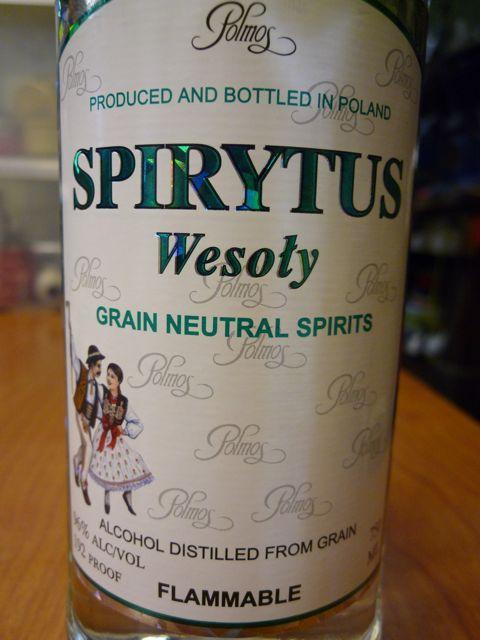
Found the 150 proof Everclear but not the 190. Found this that says it is 96%. Burns good.Ethanol

Bob Gross BPL Member
PostedJan 25, 2010 at 4:42 pm

That would fall into the definition of "white lightning!"
–B.G.–

Roger Caffin BPL Member
PostedJan 25, 2010 at 5:16 pm

> does the danger of breathing while cooking with an alchy stove compare to breathing
> while cooking with a cannister stove
Oh dear – that does depend enormously on the stove! If the canister stove is a known low-CO emitter, then it will in general be safer than an alky stove. For the hazards of the latter, see the article Tony mentions:
http://www.backpackinglight.com/cgi-bin/backpackinglight/alcohol_fuels_part_one.html
and the follow-on:
http://www.backpackinglight.com/cgi-bin/backpackinglight/alcohol_fuels_part_two.html

If the canister stove is a high-CO emitter (eg MSR Reactor) then it becomes a toss-up. See
http://www.backpackinglight.com/cgi-bin/backpackinglight/stoves_tents_carbon_monoxide_pt_3.html
for more information about this.

> burned exhaust from Yellow Heet, Sunnyside denatured, and Kleenstrip SLX ?
Since I don't know exactly what is in any of those I cannot answer that definitively. However, I am fairly sure some of them could prove quite nasty. The articles on alcohol stoves cited above have more info. Tony ended up with a severe hangover after using Isopropyl alcohol.

> Are any of the alchy fuels above more dangerous than the others
Yes.
Methanol is toxic to humans.
Isopropanol is not, but the fumes from burning it can be seriously bad for you. See second cited article.

Cheers

EndoftheTrail BPL Member
PostedJan 25, 2010 at 5:24 pm

@ Bob (or anyone else who knows):

Pray tell what is the practical advantage of 95-100% "lab grade" over 50/50 "store bought" denatured alchol?

Marc Penansky BPL Member
PostedJan 25, 2010 at 5:50 pm

Can anyone compare the carcinigenic dangers of breathing "burned" MSR isobutane/propane exhaust, to breathing the burned exhaust from Yellow Heet, Sunnyside denatured, and Kleenstrip SLX ?

Comparing toxicity of materials is always a tricky business and can lead to gross misunderstandings but I'll give it a go.
I think Roger is on the right track. I think the toxicity of the combustion (or incomplete combustion as the case may be) products of burning the above fuels is a bigger issue than the toxicity of the fuel components themselves.
Isobutane/propane mixtures are common materials of limited toxicity themselves with high vapor pressures and easily combusted. I looked up the other 3 materials:
Sunnyside Denatured is about ~ 86% ethanol, ~ 2% MIK (Methyl Isobutyl Ketone, 3.6% Methanol, ~1% Naphtha, and ~ 1% Ethyl Acetate
Yellow Heet is ~99% Methanol
Kleenstrip SLX is ~1 – 4% MIK and the rest is 50/50 mix of ethanol and methanol

The item that gives me the most concern in the liquid fuels is the MIK. It has a Threshold limit value (TLV) for short term exposure of 75 PPM but it has a very low vapor pressure so not much of it will be in the vapor phase.

Don't get me wrong, all of these materials are toxic in one way or another- even ethanol itself is toxic; you drink enough of it and you will die. But the products that concern me the most are the CO (carbon monoxide) and CO2 (carbon dioxide) that are the products of combustion (along with water) of any hydrocarbon. If you cook inside a confined space, the toxicity of the CO and CO2 will kill you long before the other compounds have any effect on you.
As long as you are not drinking or snorting the liquid fuels, the compounds in them are not likely to have debilitating effects on you short term.
The classic safety and liability clause – Please read, understand, and follow the MSDS before using any chemical. And by the way – Please Don't Sue Me!

Hikin’ Jim BPL Member
PostedJan 25, 2010 at 5:50 pm

Ethanol produces more heat per gram than methanol or "50/50".
Ethanol is safer than methanol in terms of toxicity.
"Lab grade" ethanol does not contain other denaturing agents like Methyl Ethyl Ketone.

PostedJan 25, 2010 at 5:51 pm

i.e. why I posted the info on buying Sunnyside Denatured. It's one of the few brands available that are almost entirely ethanol based.

For instance, CROWN brand denatured is 65-75% Methanol, according to their MSDS.

CROWN brand is what I've found sold at Lowes here.

Klean Strip SLX is about 50/50% Methyl/Ethyl

Supposedly Sunnyside is around the 85.7% Ethyl Alcohol, 1% Ethyl Acetate, 3.6% Methyl Alcohol, 1.9% M-I-K, 0.8 Solvent Naptha…

EndoftheTrail BPL Member
PostedJan 25, 2010 at 5:53 pm

Thanks, Jim for your explanations.

Now, I assume folks have done extensive comparison tests between pure or near-pure lab-grade ethanol vs. 50/20 mix SLX? So what are the results? How much faster per pint of water boiled? And how much fuel or weight savings per pint of water boiled?

PostedJan 25, 2010 at 5:58 pm

There's also a distinction to be made from "Short term toxicity danger" and "Long Term Toxicity danger" no?

CO/CO2 exposure have major risks in short term concentration, but some chemicals can cause major long term health risks, correct?

I'm not saying I'm an expert on this, just wanted to point out an angle.

Also, in regards to alcohol stoves, and other fuel stoves.. Fuel efficiency affects toxicity, as per my understanding, as more efficient stoves will burn toxic items off, causing less hazard, than less efficient ones, no?

PostedJan 25, 2010 at 6:01 pm

All right, I'm on a roll..

Anecdotal tests(i.e. no scientific data, just observation): 95% un-tainted ethanol gives me the best results. Everclear works great, and can be multiple use. The downside is the cost.

Otherwise, the higher the Ethyl content, the better from what I've seen. That may just be because of all the crazy denaturing mixes here in the USA.

I use sunnyside when I can't use PGA(Everclear or similar).

Coin Page BPL Member
PostedJan 25, 2010 at 6:59 pm

I use a health care product with Alcohol SDA 38B 70%. Turns out this is a type of Special Denatured Alcohol: ethanol denatured with 1% menthol. So, as above, denatured, or special denatured, can mean almost anything. (It burns poorly, but with a nice scent.)

Viewing 25 posts - 1 through 25 (of 52 total)
Loading...