Topic

Best Stove for use with Puncture Canister

  • This topic is empty.
Viewing 25 posts - 76 through 100 (of 117 total)
Brad Groves BPL Member
PostedOct 15, 2009 at 8:32 am

Just for the record… Roger made some logically false conclusions about liquid fuel stove inefficiencies. Specifically, users not switching stoves off… What?? I don't consider operator error to be a valid point of inefficiency. I bring my water to a boil, stir in food, and close the valve of the stove, allowing the remainder of the fuel in the line to burn off. I use a pot large enough to boil one batch of water; if I want a hot beverage with dinner, I decant the water into my mug. Over 15 years of using liquid fuel stoves and I never ran the stoves without something on them. Further, in terms of priming I use roughly 2ml of fuel; for those of you in the States, that's about 0.06 fluid ounces.

I now use a Caldera/Ti-Tri almost exclusively (save for winter), and it is quite a weight-efficient system, but outside the scope here…
Brad Groves BPL Member
PostedOct 15, 2009 at 8:40 am

I'm sorry for the sequential posts! It was just easier than responding to specifics this time…

I recently had the opportunity to speak with an EPA scientist who deals primarily with fuels. We got into a discussion about white gas, and whether or not the super-premium stuff was worth the extra money. Specifically, buy the $10/quart or the $10/gallon from a hardware. One of the beliefs I've operated on was that, like unleaded petrol, old white gas will gel up and get funky. If you're going to let a chainsaw, or lawnmower, etc sit for a season, you run all the fuel through the system, or add some stabilizer, whatever. So I had switched to using the smaller premium fuels, reasoning that the gallons would go bad before I could use them.

The scientist (who works daily and exclusively with fuels) politely suggested that my view was wrong. In actuality, he said, the hydrocarbon chains or whatever of the two fuels are different enough that the white gas doesn't go bad. Something about the higher refinement, maybe? Different saturation? I don't recall all the specifics. But basically, whereas unleaded can go bad, white gas basically doesn't.

EDIT: One other point… can't remember now where I came across it, but I remember reading that white gas put in plastic will basically pull some of the plastic from the bottle into solution with the white gas. (I know I've come across this in several sources, but where?!) The bottle might still hold fluid, but some of the plastic ends up in the fuel… not happy if you're running it through fuel lines…

Hikin’ Jim BPL Member
PostedOct 15, 2009 at 10:29 am

I remember reading that white gas put in plastic will basically pull some of the plastic from the bottle into solution with the white gas. (I know I've come across this in several sources, but where?!) The bottle might still hold fluid, but some of the plastic ends up in the fuel… not happy if you're running it through fuel lines…

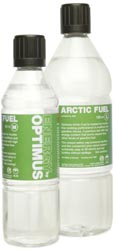
Optimus sells it's highest grade fuel in PET bottles. Perhaps some plastic does go into the fuel, but if it's actually sold in PET bottles, it would seem that the amount of plastic that gets into the fuel is immaterial.

Brad Groves BPL Member
PostedOct 15, 2009 at 10:41 am

Interesting stuff, Jim- Thanks!

Not sure why they're the only ones who sell it that way… Perhaps theirs is actually a somewhat different chemical structure? Seems that everyone would sell in PET bottles otherwise, loads cheaper for the containers, I'd think. Maybe some difference in the actual plastic composition? Ah well. Given that it looks like Hartley would go through a liter of fuel in 3 days, but perhaps 3 days between resupplies, perhaps a 33-oz fuel bottle would suffice, anyway?

Anyone else have insight into the white gas/plastic bottle thing?

PostedOct 15, 2009 at 11:33 am

So far, mostly walked in places where fuel cartrides are frequently availabe. Brian, based on Roger's comparison with the cannister, I arrived that same quantity. I will have to change my habits! Thanks everyone.

Hikin’ Jim BPL Member
PostedOct 15, 2009 at 1:13 pm

Not sure why they're the only ones who sell it that way… Perhaps theirs is actually a somewhat different chemical structure? Seems that everyone would sell in PET bottles otherwise, loads cheaper for the containers, I'd think. Maybe some difference in the actual plastic composition?

Well, actually…

Brad Groves BPL Member
PostedOct 15, 2009 at 1:40 pm

Okay, Jim. I stand corrected. I think it's safe to say that you've found the exceptions. In all my years of buying and selling the stuff, I've never seen it in plastic. But apparently some companies do sell it that way some of the time. The question, then, is why don't all companies sell it that way all of the time?

(Edit: I can be a smart-aleck too: note that the MSR bottles are not 11, 20, and 30 oz as noted, but 22 and 33 oz respectively. Does it really matter? No. We all know what you mean ;P)

Hikin’ Jim BPL Member
PostedOct 15, 2009 at 2:05 pm

Jim, what exactly is in that bottle?

Both of the bottles I’ve posted pics of contain what is commonly called “white gas” in the US. In other places it’s called Shellite, Panel Wipe, Aspen, Naptha, and God only knows what else. The most common form in the US is Coleman Fuel, but there’s also Crown Camp Fuel, MSR Super Fuel, and I believe Ozark brand white gas. Basically white gas is a refined form of fuel intended for camp stoves and lanterns.

Overseas, particularly in less developed countries, white gas is hard if not impossible to find. Typically unleaded gasoline, kerosene (aka paraffin in the UK), diesel, and aviation fuel are used as stove fuels in such countries. Liquid fuel stoves will list which fuels can be burned for that stove, but it’s generally best to burn white gas if you can get it. I believe jet fuel is the choice of last resort. Zen Stoves has a good write up on the various types of fuels that may be burned in stoves.

Roger’s site also has excellent information. Read his site, and you’ll understand why Roger is the stove guru of BPL.

Some PET is coated.

I wouldn’t doubt it. However, regular, everyday PET bottles should work short term.

Brad Groves BPL Member
PostedOct 15, 2009 at 2:16 pm

Hah! I was just going to post a link to zenstoves.

2 points of interest re: containers-

-"Ideally, petrol fuel should be stored in an airtight metal canister."

-"Additional fuel beyond what is in your main tank can be stored in other metal cans or even in certain plastic bottles."

So, some plastics, but perhaps not others? My earlier question stands: why wouldn't everyone just sell white gas in plastic bottles?

I'm interested, because if there truly are no problems, then I could just take a small aluminum bottle in winter and supplement fuel with a "nearly weightless" plastic bottle. But as I think about this, I haven't seen naptha sold in plastic, either… only in metal cans. Maybe I just haven't paid attention to different bottlings of naptha at the hardware…

Some really interesting stuff on zenstoves re: the actual stuff we variably call white gas.

http://zenstoves.net/Petrol.htm

Hikin’ Jim BPL Member
PostedOct 15, 2009 at 2:23 pm

why don't all companies sell it that way all of the time?

I suspect it's marketing and not materials science that is the driving force. I've been using Coleman fuel in the metal 1 gal. cans since the 60's. Plastic? Hunh? At least in the US, I think people expect fuel to be in a metal can, and that's what they sell.

I've only seen white gas sold in PET bottles on European and Australian websites. My guess is that Europeans and Australians don't have the long Coleman tradition that the US has and don't have the expectation that the fuel should come in metal cans.

I think materials prices may be changing the game here in the US. I notice Coleman's latest offering, "Premium Blend" Coleman fuel is offered in plastic container. I think the container is probably fluoridated HDPE rather than simple PET, but it is plastic, a break with a long standing Coleman tradition.

Oh, buy the way, did I mention that I'm a stove geek. You probably couldn't tell.

PostedOct 15, 2009 at 2:46 pm

I would imagine the packaging of flammable or otherwise hazardous materials for sale comes under the domain of agencies like the EPA, FDA, OSHA, etc in the US depending on the substance. This is the sort of regulation that one could expect to vary from country to country (suspect there would be some uniformity in the EU).

Hikin’ Jim BPL Member
PostedOct 15, 2009 at 6:19 pm

I would imagine the packaging of flammable or otherwise hazardous materials for sale comes under the domain of agencies like the EPA, FDA, OSHA, etc in the US depending on the substance. This is the sort of regulation that one could expect to vary from country to country (suspect there would be some uniformity in the EU).

Good point.

I think the bottom line for your trip is: do I bring a big aluminum bottle (or bottles if you really want to be able to carry a lot of fuel) or a little aluminum bottle supplemented by PET water bottles?

Roger Caffin BPL Member
PostedOct 15, 2009 at 6:44 pm

> I've only seen white gas sold in PET bottles on European and Australian websites.
> My guess is that Europeans and Australians don't have the long Coleman tradition that
> the US has and don't have the expectation that the fuel should come in metal cans.

Forgive me, but saying that we don't have the American Tort Lawyers Association might be more to the point.

Actually, nylon jerry cans are legal in Oz.

Cheers
PS: we buy Coleman fuel in plastic bottles here.

Hikin’ Jim BPL Member
PostedOct 16, 2009 at 1:25 pm

How cold will the wx be? What elevation(s) will you be trekking at? You're there in late Oct/early Nov? Might be a tad chilly; dunno. Maybe cut back on the 5 gallons/day water boiled ;) but don't eliminate entirely. Particularly if you're slender, hot meals and drinks can really be a life saver. Just a thought.

PostedOct 16, 2009 at 4:46 pm

"Maybe cut back on the 5 gallons/day water boiled ;)"

I missed something somewhere in 5 pages of posts, Jim. Is B.C. really gonna boil 5 gallons of water/day? Or does the winking smiley face make that a joke? Just curious.

Brad Groves BPL Member
PostedOct 17, 2009 at 7:05 am

5 gallons, 6 liters… isn't that about the same??? ;P

Although some people do choose to go no-cook, I don't think most of us would make that recommendation. Hot food and drink are fine and encouraged! But you kinda need to be cognizant of how much fuel you're using. Even if you did a full liter of boiled water each for breakfast and dinner, that'd still cut your planned-on consumption by ~65%.

Brad Groves BPL Member
PostedOct 17, 2009 at 2:25 pm

Ohhhh… my…..

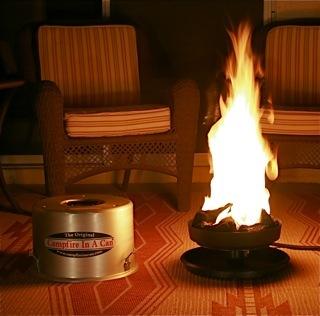
from the campfire in a can website:

"Compact light weight portable size, Dia.14.75" x H 10.25" so you can have a campfire anywhere you want easily. It’s easy to carry at only 14.6 lbs."

PostedOct 17, 2009 at 3:34 pm

"Yes, Tom, A ;) means I'm teasing".

I should'a known. What's the emoticon for red face? ;}

Viewing 25 posts - 76 through 100 (of 117 total)
Loading...