


see next post
Topic
Become a member to post in the forums.
see next post
here is a photo of the test rig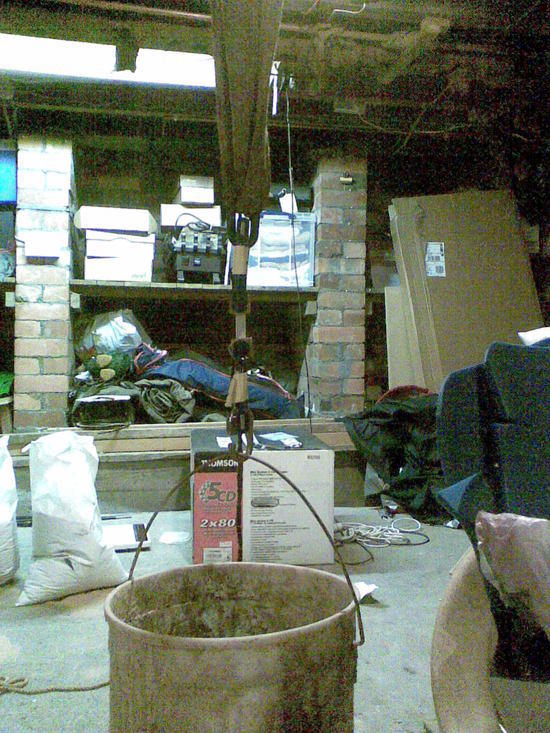
here is a closeup. The test piece is a control it is not glued it is 3" x 1" with the edges folded to the middle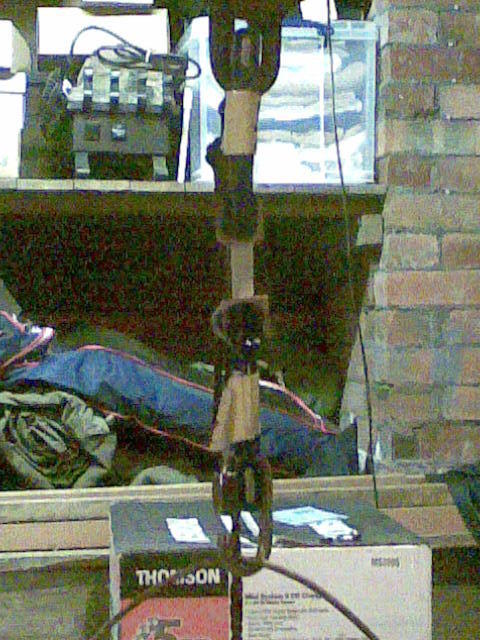
here is a side view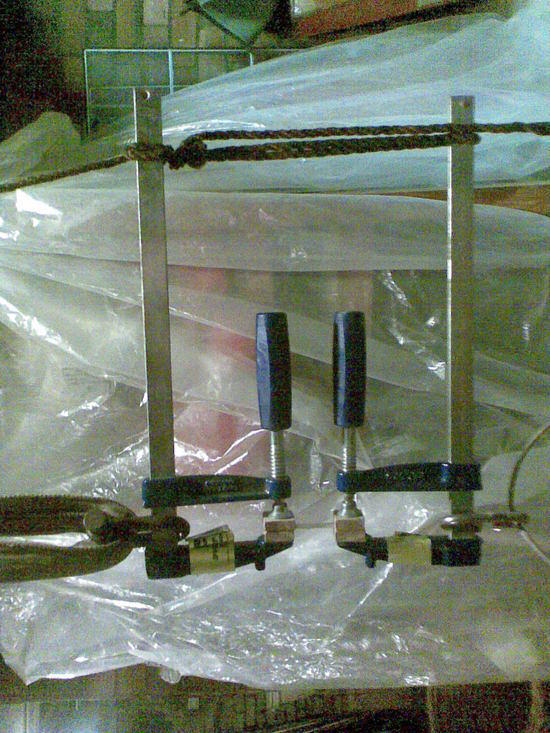
I have pasted my first results here:
completed my tensile tests of cuben to cuben glued with hysol U09fl, Aquaseal and Aquaseal 4 parts cotol 240 1 part. All glued at room temperature for 44 hours.
They will have to be repeated because the glue was stronger than the cuben.
I tested the hysol first. I tried hard to get the clamps of my set up all even so that the 25mm glued square was evenly stressed . I loaded slowly with sand in the bucket over about 10 minutes and failure happened at 27.5 kilo. Failure was along the bottom edge of the top wooden square clamp washers. I had rounded the edge of these. The glued area was intact.
I tried the Aquaseal and on reaching 29.5 kilo I stopped, without failure. Similarly the Aquaseal plus Cotol took 29.5 kilo without failure.
Looking up the 25 gram per metre breen cuben on the cubic tech website it should take 105 pounds per inch. It in fact took 60.5 pounds over an inch width of test 58% of optimum. I am pretty sure the spectra threads broke one after another from the sound they made. So I must have loaded the sample more heavily on one edge.
The hysol data sheet I saw gave lapshear strength of from one to 12.5 Newtons per sq.mm (1.5 nylon, 10 polycarbonate). The hysol glue on the sample survived 27.5 kilogram force= 270 Newtons over 25 x 25 mm . That is 0.43 Newtons per sq.mm. I tried a peel test just by pulling with my fingers. I thought the hysol was best and the aquaseal plus Cotol was worst . With The Aquaseal the glue failed not the fabric. The hysol first the glue failed then the fabric failed between the 2 spectra plys.
NEW TESTS
I tested these with a 6mm overlap on a 25mm wide testpiece.With 2 day old samples glued under weights at 15 to 20 degree C.
Aquaseal took 13 kilo Aquaseal plus Cotol took 13.5 kilo. These amount to 0.88 KNewton per sq mm. Hysol the first sample failed at 9 kilo by pulling the glue area off the vertical specra threads. I was not happy with this test as it failed as I knocked the bucket while adding sand and caused rotation which twisted the sample so I repeated it, this time the hysol was 4 day old glued under weights at similar temperatures. It failed at 8 kilo by failure of the glue with no damage to the fabric. I wonder if I am not mixing the 2 parts well enough because the glue still seemed tacky. The instruction is: mix equal amounts for 15 seconds after the colour is uniform. My 2 parts were pretty equal although one part is more liquid than the other, both are transparent so I do not get a colour change but I perhaps did not mix long enough.
I also tested a new control sample. I cut a 75mm x 25mm cuben piece and folded the edges to the middle to make 75 x 13mm. I tested that and it took 32.5 Kilo which is 68% of the Cubic tech datasheet shear stregth of 105 pounds per inch. Folding the edges does spread the asymmetric load of my testing. If I was starting again I would test all samples like this.
I will test another hysol sample mixed for minutes, an evostic timebond glue and a stitched then aquaseal sample.
—
INTERIM CONCLUSIONS
—
Error my bathroom scales only measure in half kilo. my measurement of glue overlap and sample width must be +/- half a mm. total +/-12%.
Testing small raw edge samples seems to weaken the cuben by maybe 40%.
So I cannot tell between Aquaseal and Aquaseal plus Cotol. Hysol appears weaker than Aquaseal but more testing should be done. If you treble the 6mm glue line I used you should get up to the strength of the unglued 25 gram /sqm cuben I was trialling. I recommend 3/4" 18mm of glue minimum for say a ridgeline of 25 gram /sq.mm cuben.
By extrapolation the CT.1K.08 cuben at 68 pounds /inch could be ok at 1/2" 12mm and the CT0.3K.08 at 35 pounds might be OK at 6mm but it would be just as easy to go for 1/2"
I will post this on the wiki.
To put the trial in perpective if you used a 6mm glue width aquaseal sample of 1" wide cuben to try and pull a tent peg out of the ground, at 13 kilo of pull the tent peg would mostly go first. The ultimate strength 25 gram/sq.m cuben tarp would need very big pegs.
I tested 3 more samples last night.
Evostick timebond a contact adhesive which allows a bit of slip adjustment. I had bit more overlap than designed. Allowing for this it failed at one glue/ cuben surface damging about 1/4 of the cuben face at one edge, at 9 kilo. that is 0.59 Kilo Newtons per sq. mm. There seems no advantage in using this glue with cuben, unless it is what you have. It is adequate just allow an inch of seam with 25 gram cuben.
I tested another sample of hysol U 09fl and this one was not at all tacky. I therefore believe that I did not mix the 2 parts well enough in some previous tests. The test remnants of the last tests are still tacky. This hysol sample took 24.5 kilo. This is 1.6 Kilo Newtons per sq.mm. This is in the range Loctite show. The failure was totally in the cuben from one edge of the glue area away from the glue area. With this cuben 12mm 1/2" seam width of hysol is enough if properly mixed.
I tested a 1" sample of the main seam bond I intend to use on my tarp tent. 6 stitch per inch sewn once outside to outside then opened up and a glue seam of 20mm glued down with Aquaseal. This took 31.5 kilo which is 66% of the cubic tech figure. The failure was away from the glue area following the stitches for half the distance then wandering away from the glue to the edge of the wooden clamp washer. As plain unglued samples in the same rig took only one kilo more it appears that long stitches do cause a stress concentration but not a very debilitating one. It is probable that the sewing needle never breaks a spectra thread.
I intend to use Aquaseal rather than hysol for the long seams of my tent, although hysol is better, it is more expensive and hard to get. I intend to sew the seams at least once for location anyway and it is simpler to add another 6-8mm of seam width than use the expensive glue.
Apparently silnet is recommended to glue cuben. For completeness I will test a sample sometime. It is not a priority for me though, if I need to attach cuben to a silnylon ground sheet I will need to know.
Derek,
Thank you VERY much for these tests. I'm sitting on 5.4 meters of cuben while dithering over how to join the seams. Your info is helpful.
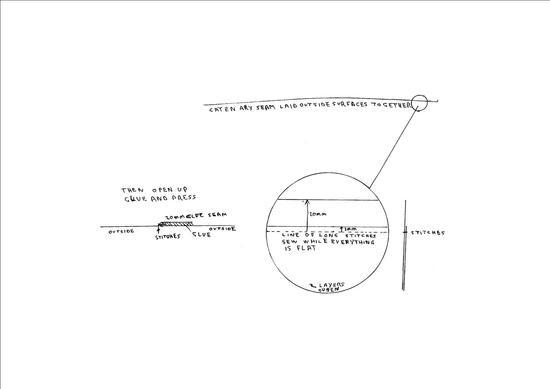
I'm having trouble visualizing what you intend to use for the main seam. Would you be willing to post a drawing?
Also, are you applying pressure while the hysol is curing?
I think I have a local retail outlet for Loctite products within walkig distance so I might go the hysol way.
Hi Jim,
Steve Evans twisted my arm to get those photos of the test rig. It took a bit of reading manuals to understand how to use wireless connections to down load from my phone camera to a laptop before I could do it. Having done it once there will be photos all over BPL! I can make a drawing and scan it and upload it. It may take me some time.
I have always applied pressure to glue. I know steve does not bother. The data says the optimum glue line is 9 mil, that is about as thin as you can get. My feeling is that thicker glue lines will not be much weaker. I intend to post pictures of the dry bag I just made with hysol and no stitching. I made a former so I could get the glue properly applied and pressed while drying. I had glued the cuben into a tube and wanted to glue on an octagonal rectagular bottom. The former made it easier for me.
I only got the hysol by steve posting some to me. I would probably use hysol if it was easily avaialable. I may well use hysol for stress concentrations like tie outs
hi Jim, here is an image of the seam I described if it is not clear ask again
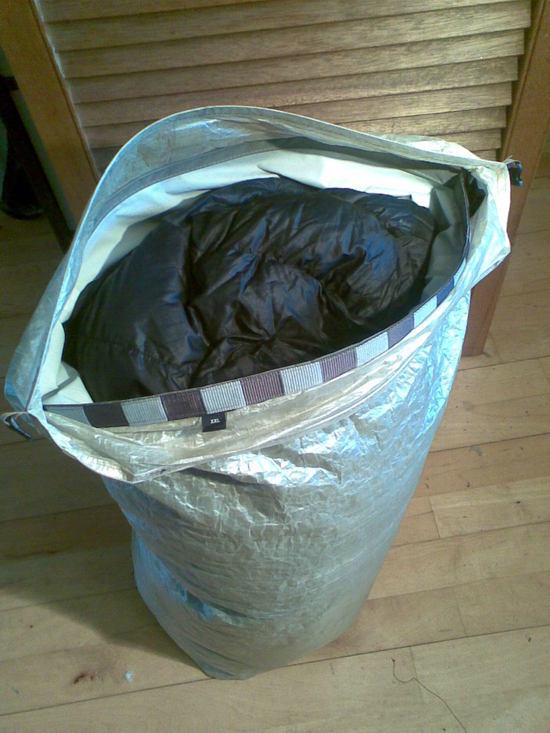
here are pictures of my breen cuben 25 gram/sqm CT.2k.08 dry bag.It has a volume of around 44 litres and weighs 31 grams. I intend to use it as a rucksack liner and later as the largest dry bag to be carried in my future ultra light exterior framed pack frame.
The first picture shows a "light" new version XXL 40 litre exped dry bag weight 109 grams stuffed with a double sleeping bag inside my new dry sack. You can just see the XXL label
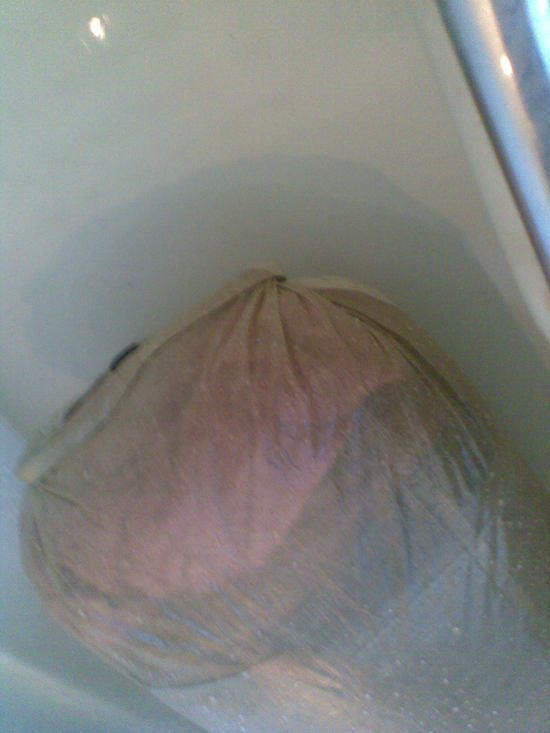
The next picture is the pack with the exped bag closed with 3 rolls of its large mouth system, then a pair of heavy shoes (that is to make the dry bag float open end down) and a dry towel put in then my narrow canoe closure system rolled 3 times. The photo is in my bath. You can just see a lighter line to the right of the canoe closure system which is the waterline. The part of the closure and cuben underwater looks whiter. I left it in there for 3 minutes. When opened the towel was dry
.
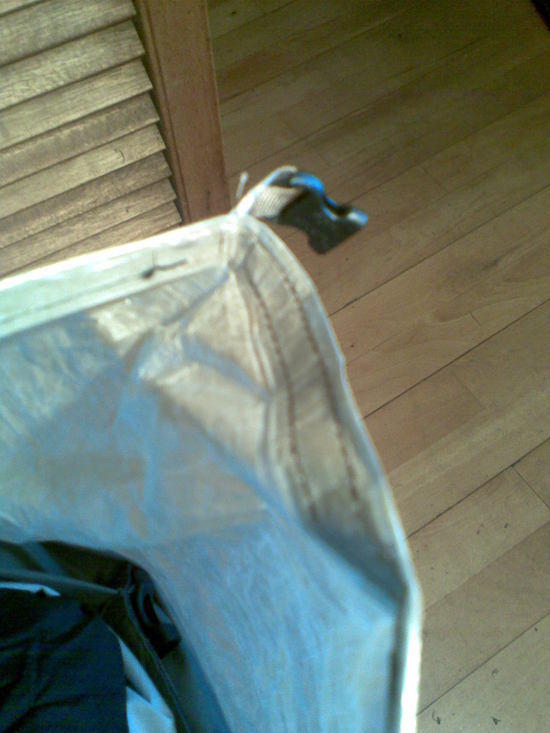
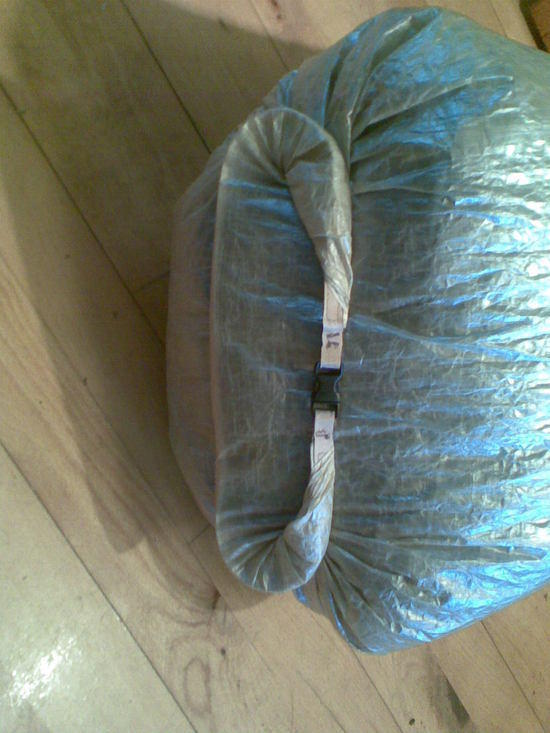
The next image is a closeup of the canoe closure buckle. There is a 12mm strip of 0.5mm HDPE sheet in one side of the bag, in the photo that is the top right side.I had to sew 2 pieces together to get the length as I got it from an A4 concertina file case. The other side has an incomplete strip as I felt only the middle was needed on the second side. I hemmed the cuben around the HDPE and machine stitched through the plastic. I then attached 10mm nylon ribbon from the ends of both bits of plastic, completing the hemming to the ends, on the lower left side the 2 rows of stitching are hemming the edges of the ribbon, and attached a 10mm buckle The cuben weighed 23 grams glued. The HDPE was 6 grams, the buckle just over 1 gram. The 32cm of ribbon less than 1 gram total 31 gram.
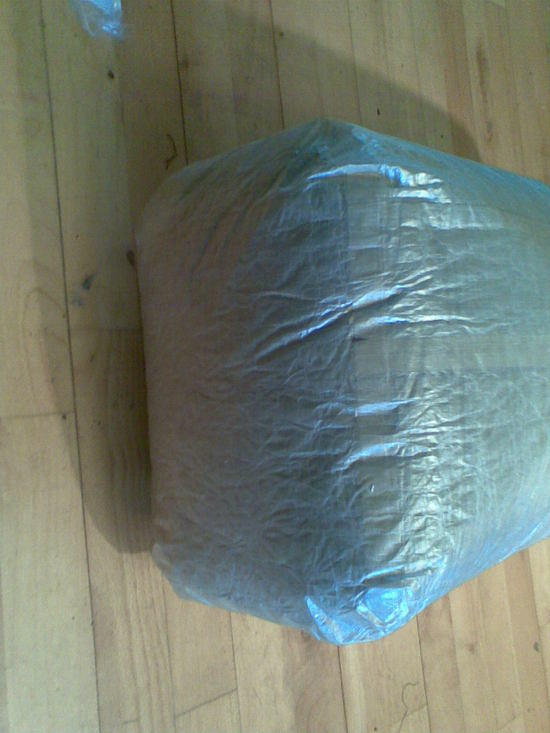
The next image is the bottom. To make the bag the main piece of cuben was 750mm (height) by 1040mm (circumference)
I glued it into a tube with hysol U09fl using poly bin liners to stop things gluing that should'nt. I weighted it until set. I made an octagonal plywood former of the same perimeter. Set it on a column of blocks, covered it with a bin liner. Set a rectangle of cuben 320 x 260 with the corners cut off to the same template as the ply, set the tube round it glued the end of the tube and the edges of the bottom folded the tube over and weighted until set.
You can see 20mm glued seams that make the tube and that glue in the octagon bottom.
The next image is the canoe closure closed. bar tacking of the ribbon loops holding the mini buckle can be seen
.
A detail of the octagon corner fold
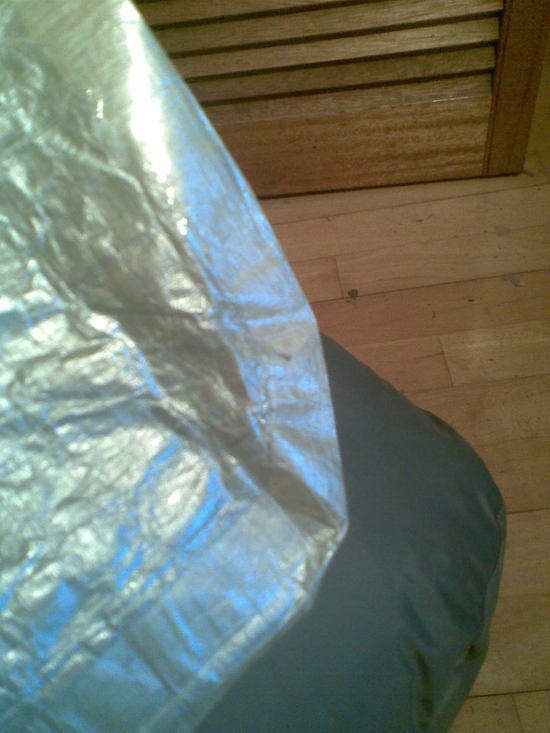
After 1 use my dry bag has a pin hole. It is in the bottom. I do not know how I got it. I was not aware of being rough. I found it by filling the bottom with water, as another test. I may have pierced it whilst making and it did not show up by my floating test. I intend to mend it with a dot of Aquaseal and see if there are more. Such a tiny hole would not be a problem in a tarp or tent but it matters in a dry bag.

Derek my friend, you have out done yourself. That thing is amazing. I'm totally going to make one for my Arctic Drypack…just need to find the time!
Derek,
Can you tell me specifically which aquaseal you are using? There is a number of different kinds.
Thanks!
On the tube it says McNett Aquasure urethane repair adhesive and sealant 250ml.
I am afraid that seemed to be referred to interchangably with Aquaseal on different vendors websites
Source for small quantity of adhesive:

Nice link for ordering small quantities of Hysoil. Can anyone offer me a guess of how many tubes of Hysoil I will need to bond an entire fly for a 2 person tent?
Removed…
I bought 1 roll of tape from them a while back and had it shipped next day. They charged me $60 which is about 500% profit off shipping. They don't show shipping upon checkout which is a scam all in itself. Mc-Master Carr is a better place to buy from
+1 on McMaster-Carr.
Amazing amount of stuff.
Real world shipping, and sometimes on smalls – No shipping!
Pretty good search engine.
Incredible folks on the phone.
Lawson,
I'm interested in hearing more about this problem you have observed with Hysol. I have used hysol for several cuben projects, and I have never observed that it produces hard spots. I have been using the Hysol U09lv (the low viscosity formula). Sparing application of the adhesive and clamping tightly during curing (and wiping away the squeezed-out excess) gives an extremely thin (probably a couple of microns)film of adhesive at the bonding interface. It seems to me that one would need a pretty heavy lump of Hysol between the mating pieces of cuben to get a hard spot. If you're clamping the pieces that shouldn't happen.
Removed….
Lawson,
I'm glad you did some testing and the results are interesting, but you really need to rewrite the above statement to CLEARLY state what your findings are. You've obviously put some work into this, but you've just given us a broad conclusion of the results we will see. Using words like "will" and "not" are very powerful, so I'm gonna to pick it apart a bit….just for fun. :)
To simply say This test shows that Hysol actually weakens the material. Not a big deal considering cuben's strength but the bond is not stronger then the cuben. is actually an untrue statement. This statement says that no matter what type of cuben fiber you use, not matter what orientation you have the material in, no matter how big your bonding area is, the bond will be weaker then the material.
You might be right, but you owe it to the people who will find this thread, and belive you word for word, to be a bit more specific.
What weight cuben fiber did you use?
What was the specified load vs the load at which the cuben fiber broke?
Why "will" the cuben fiber break at 85% of what the manufacturer claims? Is this true for all cuben fiber?
How do you know it weakened the material? Did the hysol "eat" away at the material or was it absorbed into it? How do you know this?
After bonding, why "will" it fail at 50%? Where did you come up with this number?
How come the bond is "not" stronger then the cuben. No bond will ever be stronger then cuben fiber?
>>"What weight cuben fiber did you use?" CT1K.08, CT2K.08, CT5K.08, and CT5K1.8..
>>"What was the specified load vs the load at which the cuben fiber broke?"" Around 85%..Could be testing methods but it seemed very consistent at 85% of what cubic tech specified. I think Derek had similar results…
>>"Why "will" the cuben fiber break at 85% of what the manufacturer claims?"" Not sure…It could be my testing methods..
>>"Is this true for all cuben fiber?" It was consistent with the materials I tested..
>>"How do you know it weakened the material? Easy… I tested the material with seams and without seams and the material failed with less weight using a Hysol seam.. 85% compared to about 50% of what cubic tech specified.. The hysol seam always 100% of the time failed right at the edge of the seam..
>>"Did the hysol "eat" away at the material or was it absorbed into it? It does a great job adhering to the cuben..
>>"How do you know this?" I don't.. My answer is a lot of observation plus a little bit speculation..
>>"After bonding, why "will" it fail at 50%?" Not sure why its about 50% but I think it creates a hard spot..
>>" Where did you come up with this number?" I did roughly 100 tests and averaged the results…
>>"How come the bond is "not" stronger then the cuben." I don't think any bond will ever be stronger then the cuben fiber because the bond adheres to the surface and not the treads of Dyneema..
>>"No bond will ever be stronger then cuben fiber?" I don't think its possible.. The film is weaker then the Dyneema and even so a bond isn't continuous so there were always be variables….
I will explain further..
Lets examine your options.
1. Use an adhesive
2. Use a two sided transfer tape
3. Sew
4. Use a two sided tape and sew with a really long stitch..
1. An adhesive is the strongest in peel and in lap sheer but there are only a hand full of adhesives that work great and most of them are not available in small quantities.. The most common adhesive is Hysol and it works well but ITS NOT STRONGER THEN THE MATERIAL… It gives the illusion that it is because when a failure occurs its with the material but the Hysol actually weakens the material. I don't know why but I think it creates a hard spot.. So say you are using CT2K.08 which has 105lbs/in break strenght the failure in my testing usually occurred around 55lbs/inch leaving the material usable and repairable minus seam width..
2.Two sided transfer tapes are probably the easiest to apply and offer good lap sheer but weak peal strengths.. The most common one used is 3M 9485PC. The key to tapes are with the application… For maximum bond strength the surface should be thoroughly cleaned and dried. Typical cleaning solvents are heptane or isopropyl alcohol. Bond strength can also be improved with firm application of pressure and moderate heat…No more then 130°F which will cause the adhesive to develop intimate contact with the bonding surfaces. Using 3M 9485PC with CT2K.08 the failure occurred around 35 lbs/inch due to lap sheer seam failure but leaves the material usable and repairable….
3. Sewing alone depends entirely on stitch type, length and placement. The seam is strong in peel but weak in lap sheer. The average failure was around 30 lbs/inch due to the stitches ripping the material apart leaving the ends of the material useless and not repairable.
4. Using a two sided transfer tape like 3M 9485PC and sewing is probably the second strongest bond as long as you use good stitch placement and long stitches.. It provides good peel and good lap sheer.. The failure occurred around 40lbs/inch due to the stitches weakening the material. The failure was very inconsistent but the material always ripped apart leaving the ends of the material useless and not repairable..
In conclusion all methods of construction work…some better then others.
Lawson, nice work, now we are getting somewhere…hehehe..
How do you know it weakened the material? Easy… I tested the material with seams and without seams and the material failed with less weight using a Hysol seam.. 85% compared to about 50% of what cubic tech specified.. The hysol seam always 100% of the time failed right at the edge of the seam
This is very interesting. Just so I understand, you had 3 types of runs.
1) Single piece of cuben fiber
2) 2 pieces of cuben fiber bonded with a seam
3) Single piece of cuben fiber with a section "painted" with the Hysol
Both #2 and #3 broke at a much lower load (~50% of manufacturers specifications) than #1?
Edit: I just reread your statement and I don't think you did run #3 – but correct me if I am wrong. Run #3 would be a good way to see if the Hysol is indeed weakening the material. My failures are always at the seam, but I figured it was just the concentration of stresses on the small area next to the bonded seam (ie. the weakest part).
mostly speculation but… I bet that the weakening is a result of stress concentration, not fabric weakening b/c of bonding agent. I would like to see someone preform #3 in Steve's post above.
Also, Lawson, I really appreciate the testing and your post of the results.
Also, Lawson, I really appreciate the testing and your post of the results.
James comments +1!
I really appreciate it aswell, posting the results is great for the DIY community. I hope my comments were read knowing that I'm an UL nerdball, and I like to get into the nitty gritty numbers and stuff…you guys must know me by now :)
Become a member to post in the forums.
 New Ultralight GearSee the latest releases in ultralight cottage-brand gear from small makers.
 © Beartooth Media Group Inc.
 Loading...