> That is very encouraging about the JRB Nest. I have the No Sniveller Long and would expect it to preform the same.
YMMV, so it’s certainly worth testing yourself. But I’m really impressed with the performance of the Nest, and your No Sniveler is built just the same. I wish now I’d spent the next night out after test #3; it went to -10F and I would like to know if the Nest alone would have been sufficient. (The three layers of clothing are also crucial to my overall results.)
> I was suspicious that the UnderPad would be too small. Maybe Tom would be willing to sell a long version. The width was good for you though?
It seems a bit short, but after considering how it is cut and suspended, I’m not sure it could have been made much longer without introducing other problems, such as distorting the ends. (Just a guess.) The width was fine; it came up high enough on both sides, and when side-sleeping width isn’t really an issue. It was just long enough for me to work around its ‘short’comings by separately insulating my head; you would need to separately insulate your feet as well as your head (non-compressible insulation, such as a sit-pad or boot liners) unless you sleep with your legs drawn up.
> The Hennessy web site lists the UnderPad at 6 oz and the Undercover at 8 oz. That’s quite a difference from your measurements. I bet yours are right unfortunately.
The weights came from my Pitney-Bowes digital postal scale. I just double-checked them. My other UnderPad weighs 10.6 oz (I bought two in case I needed to double-up; this was before I decided to get the Nest). The UnderPad stuff sack weighs 0.9 oz; I think the stuff sack might be necessary to keep from damaging the UnderPad (not sure, but that’s why HH includes it).
>It is sounding like the JRB Weather Shield (WS) may be a better option than the Undercover. If the UnderCover were made out of the same material as the WS and didn’t have the slit. Is the silt needed because of how the UnderCover fits on the hammock?
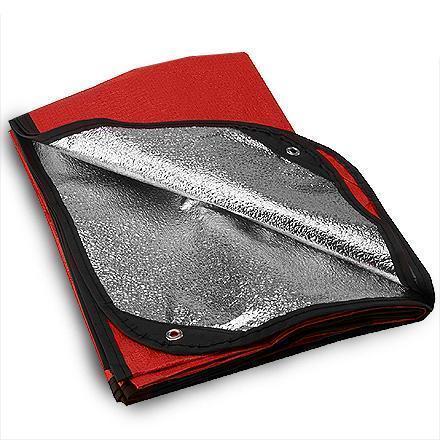
Yes, it seems to come up fairly high on the sides compared to the Weather Shield, and it’s hung to the end of the hammock rather than suspended. I tried moving it over to get in, as you do with the Weather Shield, but it really put the UnderCover side under tension and I was afraid something was going to rip. On the other hand, one good point is that you can use it to suspend other insulation right up to the ends of the hammock. (But I don’t plan to use other insulation at this point.) In my opinion the UnderCover works better with the UnderPad because it holds the UnderPad close to the hammock; the UnderPad is open-cell foam and doesn’t compress easily. The UnderCover compresses the Nest, while the Weather Shield doesn’t. I think the JRB Nest and Weather Shield and the HH UnderPad and UnderCover are well-designed pairs, just different. However, the UnderPad does work well with the Nest and Weather Shield pair, if you need to add more insulation (the GG ThinLight would work well too). Mostly I’m surprised that the UnderCover’s slit doesn’t seem to close as well as the HH hammock slit. (I’m going to check that out more carefully next time I hang the hammock.) If you only get the Weather Shield, the UnderPad or ThinLight (when used alone inside the Weather Shield) might benefit from a Space Blanket, as Richard suggests. I’ll have to try that in a few months when it gets warmer. (One concern with a Space Blanket is that it will cause condensation on the bottom of the hammock, rather than on the UnderCover. I’ve had this happen before with a Space Blanket.)
> Your test bringing the tarp down close to the hammock was interesting. It sounds like it works too well. You had 30 mph wind and did not mention it being a problem so I assume the tarp blocked it. I really want to get rid of the OverCover. It seems there must be a way.
The tarp definitely blocked the wind; it was still windy when I had the headache. I staked the tarp down very close, and I think I experienced CO2 buildup. In the future I will be sure to stake it down just far enough away to enough to expose some of the mesh (this is why the OverCover has a porthole). As I said before, I think the OverCover is something to use when it gets cold (+10F and below?). I wouldn’t use it above freezing, and at this point I’m not certain I’d use it above +10F. I did use it successfully at +15F/+10F, but that doesn’t mean it was necessary. The mesh on the hammock handles the frost from the tarp fairly well, but the dew point has been 10F lower than air temp; if it was 100% humidity the condensation on the tarp could really become a problem if you staked it close. You have a down top-quilt, so condensation in the hammock would be more of a concern for you than it is for me. The OverCover was designed for dry, very cold conditions; that’s the only time I plan to use it. If the temp inside your hammock is warm enough (about 10F above outside temp is what I have measured) then you wouldn’t need to stake the tarp close anyway.
>Just out of curiosity, which part of the country do you usually hike in in the summer?
Washington’s Olympic mountains; until recently Hawaii; and now Wyoming.