


I've got a Pfaff 130 that sewed some pretty heavy duty canvas on our old boat. Pretty good deal on one on EBay right now, probably cheaper than getting yours fixed.
Topic
Become a member to post in the forums.
I've got a Pfaff 130 that sewed some pretty heavy duty canvas on our old boat. Pretty good deal on one on EBay right now, probably cheaper than getting yours fixed.
Thanks Joe,
Off to e-bay I go.
> Roger, do you mean one like this?
Hey – gimme back my machine!
Yep. Silk to corn sacks.
cheers
Roger, any links for "old black Singer sewing machine"? What model number(s)/name(s) to look for? Thanks!
Hi Roleigh
Well, Google is your friend…
Mine is a 201P. I have seen claims that the 201 models were the best Singer ever made. Dunno about that, but mine can handle anything from silk to 1000 denier Cordura, which is more than I can say for most modern machines. (Modern machines can't handle the heavy end.)
I have happily sewn 3 layers of solid nylon webbing with the Singer.
Cheers
check out yahoo groups vintage singer group
Most of the home model “old black singers” were various versions of the model 15.
Craigslist is a place to look. I know of one that could be bought (don’t know the price yet). I did a fair amount of sewing on one until I picked up an old Viking (I wanted zig-zag).
If you REALLY want to find out about old singers, find sites devoted to quilt making (decorative quilts). But be forewarned … I’m told that many of them take the topic quite seriously (rabidly!) … by comparison, hardcore BPLers would look like folks with a casual interest in backpacking.
I had same problem with Singer stylist. I went on line and found a manual that explained how to set the timing. All I needed was an allen wrench and a screw driver. It was pretty easy.
As was suggested earlier in the thread. See if you can find a manual on line and check your timing.
I'm all up for doing self repair but just as a heads up for others reading the thread who sew, timing is easy to set on some machines (as noted above) as long as you have the proper repair manual. It's especially easy if the machine has timing marks to line up like some industrials have.
However, doing so yourself will almost always void the warranty if you touch it and can easily break lots of other parts if you do it wrong, so don't play with those set screws until you know for sure what you're doing. Timing is usually set within a paper's width so being that exact on some machines is frustrating to say the least. As easy as it sounds in the books it can still take hours to get it right the first few times, especially if parts are already worn. It can however be very satisfying when done correctly.
Good advice Joe. I bet it is tricky business. I would still like to give it a try,but I can not find a manual on line. Maybe thats a good thing,saves me the frustration I guess.
That was one I had too. Not the 330. They are great machines.
Just slower than a commercial one, otherwise I would have kept
it.
To piggyback on Joe C.
Drawings of basic timing.
http://www.sewusa.com/Sewing_Machine_Repair/Sewing%20Machine%20Hook%20Timing.htm
Thanks again everyone,I appreciate you taking the time to help me.
I am not sure if this can be my problem,but I just noticed that when I set the machine to straight stitch, it still zig-zags a 1/4". I wonder if part of the machine is set for straight,and another part thinks its on zig-zag? I have no clue whats happening. I have spent a bunch of time scratching my head.
> when I set the machine to straight stitch, it still zig-zags a 1/4".
Aaarrgghh! That means something is really out of kilter. And I think (part of) the problem may be in the top section, as that is where the zigzag mech is usually located. But without photos or engineering drawings of the mech, no chance.
Cheers
Joe Kuster said
"TH69 Bonded nylon is commonly used in outdoor products where tensile strenth is necessary. You can find it in thinner thread which is more friendly to home sewing machines and still retain some of the benefits. Either way, it's hard to get outside of a full pound cone, but it is realiable, strong and holds up to abrasion and uv well. Expect a cone to put you back around $20 bucks. Cotton will just rot in most outdoor applications. Polyester is ok but is more likely to have the color bleach in uv as well as it is usually weaker than nylon and it often frays easier."
He is right for the most part. I have been able to find a pound cone for $6. I bought two.
Here is a link. http://luthread.com/category.sc?categoryId=4
It looks like they are running out of stock, so it must be a one time only, or until supplies last thing. Everywhere else I looked, the price was around $20.
Mike: Ouch! Best of luck on that. Take off the top cover and check to make sure the lever is actually moving the linkages. I've seen one linkage rod rotate enough to fall out of place, of course that was on a old singer so I have no idea if that even applies to your PFAFF. Other than that, it'd need careful inspection vs the manual to even get a clue.
David: That's a steal at that price. Even in bulk crates they cost me $9 each when I'm buying our yearly supply for the company. I'd stock up while they have them available and if you decide you won't use that many, sell them on ebay for a profit.
As a heads up though, there is a lot of variance in the coatings on bonded nylon. Some comes practically wet with oil (feeds extremely well but the excess oily wax can cause build up on parts) or bone dry and will fray, twist and need different tensions set. I hope it pans out because that's a great price. Do remember that many sewing machines don't like that thick of thread and will a 19-22 size needle to use it.
Mike
There is a Yahoo group dedicated to old Pfaff sewing machine fans. It includes access to some SERVICE (repair) manuals for a few classic Pfaff machines. You have to get into the FILES section to get the manuals, and you need to be a member of the group to get access to the files section.
http://groups.yahoo.com/group/oldpfaffpforum/
Among other things, you are describing a needle offset from the normal position. And zigzagging when the zigzag width is set to zero…. if you did that right.
I believe that the manuals tell you how to adjust the machine settings when there is zigzagging when the zigzag width is set to zero. For most of the really old Pfaffs, the mechanism for that part is pretty much the same design.
You can buy service manuals on the web, for a price. With a lot of searching, you can find them. "Pfaff Service Manual XXX" where the XXX is the model number will often help in a Google search.
I have bought a manual that way. You might also benefit from a user's manual.
The Pfaff machines are/were precision built instruments with fine German engineering.
I am aware of models such as 230, 332, 260 and 360, but not the one you mentioned. It could be a much harder to find model than the common ones given above.
There are also many websites that describe common sewing machine problems, and solutions. You should also become familiar with the need for oiling/lubricating these older mechanical models, and don't use WD40 – use sewing machine oils and greases.
Thanks James,
I will certainly join that Yahoo group.
I have searched google for info. I find VERY little mention of the 330,maybe it is a rare bird. It was bought in 1953 in Germany and brought to the states by the original owner,I know this because it came with the receipt,Addressed Frankfurt. It cost 697 deutsche marks back then. I wonder if it was not imported to the USA,if so that might be why google has no info.
It really is a work of fine engineering,I would love to get it working again…without spending a ton of cash.
http://www.eserviceinfo.com/downloadsm/31095/PFAFF_260.html
This link should get you a downloadbable service manual of a Pfaff machine of similar vintage. It is a five part download, and you need an UNRAR program to decompress and combine the files. WINRAR – the free version, is one that will do it.
The fix to the zigzag should be in there, and be the same as for the Pfaff 330. That part of the mechanism is very near identical on many old Pfaffs. It involves loosening a screw in the base of the knob that controls the zigzag width. There is probably more about the adjustment of the needle positions.
You do need to locate a user manual, but the 330 user manual may not be common, and you most likely will have to pay for it.
If you give up and take this in for service, it is unlikely that you are going to get "Instant adjustment service", so you will almost certainly have to leave it and come back for it. For you, that is 100 miles each way, or 400 miles total. That is expensive.
One reason that you will have to leave the machine is that the actual "repair" may take only a brief period, and how is the guy going to justify his $100 estimate if it only takes a short while.
On some sewing machine discussion groups, a few old repairmen will tell you how RARE it has been for the machines to actually lose their timing.
The area which controls the zig-zag also controls the left-right-middle position of the needle, so when you changed the zig-zag, you may also have changed the left-right needle position. That part of the machine does move in an unusual manner during adjustment.
If the left-right needle position has been disturbed too greatly, it is possible for the needle to hit a part of the open slot on the top of the bobbin case. On the other hand, you may be hitting the bobbin case in the front to back plane, rather than the left to right plane. Can you see in which way you are getting interference?
Some of the discussion groups suggest that a Pfaff mechanical machine should not be given to first time sewers.
This
Or This: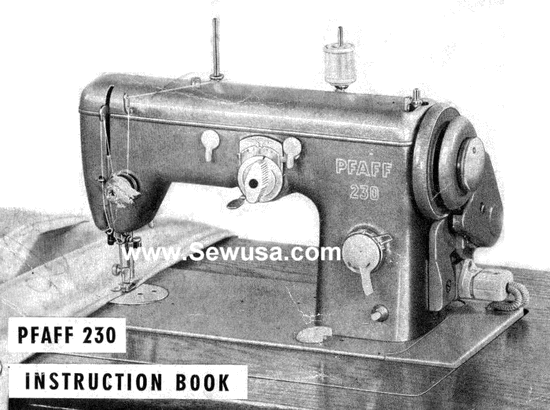
Some mechanics are just a guy who owns a sewing machine and
vacuum shop and fiddles with stuff. It may indeed take a couple of hours for him to figure it out. Or like the ones
around here, a couple of trips! You would likely do as well
yourself. If you can find a mechanic who has worked in a
sewing factory, then you will have something.
Rotate the wheel with your hand and see where the needle is
hitting. This will give you some idea of where the adjustment
is needed.
Thanks James,
My machine looks like the 332,not identical ,but close
The zig-zag knob is very erratic,at times it will move the needle so far left it will hit the feed-dog(correct term?). I just tried it again,and the needle is almost straight stitch. I am confused! Hitting the bobbin holder seems to be off on both planes,not sure though. It lines up with the hook groove,but hits about 1/2" left of the hook tip.
It is starting to look like I have a *parts* machine. I just do not have the funds for 400 miles and at least 100 bucks in repairs,bummer… but I need to stay real on this.
You are right,I do not think an PFAFF is for a rookie.
Thanks for your time.
David,
You are correct,the local mechanic(100 mile one way) owns a sewing machine and Vacuum shop. I am not sure how talented he is,but I do know my sister in law makes many trips each year…probably not a good thing!
The needle hits about 1/2" left of the hook point. I am stubborn,but I am about to give up on this one. I am dense,but I know when to admit defeat.Nah,I would have given up long ago!
What is the nearest city to you?
Become a member to post in the forums.
 Vaer C4 Tactical Field SolarDurable timepiece for wilderness users - 20ATM (200m) water resistance, 120-click bezel, 316L SS casing, sapphire glass, solar-powered, Epson VS-42 Japanese movement, C3 Lume, USA assembly.
 © Beartooth Media Group Inc.
 Loading...