Topic

Alcohol vs. Cannister Stove

  • This topic is empty.
Viewing 25 posts - 26 through 50 (of 51 total)
Roger Caffin BPL Member
PostedMay 5, 2008 at 9:37 pm

Hi Roman

OK, two people and 30 – 40 F.

Now I know my wife and I drink less than most people, but under those conditions we manage on 6 litres per day for the two of us at the most. Only a fraction of this needs to be heated: maybe 2 – 2.5 litres. Yes, that applies to conditions down to 30 F.

With a modicum of care we normally manage on two 450 g gas canisters for the month. We know this from several very long trips, where we sat on 14 days/canister for months on end. So carrying 3 (or even four) 450 g gas canisters should really leave you cooking in style.

Now, what stove. My figures are for a Snow Peak GST100 and a 1.6 L MSR Titan pot, with an 8" high close-fitting windshield and a lid on the pot. If you switched to a Primus EtaPower stove system you would be increasing the weight slightly, but you would also be increasing the efficiency. You would still have a very low CO emission, allowing you to cook inside your shelter with complete safety. In the high mountains, this can be a life-saver.

Caution: That is NOT the EtaExpress. DO NOT take this stove! The Review article is yet to be published, but …

> Someone told me that canister stoves were the most efficient at converting fuel to heat
Correct. White gas and kero suffer from several usage inefficiencies. Alcohol – forget it for any long trip.

> the jetboils heat exchangers seems very clever
Oh, for sure. But 'clever' does not mean 'optimal' in this case by any means.

> at 0-5C cannister stoves seem sluggish,
Upright canister stoves are indeed sluggish under those conditions. Thoroughly reviewed and discussed in several of our articles on canister stoves, winter stoves and the CO series.

> leaving lots of little caches instead of a few big ones is a better strategy
You could take the 230 g gas canisters and cache them regularly on the way out, but they are not as weight-efficient. On the other hand, if you end up carrying them on average only 1/4 the distance, you might be winning. Hum …

> another reason I like the cans (which we must pack out, which is why I don't like the cans).
A bit of a false argument imho. If you took white gas you would still have to carry the containers back out. Etc.

Cheers
Roger
Bill Fornshell BPL Member
PostedMay 5, 2008 at 9:52 pm

Roger,

What about the aluminum canister Coleman PowerMax? The smaller canister weighs 229 grams full. It can be punctured and flatten when empty.

Use it with some version of a lighter Coleman Xtreme Stove?

Jason Brinkman BPL Member
PostedMay 5, 2008 at 11:19 pm

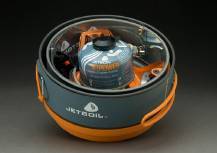
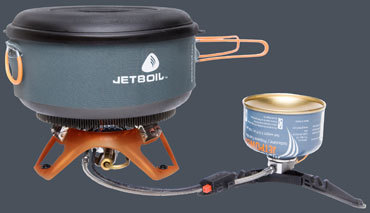
To achieive boiling 2 gal/day in the quickest and most convenient method possible, the Helios may well have some very beneficial components. The valve, igniter, hose, burner head, and other components look to be fairly optimized.

However, the over-designed orange pot support would have to go – I haven't seen hard numbers yet, but that thing looks to be half the weight of the whole system. A skeletal frame of titatium wire or a light machined support could certainly serve the intended function for much less weight.

If the lid is the heavy rubber type like the PCS I would consider ditching it in lieu of some foil. The frisbee bottom cover seems uncessary.

You can save a couple more ounces by ditching the neoprene cozy – I doubt that it is worth it's weight in fuel.

Helios

Caching seems to be your best bet, but I would argue that the largest possible butane/propane containers are the most efficient for this purpose.

Packed Helios

Overall, interesting discussion. Hopefully others will continue to weigh in with other possible systems and efficiency measures.

Roger Caffin BPL Member
PostedMay 6, 2008 at 3:30 am

Hi Bill

For sure, the Powermax canisters are very light. My measurements are ~170 g gas in 68 g can, ~300 g gas in 86 g can.
Hum … … …
Now that you mention it, for a very long trip it could be worth looking at a Coleman Xtreme for the weight savings of the cans. Good thinking! As long as you can find an Xtreme (production discontinued) and the Powermax cans (still definitely in production).

Me, I wouldn't bother flattening them afterwards. I ONLY care about weight. And on the return trip, having eaten most of the food, there should be ample room in the pack!

Roger Caffin BPL Member
PostedMay 6, 2008 at 3:33 am

Hi Jason

> The valve, igniter, hose, burner head, and other components look to be fairly optimized.
Looking very hard at the fist pic you show, I notice that the burner in the Helios looks rather similar to the Primus Gravity … I would love a better pic of the stove withOUT the pot.

The canister connection looks like a modified stove head off another stove too. Figures: cuts development costs.

Not wildly impressed by the Gravity: not bad, but …

Richard Nisley BPL Member
PostedMay 6, 2008 at 8:59 am

The Coleman Xtreme stove is still available from Campmor and is discounted $30 to $49.97 US.

Chris Townsend BPL Member
PostedMay 6, 2008 at 10:02 am

The Powermax canister/Coleman Xtreme does sound a useful combination for two for a journey like this. It's probably what I would choose.

I'll be curious to see what Roger has found about the EtaExpress. I've been using one since late last summer and I've found it fuel efficient and fast boiling. My only complaint is that it could be a fair bit lighter. The windshield is ineffective too and I don't bother with it but use a foil one instead.

PostedMay 6, 2008 at 10:33 am

Jason, Thanks for the Helios photo. Do you have one? How aout a jetboil, do you have one of those?

And Roger, Thanks for the data. Very useful! How do you get the last drops of fuel out of your cannisters? I use the big 450s too, but the flame gets weak and I have to wait hours (it seems) to get a big pot of water hot at the end of the cannister. I also generally have that big pot of water to heat inside a wet rainy/frosty 'mid that's crowded with other people on uneven terrain and we're all still in our bags because we can't put on our wet clothes until we have the hot fluids in our bodies.

I have one of those little stove heads (Snow Peak) but never take it, except for a few Adventure Races where a stove was mandatory.

But I'd sure like to see a picture of your windscreen for the stove. My single experience applying a windscreen (MSR-style) to an ol' Bluet stove resulted in melting the stove's plastic. So I am loathe to experiment — would rather see what others, like you, have successfully come up with.

Also, I have been unable to unearth a review of the Helios or other Jetboil test on these pages, but is probably because I didn't look hard/deep enough.

While I do not really consider myself a gear-head, I do have a soft spot for stoves (unsure why), which is odd because I do prefer cooking on open wood fires (no need to start a flame war here — there's plenty of chaff on fire elsewhere).

For example, largely because of these pages, I have recently (in the last year) used an alcohol stove, bought a bushbudy and a jetboil. The quick and easy functionality of the jetboil I bought last summer after watching a cameraman heat water up to warm his girlfriend's feet (!) has made me a convert. It's so easy to use anywhere and wicked quick. It is heavy, oh my, is it heavy. And little! Too little. But I absolutely adore its quickness.

I am a big drinker (one liter of hot fluid liter at night, one liter at breakfast to psyche up to put on wet clothes, socks, shoes) and like a group size of three (because its safer and more fun), so need to heat up at least 3 L at a time — hence the big, gallon-sized pot.

My trips are mostly Alaskan, with wet brush, glacial rivers, cloudy weather, low angle sun, lots of dew and rain. These conditions have driven me to perhaps excessive drink.

Mostly we drink at night to ward off hypothermia, for example after packrafting or swimming glacial rivers. Similarly, a liter of tea or cooco shakes the chill in camp after r a day of cold, rainy bushwhacks. The rain in AK does not come as short, big-dropped downpours, but as atomizer-intensity, all-day-long, soakings, usually on willows and alders. Hiking through it is like strolling through a car wash.

Indeed, I can bring less food by drinking more fluids as my body has plenty of fat to feed me. Drinking warm fluids forces the blood into my extremeties — as I write this I realize that Andrew Skurka's article on early-season hiking is essentially about what the entire summer season of Alaska is like.

Anyway, here's what I am trying to say: I am quite taken by the jetboil. I like a quick hot drink when I am wet and cold, which as you may have gathered happens a lot. However, the jet boil does not seem really good for three people each wanting a liter of hot drink at the same time.

However, I sense that you, and clearly Mr. Skurka, have no use for Jetboils. Seems like BPL.com would be a great place for a stove showdown.

What I'd to see is a replicated test of Jetboil against other stoves in sub-otimal (but above freezing temps–what Skurka's article on Early Season describe — not winter, but chilly and wet), with each component of the jetboil tested (the neoprene skirt, the radiative exchanger), if it is indeed more fuel efficient. If it is not, then that's good info, too. At least we'll know.

But the jetboil seems to be the first fossil fuel stove SYSTEM that is qualitatively different from any other since the first MSR of the 1970s challenged the Svea 123 with its off burner fuel bottle and its foldable windscreen.

PostedMay 6, 2008 at 11:43 am

Roger,

Two weeks on one canister is awesome, both as useful info and in your frugal fuel consumption.

This gives us 450 grams/ (2 L/day * 14 day) = 450 grams/28 liters ~ 16 grams of fuel per liter.

So if two of us together drink/eat 3 L per meal = 6 L per day, a 30 day trip needs 180 L heated or
(180 L *16 grams/L)/450 grams/can = 7 big cans, or 29 little 100 gram cans.

This means that total weight of fuel+cans would be 12.2 pounds (= 29 little cans * 6.7 oz/can) of little cans (caching ~one every other day and using one per day) or 10.3 pounds (= 7 big cans * 23.6 ounces/can).

With the little cans my pack weight decreases faster — wait! I think what i would do is go out with big cans and cache little cans for the return. This strategy takes advantage of the economy of scale afforded by big cans, and the quickness of shedding weight as we cache as we go. I am thinking that the outbound trip will be 19 days (114 liters, 4 big cans carried all the way) and the return trip 11 days (11 little cans left en route).

I have erred on the side of too much fuel, I hope, but would be burning each day about 96 grams of fuel and losing every other day 189 g of cached fuel+can. So every two days my pack would lose, say

4.5 pounds of food = 3 pounds of food consumed in two days plus 1.5 pounds of food cached

plus my half of the fuel weight = (96 g burned/day * 2 days + 189 g cached)/2 people = 381 g/2 people = 7 ounces

So I'm looking at a pack that's getting almost 5 pounds lighter every two days (yahoo!).

I think together with someone else that can walk far, fast, and light, this means 900 miles is doable "self-contained", but in an out-and-back fashion.

PostedMay 6, 2008 at 2:57 pm

I would like to chime in and say that while BPL has completely trashed the Jetboil PCS in past reviews, I found the Jetboil PCS to be the most wind resistant cannister stove in existence. You do not need any kind of windscreen with the Jetboil PCS and it works extremely well in reasonably cold conditions.

It is heavy compared to most other cannister stoves, although when you factor in that it is self contained with a good cooking mug, Im not so sure it matters that much unless youre a SUL weenie.

I sold mine in exchange for a Coleman F1 Ultralight cannister stove. While the Coleman F1 is extremely hot and extremely lightweight and fairly wind resistant, its nowhere near as wind resistant as the Jetboil PCS. I read about the Coleman F1 cannister stove here at BPL, you guys gave it a glowing review. Its a good stove no doubt, but so is the Jetboil PCS.

I think Im going to go out and buy another Jetboil, it was a good system and BPL is not always right about gear. You can boil water with that thing in a literal high gust windstorm and it wont blow out!

Eric

PostedMay 6, 2008 at 9:47 pm

Right on Eric!

JetBoil is the best hot lunch mountain stove out there. But my impression is a lot of SUL types eat all cold food, all the time. No stove can make me warm and happy as fast.

Unfortunately I find myself fighting off hypothermia often and the jet boil does it better than anything else other than a big campfire, which is not allowed in lots o' palces and maybe hard to build when you're cold, wet and miserable.

For example, packrafting in the Grand Canyon we used it to warm up midday, like every other day or so, after long, cold swims. It's a no muss no fuss get me warm here and now system that I like. The Bushbuddy is a really cool idea, super cool, but it just doesn't find its way into my pack like the jetboil.

BTW this is superb: http://www.backpackinglight.com/cgi-bin/backpackinglight/jetboil_stove_review.html

Post script: I never saw any of the claims or hype about Jet boil. I simply saw it in the field being used by others in ways that blew me away, used by outdoor-engaged proffesionals who need the convenience and quickness it offers; however, for elegance nothing beats a fire in my book, and if a fire's not legal and you're walking close to civilization, then alcohol's the way to go. But after reading the thorough comparison test cited above, I think for my next Arctic 1000 mile walk, I'm going to go with a jetboil.

EndoftheTrail BPL Member
PostedMay 6, 2008 at 11:50 pm

Reading the above, I can see how stove efficiency becomes critical on long trips without resupply.

But I think the overwhelming majority of hikers are overnighters, weekenders, and for the luckier ones, maybe week-long hikers. As for the truly lucky — the thru-hikers — I think many do so with caching or resupply (e.g. AT thru-hikers).

As a hiker who's solidly in the norm rather than at the "edge" of hiking durations, I remain unimpressed by the JetBoil system. I see them used often enough by short-term hikers, and still wonder what the big hoopla is about fast boiling times when we are out in the wilds? I guess I am not impressed that I can save 2(!) minutes of cooking time — by opting for a system that's 2-3 times larger and heavier than my current setup. I much prefer a truly light and compact kitchen set up as that translates into real benefits every single minute of an active hiking day.

Switching over to alcohol stoves, I dislike the caldera cone system for much the same reasons — plus the need to fuss with storing the fragile cone when not in use.

Just goes to show… different strokes for different folks. :)

PostedMay 7, 2008 at 12:10 am

"Just goes to show… different strokes for different folks. :)"

Or horses for courses…

I haven't used a Jetboil. I can't imagine a scenario where I would since the majority of my trips are from overnight to 4 nights with at least two people, and in that situation we would need at least 2 litre capacity in a pot/stove system. JetBoil as a solo set-up just doesn't compete for weight versus fuel economy. The Caldera cone works out very efficient for my uses which is need for wind and rain protection, two person/two litre capacity, and no more than 4 nights duration. Our longest trip without re-supply was 10 days (9 nights). I suspect beyond these conditions we would opt for either a true winter set-up (eg white gas + windscreen + heat exchanger) or a 3-season combo BushBuddy/Esbit caldera set-up.

If someone gave me a JetBoil for free (I mean the 1.5 litre version) I *might* take it on camping trips to reduce the fuel cost and carbon emmissions since I don't to carry the stove. Then again, if I were just camping I would probably go with an LPG gas cooker.

Roger Caffin BPL Member
PostedMay 7, 2008 at 3:51 am

Hi Roman

What a lot of questions! OK, let's work through them.

> How do you get the last drops of fuel out of your canisters?
By keeping the canister a bit above freezing point. Propane boils at -42 C while butane boils at -0.5 C. I can do this by putting it in a bowl of liquid water, or by placing it just a little bit near the stove while running. In that latter case I monitor the temperature very carefully.

> I have one of those little stove heads (Snow Peak) but never take it
Then you don't know what you are missing. I CAN use the Snow Peak stove in the snow successfully by standing the canister in a bowl of cool to warm (NOT hot) water. See gas boiling temperatures above, and do read these two articles:

Selecting a Canister Stove for Cold Weather Backpacking
Part I: Stove and Fuel Fundamentals
http://www.backpackinglight.com/cgi-bin/backpackinglight/selecting_stoves_for_cold_weather_part_1.html

Selecting a Canister Stove for Cold Weather Backpacking
Part II: Commercially Available Canister Stove Systems
http://www.backpackinglight.com/cgi-bin/backpackinglight/selecting_stoves_for_cold_weather_part_2.html

> But I'd sure like to see a picture of your windscreen for the stove.
Really pretty stock standard Al foil screen about 8" high. Widely available, comes with many liquid fuel stoves. See the last pic in the Brunton article just published:
http://www.backpackinglight.com/cgi-bin/backpackinglight/myog_winter_stove_summer_upright_stove_brunton_stnd.html

Also available from Trail Designs: reviewed at
http://www.backpackinglight.com/cgi-bin/backpackinglight/trail_designs_vari-vent_windshield-spotlight_review.html
and also discussed at
http://www.backpackinglight.com/cgi-bin/backpackinglight/taming_those_large_flexible_foil_windshields.html
You could also read Will's discussion at
http://www.backpackinglight.com/cgi-bin/backpackinglight/wind_dynamics_and_windscreen_design_part_2.html

> My single experience applying a windscreen (MSR-style) to an ol' Bluet stove resulted in melting the stove's plastic.
Aarrgghh! Please, don't even think of the Bleuet stoves! They are a dinosaur from prehistoric times. OK for tourist picnic tables.
Er – yes, the plastic on mine melted too. I was toasting raisin bread and muffins for too long … :-)

> I have been unable to unearth a review of the Helios
I am not sure you can even buy it yet!

> The rain in AK does not come as short, big-dropped downpours, but as atomizer-intensity, all-day-long, soakings, usually on willows and alders.
Yes, I know that stuff. Sadly. Shudder. (or Shiver…)

> But I absolutely adore its [Jetboil] quickness.
Ah – there are other faster stoves around. The Jetboil is kinda slow in comparison.

> like a group size of three – hence the big, gallon-sized pot.
Ah. Ok. Now, I don't know of any heat exchanger stove which has a pot quite that large! But you should definitely look at the Primus EtaPower stove system (heat exchanger). This is the largest heat exchanger stove system available at a reasonable weight, and for my money it is a very good one too. Too heavy for solo, but fine for a small group.

> Seems like BPL.com would be a great place for a stove showdown.
Yes indeed. It will happen. Just can't give a date right now.

Roger Caffin BPL Member
PostedMay 7, 2008 at 3:54 am

> So if two of us together drink/eat 3 L per meal = 6 L per day, a 30 day trip needs 180 L heated or
(180 L *16 grams/L)/450 grams/can = 7 big cans, or 29 little 100 gram cans.

I really wouldn't even think about the 100 g canisters. They are way too small and INefficient for weight. Also rather expensive. Consider instead 14 of the widely available 230 g canisters.

Yeah, the caching trick could work well.

Cheers
Roger

Roger Caffin BPL Member
PostedMay 7, 2008 at 3:57 am

Hi Eric

> while BPL has completely trashed the Jetboil PCS in past reviews, I found the Jetboil PCS to be the most wind resistant canister stove in existence.
Yes, the Jetboil is wind-resistant. You are right there.
But so is something like a Snow Peak GST100 with a Trail Designs windshield around it (or any similar bit of foil). And so are many other combinations too.

The self-contained cooking mug … I have burnt my lips on metal cups too often. Sorry about that!

PostedMay 7, 2008 at 9:03 am

>Right on Eric!

Hi Roman…

>JetBoil is the best hot lunch mountain stove out there. But >my impression is a lot of SUL types eat all cold food, all >the time. No stove can make me warm and happy as fast.

I agree that Jetboil, when all is said and done, is probably the most reliable, ergonomic and most robust cannister stove on the market today. I also agree about the SUL types eating mostly cold food…lots of energy bars for example. That doesn't make good for keeping morale up on the trail, nor for helping to ward off hypothermia. Hot food and drink is best for warding off hypothermia, which I can tell by your posts you more than realize from actual experience.

I sometimes get the impression that many BPL groupies don't actually have an awful lot of trail time, AKA real world experience.

>Unfortunately I find myself fighting off hypothermia often >and the jet boil does it better than anything else other >than a big campfire, which is not allowed in lots o' palces >and maybe hard to build when you're cold, wet and >miserable.

Again, I agree with you on this point. And Ive had mild hypothermia once and hypothermia is sneaky…slips right up on you and before you know it you're violently shaking, tripping over things, thought process deteriorates and basically, manual dexterity deteriorates to the point where doing simple things like putting up a tent is impossible. Prevention is the only way.

>For example, packrafting in the Grand Canyon we used it to >warm up midday, like every other day or so, after long, >cold swims. It's a no muss no fuss get me warm here and now >system that I like. The Bushbuddy is a really cool idea, >super cool, but it just doesn't find its way into my pack >like the jetboil.

Pack rafting sounds sort of like a potential quasi-immersion hypothermia. While not in the water all the time, your wet in cold water a lot and its easy to get chilled real fast. Who has time to stop and gather firewood in an environment like that? Just use that trusty Jetboil PCS to boil some water fast and throw some high calorie something in the water. Heated calories is one of the best hypothermia prevention methods, as you well know.

>BTW this is superb: >http://www.backpackinglight.com/cgi-bin/backpackinglight/jetboil_stove_review.html

>Post script: I never saw any of the claims or hype about >Jet boil. I simply saw it in the field being used by others >in ways that blew me away, used by outdoor-engaged >proffesionals who need the convenience and quickness it >offers; however, for elegance nothing beats a fire in my >book, and if a fire's not legal and you're walking close to >civilization, then alcohol's the way to go. But after >reading the thorough comparison test cited above, I think >for my next Arctic 1000 mile walk, I'm going to go with a >jetboil.

Go for it…I'm 100% positive that Jetboil will be ultra reliable and while not the lightest system, I bet whomever you go with will be secretly envious of your super hot, super reliable, well engineered Jetboil when things get tough on that trip.

Plus, as I mentioned before, the thing about the Jetboil is its basically impervious to wind gusts. I don't know why Jetboil doesn't make a bigger deal about its high wind resistance.

Eric

Barry Foster BPL Member
PostedMay 7, 2008 at 10:07 am

I have had many problems getting my Jetboil to light under not so cold damp conditions. It was replaced once, but it's still not totally reliable. I am a fishing guide and I like to heat water for cup-a-soup for my clients etc. I have had similar problems with a Reactor as well. I have turned back to a old Markill Hanging stove which has never let me down. I would not trust a Jetboil for hiking. If I want something totally reliable then I would take a SEAV 123. Heavy, but totally reliable. For light then I would turn to a Caldera Cone.

Barry

PostedMay 7, 2008 at 10:16 am

Roger,

First please accept my apologies.

I feel like the student who didn't do his homework before showing for class discussion.

Thanks for being patient. Having read your texts on theory, practice, and today's release on modification of gas stoves, it's amazing how much you have contributed to our understanding of stoves. It's also obvious now why you don't like the Jetboil hype and extra do-dads!

BTW I think we will simply strap an inverted cannister to the center pole of our shelter as we usually cook in the floorless shelter.

Richard Nisley BPL Member
PostedMay 7, 2008 at 10:29 am

Roman,

What is the probability that cooking odors will permeate the fabric on your MegaMid and increase the chance of a bear intrusion?

John S. BPL Member
PostedMay 7, 2008 at 10:40 am

Re Rogers pic…didn't I see that on the Warmlite site one time?…jk

PostedMay 7, 2008 at 11:35 am

Richard,

At the risk of sounding contradictory, my experience with bears is limited to Alaskan bears. There may well be some food odor in my clothes, shelter, and sleeping gear, but the smell of human seems to overpower that.

Most bears in Alaska are still a bit wary/fearful of humans and don't want a showdown with us. Meaning if they do smell my shelter and I am sleeping with it or carrying it, then they don't usually want to risk fighting me for it.

In over 30 years of wilderness travel in AK (and again at the risk of being seen as foolish) cooking in the shelter and actually sleeping with the food (like a bear sleeps on its kill) I have only had one food-related incident with bears and that did not involve cooking in a tent, but smashing a month's worth of used fish cans (sardines, herring) in preparation for hiking out.

If I were in parklands of the Lower 48 with black bears I would greatly fear cooking in or near my shelter! Those bears have little/no fear of us and nosing around for scraps is what they do, their ecological niche it seems, and they have learned to intimidate us for what they want. Again, I have little experience other than a handful of trips in the last 20 years…..

So, my note about strapping the inverted fuel can to my center pole would work well in places where, on average, a bear's fear of you is greater than your fear of a bear — or where there are no bears, like perhaps winter trips in Lower 48 parklands.

However, this might be another good BPL.com test: test "shelters" cooked in and not cooked in, then left for bear inspection/intrusion.

Roger Caffin BPL Member
PostedMay 7, 2008 at 5:36 pm

> Re Rogers pic…didn't I see that on the Warmlite site one time?…jk

Do you know just how old some of those original Warmlite photos are? !
Huh!

PostedSep 23, 2009 at 6:41 pm

A good top burner alcohol stove is light by any standard unless you are obsessive. I use an MSR Windpro and a pressurized top burner alcohol stove for back up. In my humble opinion, I would carry both. Better to have it and not need it than to need it and not have it. Recently I have been leaning toward a wood gas stove with an alcohol for back up. They are bulky but still light and fuel can be found anywhere except of course above the tree line.

Viewing 25 posts - 26 through 50 (of 51 total)
Loading...