


"that would absorb a lot of moisture" If this was Dune that moisture would be kept til dinner time and become the soup of the day.
Topic
Become a member to post in the forums.
 .
"that would absorb a lot of moisture" If this was Dune that moisture would be kept til dinner time and become the soup of the day.

Yummm recycled/reclaimed sweat and urine soup!

Solution/Fix???
Maybe I am beating a dead horse:
a) Paramo systems rely on the pump liner’s properties. Here is a quote of what Mr. Nikwax/Paramo Nick Brown himself sez on OM about it (entire thread can be read here, Nick Brown joining in at page 6).
Keep in mind that polyester is a hydrophobic fiber by its nature, the DWR of the pump liner does not seem to be mandatory though. (To allow polyester base-/midlayers to wick moisture and allow it to dissipate, the poly has to be made hydrophilic with a treatment (resulting in a capillary rise). To fine tune the wicking properties of these fabrics the hydrophilic poly is often blended with regular polyester and augmented with a denier gradient construction.)
Intrestingly PowerDry does not rely on wicking hydrophilic fibers but on a capillary depression as does the Paramo pump liner and on a denier gradient construction (so does the Paramo mesh pump liner).
b) So why does Paramo use a DWR for its pump liner? It will take a longer time (or more intensity) for rain to overwhelm a DWR-treated pump liner. Additionally there is a densely woven DWR-treated polyester face fabric (CFM 2.5 according to Paramo’s specs) that serves several purposes: reducing the amount of precip reaching the pump liner by beading off/slowing down the hitting raindrops and preventing wind from forcing water into the the pump liner. Works better with the “heavy” face fabric: the “Light” outer fabric will wet out faster (less “meat”) and is too wind resistant IMO.
c) Still over the time, due to hydrophilic contaminants (e.g. dirt, salt (from sweating), body oils, sunscreen, etc.) and abrasion of the DWR, the pump liner’s and face fabric’s function will be impaired. Therefore you have to wash the garment regularly (approx. every 4-8 weeks) with Tech Wash (or similar). This will remove the contaminants w/o damaging the DWR thereby revitalising its function.
d) Every 12-18 months or when washing with Tech Wash fails to revitalise the DWR the garment should be reproofed with TXDirect (PFC free!).
e) To remove heavy soiling, stains or any other persisting contaminants (especially when amalgamated with multiple DWR treatments w/o a proper wash w/ Tech Wash beforehand!) it will be necessary to use detergent or even dry cleaning to remove the DWR! After dry cleaning or a detergent wash re-washing the garment with Tech Wash and reproofing it with TXDirect is mandatory.
f) The combo of a “naked” pump liner inner and some nylon windshirt outer has been tried before (just google “RedYeti” and “Cioch”) – it did not work as expected. Maybe better try the Enduro Fleece/Windproof combo. Compared to your “naked” pump liner the Enduro Fleece is a different beast: superior DWR longevity and reasonable wind resistance (~CFM 50). Sounds intriguing, eh?
g) If I am expecting heavily wind driven and/or torrential rainfalls I supplement my Paramos with a Packa and a pair of SD Elite Rain Chaps – works like a charm!
Cheers
Steffen
Polypropylene has both significantly lower surface energy than polyester, and also absorbs noticeably less moisture–almost none.
Hence, while untreated polyester can “wet out” to some extent, polypropylene won’t–in other words, polyester needs a DWR and polypropylene doesn’t. You will need to occasionally deeply cleanse the PP shirt though, and with a highly alkaline cleanser that can emulsify and break up any oils on the surface, since those oils can hold debris, dirt, etc, which can raise the surface energy of the surface of the PP material.
I am aware of Yeti’s experimentation with that set up, and from what i remember, i thought he was mostly happy with it?
The question is, even if he wasn’t, it’s likely more about the HH, CFM, and DWR issues (mostly of the shell, and to a much lesser extent the pump liner), rather than the core or general concept. You can’t just use any windjacket (!). I learned this the hard way with using my Houdini with the Cioch pumpliner. I eventually figured out the HH of the Houdini wasn’t high enough, especially not on the shoulder areas. After adding more silicone to key areas, it works fine now though.
These issues are why i started this post to begin with. If the you get the HH, CFM, and DWR issues worked out and in balance, you can improve the basic concept and utilization of Paramo. It’s main weakness is the issue of DWR. Why keep buying and treating with DWR, when it’s not necessary if you use the right materials to begin with?
As far as the pump liner goes, i have one, there is nothing particularly special about it. It just relies on one side of the fabric having bundled up threads (smoothly woven), and the other side being brushed so that the individual fibers within the bundle are freed up, which basically means the inner, smoothly woven side has larger threads and the outer has smaller fibers. Then it’s DWR treated to maximally repel moisture.
A one sided brushed/fleeced polypropylene top would be and accomplish similar, except not requiring a DWR. You just have to turn and wear it inside out. :)
The main problems with using a PP top rather than a polyester is odor retention and PP is potentially very slightly warmer per same thickness than polyester because it’s less thermally conductive. Using larger fibers in the PP top can help offset that, since larger fibers trap/still less air. The PP top i have doesn’t seem to use microfibers whereas the polyester analogy pump liner does seem to use it. So, they probably are pretty close in thermal insulation overall.
Become a member to post in the forums.
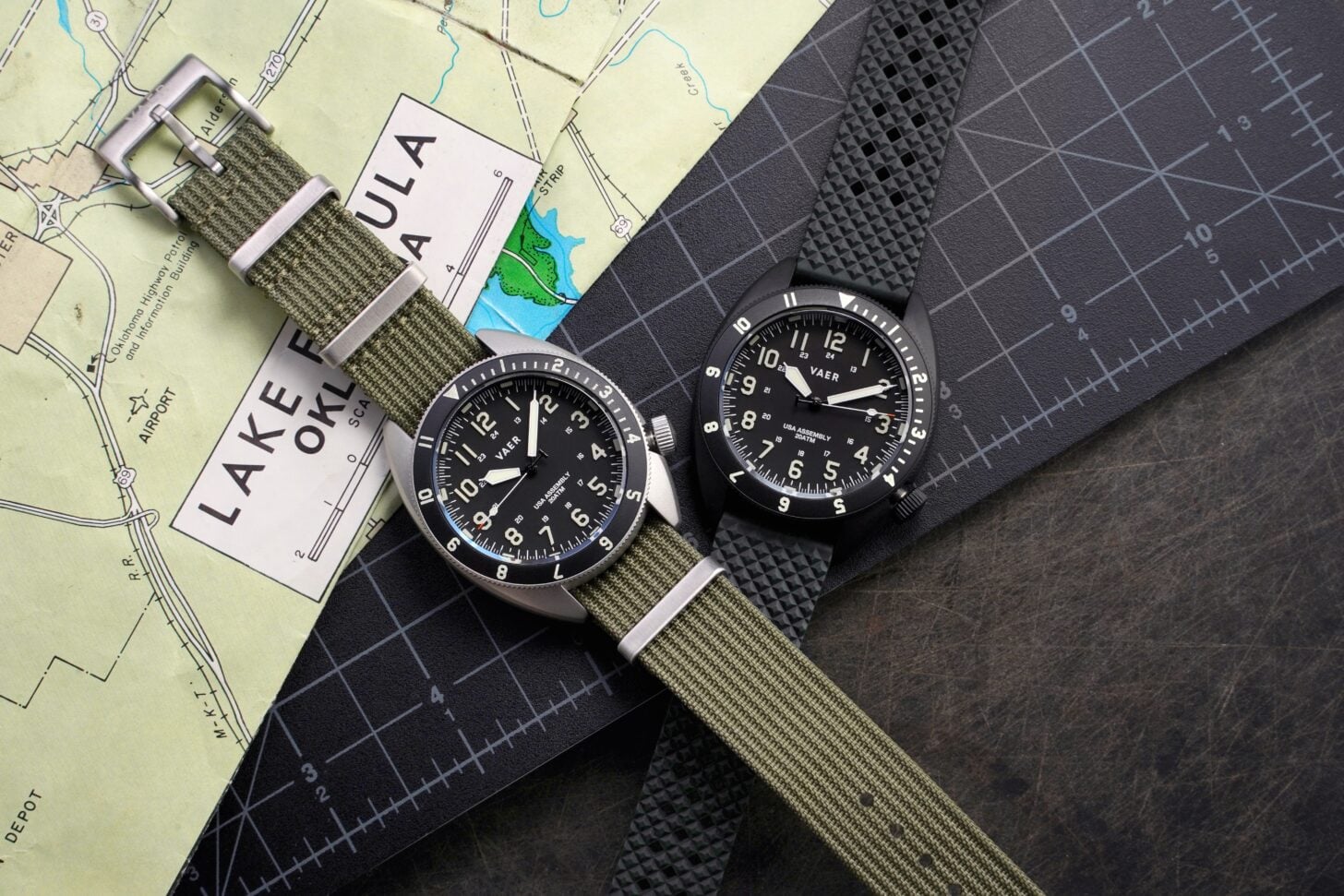 Analog by Design: The Vaer C4 Tactical Field SolarThe best gear works the moment you reach for it. The VAER C4 Tactical Field Solar (41.5mm) combines rugged functionality with everyday practicality, featuring a matte dial with bold stencil numerals, raised 3D Super-LumiNova markers, and a 12-hour bezel for timing a climb or tracking a second time zone. Powered by light, it delivers up to six months of operation from just six hours of exposure, with no routine battery changes required. A sapphire crystal, 200 meters of water resistance, USA assembly, and a two-year waterproof warranty make it a dependable companion for adventures on and off the trail.
 © Beartooth Media Group Inc.
 Loading...