


Ok Dale, don't make a fire then. Never, ever, even if safe, allowed, on a beach, with driftwood. That's ok with me.
Topic
Become a member to post in the forums.
Ok Dale, don't make a fire then. Never, ever, even if safe, allowed, on a beach, with driftwood. That's ok with me.

I thought the video was fine. I guess if you live on the west coast, it's easy to forget that there are other parts of the country and world that aren't in a drought. "The first question is where you are getting the fuel […]" As a result of our sometimes misguided wild land firefighting efforts, there seems to be an overabundance of fuel that would have otherwise been burned up in a fire years ago if we hadn't intervened. It's not terribly difficult for me to find dried firewood when I'm backpacking. I of course wouldn't have a fire right now due to how dangerous the conditions are but again, other states are in much better shape than we are.

it depends on the location and how many people go to a place often, there is an abundance of wood. Better to let it decompose naturally, but burning it releases the nutrients more quickly. If a small percentage of the wood in a forest is burned in campfires, it doesn't matter much one way or the other. I often like to build a fire just to watch it burn. Entertainment. But not if it's raining – too much work, or if it's hot in the summer.
I tried to camp in Bastrop SP last month, but failed to bring adequate insect protection. As the overnight low temperature was around 70F, wearing clothes or hiding in my bag was not an option, and all I had for bugs was a headnet. As I bailed out, driving past the RV section, I passed a camper with a generator running and two window unit A/Cs rigged up. The family was outside sitting around a fire ring. Ah, State Park camping at its finest. The fire probably kept the mosquitoes away though.

The video describes it as a survival fire and a LNT fire, those often aren't the same thing. I don't see what would make that fire a survival fire. Either make a video about one or the other, it's ambiguous, and then define what you mean and what the goal is. Regarding a small fire vs a big fire, sometimes only a big fire works, for example in a boreal forest at -40 without a sleeping bag. Big difference than a tiny tipi fire inside a fire ring which holds a lot of heat in. The video is just extremely basic and not very useful. The last place I would go for an instructional on fire would be backpacker magazine.

If you really think about it, backpacking itself serves no purpose, so saying a fire has no purpose is illogical. Backpacking is all about experiencing, and to some, that includes having a campfire.
http://dallassierraclub.org/page.htm?outingscorner201103 Why We Don't Build Fires by Bill Greer, Dallas Group Outings Chair Extensive research by the National Park Service and other outdoor managers shows that for many people a campfire is an important part of outdoor recreation. But for the most part, the Dallas Group does not build fires on our outings. I’d like to explain our policy below. The Sierra Club is not an outings club, but a conservation club that does outings. We started our outings program to show people why certain areas should be protected. Therefore, it would run counter to our goals if our outings themselves damaged areas we are trying to protect. In a nutshell, the reason we do not build fires is that they cause harm to the wilderness that no amount of care can prevent. Read on and you’ll see why. As a conservation club, we have a duty to teach a better way. Damage from the fire itself: No CampfiresSome damage from campfires is readily evident. Campsites quickly acquire a ring of rocks filled with ashes and partly burned trash. When that one is filled, or deemed too small or in the wrong place, another is built. Soon some of the best tent places are occupied by a fire ring. Makeshift furniture accompanies some of the rings. The area begins to look less like wilderness and more like someone’s primitive homestead. You don’t appreciate how this alters the forest until you see an area that has seen little human visitation. Some damage is not evident. Since it burns a lot of wood in one restricted space, a campfire chars the ground to considerable depth. This kills tree roots and alters the soil. Park Service studies show that burning trash injects toxins into the soil, and unfortunately most people do try to dispose of trash in their campfire. The damage isn’t restricted just to the forest. Back when we built fires, embers popped out by green firewood sometimes burned holes in a favorite rain jacket or tent. Today we find that without a fire, we can see the stars and our fellow campers much better. We can appreciate the woods as they are without having to burn them. We don’t have any smoke in our eyes. Some organizations try to promote “leave no trace” fires by using fire pans or excavations. But these methods are usually impractical, always a lot of work, and people just will not go to the effort. The lesson most people take away from “leave no trace” fires is that fires are OK. The rest is forgotten, and another fire ring gets built. As a conservation organization, we have a duty to show people how to do better. The only fire that truly leaves no trace is the fire that didn’t get built. Damage from gathering fuel: The first thing people planning a campfire do is start gathering fuel. At first, there are plenty of small sticks on the ground that make perfect fuel. But they are soon used up, and people then tear dead branches from trees. When those are gone, green branches start to go. Informal trails spread from the campsite as people search for fuel. Soon, people chop down small standing trees. They’re too green to burn, but people will try. Pretty soon, the forest around a campsite is scoured as high as anyone can reach or climb. Even if it were possible to build a “leave no trace” fire, this fuel-gathering damage goes on, killing trees and scarring those that don’t die. According to the National Park Service, “Campsite-monitoring surveys have consistently shown significant levels of tree damage and felling associated with campfire use.” “No strategy or action investigated in this study effectively avoided or minimized damage to trees, which was extensive in some of the study areas.” Those small branches on the ground are supposed to be recycled into new branches on new trees. We want people to learn to let that happen. The only fire that leaves no scars on the forest is the one that didn’t get built. Escaped fire: Escaped and often illegal campfires damaged some of our favorite places to hike (Blue Creek in Big Bend, Bandelier, and White Mountains in New Mexico). Tree roots can ignite to smolder unseen for hours. People often build fires where there is no water available to drown the fire. Strong winds will carry embers for long distances. They don’t always land on your tent or jacket; sometimes they land in dry leaves and start another fire. You can be as careful as possible and still be defeated by sudden gusts. The only fire that will never escape is the one that didn’t get built. We have a duty to teach a better way: When there was lots of wilderness and few visitors, a few fires didn’t hurt anything. Now there are lots of visitors and very little wilderness. In the remaining bits of wilderness, we tend to concentrate in a few special places. As a conservation organization, we have a duty to help others learn to enjoy those places without damaging them. For many years people cooked their meals over campfires, but most of us have now learned to use backpacking stoves. This is more convenient and undoubtedly reduced campfire damage. As a conservation organization, we have a duty to help people take the next step and wean themselves from fires entirely. Even in those rare cases in the wilderness where a fire possibly could be built without lasting harm, we must use this chance to teach a better way to both folks we may not see again and those who may not yet understand. National Park Service research shows that even complete bans on campfires are not completely successful in reducing campfire damage. People ignore the law and build fires anyway. The only way campfire damage can ever be eliminated is if we can teach people to enjoy a night in the woods without building a fire. It is human nature to believe that the things we really, really, like to do could not possibly be harmful. We need to help those who go on our outings look beyond that and understand that no matter how enjoyable they might find that fire, it really is harmful. Pretty soon they realize that the night sky, the dark woods, and good friends are nice enough that the night is more enjoyable without that smoky old fire. The best way to teach others not to need fire is to show them a night in the woods without one. Can we never toast our ‘smores? Does this mean that we can never enjoy toasting a marshmallow over a wood fire? Of course not. Developed campgrounds in local, state and federal parks almost always have fire sites that are carefully placed and constructed so that a fire built in them is unlikely to cause damage. You must bring your own wood rather than chop down the park’s trees. And yes, that firewood also came from trees, but at least they were probably not in a wilderness or park but rather in a woodlot that was doomed to become timber anyway. If you have just not been able to completely wean yourself from that primitive need for fire, this is the place to satisfy that perceived need. Personally, I don’t care for a fire even in this setting. If you must have a campfire, visit one of our state or national park campgrounds.
John, Good read from Sierra Club. Thanks. Jonathan, The video describes it as a survival fire and a LNT fire, those often aren't the same thing. I don't see what would make that fire a survival fire. Either make a video about one or the other, it's ambiguous, and then define what you mean and what the goal is. Could you please enlighten me as to what the difference is between a survival fire and regular fire?
I thought I hinted at that enough in my post, but I'll elaborate a little more. Having a small fire for ambiance, cooking, whatever, at the end of a day of hiking is a different thing than a fire in a legitimate survival situation. I'm surprised this actually needs to be explained. When I've slept out in sub zero weather using a parallel fire it's a rather large fire, and you burn a lot of wood, sometimes a cord if it's cold enough. Again that is much different than a little fire at the end of a day of hiking in southern California (where the video is?) where LNT practices and the like are more important and relevant. They're really different subjects, and that's not touching on other things like techniques and such to actually ignite and maintain a fire in adverse conditions. Same goes for cook fires.
I rarely have a fire. But over the years it has occurred to me that a small fire in an area of long term fire suppression may actually represent a sort of slow-motion burn for the area around a campsite. But the area is so small–even when there are a number of rings in a well established campground–that this reasoning may be faulty.
Regarding that Sierra Club article I agree that fires aren't needed to enjoy the outdoors, of course, and I often don't have fires. Many high use areas shouldn't allow fires. Some of that article is a bit silly. Fires can be made safely and with essentially no impact in many places. Just because so many people are clueless, irresponsible, and incompetent isn't enough justification to ban all fires. How about examining the environment impacts of backpacking stoves? They aren't created out of thin air. Having a twig bundle fire, or a wood burning cook stove probably has much less of an impact overall than the production, shipping, etc of a lot of backpacking gear and your car you use to get to the trailhead.
yeah, that's like arguing that since some people don't bury TP, you should carry it out (which warps your brain until you start believing in UFOs) No, just bury your TP and if it's not appropriate or you don't want to, don't make a fire In some alpine areas there are snags of dead wood. I always imagine someone burning in fire. That would be a real shame.
"Just because so many people are clueless, irresponsible, and incompetent isn't enough justification to ban all fires" Sure it is. That's the situation right now across most of the western states and I applaud the fire ban, considering both the dry conditions, fire fighters stretched to the max, unhealthy smokey air, and the exact fact that you state: "so many people are clueless, irresponsible, and incompetent". billy
I'm not against that, I'm totally for fire bans during those conditions, that isn't what I was referring to.
Yes, exactly Jerry.
"I'm not against that, I'm totally for fire bans during those conditions, that isn't what I was referring to." I did not see Jonathan advocating fire where there are bans. Have not heard anyone else suggesting that, not even the idea of having fires where it is dangerous even if it isn't banned. I also have no problem with anyone deciding that they will never have a fire again, even in the rain. :)
(Ok that was a bit much. Retracted).

The problem with fire regulation and other matters to some extent is that you just cant regulate/legislate away bad behavior. The good folks obey the rules and use their common sense and those that have no respect for their surrounding will not. The sad thing is both pay the price for the actions of the later. We decided long ago not to have a fire unless it was an emergency or in the dead of winter. We have a hard time with the deaths of the men and women that fight wildfires and out of our own personal respect for them we abstain. If I were to bring up a newbie in the sport I would steer her/him that way. Even with the best practices under ideal conditions fire remains a very dynamic thing. I kinda look at it like UL BPng in general. If I don't really need it, it stays at home. We heat our home in the NE winters with a wood pellet stove and I could sit and watch the flames dance for hours. I find enough beauty even in the darkness in the wild places that I dot need a fire.
Or you could just be smart and safe about it and not cause a wildland fire. I don't consider backpacking a sport, never really thought of it like that. But I do consider firecraft an essential skill, and being willfully ignorant of it seems dangerous. Sort of like being around firearms but not knowing anything about them and how to safely handle them. Plus if you're spending time in the woods you should have some basic fire skills.

The big white man fires vs small native american fires is silly, probably a myth. Small fires take more maintenance. If you get a fire going and put a few logs on, it can burn for hours before you need to add more. I seriously doubt there were native americans sleeping by tiny fires with plentiful wood around unless they were in enemy territory. If you are camping in the rain under a tarp and want to have a fire, the fire needs to be pretty big. It needs to be a certain distance from your tarp to avoid spark holes and big enough to receive heat at that distance. In a below alpine forest with lots of wood, not an ecological issue.
Like I said back on page one Those people, who read that, and the ones that don't will largely do what they want in the backcountry. Evidence of that behavior abounds. Don't over react.
Johnathan, "amuse oneself or play in a lively, energetic way" is one definition of sport. One that fits accurately into my idea of it anyway. You've a right to think differently. also abstaining from something is quite different than being "willfully ignorant" of it. Those are kinda strong words. It is simply a choice. Nothing more nothing less. with respect, jimmyb
Justin, you're probably right about Indians and fires. The ones I know will build a big fire when they need big heat, say, to heat rocks for a sweat lodge. However, a northern plains teepee is designed to have a small fire inside. And a small fire is plenty warm enough. The Crow don't use fire inside their teepees any more for two good reasons: First, they like to keep the canvas as clean and white as possible, so it looks like new. Second, they usually only break out the teepee for Crow Fair, which is in August.
We rarely have fires when we go backpacking, but when we do they are medium sized and in the designated fire pit. They have these way out in the backcountry in the los padres forest. It's always a pleasant experience when we have a fire but I prefer not to because I don't like getting the campfire smell on my stuff. We haven't had a fire in a long time. With the drought it seems like a pretty scary thing to do. We don't even use our alcohol stoves anymore. I'm back to using a canister stove. I guess I don't really mind if we come across a fire circle someone left behind. It makes me imagine what the spot would be like to camp here, what it might be like at night. Gives me a pleasant feeling to think about it. We might disperse the rocks if we come across one. Some of my friends will do it angrily, but personally it doesn't bother me to see this.
Upon further reflection, I would be more or less fine with this video if it came with the following introduction: Welcome to the next of our “survival skills” video. By now you will have seen our videos on how to avoid finding yourself in a survival situation: >> You know how to avoid getting lost by taking a map, knowing how to read it, and staying found. >> You know to take the right equipment on a hike, so you will be prepared the conditions you are going to encounter. >> You’ve seen our video on day hikes how important it is to be prepared for an emergency even on a day hike. >> You know enough to check the weather report for your trip to know what conditions you are going to encounter. >> You know that when you choose to hike solo, you need to be extra careful, because you don’t have a lot of back-up equipment, and you don’t have anyone you can count on for help. And despite all of that, you now find yourself in a survival situation where building a fire is critical to your survival. How did that happen? Why are you in a survival situation? You obviously didn’t learn anything from at least two of these videos. Which two did you not understand? Didn’t you pack the right equipment? Or did you get lost far from the trailhead—without a hiking companion? Were you surprised by the weather, and left all of your warm equipment behind? Now that we know that you are not a quick learner, here is a video on how to make a fire in a survival situation. We’ve made it using materials you can find on any sunny, dry day in the mountains, because we know that when you need it, those conditions will prevail. If it’s raining and the tinder is wet, this system won’t work. But that shouldn’t be an issue with you because you’ve already checked the weather. Or not. And if the tinder is very dry and the fire easy to light, it’s probably because you are west of the Rockies in an area that is so susceptible to wildfires right now that they are prohibited in many national forests and national parks. Note that in the video we suggest that you keep the fire small, so that it is easily controlled. But we also have suggested that you study all the videos above, and you haven’t taken our advice very seriously yet. So we figure you are going to make a huge fire anyway, because you won’t want to wake up every 45 minutes throughout the night to feed it again. So when the wind picks up and blows sparks into the surrounding forest and lights off a conflagration of thousands or hundreds of thousands of acres, you’ll want to be on the windward side of the fire you started. Finally, if there’s snow on the ground, this system will quickly melt the surrounding snow and put out your fire. And there will be precious little available fuel to re-light it. That would be a good time to pull out a nice book to read for the remaining minutes you have before hypothermia sets in and you die. We’d suggest Darwin’s “The Origin of the Species” on natural selection…
Become a member to post in the forums.
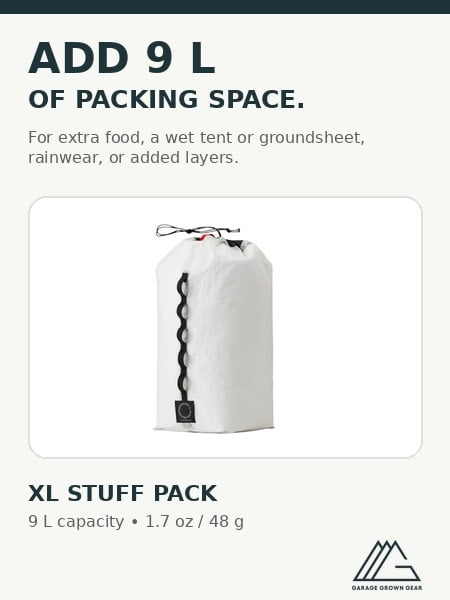 XL Stuff PackLightweight stuff pack designed to secure to the top of your backpack for carrying wet gear, extra food, rainwear, or layers.
 © Beartooth Media Group Inc.
 Loading...