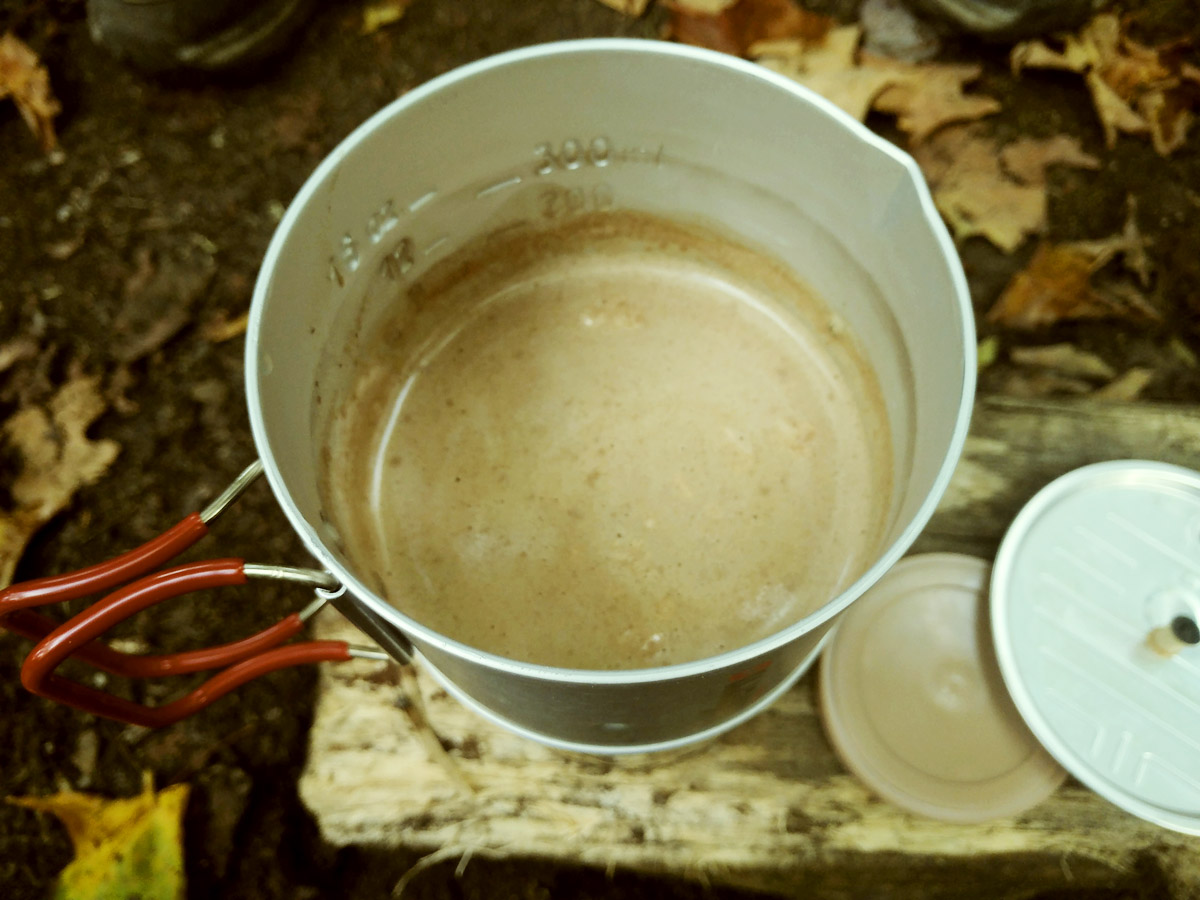
After performing a lot of tests, comparing a straight sided (cylindrical) pot support/screen to a cone-shape support, trying different stoves with each support/screen, testing in varying temperatures and windy/breezy/calm conditions, and using a pot cozy vs. no cozy, I believe it’s now time for me to post my results. I think I pretty much know how things work with the blasted Sterno Inferno pot.
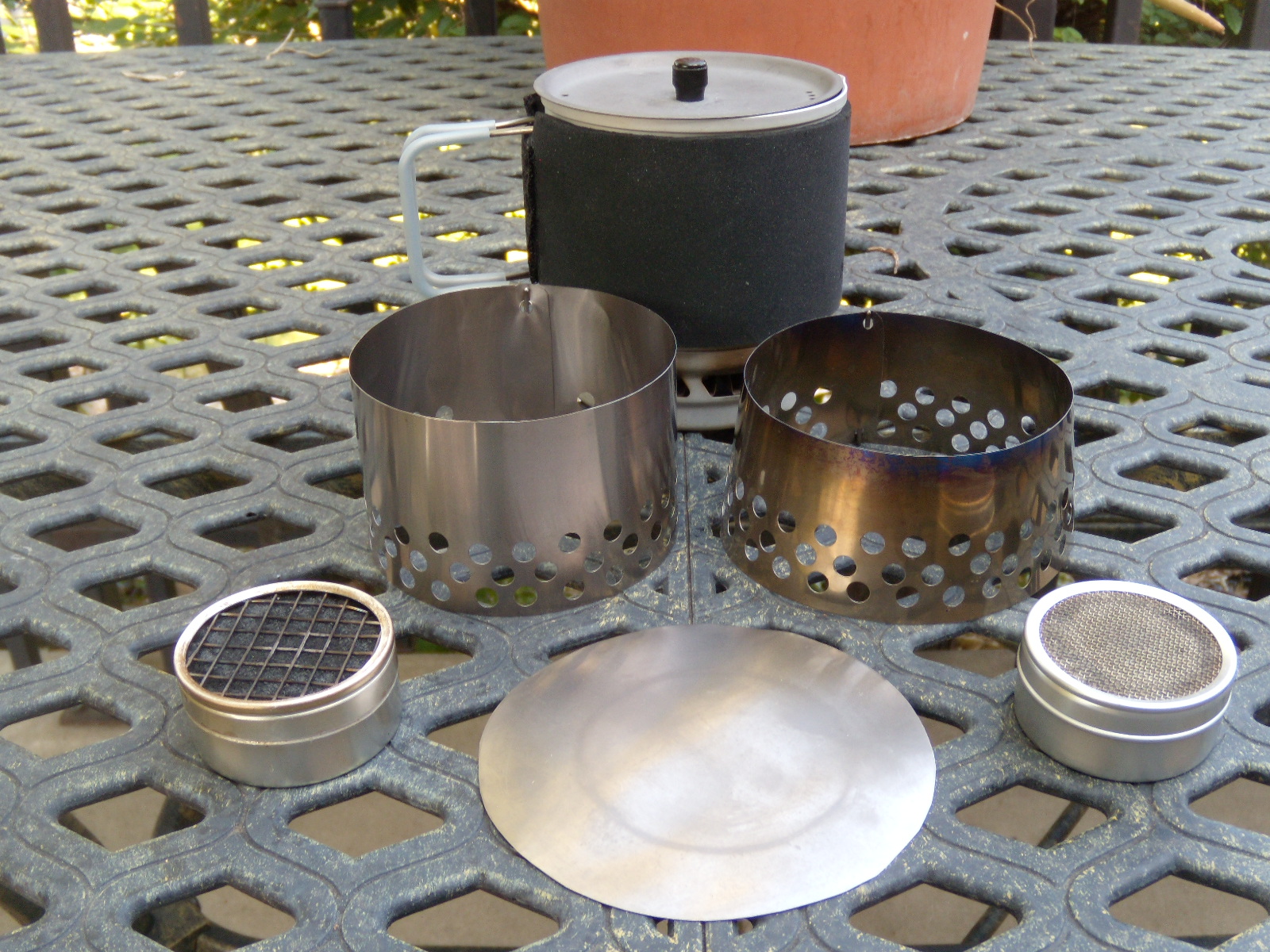
The following photos show the components that I’ve settled upon:

What you see is the Inferno pot with the cozy I made for it, a 2-3/8″ tall cylindrical pot stand/support (left), a 2.0″ tall cone support (right), one of Dan’s original Starlyte stoves (on the right) and my carbon felt version of a similar stove (on the left), and a titanium base disk in the foreground.
The next photo shows the pot on the cylindrical pot stand, the base disk, and a mini windscreen to be used in the event of a stiff breeze. I haven’t actually needed to use it yet, but during prior tests a significant breeze did in fact play havoc with the flames, making them dance around wildly. With air intake holes placed around the entire periphery, there will need to be a way to block the breeze.
Now, the evolution of my pot supports. My first rounds of testing were done with a 3″ tall cylindrical support like Bob made, using Dan’s Starlyte XL-3 burner. I used Klean Strip Green alcohol, which is what I had on hand. I only had air intake holes around 2/3 of the periphery, so that I could place the hole-less side into the wind for flame protection. The results were consistently poor – Lots of soot on the pot, wildly dancing flames, and 10-11 minute boil times. For starters, I bought a quart of Klean Strip regular denatured alcohol, which I think used to be called SLX. I then made the cone, which was 3″ tall and also had air intake holes on just 2/3 of the perimeter. The results were pretty much as before, although the cone seemed to be an improvement. At least the soot problem was eliminated.
I decided that there were several things wrong with what I’d been doing so far. First, I felt that the XL-3 burner was too large (in diameter) for such a small diameter pot/screen. There was just 3/8″ between the wall of the stove and the screen. It seemed that this might impede the airflow getting to the top of the stove. The XL-3 worked a bit better with the cone since it had more room at the base.
Next was my concern that the stove-to-pot distance was excessive. I also thought that I probably needed more air intake holes, to extend around the entire periphery. Finally, I felt that a smaller diameter stove would be better, so I ordered an original Starlyte from Dan. I had decent luck with a wedding tin filled with disks of carbon felt that I’d made, but I figured that Dan’s Starlyte might work better. In fact we both used identical wedding tins to make these stoves, but I think Dan’s wicking material (ceramic?) is superior to my carbon felt.
I cut the cylindrical pot support down to 2-3/8″, which decreased the Starlyte-to-pot distance by 5/8″, to 1-15/16″. I also cut the top of the cone support a bit so that the Starlyte-to-pot distance became 1.5″. I also placed air intake holes all around the periphery of both pot stands.
So there are several factors, aside from ambient and starting water temperature, as well as wind, that enter into maximizing the efficiency of this Inferno concept:
- Using the proper alcohol fuel (I actually prefer Klean Strip Green, but it doesn’t work well in this application for some reason. It boils comparably, but it is very sooty).
- Using the right stove.
- Optimizing the correct stove-to-pot distance; it does appear that there is a fairly wide range where it works OK. Still, there must be an optimal distance, right?
- Having plenty of air intake holes that are placed all around the pot stand periphery.
The past several mornings, conditions were right early in the morning to run a bunch of tests with my ‘final’ versions of pot stand/screens, using the Starlyte and comparing it to my MYOG felt wedding tin stove. The ambient air temperature was between 55-60 degrees F, and the water was the same temperature (I leave the jug outside all night).
The results were that every single 2-cup boil using either stand with the Starlyte was 8:30 minutes. Talk about consistency! The felt wedding tin stove was marginally less efficient, averaging 8:50 minutes.
Now, another test was done during all of this. I monitored the performance with using a pot cozy vs. not using one. The results were identical – every boil was achieved in 8:30 minutes whether a cozy was used or not. This observation differs from the one test that I had reported earlier. But after doing 10 tests now with, and without, a cozy, I am pretty convinced that there’s no loss of heating efficiency while using a cozy.
But this $25 steal of a pot became considerably more expensive as I got more into it. 2 quarts of alcohol, a fair amount of titanium foil, the fishing gravel gaiters to make the cozies, mailing one each to Dan and Bob, and the Starlyte stove brought the total to over $80. Not a cheap pot now, but it has been hours of fairly cheap entertainment. Still, it came with a heck of a lot of frustration and failed attempts and re-dos. And I haven’t even matched Bob’s excellent results…
If I might say so, this has been a program of passionate (if pitiful) persistence, akin to pensively perching precariously atop a proverbial pile of petrified putrified Pakistani poodle poop (alliteratively speaking…).
But it’s all for stove science, right?