Topic

DIY Walking Axe

  • This topic is empty.
Viewing 25 posts - 101 through 125 (of 160 total)
Steven Evans BPL Member
PostedJan 20, 2008 at 6:16 pm

Aaron,
I was talking with Kevin (he supplied the shaft) on Friday, and he told me to test the axe until failure so he could see if we can make some changes to the shaft. As it stands, the shaft is seriously strong. I actually supported it on both ends and stood in the middle of it, bounced lightly up and down and the shaft held strong (see pic).
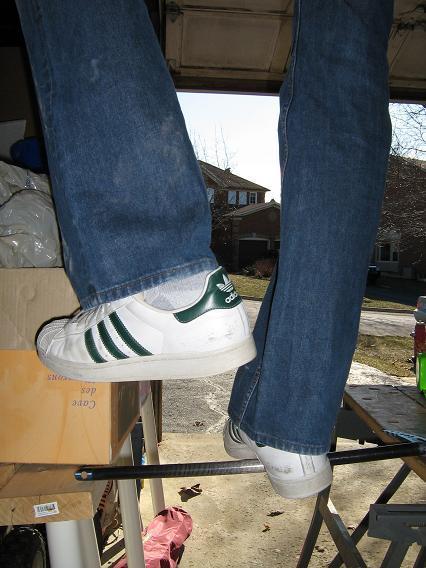
axe standing

The weak point is when I fix the axe head and load the other end. It should be able to hold about 130 lbs but at about 60, the ferrule of the head breaks through the side of the shaft. While I'm sure the longer ferrule in my new design will hold better, I'm not sure it will pass the UIAA requirements. I know that I'm not out to get it certified or anything, but it's nice to know that it can hold it's own with the big boys. I am wondering if some extra wraps on the end of the shaft would help it from breaking through while adding almost no weight – I'll find out from Kevin.
And don't worry Aaron, your name is on the list :) Heck, after breaking this one, my name is on the list too!

Rog Tallbloke BPL Member
PostedJan 20, 2008 at 6:33 pm

Yes please!
Oh, and can I have a 1/8 unf x 1/4" thread in the pick and point ferrules? Just glue the head in, I'll supply my own tie rod and do the rest. ;-)

PostedJan 20, 2008 at 7:33 pm

I'm all over that! Nice, thanks Steven!

Might not hurt to ease the edge on the ferrule-tang. Not substantially, just so it's dull.

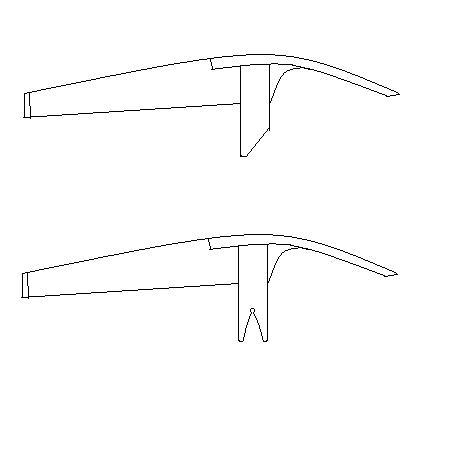
Imagine a long ferrule, with slices and.. :ferrule
Flexible because of the slices..

Roger Caffin BPL Member
PostedJan 20, 2008 at 8:53 pm

Hi Steve

> I am wondering if some extra wraps on the end of the shaft would help it from breaking through while adding almost no weight – I'll find out from Kevin.

You can put extra wraps of CF fabric on the outside, but I suspect it would have to be done by hand, and it requires a vacuum oven to cure it. Possible, but tricky.

Can I suggest getting Kevin to supply you with about 75 mm of CF tubing sized to fit just INSIDE the current tube. Sized to fit pretty tightly, and about double the length of the ferrule. Then, after you have glued the head to the shaft, glue the extra bit of tube inside the shaft at the head.

Another possibility is to use some high-tensile (7075) Al tube to sleeve inside.

cheers
roger

PostedJan 21, 2008 at 1:06 am

How about easing the edge of the ferrule, and a 'wedding band' on the outside? A looser fit on the ferrule might allow the glue layer to be thicker and mediate the strain. If the glue is harder than the CF, it should be less easy to penetrate by the ferrule, but would damp less.

What are the white 'flags' off the side of the ferrule in the tested to destruction photo? They look like tape.
Can't be certain from the photo, how was the adhesion?

A suggestion might be to rough the ferrule with 40 grit or turn a few scratches in it. Or drill a few small holes, some extra physical purchase for the glue.

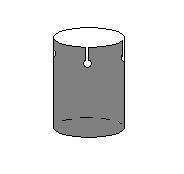
Another possibility to spread the strain would be to allow the tip of the ferrule some flexibility, why I had the pic above, but perhaps cutting it at an angle would do, if it's only failing in one way? OK one more and bed:piolet adze ferrule

Steven Evans BPL Member
PostedJan 21, 2008 at 5:10 am

Tallbloke,
I'll try my best, but I can't make any promises.

Roger,
I just e-mailed Kevin about the extra wraps – if you are correct, then we have to go another route. I really like the idea of adding another piece of the shaft inside as you mentioned. I e-mailed him all my test results, and since he would most likely be the CF guru, I'm hoping he can give some input.

Paul,
The white flags are the epoxy peeling off the ferrule. I kept them on for a more destroyed look ;) I am planning on adding some grooves on the ferrule for better adhesion aswell – and of course rough the surface. The angle idea is good aswell – the tests only call out for the axe to be tested in one direction (stress on the pick side, not the adze side), so maybe an angle on thew ferrule would allow me to lengthen the one side while shaving weight off the other.

I was thinking of placing the shaft inside the ferrule, so to speak. This would eliminate the loads that are breaking through the side wall and place it in tesion – which it handles very well.

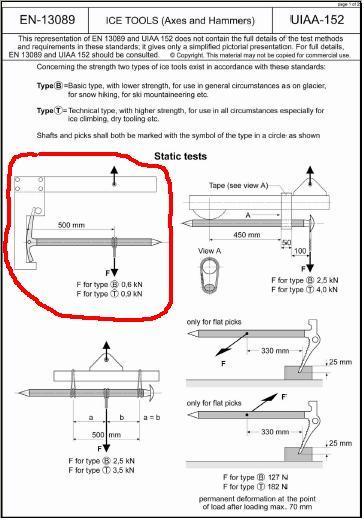
Here's a page from the UIAA req's. As suspected, it fails the one circled.

axe test

Rog Tallbloke BPL Member
PostedJan 21, 2008 at 2:35 pm

Thanks Steven!
If tapping the threads isn't possible, I'll settle for your glue job and make offerings to the epoxy fairies.

Roger Caffin BPL Member
PostedJan 21, 2008 at 7:58 pm

Hi Steve

I just took another look at the pic of the failure. I thought you had the Ti outside the CF shaft, but now I see it is inside. That kills the idea of the extra insert inside as the diameter inside changes.

Options:
1: put the CF shaft inside the head and reinforce inside the shaft for about 74 mm. Make the length of the ferrule at least TWICE the diameter of the shaft!!!
2: Put the CF shaft over the Ti ferrule as for V1, but make the length of the ferrule which goes inside the shaft at least TWICE the diameter of the shaft.

In hindsight, I am not surprised the joint failed: the length of the coupling is too short. This allowed too much leverage inside the joint. Me, I would go for 2.5 times the diameter…

cheers
roger

Steven Evans BPL Member
PostedJan 22, 2008 at 4:32 pm

I am beginning the design of revision 3. I am much more knowledgable about carbon at this point and feel much more confident in the next version. But, instead of updating this thread, I am compiling all my info into one document to hopefully get posted in the end.
The goal for the next design is to meet "most" of the UIAA requirements (selected by me, which will make me feel comfortable using the axe), especially for the shaft/head connection, while maintaining a sub 4.5 oz total weight. The carbon shaft will be bonded to the inside of the titanium head ferrule this time around. I am working closely with Kevin on the design of the shaft and he is going to supply me with several test shafts to perform stress tests. In the end, we should have a decent product. The goal of this axe is not to be certified as per UIAA standards, but to have the knowledge (and actual numbers) of the axe's strength, while feeling confident in it's capabities.
Afterwards, I will run a batch off and have them available for those that contacted me. Sorry for the delay, but I believe the wait will be worth it, as you will have a superior product.
Steve
p.s. don't worry Roger – longer ferrule is in the works!

PostedJan 22, 2008 at 5:11 pm

Hey Steven, last ideas for a while:

* A round-over or angle on the ferrule bottom outside arris, so it doesn't rub. Might pick up some flex if turned down to a cone on the outside, just watch for ripping if the wall gets too thin at the bottom. More operations though.

* If chopping the ferrule at an angle as in my pic above, would need to reverse the angle, since the handle is inside.

* Since inside now, may be possible to extend the handle up into the head some ways.

* If failing a test by crushing the tube, a small plug of balsa or something inside the handle, extending a short distance from the ferrule, may reinforce for little weight. It could be a disk with the end grain running parallel to the axe head. A la bamboo.

Keep up the good work!

Steven Evans BPL Member
PostedJan 23, 2008 at 4:45 am

Paul:
"Since inside now, may be possible to extend the handle up into the head some ways"

That is the plan.

Denis:
"I would be interested in getting on your list. Is this possible?"

Of course – While there is no official list, I'll take a total number at the end and run a batch off. Denis, your number 18!

Aaron Sorensen BPL Member
PostedJan 24, 2008 at 2:10 pm

Hey Steven,
I hate to say this, but.

I would rather have the 3 oz version.

The current strength, or least changing it to the ferrule Paul described is good enough for me.

Adding 50% of the weight just does not justify the weight penalty for what I will be using it for.

Someone out there has a carbon shaft just like this that is about 3.1 ? ounces but is not approved and they call it a trawl.

I'm sure your current version is stronger, but at 4.5 ounces and still not having it pass UIAA requirements is more of a negative factor than what the current 3 ounces has to offer for the weight.

I am sure most will disagree with me, but again, I am not going to be climbing ice-falls with it.

Kevin Sawchuk BPL Member
PostedJan 24, 2008 at 4:07 pm

I'm interested in one of these as well. I've been disappointed in how quickly the helix head has worn out with use–it didn't seem like titanium.

Bob Bankhead BPL Member
PostedJan 24, 2008 at 4:59 pm

Any idea of the price range for one of these? I'm sure that would help to populate the "I'll take one" list with folks who'll actually pony up the bucks when the time comes.

Steven Evans BPL Member
PostedJan 24, 2008 at 5:15 pm

Aaron,
I like the way you work my friend. :) – I too hate to add weight to this thing. While I'm not trying to convince you that the weight is worth it, at the current design stage, weighing in at 4.4 oz(only 0.4 ounces heavier then the last) – it is a tank.
Another reason for the added weight is that I have 14 local guys waiting for these things (plus 8 from BPL), and they are all concerned with the head tearing through the side wall at 60lbs – which happened.
But, I always like a challenge…
Sooooooo, I can make you the exact same one out of aluminum and it would weigh 3.3 oz. Or perhaps an aluminum head with a titanium spike? That one would come in at 3.45oz.

Steve

p.s. Kevin, you are #22. Is the aluminum head wearing that much? I'd be interested in a pic if you have one.

Steven Evans BPL Member
PostedJan 24, 2008 at 8:31 pm

"Any idea of the price range for one of these?"

While I would love to compete with the price of the Helix, I'm afraid this one will be around 200 bucks. :(
No need to worry about "ponying up" when the time comes, those who have contacted me about them are welcome to back out. I only planned on making about 25 – so by the time I have designed, manufactured, and tested the new version – you'll know if you want one or not.

Steve

Aaron Sorensen BPL Member
PostedJan 24, 2008 at 9:56 pm

Steven,
Aluminum??? Why?
I love Titanium.

If you make/buy something you aren't happy with you'll just end up making/buying what you wanted in the 1st place later.

3.3 ounces sounds a lot better than 4.5.

Steven Evans BPL Member
PostedJan 25, 2008 at 4:53 am

"3.3 ounces sounds a lot better than 4.5."

OK, I'll try my best.

Or, I could just do what most of the big guns do. Claim a 3.3 oz weight and when you get it, it weighs 4.4. ;)

PostedFeb 5, 2008 at 4:22 am

Steve,
I would like 2 if possible
thank you for being gentle with my brain storm session on radius of gyration. Thinking about it practically the curve of the adze head has to be right at the end, or otherwise the extension beyond will hit the ice and be impractical, and therefore the adze blade will be beyond the radius of gyration, It will still work best if the radius of gyration is as close as possible to the end. I imagine your ultra light shaft will make this axe better than most in this way. When it comes to the pick you do have the chance to put the pick point right on the radius of gyration. If you straighten the point as you mention in your field test, I think you will be moving in the right direction.

Steven Evans BPL Member
PostedFeb 5, 2008 at 2:42 pm

No problem Derek. 2 it is.

You'll be happy to know that I put much more thought into the head this time around…including measuring my actual swing radius! I'm no mountaineer, so all input is welcome.

I've already cut the pick and adze, waiting on the shaft from Kevin and just need to machine the ferrule and spike.

Steve

PostedFeb 6, 2008 at 5:46 am

I am keen on your axe because I expect it to be tougher and blunt less, than a Helix because of the titanium head. I would prefer a design that is a lttle better in every way than the Helix (price excepted) so I hope it will be at least as strong as the helix and a little lighter.
I have a degree in Ergonomics rather than hard engineering and I am a carpenter so I have used a traditional adze a lot.
Concerning the swing radius of the adze head. When cutting slash steps I was taught to swing from the shoulder with a straight arm. However with such a light axe I would have thought the optimum technique would be more wristy than that. The swing radius depends on how you use it. I would have thought the worst error would be to have an adze head too curved for the users action. So I think I would work the adze swing radius on something near a swing from the shoulder.
Concerning the pick point placement: ideally someone has a computer programme which can put in the position of masses and work out the radius of gyration. Otherwise it is educated guesswork. I would have thought that using the pick point was a very wristy action and the centre of the swing radius will be near the hold position. With a theoretical weightless shaft and all the mass concentrated at one point then the radius of gyration is the radius of the mass from the swing centre.If the mass is a real life sphere the radius of gyration will be a little further out than the C of G of the sphere, because we are talking 2nd moments of inertia and the mass further out has more effect. To remember back 40 years to A level physics the radius of gyration of a uniformly distributed shaft with no head rotated about one end was an exact fraction 3/4 or just maybe 7/8 of the shaft length. Whilst of course the C of G would be 1/2 length
If we think that a traditional ice axe has become right through use. I would predict that this markedly different adze with a relatively weightless shaft would have a radius of gyration further out than tradition is used to.
If you test axes to find the C of G I guess a wooden handled one will have a C of G well inboard of the head, whilst your prototype will have a C of G almost on the head. (I sort of feel that the spike weight should be discounted because it is very near the swing point). If the C of G is almost on the head then it is much more like a sphere of mass on the end of a weightless shaft. In one model(the uniform shaft) my guess would be the radius of gyration might be half the distance from the C of G to the outer end, in the other (weightless shaft) it would be just beyond the C of G. I would use the C of G position to determine the proportion of each model involved. If you drew such a radius of gyration on a drawing of your axe I think the point should be on the arc.
I hope thst helps, or at least gets people who remember their physics better than me to put me right.

PostedFeb 10, 2008 at 4:03 pm

Hi Steve, I am wondering about actual tests in self arrest? That and self-belay are my main uses.

Hope you have plenty of hard snow and ice there! Turned out to be a good winter here.jakes view west

PostedFeb 11, 2008 at 12:57 am

Steve,
I imagine you are changing the design of the axe to stop it filling with snow. I have a multi use purpose for a short aluminium tube up the hole in the spike. I hope your new "plug" is going to be removeable.

Viewing 25 posts - 101 through 125 (of 160 total)
Loading...