


Thanks for the info Edward, Jerry, and Owen. I wasn't completely certain, and what you all say makes sense.
Edward, i'll get back to you about the silicone DWR etc. Up too late currently.
Topic
Become a member to post in the forums.
 .
.
Thanks for the info Edward, Jerry, and Owen. I wasn't completely certain, and what you all say makes sense.
Edward, i'll get back to you about the silicone DWR etc. Up too late currently.
Specific way to keep feet warm with light shoes or boots
http://blog.owareusa.com/2011/11/14/using-light-boots-in-the-snow-and-wet-vapor-barrier-socks/
External heat from a hot water bottle(s) can revive cold hands, damp sleeping bags and frozen boots.
Stiff lower backs respond well to a hot water bottle tucked in your mid layer.
Bring extra fuel.
If you know you'll be wet (soaked by rain, constantly wading creeks, for ex.) Gore-tex boots will only work for a day or two at most before they wet out.
I recommend wearing thin (2 or 3 mm), seam sealed neoprene diver's sox over very thin poly liner sox. Change the liner sox nightly and turn the neoprene sox inside-out to dry at night.
Your feet will be warm even though wet with sweat and outside water.
And what Eric Chan and Roger said, wear gloves-> Neoprene gloves work well for this kind of weather too. Reinforce wear areas (web of thumbs, etc.) with Shoo Goo or heavy Seam Seal.
Wow, thanks all for the plethora and variety of responses to my post. I'll also look forward to hearing Chad's comments and experiences as he was hiking the same trail the day I finished up.
From reading your responses, there are two approaches that stand out. I'll try to outline them as best I can and allow you to assess whether I'm portraying them accurately. (I'll focus on feet and upper body as these seem to be the areas most susceptible to cold).
Approach #1: Keep feet dry (using Gore-tex socks, i.e., Rocky Goretex, and waterproof gaiters, such as the UL ones that MLD sells) and/or wear a heavier midlayer top (e.g., 100 wt to 200 wt fleece or synthetic puffy) to keep the upper torso warm.
Approach #2: Allow feet to get wet but perhaps minimize the effect on bodily warmth by using non-waterproof neoprene socks layered over thin wool socks, such as NRS Hydroskins. (This technique is used by surfers and fishermen). Leave behind the heavier midlayer in favor of a thin synthetic baselayer (less clothing to get wet), relying on movement to keep warm. Set up shelter as needed and don warm puffy layers (down or synthetic fill jacket and dry socks / baselayers) to stay warm.
I'm tempted to try a combination of the two methods. With regard to wet feet, I've tried on Rocky Goretex socks before and found them somewhat uncomfortable. But has anyone tried these?
http://www.sealskinz.com/UK/socks/thin-ankle-length-sock
Are they good to be true?
Reflecting on my own situation this past week, the main problem I had was that I allowed my down insulating garments to be exposed to the elements, not realizing how quickly snow/sleet could turn into rain. This problem was compounded by wet feet (I exclusively wear breathable trail runners and find no reason to stop doing so). I'm wondering whether dry feet would have staved off the cold/wet long enough so I could get to / set up shelter, get a hot meal, and keep going. As it was, I was exhausted from lack of sleep (and lack of food) the night before and decided to hike out.
Dryer than goretex socks are to use fully waterproof barrier with insulation and VBL under that.
Rubber boots or plastic boots also will be better in some conditions.

I put bread socks directly on feet, and they "turned into prunes". Seemed like high risk of getting blisters,…
Maybe I should have had thin socks under bread bags?
Use the neo socks for the VLB, then wool then bread sacks over everything including insoles and tape over top of instep to hold it all in place. Use gaiters and rain pants in shingle fashion. See my link above for pitchers.
or buy some $14 gum boots and wear two pairs of wool socks and deal with damp but warm feet.
or buy some Tingley half height rubber over shoes for your hiking sneakers.
http://www.tingleyrubber.com/product/natural-rubber-overshoes.html

I've been considering bread bags over wool, Rocky GoreTex over wool, or neoprene socks in my winter (i.e. larger) trail runners instead of just letting my wool socks get wet and changing to dry socks once I set-up camp. Like someone has already said, changing into wet socks is a blaa way to start your morning.
+1 on the hot water bottle, I'm not ashamed to say that when I climb into the sleeping bag my nalgene bottle is kind of hawt.
Bogs with sheepskin insoles and heavy wool socks are my go to day-to-day winter footwear, but I've only used them a few times on short hikes, I'm not sure how I'd like them on longer hikes.
Since I have never been able to find waterproof socks to fit over my size 14/15 feet I was wondering if there was a more durable bread bag variant? Thank you.
The next time you're at Costco pick up a couple of the bags they have on rolls in the meat department. They're big and pretty tough.
The bags in Whole Foods meat department are thick and fairly durable, and lighter than bread bags. Last weekend I tested a Rudi's bread bag, and it was indeed waterproof and pretty tough. 7 grams each though…
Your feet will slide through the toe of the sacks unless you gather the extra over your instep and use a 3 inch piece of duct tape to hold it together. Putting your insoles inside the plastic helps too.
A lot of good responses; and here’s my method of madness:
“My feet were soaked through after stepping in puddles, and starting to freeze up.”
“I'm curious to hear what approach you guys take to hiking in sustained, cold/freezing rain (or in snow, for that matter).”
Ironically, my feet are the warmest in these terrible conditions (hiking in rain/sleet 30-50F. I’m in my sandals with a thin cool-max sock overlaid by a thick Fox River wool sock. They get wet; but wow they stay warm (as long as I’m walking)! I don’t quite understand the science of why. From 20-30F I do don sealskinz. I don’t wear these long or I’ll get blisters. Another option I do is put on a down bootie if I need more warmth. I show some pictures at http://www.backpackinglight.com/cgi-bin/backpackinglight/forums/thread_display.html?forum_thread_id=81320
“Do you use waterproof socks?”
Sometimes. I don’t want to stay too long in this condition if my foot is heating up. When my foot gets warm I immediately take off the sealskinz and if I’m in sleeting rain I just let the feet get wet. In these super-wet boggy conditions, it’s important my feet can breathe. Otherwise they can prune up and crack and bleed (like several of my hiking buddies). And as explained above, my feet are wet, super breathable, and yet warm.
“An additional synthetic midlayer?”
I wear a light synthetic T-shirt, then button down long sleeve nylon shirt. Over that I (sometimes) wear a Montbell Thermawrap action (only holds 1% water weight — unlike fleece). And I use my Golite Umbrella over me. And I definitely need gloves. For 8 years I’ve been doing well with some Manzella Men's Silkweight Windstopper Gloves. They get wet but my hands stay warm enough when I’m flexing them on my GG poles. My nylon zip off pants just get wet but they stay warm from walking. I take off the coat a lot because I warm up. The shirt stays dry because of the umbrella; much dryer than wearing a rain coat. My hiking buddies get jealous because of my super dry shirt. Every single time they go out with me (since then), they bring umbrellas. And I wear wrap-a-round earmuffs with Velcro (I have a hard time finding these).
Good luck in the wet cold wild,
-Barry
-The mountains were made for Tevas
"Have you tried again with a non-DWR fabric?"
I had treated a few different fabrics before hand, but i haven't had the other ones tested for HH or CFM by Nisley or others. For some examples, i bought a few cheap (Champion brand) windshirts at Costco made out of mostly polyester. They were too breathable and didn't seem to have a DWR. In case they did have a DWR (i knew nothing of the fabric except superficial judgement), i washed them in hot water and with oxy clean and rinsed very well, then i treated them with similar silicone treatment as i did with the Maxima ESD fabric i had sent to Nisley. They now are obviously better with both wind resistance and water repellency, though i'm sure i added some noticeable weight.
"I imagine you could just do a water column test of your own and compare fabrics that way, or a coffee-filter type test in lieu of something more sophisticated for air permeability."
Sure, but at this point, i'm not that invested. I've gotten away from both BPL and gear obsession quite a bit lately.
"Some time back, Richard tested Momentum 90 taffeta to 950mm and 4.7CFM, which is pretty startling I agree. Nothing else seems to come close, and I can't help but wonder how they achieved this with 1.1oz DWR nylon."
That's pretty impressive. Sounds like a combination of tight enough weave, non rip stop weave improving the HH a bit, small enough fibers, and high quality DWR coating. Sounds like it would work well for Paramo type applications, though perhaps you might want some higher CFM off the bat.
Regarding trying different insulations with a Paramo type system you wrote, "I wonder if a less insulating, lighter middle layer could be used – maybe Fullrange or Alpha. Either would certainly be lighter….60-80g/m2 vs maybe 150g or more for the dwr fleece pump liner, and perhaps more air permeable/cooler. Not sure if they would still prove too warm though? I suppose Fullrange is still warmer than 100 wt fleece anyway…"
The Nikwax Analogy pump liner fleece and similar equivalents will be much more breathable and definitely less warm than Fullrange and Alpha insulations. I would say the pumpliner is slightly thinner than 100 wt fleece and so it will be slightly less warm than even that.
Fullrange and Alpha sound like a cross between Thermal pro and continuous filament insulation like Apex, with a more breathable shell and lining material. If also combined with a windjacket as in a paramo type system, it will be much less breathable than pumpliner plus windjacket.
Anyways, you can go up to about 50* F with a proper paramo type system. For temps higher than that, i would recommend at least a partially WPB Poncho. For example, i took two ponchos and cut out a large part of the chest area and sewed other material onto same (in one case, EPIC and in another Maxima ESD, but i'm thinking i will have to replace the Maxima with something more water resistant). Combine that with a WPB wide brimmed hat, so that you can open up the top part of the chest of the Poncho, you'll get about as much breathablity as is currently possible in rain protection systems for warmer weather conditions. eVent Packa looks nice, but too expensive for me.
I've hiked a lot in cold, wet conditions here in Alaska. I have found that a pair of Cabelas neoprene socks and running shoes works best for me – warm feet even when wet.
At night, I turn them inside out to dry. I sometimes wear knee high hose as a liner sock inside the neoprene.

I always wear waterproof socks when I hike. I recently tried RANDY SUN waterproof socks. They are very waterproof and comfortable and breathable enough to keep my feet dry and comfortable.
Jared, Do you work for RANDY SUN? You have only posted 3 times here on BPL and all 3 are promoting RANDY SUN waterproof socks, and you are digging up old posts like this one that is 8 years old and another one that was 12 years old just so you can mention that brand of socks. You should be up front about your affiliation with the brand, instead of pretending to be a member who has something to say on hiking and not just advertising your product.
3 MM CLOSED CELL DIVERS SOCKS:
For many years now here on BPL I have explained the benefits of these divers socks (in particular US Divers brand) as the way to keep your BOOT INSULATION protected from your sweat.
Yes, the next trick is to keep that insulation protected from outside wet. Gore-Tex won’t last long enough to pay for the investment so you need a WATERPROOF non-breathable upper to at least your ankles. For cold, sub-freezing weather I have SCARPA plastic Telemark ski boots with a Vibram sole and removable insulating liner. For VERY cold weather (sub-zero) I wear Canadian SOREL felt pacs.
With both I wear 1.) thin synthetic liner socks and 2.) 3 mm divers socks I carry one pair of liner socks per day, changing them out at night before bed.
The skanky, wet liner socks go into a ZipLoc freezer bag. New liner socks go on when my feet get dry in a few steaming minutes then thick wool “sleep socks” go over the new liners. The divers socks get turned inside-out and go in the bottom of my winter mummy bag along with the boot liners. In the morning I don the divers socks, put the warm boot liners back into the boots, don the boots and VOILE’ ! warm feet all day.
BTW, knee high gaiters always keep feet at least another 10 F. warmer plus , importantly, they keep snow out of boot tops and off the liners.
Become a member to post in the forums.
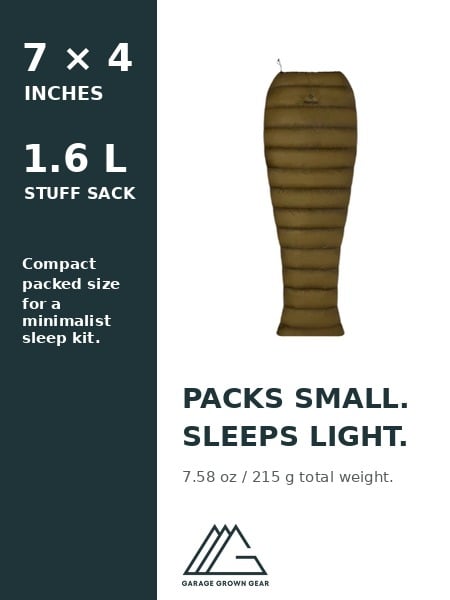 Magic 100 Sleeping BagMinimalist 900-fill-power down sleeping bag with a 55°F | 13°C comfort rating. Weighs 8.46oz | 240g
 © Beartooth Media Group Inc.
 Loading...