

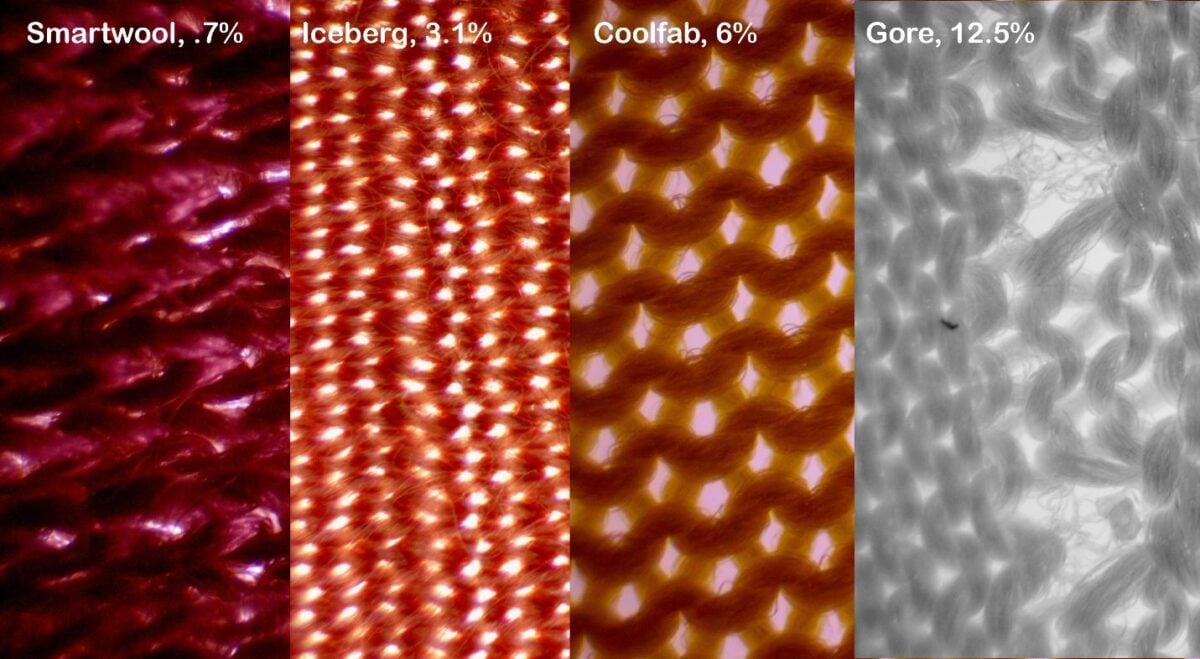

You have been hiking for hours, working hard, and sweating a lot. You arrive at camp, sit in your camp chair, and look forward to enjoying the reward for your efforts while waiting for your sodden base layer to dry using your body heat. You wonder, can I produce enough body heat to dry my sweaty shirt?
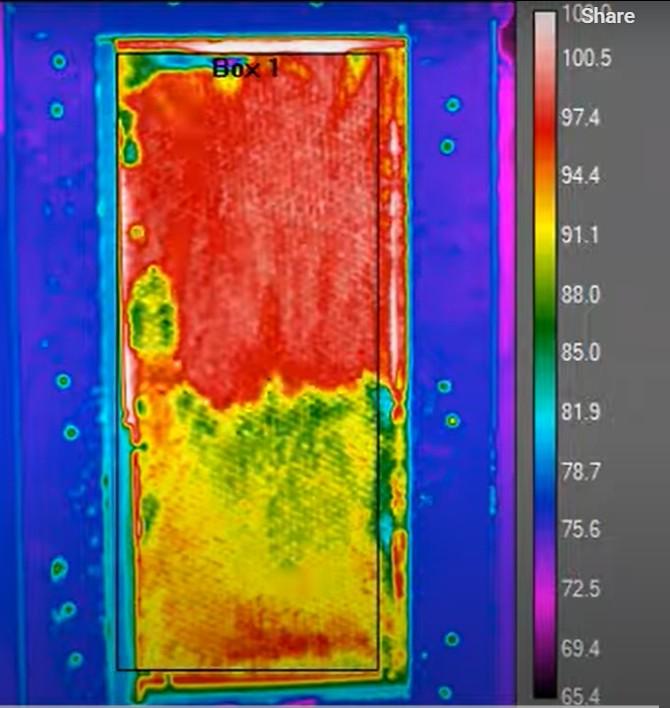
In this article, we will explore two things. 1) How much of your body’s energy does it take to dry your wet base layer, and 2) Do fabric choices make a meaningful difference in the energy required to dry your wet base layer?
Here is a quick example:
Suppose your shirt is 250 grams per square meter (GSM) Smartwool. When tested in my lab, that shirt, when saturated, would hold 630 grams of water, and drying that water would require 637 watts of heat. 637 watts is a lot of heat! It is equivalent to the heat produced by a 100-watt light bulb operating for 6.37 hours! I think you would be hard-pressed to dry this fabric with body heat without risk of hypothermia.
Why Another Drying Article?
I undertook this article because I wanted to investigate the drying penalty imposed by hygroscopic fibers, such as Merino wool or cotton, on base layers. As I discussed in my previous article, water molecules bond to the surfaces and interiors of hygroscopic fibers, providing water with a place to cling that is not found in hydrophobic synthetic fibers, such as polypropylene and untreated polyester. I reasoned that hygroscopic base layers should require more energy to dry. The results were not what I expected, but other key findings emerged.
Key Findings
- The primary driver of the energy required to dry a fabric is the quantity of water it contains. Variation from other factors is minor. In this study, variation from other factors, such as fiber type or fabric construction, was less than 10%.
- I could not find a hygroscopic drying penalty that warranted concern. Therefore, I must conclude that the fiber type had no significant effect on drying behavior. In fact, the second-best performer, by a small margin, was a hygroscopic fabric.
- At saturation, the primary determinant of how much water is trapped in a fabric is fabric thickness, accounting for nearly 90% of the variation in drying energy.
- Small variations in drying energy come from changes in fabric structure and fabric type. At this point, I would say that fabric porosity, the number of voids in the fabric, is likely the most significant secondary influence on drying performance.
- To reduce drying energy for your base layer, choose a thin fabric. It will hold less moisture and dry with the least energy. It will also saturate quickly, so your sweat will just drip down your soaked shirt and be wasted as you try to stay cool. Tradeoffs!
Test Setup and Methodology
When we hike, we don’t care about how fast a fabric dries. Instead, we care about how much of our body’s energy is required for drying. That is one of the key metrics I aim to measure in this study. Likewise, to assess the hygroscopic drying penalty, I need to determine the energy required to dry each fabric, enabling a comparison of energy needs between hygroscopic and non-hygroscopic fabrics.
These realizations led me toward a new approach to drying, which I accomplished using my guarded hot plate, a device I had built several years ago to measure the thermal resistance of insulation. This instrument measures the energy required to dry a sample in watts/hours.
A guarded hot plate is closer to the drying process for a base layer worn by a hiker than the air drying process I used in the last two drying articles.
During air drying, air flows over both sides of the test fabric, enabling moisture to evaporate from each side. There is no actual heat source.
Fabric dried on a guarded hot plate comes into contact with the heat source, much like when a base layer is worn over warm skin. With the guarded hot plate, all moisture in the fabric must evaporate and escape through one side into the surrounding air.
As part of the process, the guarded hot plate directly measures the amount of energy required to dry water trapped in a base layer.
How is a Guarded Hot Plate Constructed and Controlled?
A hot plate’s primary component is a metal plate where the wet fabric sample is placed. An electric heating wire is tightly wound in a serpentine pattern on the bottom of the plate. One or more thermocouples are used to measure the temperature of the hot plate’s surface. Additional heat plates, called guard plates, are positioned around and beneath the hot plate. The guard plates ensure that all heat produced by the hot plate is transferred into the test sample.
Member Exclusive
A Premium or Unlimited Membership* is required to view the rest of this article.
* A Basic Membership is required to view Member Q&A events


Discussion
Become a member to post in the forums.
Companion forum thread to: By the Numbers: The Energy Cost of Drying Your Base Layer (Drying Part 3)
Drying wet base layers with body heat demands significant energy. The choice of fabric (wool vs. synthetic) makes little difference; the quantity of water is key.
Nice article. Good test setup. Thanks for doing this.
That makes a lot of sense. Type of fabric not important, just the amount of sweat.
Special “wicking” fabrics seem more marketing driven than being better. If the fabric wicked away water it may actually be worse because you won’t notice you’re sweating and remove insulation layers, so there will be more sweat to evaporate.
I wonder how much the effective R value would be while it’s drying? Some power is used to evaporate water and some power will make you warmer. If the insulation is dry, for a certain power, there will be a temperature difference across the fabric. This temperature difference is proportional to the R value – if you have a higher R, there will be a bigger temperature difference. If the insulation is wet, the temperature difference will be less, because of the heat required to evaporate the water. If, for example, the temperature difference is half when it’s wet, then it’s effective R value is half.
When I’ve gotten my base layer wet (because I was too slow to remove insulation) and I get somewhere and it’s cold, I’ll put some insulation on and after a while the base layer will dry, but I seem a little colder than I would with a dry base layer. Just guessing, while the base layer is drying my insulation is half as warm.
Hi Jerry: Thanks for reading. I will take a shot at what you have observed. If you place a layer of insulation over your wet layer, the Delta T present over the base wet layer is reduced because it is shielded from the presumably cooler ambient air temperature. The amount of energy required to dry the wet base layer remains unchanged. However, the drying time is increased and your heat loss at any given movement slows. This makes the drying process less uncomfortable for you. For example, this is evident in the Alpha Direct drying process quantified in the article. All of the fabrics dry at about 1 watt/hour per gram of water. Most fabrics dry at a similar rate of about 1 gram per minute. There are two outliers: Smartwool and Alpha Direct. I am not quite sure what is going on in Smartwool but it might be the same as Alpha Direct. These fabrics take nearly twice as long to dry, but their drying energy is about the same as the others. The sample dries from the bottom up because it is sitting on its heat source. As the bottom insulation dries, the insulation above is still wet. The bottom dry insulation decouples the wet insulation from the skin in a way that does not occur in the other test fabrics (except perhaps Smartwool). I have not come up with an explanation yet why this does not happen in the other fabrics. When the thermal decoupling occurs, drying slows, the rate of heat loss from your skin slows and you probably feel less uncomfortable and might even feel like the wet insulation has dried. You feel dry and warmer, but the drying load on your body remains until the fabric is completely dry. I am presently studying various aspects of five fuzzy fabrics, and this decoupling effect has become unmistakable in my data.
Thanks
If it slowed down drying which made it feel warmer that might be a good trade-off
It also validates the old wisdom of wringing out your clothes when you fall into a stream/lake.
Thanks Stephen. This, and your earlier article on drying times, are very important contributions to a critical issue.
Just to add to tkkn c’s point about wringing out – This seems key. I was able to dramatically reduce the amount of water in my saturated alpha direct top by ringing it out. My AD90 hoody weighs about 130g dry, after immersing and resting on a drying rack for a bit it weighs around 1kg(!). But then a thorough ringing with my hands and I got the saturated garment weight down to about 400g.
interestingly I seemed to get quite a repeatable water gain after soaking and ringing. Could “rung -out weight” be a useful metric to include in the mix?
Very interesting article, thanks for posting. I’m curious how cotton would’ve compared – did you collect any data on cotton?
Eric S – yes, part 2 of Stephen’s series on drying looks in-depth at cotton.
Hi Hugh. Thanks for reading. Interesting about the repeatable water gain after saturation. I find this is a hard thing to do, but I used that method in my first drying article. I would saturate a sample a bunch of times and average the results. I eventually concluded I was removing too much water. In this article, I decided not to dry from saturation because, even if you can achieve repeatable saturation, it is still difficult to compare drying performance with other fabrics that hold different amounts of water when saturated. My present treatment for saturation is to saturate the sample so that it stays under water (meaning all the air bubbles are gone). Then I pull it out and let it drip for 10 seconds. Then I place it on a sheet of paper towel for 10 more seconds to remove surface water. Then I weigh it and calculate how much water was added to the dry sample. I do this three times and take the average. I think this is useful so that a user could understand which fabric might hold the most water and therefore, require the most energy to dry. Certainly, a user’s experience will vary because this method probably removes more water than would be the case if you actually saturated one of your layers. Of course, we have seen in these articles that the thickest fabric will tend to hold the most water.
Hi Eric. Thank you for your comments. I have since done more fabrics, but not a piece of cotton. I should cut up a T-shirt and do just that. I did look at a single piece of T shirt as Hugh pointed out. I really think the drying energy is what we should be interested in so it will make a good addition to the fabrics I have already dried. I will post back when I have done it. Who knows, maybe I will find the elusive drying penalty for hygroscopic fibers.
Hugh,
Your process and resulting conclusion are valid but missing one added step after wringing; tightly wrap it in a pack towel or sacrificial dry garment and then stomp on it to remove about 50% of the remaining water before putting it on. For most of the people, the following details are of little or no value (smile).
Below is a back-of-the-envelope comparison that shows how much extra heat a person would have to supply to dry an Alpha-Direct hoody (light polyester) and a mid-weight 100 % wool hoody after full immersion.
Key assumptions (you can scale the numbers up or down if your garments differ):
1. Dry mass
• Alpha-Direct hoody ≈ 0.25 kg
• Wool hoody ≈ 0.40 kg
2. Water remaining in the fabric
(values are typical of field tests; they differ because polyester doesn’t absorb inside the fibre, wool does)
• After simple immersion/drip:
– Alpha ≈ 2 × dry mass → 0.50 kg water
– Wool ≈ 4 × dry mass → 1.60 kg water
• After a strong hand-wring: about 60 % of that water is expelled.
– Alpha 0.20 kg water
– Wool 0.64 kg water
• After “roll-in-towel & stomp”: another 50 % of the remaining water is removed.
– Alpha 0.10 kg water
– Wool 0.32 kg water
3. Latent heat of vaporization of water (at garment temps around 20 °C):
L ≈ 2.45 MJ kg⁻¹ (= 2 450 kJ kg⁻¹).
4. Typical time needed to dry while worn (ventilated but not windy):
• Alpha – 3 h (soaked) → 2 h (wrung) → 1.5 h (towel)
• Wool – 6 h → 4 h → 3 h
These times are only to turn the garment “comfortably dry to the touch”; in reality they vary with air flow, humidity, body heat production, etc.
────────────────────────────────────────
How much energy (MJ) must be supplied?
Energy = water_mass × L
Alpha-Direct
1. Wear soaked: 0.50 kg × 2.45 MJ = 1.23 MJ
2. Wring, then wear: 0.20 kg × 2.45 MJ = 0.49 MJ
3. Wring + towel, then wear: 0.10 kg × 2.45 MJ = 0.25 MJ
Wool
1. Wear soaked: 1.60 kg × 2.45 MJ = 3.92 MJ
2. Wring, then wear: 0.64 kg × 2.45 MJ = 1.57 MJ
3. Wring + towel, then wear: 0.32 kg × 2.45 MJ = 0.78 MJ
────────────────────────────────────────
Convert that to average extra power (watts) over the assumed drying time:
power = energy / time
Alpha-Direct
1. 1.23 MJ / 3 h (10 800 s) ≈ 114 W
2. 0.49 MJ / 2 h (7 200 s) ≈ 68 W
3. 0.25 MJ / 1.5 h (5 400 s) ≈ 45 W
Wool
1. 3.92 MJ / 6 h (21 600 s) ≈ 182 W
2. 1.57 MJ / 4 h (14 400 s) ≈ 109 W
3. 0.78 MJ / 3 h (10 800 s) ≈ 73 W
────────────────────────────────────────
What those numbers mean to a wearer
• Resting humans give off ~80–100 W of heat. Light walking/hiking raises metabolic production to ~200–300 W (about half of which is useful heat, half mechanical work).
• Therefore:
– Alpha-Direct, even when dripping wet, can usually be dried just by sitting inside a shelter or strolling around; the 114 W is within resting output.
– A soaked wool hoody needs roughly twice that. You would have to be walking briskly, skiing, or otherwise active to supply an extra 180 W of heat without getting chilled.
– Removing water first (wring, towel) drops the requirement to a comfortable range for both fabrics. A quick towel roll is therefore worth the effort, especially with wool.
────────────────────────────────────────
Caveats
1. Real drying times hinge on air movement and humidity; with wind the power needed from your body falls because the environment does more of the work.
2. If the garment is under a shell, moisture must first migrate through that shell, slowing the process.
3. The numbers above are additional watts needed for evaporation alone. They do not include the heat your body expends to stay at core temperature in cold air.
4. Latent heat drops slightly at higher garment temperatures; the ±5 % difference is negligible here.
Use these calculations as an order-of-magnitude guide rather than an exact prediction, and adjust the water masses or drying times to match your particular gear and conditions.
Richard Nisely is back, hi, good to read your comments!
Nice calculations. Makes sense.
My only question is the last step. If it takes 114 W to be drying off your alpha direct, that exceeds the 100W that your body produces at rest. If it’s warm out that’s fine, when I first stop hiking and start drying, I’ll be producing more like 200 to 300 W so there will be plenty to spare. By the time my production goes down to 100 W I’ll be dry.
Sometimes when I stop it’s cold so I’ll need some watts to stay warm. Wearing a wet base layer will make me colder. So I put on some insulation over the wet base layer. I will need more R value in my insulation than I would if I was dry.
I’ve fooled with this before and found that I needed twice as much R value.
If the drying is slowed down because of adding insulation on the outside, that’s a good thing in a way, because less power is needed for drying, so more is available to stay warm.
temperature difference across an insulation (C) = R value (Rsi = m2K/W) * power (W) / area (m2)
Jerry,
You said in part, “My only question is the last step. If it takes 114 W to be drying off your alpha direct, that exceeds the 100W that your body produces at rest.”~114W drying energy drawn from your body at rest reflects the case in which the AD is still saturated due to something like a recent rain storm or a swim. If you will be static, have no other insulation layer, and you are not warm, wringing it out and putting it back on drops that to ~68W; the additional step of wrapping wrapping it in a pack towel and stepping on it repeatedly drops that to ~45W.
As I understand the second part of your post, we are in general agreement about the situation in which you must be static but have additional insulation that you can put on.
yeah, that makes sense
if you need some amount of insulation to stay warm at a particular temperature (and other conditions), how much extra insulation do you need to stay warm and dry out your base layer?
I routinely do this but I don’t know how much extra insulation I need. Maybe when I first put on the insulation I still have a higher body heat (MET) so I’m warm. By the time my MET goes down to a normal resting level, the base layer has dried out a lot so it quits robbing me of heat. Also, the temperature normally decreases over time – I get somewhere in the late afternoon at which point the temperature is dropping. By the time the temperature has dropped, my base layer has dried enough…
Become a member to post in the forums.