



Introduction
This article describes the design detail and performance of v4 of my DIY remote inverted-canister stove. Review Part 1 for background information about how this design evolved.
Pot Supports
How a stove supports the pot might seem like a minor detail, but it isn’t. A weak pot support can bend at the wrong moment, and there goes your dinner – plus a few other disasters – up to the point where you could end up with a destroyed tent.
Put the pot too close to the burner head, so the flame does not burn to completion, and you have a lot of CO coming off to poison you. Have a wobbly system there and you can even have the whole assembly falling over – with the flame still burning. Not an encouraging idea.
So we start with a little history:
V1 used a commercial burner head complete with its own integral supports, plus some pivoting legs underneath to hold the whole thing up. It was quite functional, but I didn’t make the burner head and that was disgruntling.
V2 used an external titanium wire tripod as pot support, which is a bit more stable but slow to set up. The stove support itself was based on a solid disk which was slow to set up on the mandatory base board. You could have problems if you used the small version of the tripod with a large heavy pot and ran the stove flat out.
V3 changed the titanium wire pot supports into radial things, so that only the inner ends of the titanium wires were near the flame and the supports themselves were vertical wires going down to the ground. However, manufacturing the stove body to secure those wire legs was very complex, and assembling the stove in the field took some time too.
Now, some commercial stoves use pivoting legs, and these are very easy to set up in the field. Rotating the legs out is simple. This was what I wanted. All I had to do was sort out the design constraints.
First, pivoting aluminum legs worked fairly well with V1 – but I only as a stove support, I didn’t use them for pot supports (I had concerns).

I worried that thin aluminum legs might have problems with the flames if they were used as pot supports, as well as being perhaps a bit wobbly. After all, I wanted the pot supports to be far more robust than, say, the old Pocket Rocket. On the other hand, Ti wire pot supports as in V3 can handle the heat and are fairly stiff, but how do you make simple rotating legs with them?
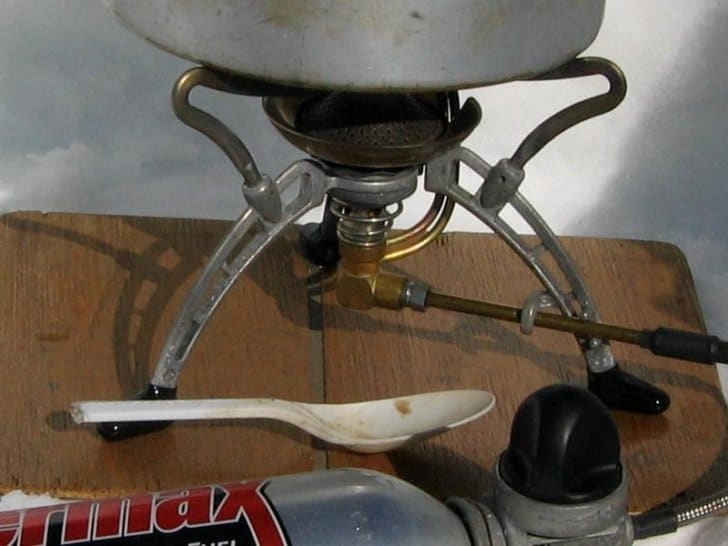
I diverted here to study the very fine Coleman Xtreme stove.
Member Exclusive
A Premium or Unlimited Membership* is required to view the rest of this article.
* A Basic Membership is required to view Member Q&A events


Discussion
Become a member to post in the forums.
Thanks @Roger,
I went and checked, and it measures 21.5cm across, so about 3.5l.
However, that doesn’t mean it is ever full of 3.5l water. I put in a bit of water, and the fill it with snow. I do add snow partway through, but never end up with it full of water.
Don’t I remember @Ryan Jordan using a ~6l popcorn pot for group trips?
I have some of the tall, narrow 2l pots, and there is no way I could get enough snow in those in any time effective manner to melt enough for even two people.
Does 21.5 cm count as a ‘large’ diameter in your experience, creating the issues of reflecting heat back down?
I would never use that on an upright canister stove, simply because of balance issues.
@Tjaard
21.5 cm – that is probably OK with a REMOTE canister stove, imho.
I hear you about snow melting. It doubles my fuel consumption.
Cheers
AHHH! A cliff hanger ending..
well done Sir
Part 2 this week I believe.
Cheers
Great article!
I want to buy one!
Let us know when you’re ready to make a small serie for us gear-lovers.
Binne Smid
Yeah, great articles, I like the sleeping on problems part…
If a stove flame output is turbulent, there may be better heat transfer leading to more efficiency
Are you considering this in your designs? Are you measuring grams of butane to boil a volume of water?
Hi Binne. Please email me direct via roger@backpackinglight.com for details.
Hi Jerry: oh yes, the flames are turbulent for sure. With the rates of expansion due to burning they could not be otherwise. There is also turbulence at a micro scale inside the burner head: that is how we get the fuel/air mixing.
As to efficiency, see for example our articles
https://backpackinglight.com/canister_stove_efficiency_p1/
https://backpackinglight.com/canister_stove_efficiency_p2/
https://backpackinglight.com/canister_stove_efficiency_p3/
and
https://backpackinglight.com/heat-exchanger-pot-test-hx-haa-caffin/
for some figures.
I don’t use ‘grams per litre’ very much myself; rather I use ‘grams per day’ for the two of us in practical conditions (ie, walking). Over long periods in the mountains (like 2 – 3 months) I find I use 30 grams per day for the two of us in summer, and I allow 60 g/day for the two of us in the snow. The latter is probably excessive, but it does allow for melting snow every day – which I try to avoid.
Cheers
Roger, thanks for sharing your stove design “secrets.”
Do you have a photo of the V4 stove folded up, with rough dimensions?
Thanks again.
Photo from David G of V4 stove inside a Toaks 900 mL pot, 115 mm diameter.

Cheers
Very cool to see! Looks like a fantastic stove!
How big is the pot support from side to the other? (In other words, what diameter pot would exactly Line up with the pot supports)?
4 pot supports, not 3.
Between inner ends of pot supports: 70 mm (beer cans need not apply)
Between Ti wire uprights: 124 mm (but note that the outer corners have a radius)
Larger pots (up to a point) are of course fine.
Cheers
Is there some info about the exchangeable gas cannister connectors in some of the other articles maybe? (I hope i haven’t missed it here…?)
I’m interested in getting one of these stoves (will send a mail!) and would like to know a little more about compatibility with different containers and their usages. I see you mention three different connectors, and the most common here in Sweden/Europe are the 7/16″ and the bayonet(?). Is there something special to think of when using different types of cannisters, with gas or liquid feeding?
Trying to get a grip on the different connections I found http://bushwalkingnsw.org.au/clubsites/FAQ/FAQ_GasStoves.htm and spent quite a long time there before I saw the authors name. :)
before I saw the authors name. :)
Chuckle.
There is some info in some of the other stove articles – but a bit scattered. I don’t think we an article focusing on connectors as such.
The French Campingaz connector is the best in my opinion: safe, long-lasting and reliable. But the French did not stir their backsides to get international sales, and lost out.
The screw-thread (7/16″) is the most common, but as one might expect, it is an abortion of a design. It’s a partial steel thread, rough surface, ‘mating’ with a soft brass thread on the stoves. The stove thread strips after a while, and yes, it happened to me.
The bayonet connection is found only (?) on butane canisters (ie not butane/propane), and is designed for what we call ‘wok stoves’. We have an article coming here at BPL about them. You can buy adapters on ebay to convert them to screw-thread.
Cheers
Become a member to post in the forums.