


Introduction
Sleeping bag liners are marketed primarily to adventure travelers as a hygiene barrier for sleeping in provided bedding in huts and hostels, and in this context, are made primarily from silk or polyester. This makes them very packable and lightweight. Backpackers incorporate them into their sleep systems, with additional (claimed) benefits for wilderness backpacking. Those claims usually fall into a few buckets: keeping the primary insulation cleaner, improving next-to-skin comfort, adding some warmth, and protecting long-term down loft from degradation resulting from sweat and body oils. For backpackers, the category has expanded to include liners made from fabrics other than silk or polyester (e.g., merino wool, fleece).
Here, I am going to focus on a narrow use case for sleeping bag liners: using them inside quilt-based sleep systems to reduce convective heat loss. I’ll examine how a liner inside a quilt alters air movement and heat loss within the system, and identify use cases where adding a sleeping bag liner to a quilt-based sleep system provides enough thermal benefit to justify the additional weight and system complexity.
Heat Loss in Sleep Systems
A sleep system loses heat through several pathways:
- Conduction into the sleeping pad (and then the ground) and the sleeping bag insulation;
- Radiation from the sleep system to its surroundings;
- Evaporation of moisture from the skin and clothing; and
- Convection from warm air near the body mixing with (or being displaced by) cooler ambient air inside the sleep system.
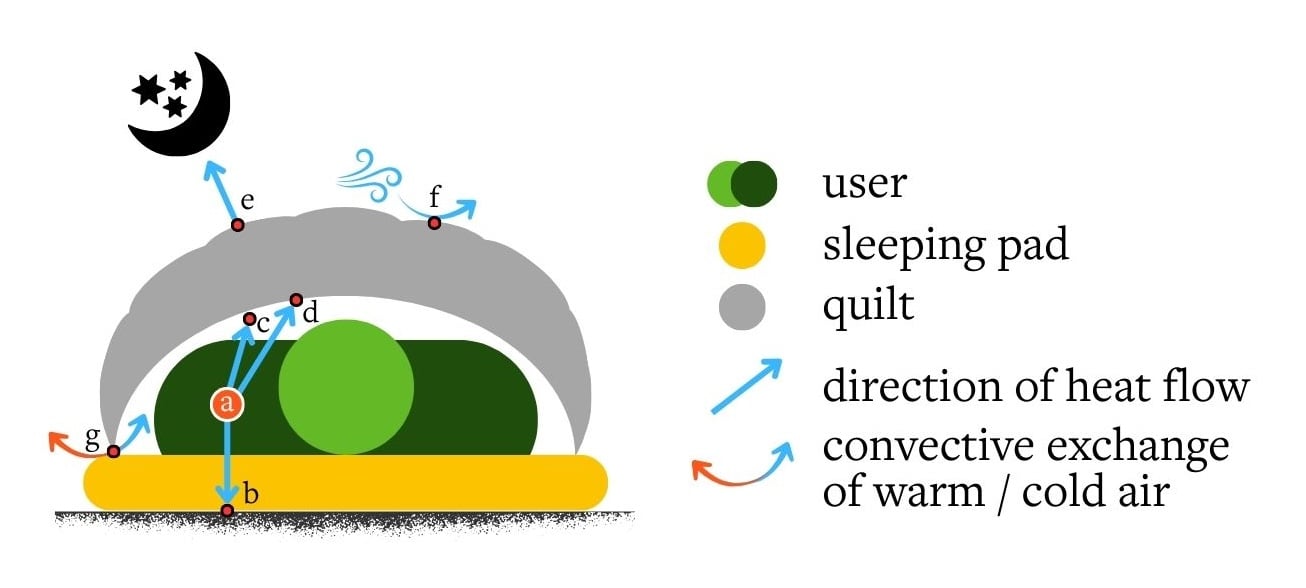
Conduction through the pad is mostly a pad problem. Radiation is relatively small in this context compared to the other modes. Evaporation is important to consider for moisture management, but not the primary focus here. And most sleeping pad liners are too thin (relative to the loft of a sleeping bag or quilt) to add meaningful insulative value to a sleep system. So, in short, a sleeping bag liner probably has the most potential to impact convective heat loss.
And since quilts suffer from convective heat loss more than sleeping bags, they may stand to benefit more from using a sleeping bag liner. The liner can address the key sources of convective drafts of quilt-based sleep systems:
- Gaps at the neck and shoulders;
- Edge leakage along the sides when a user moves around or when wind blows across the quilt; and
- Internal air movement when there is extra space between your body and the inner surface of the quilt.
Mechanisms by which a liner can affect convection
There are three plausible ways a liner inside a quilt might influence convective heat loss: creating a more stable boundary layer next to the skin (body), reducing internal air volume and mixing, and partially buffering edge leaks.
1. Creating a more stable boundary layer next to the skin
Any fabric worn or used next to the skin creates a thin layer of relatively still air, often described as a boundary layer. A liner that is reasonably close-fitting around the torso and legs:
- Reduces direct air movement across the skin; and
- Keeps the air immediately adjacent to the body more stable when you move under the quilt.
This effect is similar to wearing very light base layers. Most laboratory studies on thin clothing layers suggest a slight but measurable (and perceptible) increase in thermal resistance. The magnitude is modest, but it can reduce the rate at which moving air strips heat from the skin.
2. Reducing internal air volume and mixing
If there is extra space inside the quilt, body movement can pump and mix air within that volume (via a bellows-like effect). A loosely attached quilt over a small sleeper is a common example.
A sleeping bag liner can:
- Slightly reduce the effective air volume that moves freely around the body; and
- Dampen internal air currents when you roll or shift position.
This is not a seal, but it can reduce mixing within the system, thereby lowering convective heat transfer.
3. Partially buffering edge leaks
A liner does not stop cold air from entering around the edges of a quilt, but it can change how that incoming air interacts with the body.
When cold air enters at the neck, shoulders, or sides:
- Without a liner, it can contact skin (or other worn clothing) directly and rapidly strip heat; and
- With a liner, the incoming air must first move past the liner fabric, and heat exchange occurs over a slightly larger surface area and over a longer period of time.
The result is a slower perceived draft. Thermally, the benefit is again modest, but on the edge of comfort, it may be enough to reduce the number of “wake up cold, re-position the quilt” events.
My Field Observations
Thin silk or synthetic liners are similar in thickness and construction to very light base layers. In my field tests using silk and thin polyester liners with quilts this past year, I observed no insulation benefit but a small, albeit perceptible, benefit in draft control. However, when using sleeping bag liners made with Polartec Alpha Direct, I perceived both insulation and draft-control benefits – to a surprising degree.
In all cases across a wide range of environmental conditions (including cold temperatures near a quilt’s lower temperature rating and exposure to wind while cowboy camping or sleeping under a tarp without a bivy sack), all liners that I tried (including thin silk, polyester, and Polartec Alpha), enhanced my sleep system comfort more than simply adding the same fabrics as extra shirt-and-leggings clothing layers.
Translating these findings into more precise quantitative information is not defensible without further testing under controlled conditions (currently in progress).

Use Cases & Recommendations
I don’t think a liner can transform a quilt into a dramatically warmer system, but it can make marginal nights more tolerable, especially for people who move frequently in their sleep, use narrower quilts, or camp without any kind of wind protection.
Conversely, there are many scenarios where the convective benefits of a liner will be very small relative to its weight:
- Warm nights where you are already well above the quilt’s comfort rating;
- Very wide quilts with sliding pad strap attachment points that already control edge drafts effectively;
- Sleep systems that include substantial clothing layers that perform the same boundary layer and mixing control functions as a liner; or
- Shelters or bivy systems that strongly limit air movement around the quilt itself.
In these situations, the primary benefits of a liner, if any, shift back toward hygiene and comfort rather than any meaningful convective gain.
Practical guidance for quilt users
From a convective heat loss perspective, adding a liner to a quilt-based sleep system is most rational when:
- Expected nighttime lows are within a few degrees of your quilt’s comfort limit;
- You have already optimized pad R value, quilt sizing, and attachment, but still experience drafts or cold spots due to movement or wind exposure; or
- You prefer lighter sleepwear (or none at all) and want a low-bulk way to add a continuous, thin layer between your skin and moving air.
In that context, a light silk or synthetic liner can provide a small, incremental reduction in convective loss at a relatively low weight cost, and a Polartec Alpha liner can boost both the insulation and heat loss resistance of a quilt-based system.
Gear Options
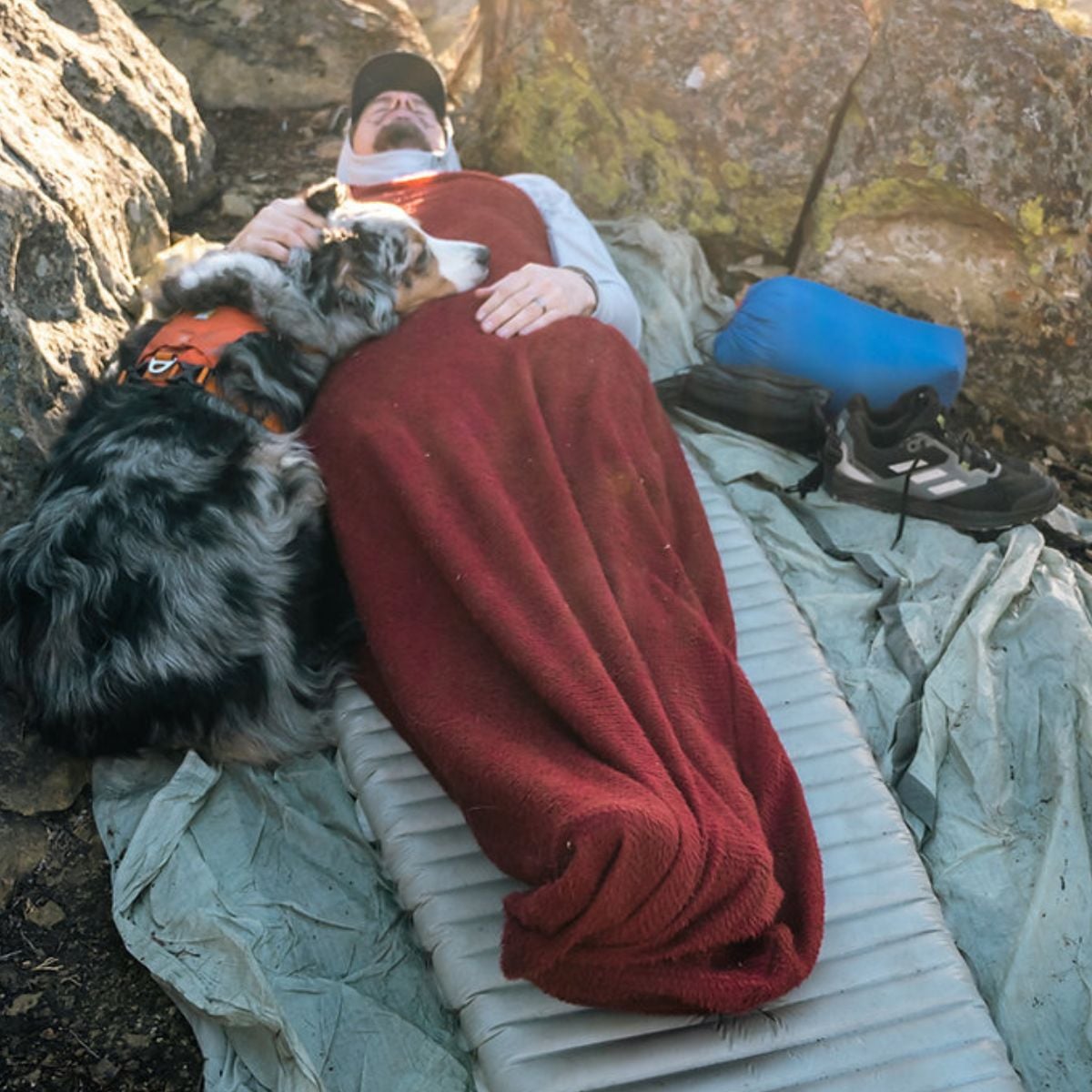
The Magnet Designs Alpha Sleeping Bag Liner addresses the need to extend a sleep system’s comfort range with minimal bulk with this Polartec Alpha Direct 60 gsm insulating layer. Unlike silk or thin polyester knit liners, the Alpha Liner adds 6 to 8 °F of comfort for 7–8 oz in a ~4 x 4 x 6 inch packed size.

The Sea to Summit Silk Blend Sleeping Bag Liner increases in-bag warmth and hygiene by adding a 72% synthetic fabric using hollow-core polyester yarns with ceramic infrared-reflective pigments, recycled polyester fibers from 100% textile waste, and 28% silk, plus a bio-based amino-sugar odor-control finish, in 130–160 g mummy or rectangular patterns with stretch panels and shoulder openings.

The Western Mountaineering Tioga Sleep Liner is a 100% silk sleeping bag and travel liner that reduces direct contact with bedding and helps keep insulation clean by adding a tightly woven silk layer, available in mummy, taper, and rectangular patterns (regular/long) at 92–124 g with drawcord closure (non-rectangular) and integrated stuffsack. The Sonora features a similar design, but in a slightly heavier synthetic (polyester) fabric.
In addition, you can find a variety of silk, polyester, merino wool, fleece, and organic cotton sleeping bag liners at REI.
What’s next?
One of our research initiatives during this off-season is sleep system testing – exploring pad-clothing-liner-quilt/bag-bivy systems and quantifying their thermal performance. At the time of this writing, the experimental design and validation have been completed, and we are deep into our first proof-of-concept project: investigating the effect of various quilt-to-pad coupling strategies on convective heat loss. Some initial results from these studies will be published in the next few days – stay tuned!
Our experimental roadmap for the next few months:
- Nov/Dec 2025 – Quilt/Pad Couplings
- Dec/Jan 2025 – Sleeping Bag Liners
- Jan/Feb 2025 – Bivy Sacks
- Feb/Mar 2025 – Sleeping Pads


Discussion
Become a member to post in the forums.
Companion forum thread to: Sleeping Bag Liners and Quilts: Convective Heat Loss, Draft Control, and Practical Benefits
Sleeping bag liners are often sold as warmth boosters, but their real value in quilt-based sleep systems is managing convective heat loss. Drawing on field use and ongoing experiments, this article explains how liners affect drafts, when they help, and when their weight is better spent elsewhere for cold sleepers.
I like the ZenBivy system. Rock Front makes a similar one. I can seal one side while leaving the other open for easier access. I theorize that the sheet adds some R value to the pad. I never liked the restrictiveness of a mummy, hence I’ve avoided using a liner. The AD60 does look inviting. More so if it was open on one side.
I’ve taken to wearing warm clothes to bed while counting less on the quilt. Less of a cold snap when I get up. Not the most weight efficient, but dual purpose.
I have developed a very versatile system that works great for me from the low 70’s(F) down into the low 50’s(F) that weighs a total of 12.5 ounces, a Cocoon Silk Mummy Liner (4.5 oz) and JacksRBetter Alpha Direct 90 Quilt Liner/Summer Blanket (8 oz). It has worked for ground camping, hammock camping, and during a pilgrimage walk I did last year. Here is how I use it in rank of warmest to coolest conditions:
1. Silk Liner alone
2. Alpha Direct 90 Liner alone
3. Alpha Direct 90 Liner OVER Silk Liner
4. Silk Liner OVER Alpha Direct 90 Liner
Thanks for this, Ryan!
In the building science world, we’ve always used the rule of thumb that one square inch of air gap in a building’s envelope is equivalent to eight square feet of no insulation. So the impact of air exchange in a sleeping system is very important to consider. Additionally, body movement during the night should not be overlooked, since this not only affects the convective air between the user and their quilt/mattress systems but the air-only mattresses as well. (As we know, ASTM F3340 does not take body movement into account, which would be awesome if it could somehow but understandable that it doesn’t.)
For years, I’ve sworn by the use of a silk liner with my quilt setup but with a slight but important modification to what you’ve described.
I have my liner drape over top of my quilt, and have it wrapped in between myself and my sleeping pad, NOT under the pad. I cut very small slits on the sides of the liner so my quilt straps would still securely connect under the mattress. While this connection would cause the liner to be tucked under the sides a little due to the strap tension, I noticed it actually created a better air seal as a result.
Admittedly, I did this to mitigate two other issues:
1) I find the “plastic” surface of the mattress to feel terribly uncomfortable, especially on more humid nights.
2) The silk layer over top of the quilt was superb at catching and absorbing rogue condensation that would eventually drop from whatever tent or tarp surface that was overhead, a very normal occurrence in mid Atlantic climate throughout the year.
And the liner was always pretty easy to dry out.
Perhaps you could explore this system in your testing?
Cheers!
Matt and Gerry. 👍👍 for the idea.
The A.D. quilt liner at JrB fit the bill. I do have a old silk sheet from Rab that is as meant to slip over a sleeping pad. Basically a sheet doubled over, with the sides seen together. Unfortunately what I see on their website now is cotton. Turning it inside out, I found that my 20* EE quilt fit comfortably inside. That might just become a thing.
Sea to Summit frame their Reactor liners as not providing much if any draft control. Reminds me of alpha-D needing a wind shirt:
“When sleeping outdoors, the main factor to be aware of is moving air. The Reactor liners are primarily designed for use inside a sleeping bag, so they allow enough air to pass through their fabric to guarantee a comfortable night’s sleep in that configuration. Breezes and drafts in an outdoor situation will also pass through the fabric and rob you of the warmth you have generated.”
It added up to 5C warmth inside a 10c bag in a backyard test in a hammock but was constraining and didn’t really offset its weight in my use case.
The Reactor’s too heavy for Gerry’s good idea but the MLD might work and be only 2 or 3 oz. Oh man, trying not to buy more gear….
MLD discount…
ADVENTURE15
JrB
Thanks for the JrB link but Apex is a much better insulator for the weight than alphaD
A 40F Apex/7D quilt might be my first MYOG project when I retire. They go for $310Canadian up here which seems a bit excessive for what it is
I think a 40* Apex quilt has been on your list. I did order the MLD liner. Thank you for that. If my 20* quilt fits inside, it might be good down close to 30*. Using my sheet over the 10* ZB worked well. Fit like a spacious mummy bag. Better than the ZB alone, which otherwise still has a slight gap by the upper leg.
I find sleeping bag liners to be totally not worth it. First of all, it’s already hard enough to secure yourself under a quilt getting the straps properly around the pad and all. Then with a liner you also have to shimmy like a worm getting in and out of a tube. Makes urination breaks even more of a hassle. Secondly liners provide very little warmth for their weight. Add that extra weight in down or synthetic insulation and you get a much more warmth per gram. I used to laugh at the estimates S2S touted with their Reactor and Reactor Extreme liners. I see they finally stopped giving warmth estimates which is a good thing. If you can’t seal off the cool spots with a quilt then go with a sleeping bag
For just in case overnights on day hikes I pack a thicker and warmer 7 oz Thermasilk silk liner with a 4.2 oz SOL emergency (mylar) bivy.
Would the same be true with something like the HMG 40* with sewn through baffles?
I’m with Monte here.
For around the same weight as an Alpha liner, you can carry a down filler bag like the Cumulus Magic 100 mummy. It’s a basic sewn through bag with 100g of decent down.
This will cut draughts, give some insulation, and reduce convection in dead space.
Tests by PHD Designs of similar bags report increases of 5-10 degrees centigrade, which is pretty impressive for 240g of weight.
The reactor was a waste of money for me, it’s never been used once because of the weight, modest warmth and extreme fiddle factor.
The mld with Gerry’s idea looks worth the look. Still a fiddly garden hose to slip in and out of but less than a third the weight of a reactor and this could be much more effective at blocking drafts than any interior liner because it forces the quilt to block the drafts and doesn’t rely on the porous liner material to do so. All depends on whether a quilt fits inside it
I’ve tried going strapless but I twist and turn way too much. Far too many broken bones and torn ligaments over the years to sleep in one position for too long
Oops, sorry, I meant Matt’s idea!
It depends if you need extra insulation or just a draft stop. As with the alpha, going back to Gerry’s idea. Using it inside a liner as a summer blanket or a just in case overnighter. As a quilt liner, it should be nice for car camping.
The MLD has a shoulder girth of 64″. I’m thinking one could sit up, slide it down, then shimmy out. If not, modifications might be in order.
Draft control would be the main benefit of a liner or a bivy. If a 10* quilt needs further insulation, chances are that I’ll have insulated clothing to use.
@Geoff
The Cumulus Magic 100 Zip is 240 g but the regular non- zip weighs only 214 g. I’d take the 25 g weight penalty of the Zip for the much easier entry and exit. 7D shell is only a mere 114 g. https://cumulus.equipment/en/ga/p/down-sleeping-bag-magic-100-zip
But if I was in fact going to use a liner, the question would become which provides more warmth per weight, a down fill bag with 7D shell or Alpha Direct liner with no shell? Sure, down beats synthetic, but when you add in the shell weight much of down’s advantage is negated. Of course Alpha Direct on its own without a shell on the outside is not very good when exposed directly to the cold, however inside of a quilt/bag it performs well. I just don’t know where you’d find an AD liner though. JRB offers an AD quilt and Timmermade an overbag/quilt, but neither would completely seal you off like a liner or summer bag. Probably would have to make one yourself.
I experimented with AD on some quilt designs and concluded it is not worth its weight. Down is so much better than AD that even with the penalty of some 7D to contain it the down will be much warmer per weight. There are admittedly things that down won’t work for, but for those APEX will still be better than AD.
I also experimented with some liner-type sheets for draft blocking and decided it was easier to instead just add that to the quilt itself by making the quilt wider. A 58″ wide quilt can be snapped to the sides of the pad to provide complete draft blocking but still give plenty of room for movement. I put Kam Snaps on the lower sides of the pad with squares of tenacious tape to hold them in place, as well as on the sides of the quilt.
Yeah, well said Scott, I have same experience except just using regular fleece rather than AD. And the quilt is sewn rather than kam snaps, but same result.
One problem is what Geoff mentioned, there’s now an internal air space at your sides where the quilt goes down to the edges of the pad. I’ve measured the temperature of that air space and it was about half way between ambient and skin temperatures, when I was also wearing insulation. Which would say that wearing insulation maybe prevents this problem.
I should repeat that just wearing a base layer.
Rock Front has another solution, different than zen bivy. They have zippers to connect the sides of the quilt to the sheet covering the pad. If it gets too warm, you can unzip as needed.
(Bill told me about Rock Front)
The zippered up RF quilt looks like it would create that sort of clam shell effect leaving air space. For me using a large ZB, it sort of creates the same affect while an XL doesn’t. An XL will fold in and surround me. ZenBivy doesn’t directly attach at the edge. The sheet does while overlapping the quilt. A minor, yet a big difference.
Edit: effect/affect. Still gets me.
Yes the goal is to have the quilt draping down on the pad and to not have so much tension that there are air pockets on the sides. If the quilt is not wide enough there will be air pockets on the sides. Smaller bodies need less width on the quilt; I am an average sized male and 58″ works OK for me. Even wider would be a bit better as the quilt is sometimes off-center and in that case there is a bunch of slack on one side but it is tight on the other side and creating an air pocket.
An advantage over straps is one side of the quilt can be fastened with the second side left loose. Easier for ingress. Laying on my side, my back goes against the fastened side while I bunch the loose side around me. Any draft comes from where the wings end and the footbox begins. A short sleeve with adjustable compression?
“Yes the goal is to have the quilt draping down on the pad and to not have so much tension that there are air pockets on the sides.”
I have been working on that for years and have not found a good way to make that happen.
Maybe when I’m laying on my back, the quilt will drape down and have no air space.
But when I roll from side to side, there’s an air gap.
I have my tent set up outside now for testing, and I popped in to see exactly what the gaps were so I wasn’t just going from memory. When on my back the quilt would settle down to a 0-1″ gap at the mattress juncture. When on my side there was something like a 4″ gap. I’m overall less concerned about the side sleeping gap though, the side sleeping position is warmer even with the gap due to the well-known advantages of the fetal position keeping you warmest. That has been confirmed by testing with my current setup.
I know a lot of people love quilts for cold conditions and I get it, but count me as one of those who prefers a sleeping bag instead. In temps above 40* F quilts are great, however from 30’s downward I’ll take my Western Mountaineering bags thank you. Even though it’s going to be about 5 to 7 ounces heavier than a same fill weight quilt, the superb WM draft collar, zipper tube and well-fitting hood is going to make it warmer. And it doesn’t involve a lot of mental and physical gymnastics with straps, liners, etc. All you have to do is just zip the bag open, easily slide in and then zip it up. Simple, quick and there’s almost zero chance of drafts or leaks if the bag fits properly. As many options as WM has that should be doable for any body type. Toss and turn all you want, no worries.
Become a member to post in the forums.