


Introduction
Sleeping bag liners are marketed primarily to adventure travelers as a hygiene barrier for sleeping in provided bedding in huts and hostels, and in this context, are made primarily from silk or polyester. This makes them very packable and lightweight. Backpackers incorporate them into their sleep systems, with additional (claimed) benefits for wilderness backpacking. Those claims usually fall into a few buckets: keeping the primary insulation cleaner, improving next-to-skin comfort, adding some warmth, and protecting long-term down loft from degradation resulting from sweat and body oils. For backpackers, the category has expanded to include liners made from fabrics other than silk or polyester (e.g., merino wool, fleece).
Here, I am going to focus on a narrow use case for sleeping bag liners: using them inside quilt-based sleep systems to reduce convective heat loss. I’ll examine how a liner inside a quilt alters air movement and heat loss within the system, and identify use cases where adding a sleeping bag liner to a quilt-based sleep system provides enough thermal benefit to justify the additional weight and system complexity.
Heat Loss in Sleep Systems
A sleep system loses heat through several pathways:
- Conduction into the sleeping pad (and then the ground) and the sleeping bag insulation;
- Radiation from the sleep system to its surroundings;
- Evaporation of moisture from the skin and clothing; and
- Convection from warm air near the body mixing with (or being displaced by) cooler ambient air inside the sleep system.
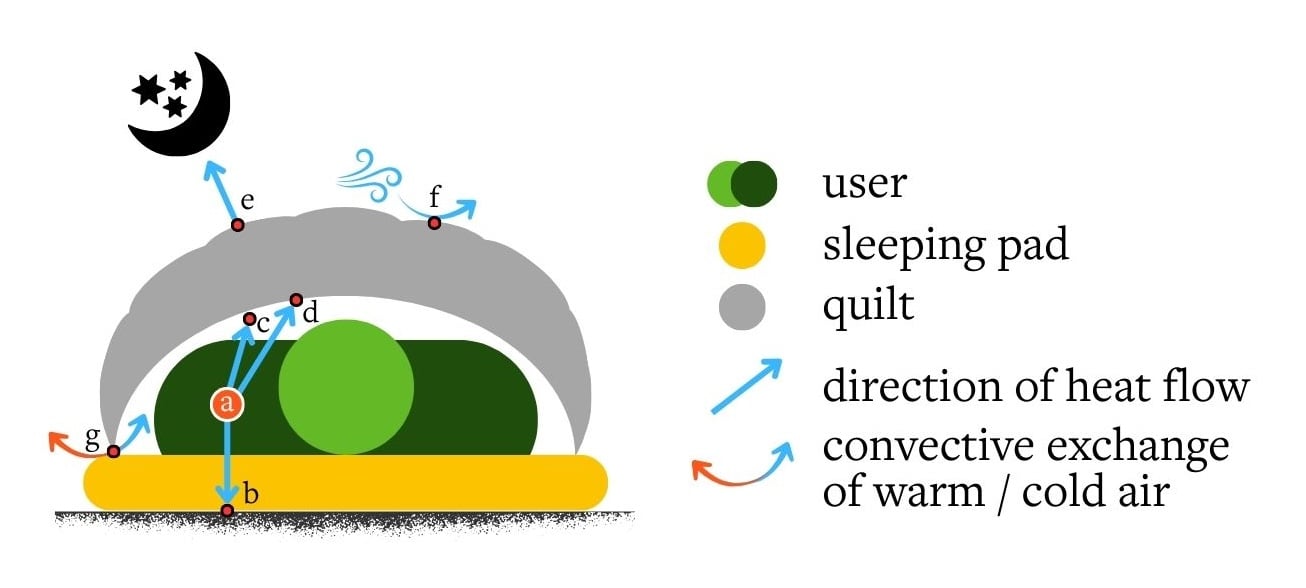
Conduction through the pad is mostly a pad problem. Radiation is relatively small in this context compared to the other modes. Evaporation is important to consider for moisture management, but not the primary focus here. And most sleeping pad liners are too thin (relative to the loft of a sleeping bag or quilt) to add meaningful insulative value to a sleep system. So, in short, a sleeping bag liner probably has the most potential to impact convective heat loss.
And since quilts suffer from convective heat loss more than sleeping bags, they may stand to benefit more from using a sleeping bag liner. The liner can address the key sources of convective drafts of quilt-based sleep systems:
- Gaps at the neck and shoulders;
- Edge leakage along the sides when a user moves around or when wind blows across the quilt; and
- Internal air movement when there is extra space between your body and the inner surface of the quilt.
Mechanisms by which a liner can affect convection
There are three plausible ways a liner inside a quilt might influence convective heat loss: creating a more stable boundary layer next to the skin (body), reducing internal air volume and mixing, and partially buffering edge leaks.
1. Creating a more stable boundary layer next to the skin
Any fabric worn or used next to the skin creates a thin layer of relatively still air, often described as a boundary layer. A liner that is reasonably close-fitting around the torso and legs:
- Reduces direct air movement across the skin; and
- Keeps the air immediately adjacent to the body more stable when you move under the quilt.
This effect is similar to wearing very light base layers. Most laboratory studies on thin clothing layers suggest a slight but measurable (and perceptible) increase in thermal resistance. The magnitude is modest, but it can reduce the rate at which moving air strips heat from the skin.
2. Reducing internal air volume and mixing
If there is extra space inside the quilt, body movement can pump and mix air within that volume (via a bellows-like effect). A loosely attached quilt over a small sleeper is a common example.
A sleeping bag liner can:
- Slightly reduce the effective air volume that moves freely around the body; and
- Dampen internal air currents when you roll or shift position.
This is not a seal, but it can reduce mixing within the system, thereby lowering convective heat transfer.
3. Partially buffering edge leaks
A liner does not stop cold air from entering around the edges of a quilt, but it can change how that incoming air interacts with the body.
When cold air enters at the neck, shoulders, or sides:
- Without a liner, it can contact skin (or other worn clothing) directly and rapidly strip heat; and
- With a liner, the incoming air must first move past the liner fabric, and heat exchange occurs over a slightly larger surface area and over a longer period of time.
The result is a slower perceived draft. Thermally, the benefit is again modest, but on the edge of comfort, it may be enough to reduce the number of “wake up cold, re-position the quilt” events.
My Field Observations
Thin silk or synthetic liners are similar in thickness and construction to very light base layers. In my field tests using silk and thin polyester liners with quilts this past year, I observed no insulation benefit but a small, albeit perceptible, benefit in draft control. However, when using sleeping bag liners made with Polartec Alpha Direct, I perceived both insulation and draft-control benefits – to a surprising degree.
In all cases across a wide range of environmental conditions (including cold temperatures near a quilt’s lower temperature rating and exposure to wind while cowboy camping or sleeping under a tarp without a bivy sack), all liners that I tried (including thin silk, polyester, and Polartec Alpha), enhanced my sleep system comfort more than simply adding the same fabrics as extra shirt-and-leggings clothing layers.
Translating these findings into more precise quantitative information is not defensible without further testing under controlled conditions (currently in progress).

Use Cases & Recommendations
I don’t think a liner can transform a quilt into a dramatically warmer system, but it can make marginal nights more tolerable, especially for people who move frequently in their sleep, use narrower quilts, or camp without any kind of wind protection.
Conversely, there are many scenarios where the convective benefits of a liner will be very small relative to its weight:
- Warm nights where you are already well above the quilt’s comfort rating;
- Very wide quilts with sliding pad strap attachment points that already control edge drafts effectively;
- Sleep systems that include substantial clothing layers that perform the same boundary layer and mixing control functions as a liner; or
- Shelters or bivy systems that strongly limit air movement around the quilt itself.
In these situations, the primary benefits of a liner, if any, shift back toward hygiene and comfort rather than any meaningful convective gain.
Practical guidance for quilt users
From a convective heat loss perspective, adding a liner to a quilt-based sleep system is most rational when:
- Expected nighttime lows are within a few degrees of your quilt’s comfort limit;
- You have already optimized pad R value, quilt sizing, and attachment, but still experience drafts or cold spots due to movement or wind exposure; or
- You prefer lighter sleepwear (or none at all) and want a low-bulk way to add a continuous, thin layer between your skin and moving air.
In that context, a light silk or synthetic liner can provide a small, incremental reduction in convective loss at a relatively low weight cost, and a Polartec Alpha liner can boost both the insulation and heat loss resistance of a quilt-based system.
Gear Options
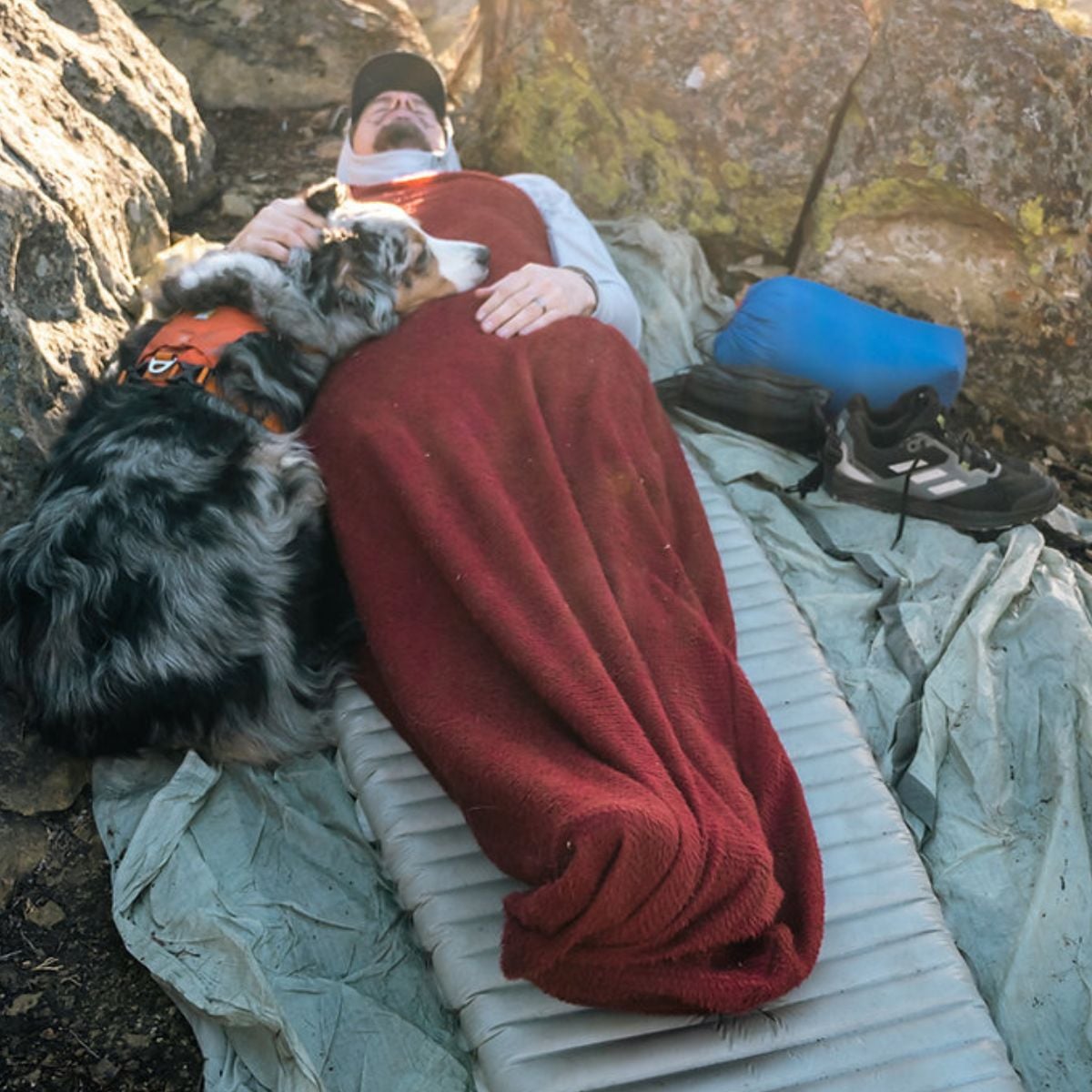
The Magnet Designs Alpha Sleeping Bag Liner addresses the need to extend a sleep system’s comfort range with minimal bulk with this Polartec Alpha Direct 60 gsm insulating layer. Unlike silk or thin polyester knit liners, the Alpha Liner adds 6 to 8 °F of comfort for 7–8 oz in a ~4 x 4 x 6 inch packed size.

The Sea to Summit Silk Blend Sleeping Bag Liner increases in-bag warmth and hygiene by adding a 72% synthetic fabric using hollow-core polyester yarns with ceramic infrared-reflective pigments, recycled polyester fibers from 100% textile waste, and 28% silk, plus a bio-based amino-sugar odor-control finish, in 130–160 g mummy or rectangular patterns with stretch panels and shoulder openings.

The Western Mountaineering Tioga Sleep Liner is a 100% silk sleeping bag and travel liner that reduces direct contact with bedding and helps keep insulation clean by adding a tightly woven silk layer, available in mummy, taper, and rectangular patterns (regular/long) at 92–124 g with drawcord closure (non-rectangular) and integrated stuffsack. The Sonora features a similar design, but in a slightly heavier synthetic (polyester) fabric.
In addition, you can find a variety of silk, polyester, merino wool, fleece, and organic cotton sleeping bag liners at REI.
What’s next?
One of our research initiatives during this off-season is sleep system testing – exploring pad-clothing-liner-quilt/bag-bivy systems and quantifying their thermal performance. At the time of this writing, the experimental design and validation have been completed, and we are deep into our first proof-of-concept project: investigating the effect of various quilt-to-pad coupling strategies on convective heat loss. Some initial results from these studies will be published in the next few days – stay tuned!
Our experimental roadmap for the next few months:
- Nov/Dec 2025 – Quilt/Pad Couplings
- Dec/Jan 2025 – Sleeping Bag Liners
- Jan/Feb 2025 – Bivy Sacks
- Feb/Mar 2025 – Sleeping Pads


Discussion
Become a member to post in the forums.
In an odd twist, as someone allergic to down I’m largely forced to a quilt below 40F. The weight penalty for an effective 20F synth bag is severe. The lightest I found was ~ +10oz over an Apex quilt but gave the most miserable sleep of my life. To hit that temp rating and weight, it had marginal insulation underneath so was freezing when side sleeping and used 40D fabric to lessen heat loss by being a near-VBL. So it was freezing and sweaty. (Marmot Trestles Eco Elite, blech)
As long as I’m warm from the top, I can keep flipping. Just not if I’m sweating. There’s where the alpha may help. Not without venting. . Is it Thermarest that has top venting of sorts on a mummy?
It is in the low 40’s F that a draft starts to matter. I’ve been comfortable in a quilt in the mid 20’s. Inside a tent, so there was no wind. Any potential drafts as mentioned can be mitigated with a wider quilt. If your goal is to save weight, it becomes more difficult. It comes down to preference.
I’m still a sleeping bag user, for all conditions. I sleep well cocooned and swaddled! Easy to turn and toss because the bag moves with me. And I just don’t want to spend the bucks to try something like a quilt that so many people end up shivering in, or that require straps and buckles and adjustments and whatever. I hate fiddling with stuff. I know I’m in the minority, but my systems work for me.
In above freezing weather, I can get by with a 40F EE bag and a silk liner, with a decent pad and the thinlight pad beneath it (which is my daytime sit/nap pad as well). I wasn’t sure if the 40 bag would work on a recent PCT trip from Tahoe to Yosemite, and even on one night of freezing weather at Smedberg Lake the system worked great. I was super cozy, although I did have a hat on, and my EE puffy. Colder than that or in Alaska’s extended wet chilly summers I have my 20F Feathered Friends and it has never failed me. I will rarely use a silk liner with that colder bag also.
I find the silk liner to be easy to get in and out of, because the silk just slips off; I pull it off and on like you would a sock, rather than trying to insert myself into it. No problem. And it’s soooo cozy! Just as you would have a sheet at home in your bed, with blanket on top, it’s nice to have a sheet camping. But much of the time I don’t bring it in order to save the 3 ounces; depends on conditions. I also like having the silk liner for Grand Canyon trips, because sometimes it’s in the 50s-60s at night and I’ll use just the liner for cover at night.
Much as I appreciate the deeper analysis Ryan does on most things, my own experience gives me the knowledge I need to be comfortable at night in my sleep system, science be darned. Maybe some day I’ll try a quilt, but from what I’ve seen and heard, I’m not convinced they’re worth the high cost.
8.8 ounces for the JRB AD90 liner. Roomy footbox. Plenty long. Good quality. Shipped fast. Decent price. Hard to say how much warmth it adds. It feels cozy. Comfortable as all heck. IDK. Extra weight. Single purpose, but it’s kinda nice.
11.3 oz for the MLD and the JRB AD90 liner. Comfortable at 50*f. A little confining with my arms inside. No worst than a mummy bag. I can leave my arms out and pull the AD liner further up. Pull it on like AK said. The JRB liner is nice in a 10* quilt. A bit luxurious, but probably not worth the carry for most folks. I could see pairing it with a 40* quilt. I’d rate the combined pair for around 50* to 60*.
I like the Sea to Summit Reactor liner for cold weather, it gives a little bit of warmth, but probably its main function is to catch the sweat, dirt etc so my sleeping bag stays clean. I wash the liner and tumble dry the sleeping bag after each use. The liner alone was warm enough last week at Tahune hut on the Frenchman’s Cap walk – the 2013-built hut has a hydroelectric heating system and amazing insulation, too hot for a sleeping bag/quilt.
Has anyone used the Western Mountaineering HotSac VBL? It looks good as a VBL liner and potential emergency bivy bag, only 101gm.
The MLD xl liner has an inch more girth at the head and eleven inches more at the foot then the StoS. Using the AD 90 liner inside the MLD liner, I find adequate room for my arms and legs. The same was true using a 20* quilt. With a 10* quilt, l still had plenty of legroom, but my arms were a bit cramped.. In all cases though, I preferred pulling it up to my arm pits and leaving my arms out. Basically forming a fabric bottom mummy bag with a quilt at the head end. Pull the MLD up to stop drafts or down for ventilation. DWR finish, it’ll keep my quilt clean. About 2.5 oz. and 11 oz. with the AD90 liner.
have used silk liners for years but find they wear out too fast. The reactor liner is too hard to get into and out of as it is not slippery. It would be nice it liners could attach at the foot end of bag so they are easier to get into and out of, especially at nite. I like the liner as it makes it easier to keep the hood open and I still stay warm. Look forward to more info on liners. Have used them all the way down to minus 35F.
The MLD is 7D nylon ripstop and pretty slick. Other than wind protection, it doesn’t add much insulation on its own. The AD90 liner sticks to my wool socks. I’ve also thought that it would be nice if it attached at the foot. Not wanting to modify my quilt, I’ve found ways to deal with it.
Become a member to post in the forums.