


This article describes a physiologically sound but rudimentary model for predicting body fat loss on a backpacking trip when you know the trip’s overall caloric deficit.
All-day backpacking can burn 5,000 to 8,000 kcal/day (this includes the sum of basal and activity-based energy requirements). For calorie-dense foods (e.g., 125 kcal/oz), this equates to 2.5 to 4.0 pounds of food per day. This is impractical. You can’t carry enough food to cover the caloric deficit you are likely to experience on a trip, and that deficit has to come from somewhere – your body fat stores are that source.
The central idea is based on the following:
fat loss (kg) = total energy deficit (kcal) × f ÷ 7,700 (kcal/kg) (eq.1)
where 7,700 kcal/kg represents the energy density of one kilogram of body fat tissue. (Note: my physiology textbooks cite 9,000 to 9,500 kcal/kg as the energy density of pure triglyceride, but human adipose tissue is comprised of 15 to 20% water and supporting tissue, resulting in the commonly cited energy density of human body fat as 7,700 kcal/kg.)
In eq.1, f represents the fraction of your total energy deficit supplied by body fat, and can be approximated by:
f = min ( 1, E_fatmax ÷ Δ) (eq.2)
where
- Δ = daily average caloric deficit (kcal/day)
- E_fatmax is the daily max fat-derived energy (kcal)
E_fatmax = FM × (60 + 4×H) × 0.85 (eq.3)
where
- FM = body weight (kg) × body fat percentage (%) and represents the body’s total fat mass store (kg)
- 60 is a reasonable calibration parameter that represents a baseline daily capacity to supply energy from fat stores in the absence of activity (kcal/kg of body fat mass/day); 4×H represents the additional energy that can be oxidized from the same fat in response to aerobic exercise (kcal/kg body fat per hr of hiking), where H = # of hours of hiking per day.
- 0.85 represents an intensity penalty – a simplified way to encode that at higher intensities, a smaller fraction of energy comes from fat (relative to below your aerobic threshold (AeT), when carbohydrate reliance rises. Sub-AeT effort results in reducing penalty (1.0), and exceeding the AeT results in increasing the penalty (approaching 0.7).
The entire trip fat-loss estimate can then be described by combining eqs.1-3 as long as you can estimate the caloric deficit you expect each day.
For example, if I know I’ll expend 7,000 kcal/day while hiking 10 hours a day on average during a 14-day trip, and I’m packing 3,000 kcal/day of food, then my average deficit per day will be 4,000 kcal and the entire trip deficit will be 56,000 kcal.
I know my body weight (72 kg) and my body fat percentage (18%), so I can calculate E_fatmax = 72 × 0.18 × (60 + 4×10) × 0.85 = 1,102 kcal (eq.3).
Then, using eq.2, my fraction total energy deficit supplied by body fat, f, can be calculated as 1,102 kcal ÷ (4,000 kcal) = 0.28.
This indicates that about 28% of my total energy deficit will be supplied by body fat, and now I can calculate my approximate body fat loss during the 10-day trip from eq.1:
fat loss (kg) = 56,000 kcal × 0.28 ÷ 7,700 kcal/kg = 2.0 kg (~ 4.5 lbs)
I find this method (based on body fat analyses performed before and after all of my long trips over the past 30 years) more accurate than the commonly used method for long-distance hikers, which assumes that “one pound of body fat can be converted to 3,500 kcal”. If I assumed that to be true, then my 56,000 kcal trip deficit would require me to lose 16 lbs of body fat – a gross overestimation of reality because of metabolic inefficiencies inherent to the complexity of human physiology.
The “3,500 kcal per lb” rule traces back to work by physician Max Wishnofsky in the late 1950s, where he asked: what is the caloric equivalent of one pound of body weight gained or lost? and concluded a value of about 3,500 kcal per lb.
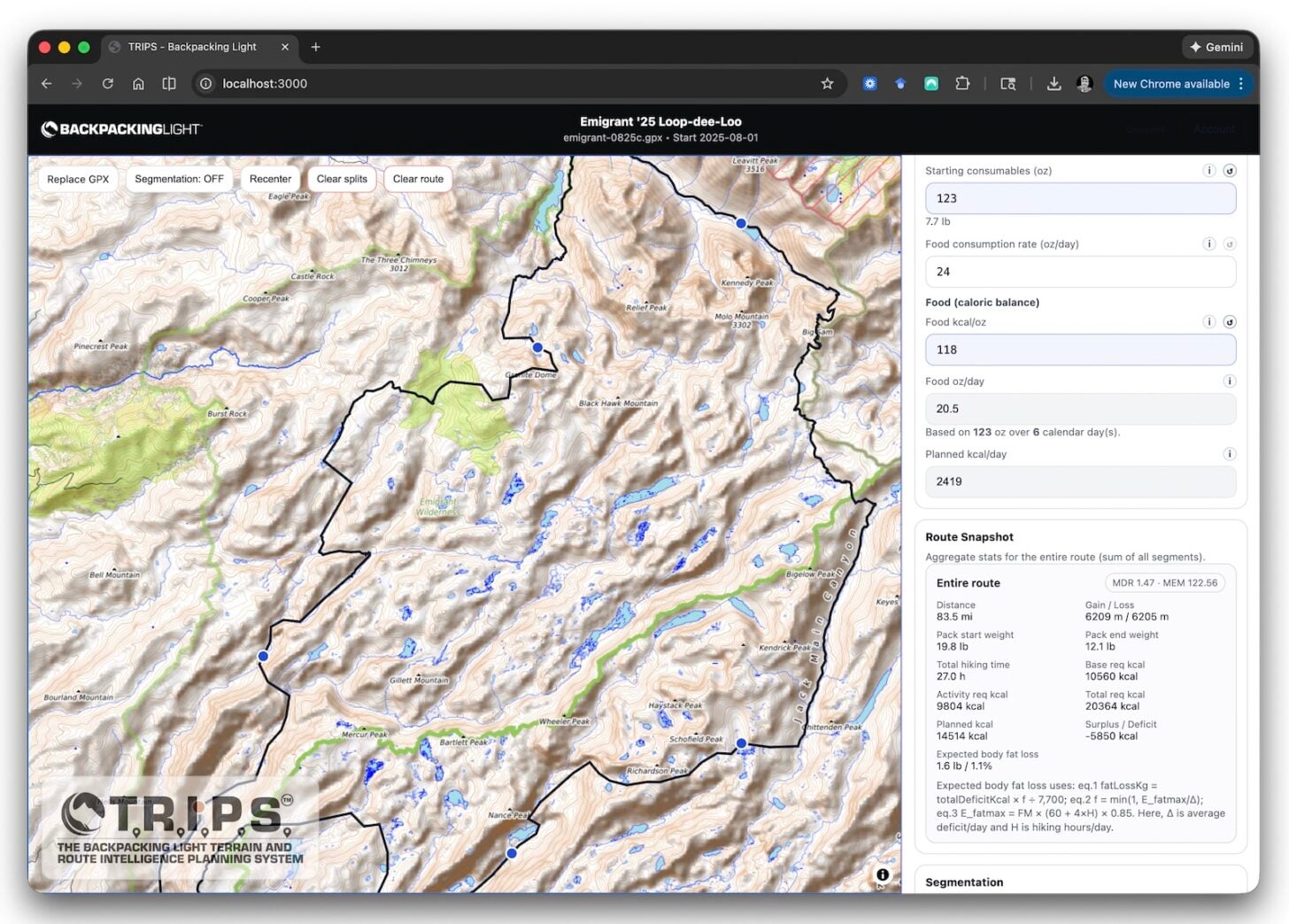
The principles described here underpin fat loss modeling in the Metabolic Energy Mile framework and constitute a core component of our TRIPS application modeling architecture (Terrain and Route Intelligence Planning System), which is currently in development and slated for release in 2Q26.


Discussion
Become a member to post in the forums.
Companion forum thread to: How much body fat will you lose on a backpacking trip?
Backpacking creates large calorie deficits you can’t fully pack as food. This article presents a simple, physiology-based model that estimates fat loss from total trip deficit by capping how much energy can realistically come from body fat, using fat mass, hiking hours, and aerobic-threshold intensity.
Sue and I have done a number of 2 month long walking trips in the European Alps. Lots of 1,000 m ups and downs. One day saw us clocking 3,000 m in one day: up, down and then up again.
Can’t say we came back home much different in weight from when we started.
Perhaps we were eating differently?
Cheers
My experience is not much different from Roger. I’ve done the Camino Primitivo is Spain, and lost maybe three or four pounds over the 17 days of hiking. But some of that must have been dehydration, because I gained most of it back in a few days.
When i backpack in the Sierra, if I keep it up for long enough, my metabolism seems to improve, and that will allow me to lose a few pounds and keep them off–at least for a while. But that takes a few weeks of on and off trailwork…and a conscious effort to not overcompensate and tank up on food once I’m out of the mountains.
I went to Philmont last summer with my son’s boy scout troop. We did a 10 day hike that was roughly 65 miles. Philmont provides all food and has it rationed in packages by meal and day. They claimed it was based on 3000 calories per day. I am not sure where they learned math. Adding up the calories on the packaging, breakfast and lunch were roughly 400-500 calories. Dinner had two people per Mountain House package with a few extras. They also provided a small amount of snacks. i doubt I ever ate more than 2000 calories on any day. I started the trip at 240lbs and dropped 12 lbs.
Philmont claims the meal plan design ensures hikers are getting sufficient nutrition.
I never go more than a week
In the winter, when I get back from trip, I’ll weigh a couple pounds less but gain it all back in a couple days – I assume it’s either water loss, or food in my digestive track
In the summer, that happens but I’ll lose a little more weight, and it takes a week or two to gain the weight back – I think I lost a little body fat.
I tried taking more food, but it didn’t seem to matter, still lost weight, so I’ve just been ignoring it. I could stand losing a couple pounds anyway.
A few years ago I actually hiked more and lost less weight. I was pushing 200 pounds. Then I started going down to 190 pounds or even less. I have noticed many old people lose weight and become frail. So when I go below 190 pounds, I start eating more to get back above. Eating more is pleasurable, so it’s a good thing.
So, for me, losing body fat on a backpacking trip isn’t a matter of balancing calories consumed with calories burned, but just an old age thing – something is happening which can cause me to lose weight. Hormones or digestive system functionality or something.
I wonder whether the problem is not human physiology but exaggerated claims on commercial food packets about their calorie content? Reading the packets you might think you are getting 3,000 calories, while in reality you are only getting 2,000 calories. If you are trying to manage your intake that way, you could be in trouble!
We just ate as much as we wanted each day. That seemed to work.
Cheers
Also, some physiological principles that accelerate fat loss:
You can come to a similar number from the other direction. The typical human metabolism is able extract around 30 kcal/1lb of fat/day. This means if you are running a calorie deficit more than body fat * 30, you are most likely metabolizing muscle, bone, and/or slowing your metabolism which impacts things like your immune system.
People are keto adapted are able to pull way more from their body fat. Some links about this topic I have handy.
https://pubmed.ncbi.nlm.nih.gov/15615615/
https://builtwithscience.com/diet/fat-loss-one-week/
https://bengreenfieldlife.com/article/low-carb-ketogenic-diet-articles/how-much-fat-can-you-burn-2/ which links to part 1.
Lots to unpack here. This is potentially really impactful stuff. Not trying to play gotcha with these questions, genuinely curious about this and would love to see you come to an accurate solution.
Caloric and Fat Burn
Ryan wrote:
It seems the approximation assumes a fixed intensity? Wouldn’t a sustained high intensity burn notably more calories in total (though less fat as a %) than a modest pace over the same time?
Multiple studies show as captured here with a modern recalibrated Pandolf equation that speed, grade and load (combined to approximate intensity) have notable impacts on caloric burn:
As Andrew Skurka does a nice job explaining, intensity also affects fat burning percentage: “burn more fat relative to carbohydrates at lower intensities, and more carbohydrates to fat at higher intensities”
About the 3500 cal approximation
Ryan wrote: “I find this method (based on body fat analyses performed before and after all of my long trips over the past 30 years) more accurate than the commonly used method for long-distance hikers, which assumes that ‘one pound of body fat can be converted to 3,500 kcal'”
That approximation works well for me for total weight loss but it didn’t explain the radically different weight loss/gain vs caloric deficit in two controlled through hiking studies I could find:
A previous discussion looking at this in a more primitive way
I think Ryan’s method gets closer but, unless I missed it, I think intensity needs to be accounted for
Your screenshot shows an app you have created. How do we get access to it. I tried to find it but could not. Is is available for IOS and android? Thanks Karl
There was a Nova on PBS where they studied metabolism. They gave people some radioactive solution and then measured out how much came out in pee. This is “the gold standard” for determining how many calories are burned.
They determined that the total calories burned as determined by radioactivity in the pee was the same – if you exercise more which burns more calories, then other parts of your metabolism will compensate and burn fewer calories. Therefore, exercise is not a good way to lose weight. I’ve read that other places also. And read other places that contradict, so it’s confusing.
So, calculating how many calories you need with some formula based on how much exercise you’re getting is suspect.
In hot weather, I now lose weight after a trip. Eating more during the trip didn’t make any difference – I still lose weight. It would seem your body has a limit on how much of your food it can metabolize. Eating more than that doesn’t make any difference – it just passes through your digestive system.
Weighing yourself at the end of a trip is better. You have to wait a few days for your body to return to normal. If my weight is now lower than I want, then I’ll eat more and can eventually regain the weight. Maybe I lost some body fat or muscle during the hike, and then regained it after.
The human body is very complicated.
In those observational studies referenced at goruck, they found a stronger correlation than that between intensity and caloric burn
Hard to know what to believe
I weigh myself after long trips after waiting a couple days for water weight to reset and the 3500 rule works well for me so far once I personally calibrate it for intensity
I think this is one of those complicated phenomenon that it’s easy to fool ourselves into thinking we understand with models that we can’t verify against many people and many varied trip types due to the effort involved
Yes, we do lose some weight on trips in hot weather.
We put it back on very quickly after a few long drinks.
I suspect it is just water balance. Like on Dune.
I remember after one trip where the last day, uphill, with little water (the source had dried up), and the late afternoon temperature was about 40 C (measured). We had several large milkshakes each when we got to town. I sort of wobbled as we left – or maybe sloshed. After about 1 hour’s driving, no slosh, but hungry.
Cheers
I definitely lose weight in hot weather from dehydration, and then regain it after a day.
But there’s something else happening. I lose weight and it takes a couple weeks to gain it back. And when I take more food with me and eat more it doesn’t make any difference, I still lose weight. Maybe this is just an old age thing. I don’t remember this used to happen.
It’s not just water weight for me. Permanently lost 5 lbs on a 10 day trip once, no nausea involved. It got me down this rabbit hole
have you still lost that 5 pounds?
Yup
There are two different concepts being discussed here and I want to re-center the discussion on the main idea of the original article.
We’re not talking about “body weight” loss here. That’s obviously a big can of worms because not only may it involve fat loss, but also digestive cycling and water weight loss – both of which can vary by *pounds* depending on the day (or even time of day). And this weight is lost (and re-gained) rapidly – on the order of days.
What I’m trying to center the discussion around is the actual reduction of body fat mass (adipose tissue) that results from you having “burned” some of that while operating in an aerobic state for an extended period of time (several days).
These are two different outcomes and generally stay decoupled from each other.
Measurable losses of body fat require several days to measure. Likewise, so too do measurable gains – you don’t just “lose body fat” on a trip because the scale shows you’re lighter and then “gain it all back” in a few days.
If you want to monitor this, use precision tools to do it – dexascan, research-grade impedence transmitters, or as a good enough proxy – fat calipers in the hands of someone who is skilled and experienced with your specific body – and lots of continuous monitoring before and after the trip. Consumer grade body weight and impedence scales aren’t really sufficient.
Of course, there’s a poor-man’s option too – your belt and a measuring tape. It’s not (very) quantitative, but it’s real – and can’t really be fooled by digestive cycles or water weight too much.
Backpacking creates large calorie deficits you can’t fully pack as food.

Trouble is, our experience is otherwise.
Many cycles of 2 months backpacking in Europe: GR10 (French Pyrenees), GR11 (Spanish Pyrenees), GR5 (across France via the Alps), Swiss Alpine Passes (Switzerland), Via Alpina (Germany and Austrian Alps), and more.
For many of these we camped (and cooked) each night. Our return weight was never very different from our start weight.
Cheers
Roger: experienced thru-hikers who start and end a thru-hike lean will experience the same thing. It’s not going to be sustainable to hike for that long under substantial calorie deficits – so in this scenario, you probably aren’t experiencing much of a net deficit over the 2-month period (caloric efficiency – “kcal burned per mile” – resulting from fitness, topping off some caloric intake at resupply points). The model presented above reinforces this point, and if you run it with numerical simulations, you’ll start to see that we’re not losing as much body fat as you think, even at moderate caloric deficits.
But it also reinforces the point that if you start a long and difficult trip with high fat reserves (which usually corresponds with low fitness) and a caloric deficit (energy burned minus energy consumed), you’ll have a model that is a pretty good proxy for the rate of fat loss you can expect.
So, doing the math here, does that mean that you (Ryan) would not be able to do a through hike like the AT, PCT or such? Several people have done this, how do they maintain weight? I can image that their reserve body fat is pretty low by the end of a through hike. I wonder what the people who go after FKT’s do? It seems like there may be a lot more going on. My 2 cents.
Karl Hafner wrote:
This is a desktop planning app in its current form. The beta release is scheduled for early Q2 2026, but we’re well ahead of schedule and will likely make an early beta available much sooner.
David D wrote:
There’s an intensity penalty in eq.3, and in turn many physiological models that can be plugged in there that relate intensity relative to the AeT (aerobic threshold) to caloric burn efficiency.
Jon wrote:
There is a lot going on, but from a caloric balance standpoint, I can tell you what I’ve done in the past.
Long trips with a really hard effort – fastpacking/FKTs – you’re probably already lean (you’ve been training for this). You need to pack a lot of calories. You’re going to lose some body fat. If your fat reserves get too low, your performance will be compromised in strange ways because you’ll run into a nasty caloric deficit. You’ve all seen this happen from FKT documentaries.
Thru-hikes – the effort is lower than an FKT, so burn rate is less. After several weeks, you’ll be pretty lean. And you’ll be packing and eating more calories, including topping off at resupplies. And your burn rates will be really efficient (calories per mile = efficiency).
I’m not a thru-hiker, but have done many long trips (300 to 500 mi, 20-30 days, 8 to 12 hr of hiking time per day) w/o resupply. The strategy here is to carry a lot of calories. I plan on eating about 1.5 lb/day the first week, 2.5 lb/day the second week, and 3.5 lb/day the third week. After the first week, fat loss starts to get pretty real (assuming I started pretty lean), so you don’t have much choice other than to carry more food weight.
I’ve been a fulltime dirtbag thru-hiker for 3 years now. I typically shoot for 3500 fat focused calories per day and big calorie intake at resupply locations. My weight loss usually happens after the second week on trail (roughly 6 pounds) then It seems to level out with no change. Starting in November I decided to implement intermittent fasting (8 hour eating window 16 hour fasting) and it seems to give me a more steady burn of energy. I have over 4k miles planned for this year (AZT, PCT, and part of the PNT) and want to keep the I.F. schedule if it will work. Any thoughts on how the I.F. may effect this?
Become a member to post in the forums.