


This article describes a physiologically sound but rudimentary model for predicting body fat loss on a backpacking trip when you know the trip’s overall caloric deficit.
All-day backpacking can burn 5,000 to 8,000 kcal/day (this includes the sum of basal and activity-based energy requirements). For calorie-dense foods (e.g., 125 kcal/oz), this equates to 2.5 to 4.0 pounds of food per day. This is impractical. You can’t carry enough food to cover the caloric deficit you are likely to experience on a trip, and that deficit has to come from somewhere – your body fat stores are that source.
The central idea is based on the following:
fat loss (kg) = total energy deficit (kcal) × f ÷ 7,700 (kcal/kg) (eq.1)
where 7,700 kcal/kg represents the energy density of one kilogram of body fat tissue. (Note: my physiology textbooks cite 9,000 to 9,500 kcal/kg as the energy density of pure triglyceride, but human adipose tissue is comprised of 15 to 20% water and supporting tissue, resulting in the commonly cited energy density of human body fat as 7,700 kcal/kg.)
In eq.1, f represents the fraction of your total energy deficit supplied by body fat, and can be approximated by:
f = min ( 1, E_fatmax ÷ Δ) (eq.2)
where
- Δ = daily average caloric deficit (kcal/day)
- E_fatmax is the daily max fat-derived energy (kcal)
E_fatmax = FM × (60 + 4×H) × 0.85 (eq.3)
where
- FM = body weight (kg) × body fat percentage (%) and represents the body’s total fat mass store (kg)
- 60 is a reasonable calibration parameter that represents a baseline daily capacity to supply energy from fat stores in the absence of activity (kcal/kg of body fat mass/day); 4×H represents the additional energy that can be oxidized from the same fat in response to aerobic exercise (kcal/kg body fat per hr of hiking), where H = # of hours of hiking per day.
- 0.85 represents an intensity penalty – a simplified way to encode that at higher intensities, a smaller fraction of energy comes from fat (relative to below your aerobic threshold (AeT), when carbohydrate reliance rises. Sub-AeT effort results in reducing penalty (1.0), and exceeding the AeT results in increasing the penalty (approaching 0.7).
The entire trip fat-loss estimate can then be described by combining eqs.1-3 as long as you can estimate the caloric deficit you expect each day.
For example, if I know I’ll expend 7,000 kcal/day while hiking 10 hours a day on average during a 14-day trip, and I’m packing 3,000 kcal/day of food, then my average deficit per day will be 4,000 kcal and the entire trip deficit will be 56,000 kcal.
I know my body weight (72 kg) and my body fat percentage (18%), so I can calculate E_fatmax = 72 × 0.18 × (60 + 4×10) × 0.85 = 1,102 kcal (eq.3).
Then, using eq.2, my fraction total energy deficit supplied by body fat, f, can be calculated as 1,102 kcal ÷ (4,000 kcal) = 0.28.
This indicates that about 28% of my total energy deficit will be supplied by body fat, and now I can calculate my approximate body fat loss during the 10-day trip from eq.1:
fat loss (kg) = 56,000 kcal × 0.28 ÷ 7,700 kcal/kg = 2.0 kg (~ 4.5 lbs)
I find this method (based on body fat analyses performed before and after all of my long trips over the past 30 years) more accurate than the commonly used method for long-distance hikers, which assumes that “one pound of body fat can be converted to 3,500 kcal”. If I assumed that to be true, then my 56,000 kcal trip deficit would require me to lose 16 lbs of body fat – a gross overestimation of reality because of metabolic inefficiencies inherent to the complexity of human physiology.
The “3,500 kcal per lb” rule traces back to work by physician Max Wishnofsky in the late 1950s, where he asked: what is the caloric equivalent of one pound of body weight gained or lost? and concluded a value of about 3,500 kcal per lb.
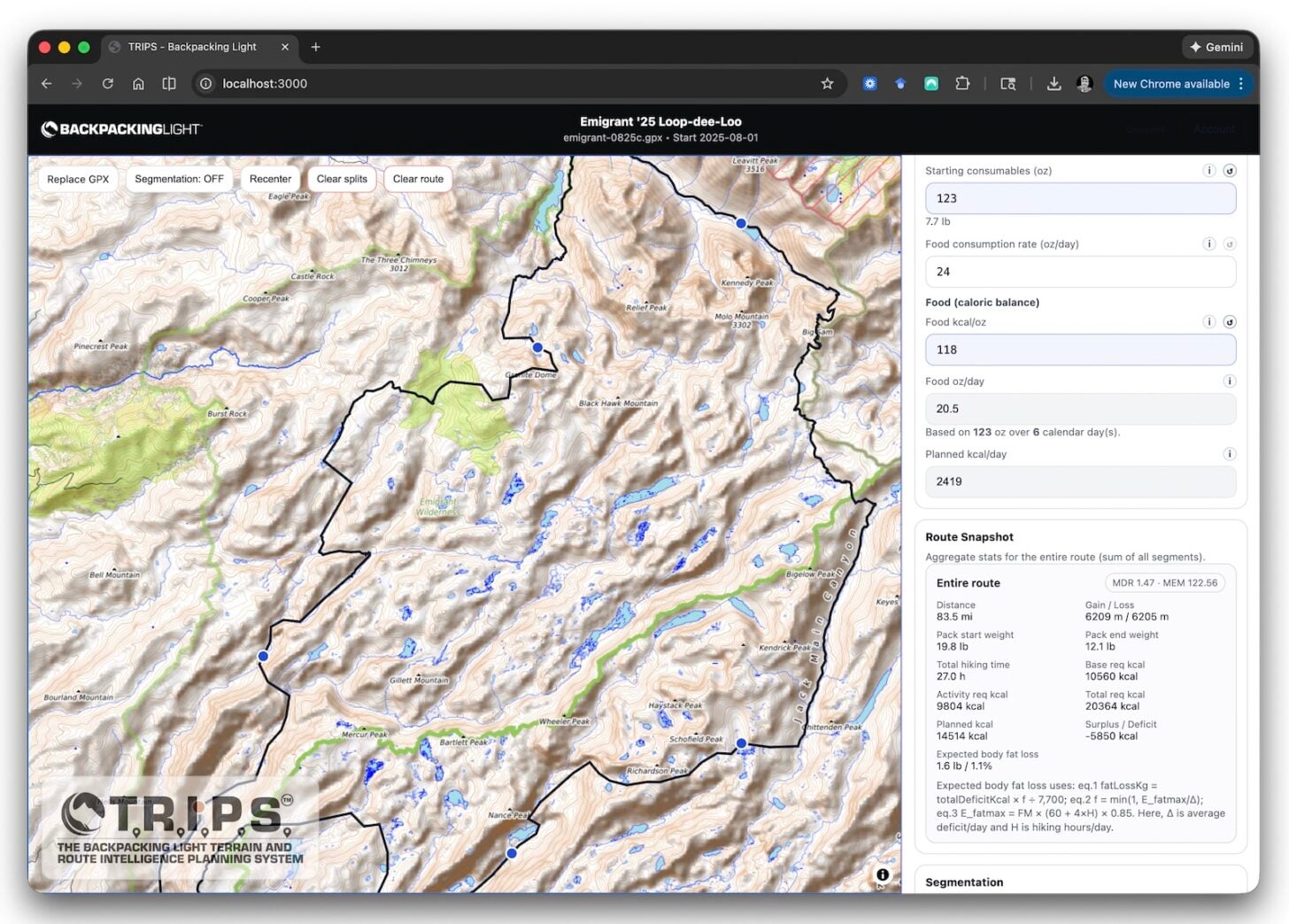
The principles described here underpin fat loss modeling in the Metabolic Energy Mile framework and constitute a core component of our TRIPS application modeling architecture (Terrain and Route Intelligence Planning System), which is currently in development and slated for release in 2Q26.


Discussion
Become a member to post in the forums.
Tom, assuming you are IF-adapted, and your intensity stays “low” (< 80% of AeT), the effects should be pretty minimal. As you approach intensities closer to your AeT, you are going to preferentially use glycogen stored in muscles (and a small amount in the liver), so doing that in a fasted state is a little bit of a ticking time bomb, because those stores are limited and need to be topped off if you are (I assume) hiking long days of 8+ hours (hiking time, not incl. breaks).
Yes, I acknowledged that in my response quoted. My comment (supported by the reference link) was that it’s fixed and that there’s convincing evidence that different intensities require different calorie intakes, and that the variance isn’t inconsequential.
So the model purposely decides to skip that detail (which is OK if that is the intent?) or you disagree with it. Wondering which is which.
David – no, the intent is just to illustrate that there’s an intensity modifier there (in the article it’s just a placeholder) – it’s definitely not a fair assumption to assume that 0.85 is any kind of intensity modifier gold standard. Physiological models suggest this varies between about 0.7 and 1.0 below the AeT (with 0.7 being more accurate right near the AeT).
Thanks Ryan
I love Roger’s idea of eating to match one’s hunger, but in reality that doesn’t work for me on or off trail. On trail I have a hard time eating. I just don’t feel hungry although above 10,000 feet I always feel a bit nauseous, which may actually be hunger. At home I’m hungry much more often than I need to be, and gain weight quickly. I just watch the belt and deal with it so I can maintain. On trail I have been trying harder to find food I feel like eating but it’s a challenge. Ramen noodles always work.
Eating at altitude –
This can be difficult IF you are trying to eat the wrong foods. As the altitude goes up, you need more and more to discard the fats as your body can’t digest them all that well.
Revert to rice, pasta, dehi potato, bread, biscuits: fairly simple carbohydrates. Mind you, I don’t seem to have trouble with chocolate … or dried fruits such as sultanas and raisins. Cheese – tricky.
Cheers
Simple carbs work best at altitude because they require less O2 to metabolize. But you pretty much have to have protein, which requires more O2 to metabolize. The trick, IME, is to eat most of your protein at dinner and metabolize it overnight. That way digestion won’t be competing with the working muscles for blood supply, and therefore O2, when you’re on the move during the day. My solution was to use Perpetuem, a maltodextrin based energy powder with a little soy protein mixed in, during the day and rely on body fat to supply the remainder of my energy needs while on the move. Not for everybody, but it worked very well for me. An added advantage to eating protein in the evening is that it produces a substantial amount of heat when metabolized. Better to have it help warm your sleeping bag than have to deal with it when on the move, where it can contribute to overheating. Fat, including body fat, produces the lowest amount of heat during metabolism, and is not a siginificant problem when on the move. Heat generation during metabolism is called the thermic effect. The link below gives a pretty good description of how it works.
https://biologyinsights.com/thermic-foods-and-their-effect-on-your-metabolism/
Due to genetics alone, the equation may be slightly different for every single person? Other factors to account for in weight loss include age, gender, current health status, appetite, hormones, stress levels, sleep quality, and medications. In Mark’s first link (by Alpert), the figure of 30 kcal/lb fat/day was said, by the author, to have been miscalculated and later corrected to 22 kcal/lb fat/day but was never republished.
“How Much Fat Can You Lose?
Contrary to popular belief, there is a limit to how much fat your body can lose in a given time. A paper by Alpert et al. published in the Journal of Theoretical Biology concluded that the maximum energy transfer rate from fat mass (FM) to fat-free mass (FFM) is about 31 calories per pound per day. Alpert subsequently identified that he had miscalculated and proposed the corrected value of about 22 kcal/lbs d. Unfortunately, this corrected figure was not republished in the paper before his passing. The study is theoretical and has limitations, but the numbers align well with past research.
This means that your body can burn fat for energy at a maximum rate of approximately 22 calories for each pound of fat per day. If you are on a calorie-deficit diet that surpasses this limit, your body is forced to use muscle tissue for energy, reducing muscle mass. Staying within this limit is best to optimize fat loss. It doesn’t mean you won’t lose some muscle mass, even at or below that limit. It simply represents the threshold value that increases the muscle loss rate exponentially if passed.”
https://fatcalc.com/mfl
Um. Thank you.
Cheers
Thanks for the calculator.
If it’s accurate, it doesn’t bode well us over 60ers trying to run a calorie deficit on trail to reduce pack weight. It predicted max fat weight loss ~ 1.1 lbs/week for me. Ryan suggests 1.75lb/wk and 0.5lbs/day max.
I’ve permanently lost a lot more than these before.
Building up muscle after 60 is hard. Harder than carrying extra food weight.
Damned if you do, damned if you don’t.
But at least you can still enjoy the mountains.
Cheers
Age does play a factor on metabolism as I don’t seem to burn as much calories now that I’m in my 50’s, while doing the same mileage. Even when I was 40, I wasn’t burning what I did at 20. Some people seem to burn more than others at the same age. Having done a few multi-month through hikes, I find that while weight loss is going to happen, it can be managed by many of us who don’t have a naturally high metabolism that keeps a person stick like.
Trying to get some proper nutrition beyond just calories helps you to burn calories more efficiently since you need those nutrients to fully use what you are eating. While you can partially compensate for a poor trail diet, while eating well in town while resupplying, I think some effort is needed to eat decent on trail. I’ve run into too many PCT thru-hikers in the Sierra Nevada that suffer from a lack of energy after they have been on the trail for 2 months. I’ve driven several into town from a remote trailhead with this issue. One mentioned, that he had the same problem before 2 weeks earlier, but after 5 days off in town, he seemed normal. And now he is back with the same problem. I immediately thought it was likely diet related.
Another trend I’ve noticed in the last 10 years is an overemphasis on eating protein bars during the day. One, the type of protein is a bit questionable. Two, if you are eating it during the day’s exertion, your body is going to try to burn it instead of using it to rebuild muscle. And it’s a poor source of calories due to how hard your body has to work to break it down compared to fat or carbs. I’m not suggesting you don’t want protein, but I find that having it mostly at the end of the day and some at my hour long lunch break is more than sufficient to rebuild overnight.
At age 39, over the 4.5 months on the Pacific Crest Trail, I only lost 10 pounds by the end, though I think I probably gained a little muscle in my lower body; my upper body wasn’t particularly muscular before so there wasn’t a lot of muscle loss there. In fact, I had gained a few pounds back during the last month as I increased my calorie carry, being concerned that I might not have the fat reserves needed for the colder weather that was sure to come as winter approached and snow started to fly.
When I hiked the CDT a few year ago, at the beginning, I fractured my jaw on a fall. And I was hiking on a restricted soft diet for weeks after. Due to a huge calorie deficit and the high exertion, I lost a lot of weight quickly. But once I could switch to a normal diet, I was able to hold my weight for the remainder of the trip (5.5 months total).
Last year, I hiked the AT over 5 months, I started much heavier than ideal and deliberately wanted to lose a lot of weight quickly, as that extra weight would make the hiking harder. But my body resisted, now having a lower metabolism due to being in my mid 50’s. I wasn’t trying to starve myself as I didn’t want to bonk during the day. But I was having less snacks during the day and trying to exclude the sugary junk like Snicker bars and ice cream in town. My weight often flat lined for weeks over the course of the trip before starting to slowly drop again, It didn’t change much over the last 6 weeks of the trip, despite being in the toughest terrain of the trail (NH and ME). While I did lose 30 pounds overall, that was in part due to deliberate effort.
Become a member to post in the forums.