

Introduction
The purpose of this article is to present to the reader several different methods that can be employed to keep fuel warm during canister stove operation in sub freezing temperatures.
I will first offer some basic information about canister fuel which might be of interest to those that are somewhat inexperienced in its use.
The Fuels
The commonly available fuel canisters used for camping and backpacking contain some combination of three fuels – propane, iso-butane, and n-butane. These have somewhat different physical properties, but they all yield about the same amount of BTUs (heat) when they burn. These gases are compressed into their (mostly) liquid form when inside the canister, and when the stove valve is opened the vaporized form of the gas is allowed to escape the canister. We ignite this gas and start boiling our water or cook our food.
Recent experiences suggest that an increasing number of canister brands also contain higher order hydrocarbons, heading into the wax category, and some fine dust or dirt. the amount of ‘refining’ being done seems to be falling, especially in China.
The main difference among the three gases is the temperature at which the liquid vaporizes into the gaseous state, which is required for us to burn it. The following is a list of the three gases and the vaporization temperature of each at sea level:
| Propane | -44 F (-42 C) |
| Iso-butane | +11 F (-12 C) |
| n-Butane | +31 F (-0.56 C) |
As you can see, n-butane is rather useless in below-freezing temperatures as it won’t vaporize. For this reason I find it important to not use any fuel that contains n-butane. In summer it is fine, but not in winter. We want as much propane in the canister as possible, with the rest being iso-butane. There is another fact to be aware of – these vaporization temperatures become lower as one goes up in altitude as the reduced atmospheric pressure allows the gases to vaporize more readily. For example, iso-butane vaporizes at +2.3 F (-16.5 C) at an elevation of 5400′ (2,550 m).
Also, there is something else to consider. When the fuel ‘boils’ from the liquid state to become a gas, it robs heat from the canister. This is called the latent heat of vaporization, and the heat loss happens automatically. So the canister cools itself when the stove is in use, and it will become colder than the ambient temperature.
We can now see that there are two conditions which we must overcome – the ambient temperature, and the self-cooling of the canister. There are numerous ways we can accomplish this.
WARNING!
Overheating a fuel canister can have dire consequences, including serious injury, death, and forest fires. The U.S. DOT requires that these fuel canisters be safe to be transported at temperatures of up to 50 C (+122 F). In common field use, if a canister is too hot for you to comfortably touch (over +104 F or +40 C), it must be cooled down immediately. This is known as the ‘touch test’. See our article on Exploding Gas Canisters for more details. You are on your own to assure that you don’t overheat a canister and cause it to explode.
Techniques for Warming
The following is a list of various techniques that have proven to be effective in warming a fuel canister. Some are superior to others, and this will be discussed as I describe each technique individually. Keep in mind that warming a canister is usually not necessary at ambient temperatures comfortably above freezing.
- Carry the canister during the day in your pack near your back.
- Store the canister in a warm coat pocket, or sleep with it at night.
- If you have a campfire, place the canister and stove close (but not too close) to the fire.
- Warm the bottom of the canister with a small butane lighter; a candle will work as well.
- Use a water bath.
- Place a hand warmer under the canister.
- Employ an IR reflector screen.
- Employ a 3/4 windscreen.
- Employ a copper heat exchanger strip or wire.
- Use a remote inverted canister stove.
We will look at each of these in some detail. But whatever you do, remember the touch test.
Member Exclusive
A Premium or Unlimited Membership* is required to view the rest of this article.
* A Basic Membership is required to view Member Q&A events


Discussion
Become a member to post in the forums.
I spent a week up in northern Norway observing the glaciers and Northern Lights. That was back in the days prior to i phones and digital cameras. We used canister stoves like this one and heavy military tents:
That Bleuet stove (top right) is probably the source of all the old myths about the inadequacies of canister stoves. I have one of them still, and yes, it is under-powered, and it freezes up.
But I had never seen the blue case before!
Cheers
Ro(d)ger, I would like to see a photo of your remote canister stove setup. As you well know, I am the proud owner of one of your V.2 beauties. If you have access to the stove’s control valve through the opening of the 3/4 windscreen, then do you have a hole in the screen for the fuel line? The valve and the fuel line are positioned 180 degrees from each other (a problem that seems to be eliminated with your new vortex stoves). I have 2 issues with this: (1) I would need to cut a slot on the windward side of the screen for the fuel line to pass through, which of course would allow some wind to get inside the screen, and (2) the fuel line isn’t long enough to run outside the windscreen in order to position the canister near the opening of the 3/4 windscreen. The fuel line could be sort of “wrapped around” the stove legs inside the windscreen I suppose, but then I expect that it would be subjected to quite a bit of heat (maybe that’s OK?). The best I can do with this is to run the fuel line out through the opening of the windscreen. I set the stove’s valve in a particular position before lighting it, and just leave it there. If I have to adjust the flame I need to remove the screen to gain access to the control valve. A photo of how you do it would be very helpful, Roger.
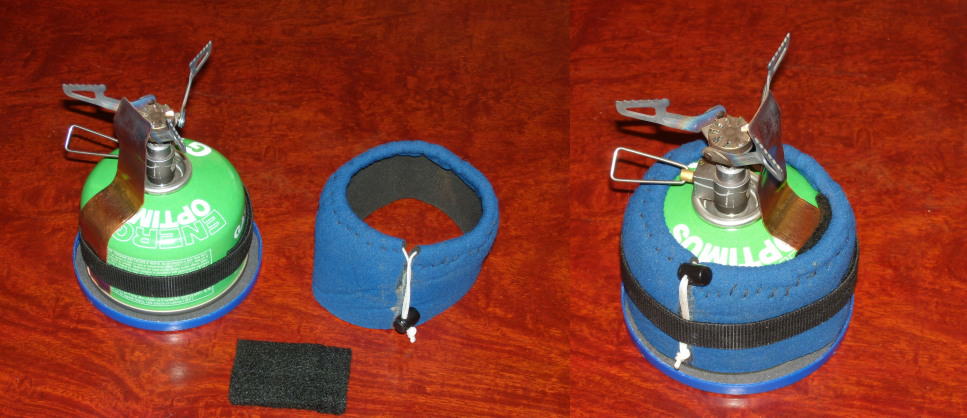
The second thing I would like to note relates to the weight of our different techniques. You say 80 gm for your stove. My V.2 is 88 gm, which includes a cute little cuben bag. Now, there must be a windscreen, and of course an insulating base. So we are up to ~ 170 gm by now, right? Not actually very heavy, I think. However, my BRS-3000T stove (28 gm) and the canister cozy, copper strip, and insulating base (40 gm complete) are a total weight of 68 gm. If I feel that a wind screen is also needed, that would add another 26 gm. Call it ~100 gm total, including all bags, etc. If I chose to use a Snow Peak Giga stove instead, that would bring my weight close to that 170 gm. But I would bet my next paycheck that the Moulder Strip/cozy setup would totally outperform the best of remote canister stoves in VERY frigid conditions (say -32C, or -25F). Want to meet me in Fairbanks next Christmas for a proper burn-off?
Thanks everyone for the detail information! I cannot wait for next winter (even though it is really cold in Berlin for this time of year right now). You guys start to really sell me on this method!
Anyway, back to the topic! Just out of curiosity: How warm (or hot?) does the copper strip (or “MS” as the pros seem to call it) itself get? I am not talking about the bit in the flame, but the rest of it where you might unintentionally touch it during cooking or melting snow if you are not careful enough.
Hot enough that you won’t do it again.
Hi Gary
> a photo of your remote canister stove setup. As you well know, I
> am the proud owner of one of your V.2 beauties. If you have access
> to the stove’s control valve through the opening of the 3/4
> windscreen, then do you have a hole in the screen for the fuel
> line? The valve and the fuel line are positioned 180 degrees from
> each other (a problem that seems to be eliminated with your new
> vortex stoves).
You are correct that where the hose comes off the stove varies, and this can affect the windscreen placement.
The V1 stove has the hose opposite the valve, but this is not an insuperable problem. I just curl the hose around so the canister is close to the valve and arrange the windscreen opening to suit. In warmer weather when I don’t need the thermal feedback I don’t bother: I have the canister outside the windscreen and arrange the hose to be on the ground. That lets me drop the windscreen over the hose with only a tiny gap under the edge. Yes, you could cut a small ‘tail hole’ in the windscreen for the hose, but I don’t bother.
More to the point is that I am not worried if there is a tiny gap on the windward side for a little bit of breeze, for two reasons.
The first is that at ground level the wind is never strong, so not much wind will come through that gap.
The second is that I never try to use the windshield to block a high wind; rather I try to find a fairly sheltered spot to start with. For dinner this is inside the tent.
This means the windshield acts more to keep the hot air near the pot rather than deflecting a high wind. The term ‘windshield’ is a bit of a misnomer.
The V2 stove has the hose coming from the valve. Problem solved, but all the above still applies.
Can the hose handle some heat? Yes. It is made of PFA tubing inside SS braid. The PFA tubing is rated to about 260 C (500 F) at pressure – and it has cold fuel running through it. Caution: many hoses can’t take those sorts of temperatures as they are made of cheaper stuff.
Stove weights: variations of a few grams here or there are likely. I use a stove base and a windshield in the snow with any stove. But yes, the BRS-3000T is very light. And the rest of my gear (and food and water) is much heavier than the stove.
Photos – I have lots of posed photos of the stoves, but they all have the canister pushed a bit out of the way for the photo. Hum …
> But I would bet my next paycheck that the Moulder Strip/cozy setup
> would totally outperform the best of remote canister stoves in
> VERY frigid conditions (say -32C. or -25F).
Chuckle. You won’t get any gas out of the canister when it is at -32 C! So you will have to warm the canister up a bit with either stove to get it started. The remote canister stove does not have the delay found with the heat shunt. Does that matter?
But it is an interesting question: remote canister vs heat shunt. Both work: is that enough?
Cheers
I see now, Roger – mine is a V.1 stove, and not a V.2 after all. Having the fuel line come out next to the control valve would solve everything, allowing access to the valve. I have the proper valve setting at the stove figured out now, and when I want to shut the stove off I do so at the canister. However, is there a way that I could retro-fit my stove to move the fuel line over to near the stove’s control valve?
Well, yes, both stoves will work in frigid conditions. Maybe. So far, no one has been able to test the Moulder Strip at the challenging temperature of -32 C (-25 F), but I am thinking that it will work once you get the copper strip happening. If it falters, the simple addition of a hand warmer sealed at the bottom of the canister should do the trick. This would likely enable the inverted canister stove to perform as well. I doubt that any other canister warming technique would be enough (except for a campfire, which I would damn well want if I found myself in such conditions).
Hi Gary
Yes, you have a V1. You don’t seem to be on my list of customers, so did you buy yours second hand? I am not fussed at all – just curious.
is there a way that I could retro-fit my stove to move the fuel line over to near the stove’s control valve?
NOT easily! To be sure, if you have a good workshop anything could be possible, but … not easily.
Campfires … could be difficult!

Cheers
Yes, Roger, I bought it from another BPLer (Clay Mauritzen). So V.1 it must be. What burner head is it–the FMS 300T?
Yeah, one can’t count on having a campfire in Iceland, Antarctica, the Empty Quarter of Saudi Arabia, or wherever you were camping in that photo. But still, one kept me alive in Dec. 1974 (along with my trusty Optimus 8R white gas stove), which helped me stave off hypothermia one night at -34* F (-37* C) when I skied down from a pass in Colorado to spend the night in an aspen grove under a frigid full moon. I’m done with subjecting myself to such conditions these days. Once was enough…
Yes, it’s the FMS-300T burner. I had to buy a job lot of 100 of them from FM to get anything like a reasonable price.
wherever you were camping in that photo.

Australia, Kosciusko NP, Upper Geehi valley. The average annual temperature there is below the lower limit for tree growth. Grass, rocks, and some very flat bushes in sheltered places, on rocks.
The two photos here are exactly the same place, 12 hours apart (fine evening, not so good morning). A bit short on trees.
Cheers
Great article and discussion.
Does paragraph 6 have a conversion error? (5400 feet vs 2550 meters).
It sure does, Rod. I don’t know how that slipped by. An elevation of 5440 feet is 1658 meters. Thanks for pointing that out. Hopefully, all of the other conversions are accurate.
Become a member to post in the forums.