


Low-carbon hiking in Colorado
Nothing about long-distance hiking is normal, I think. Normal people don’t go away for weeks or months to live outside, walking 20 miles a day. But humans are nothing if not adaptable, and what seems at first to be profoundly abnormal (i.e., choosing to become a vagrant) can start to seem normal once you start doing it. And then this new normal creates its own expectations.
One of those expectations is that once you set out on a hike, you will be able to complete it. That if you don’t it is because of reasons of your own choosing, such as deciding you no longer like being a vagrant. What you don’t expect is that you have to get off trail because of disasters like wildfires. Or never get on it because the trail has been closed because of last year’s wildfires. Or the year before’s wildfires.
But that is normal now, and we are all getting used to it. When I got off the PCT at Elk Lake in 2021 I expected to be back in 2022, hiking the last 700 miles to Canada. But as the days counted down, the Lionshead closure was still in effect, as was the Canadian ban of Pacific Crest Trail (PCT) hikers. Hiking the PCT in 2022 would mean skipping a big chunk of Oregon.
So I made plans instead to do some long loops through the Sawtooths and the Wind Rivers. I would wait for the PCT to get back to normal and do some interesting hikes in beautiful country this summer.
We may be living in a new normal, but it’s not like the old normal was always great. Getting to a trailhead normally means burning up a lot of fossil fuels to get there. We’ve all implemented Leave No Trace on the trail, but getting TO the trail often requires high-impact activities like flying or driving hundreds of miles, emitting hundreds of pounds of CO2 in the process. A drive to Ketchum, ID and back would result in me pumping over 1,200 lbs of CO2 into the atmosphere. So much for LNT. This bothers me. Not enough to keep me from doing it, but it bothers me.
So when my wife and I were driving (yes) back from a hike in the Indian Peaks and the governor was on the radio talking about the new bus service to towns in western CO, I was ready to listen when she said “you know, instead of driving to Idaho, you should just take the bus to Crested Butte and walk home”.
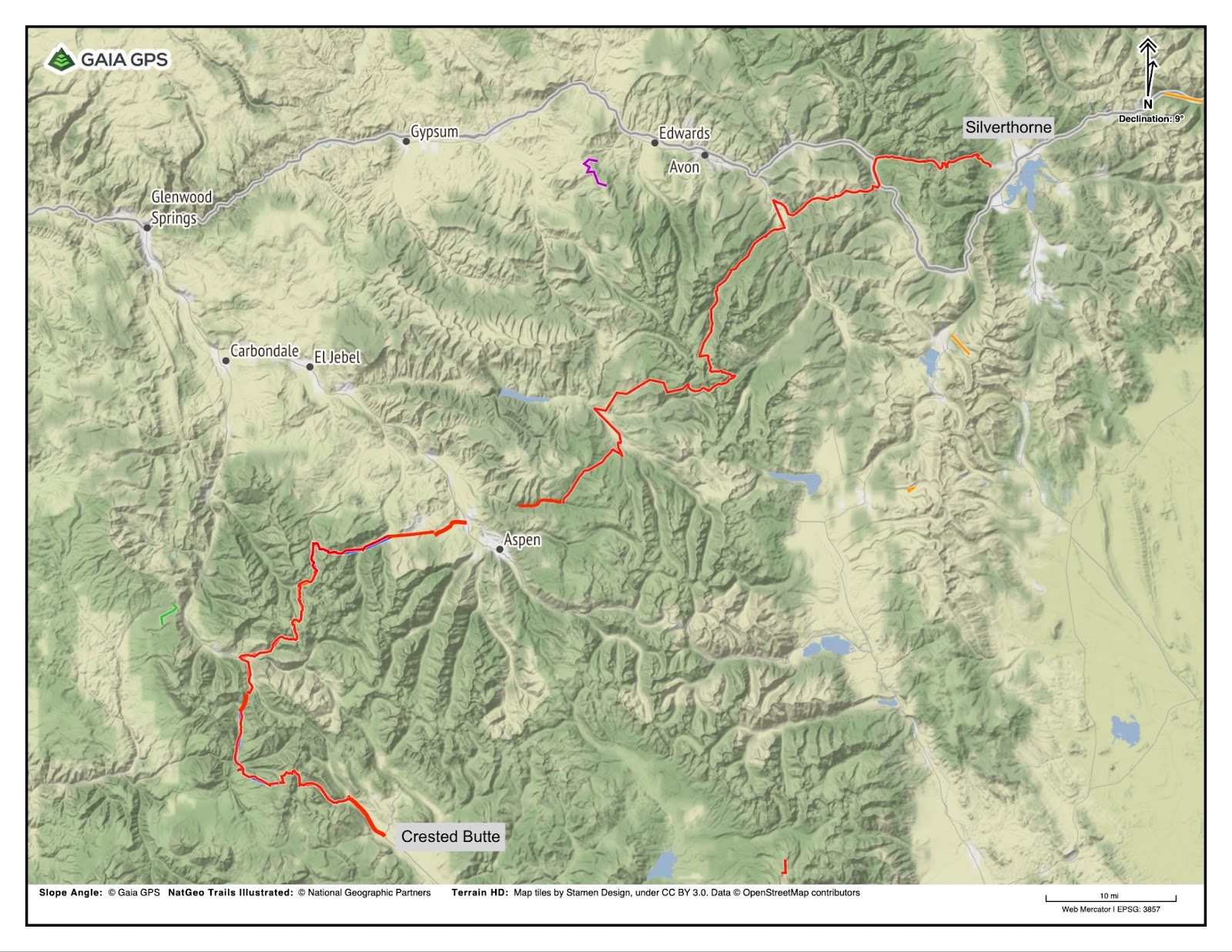
It was one of those ideas you know is right as soon as you hear it. I opened up Gaia GPS and in a few hours had a plausible route from Crested Butte (a ski town in western CO) to Nederland, a Boulder County mountain town with bus service. I could do a two-week traverse through the heart of the Colorado Rockies without getting in my car, relying solely on public transportation. Not a zero-carbon hike, but a low-carbon hike for sure.
Two days later I took the RTD (the regional agency operating public transit in the Denver-Aurora-Boulder Combined Statistical Area) to Denver’s Union Station, then got on the Bustang – headed to Crested Butte. There were maybe fifteen people on the bus, which was equipped with comfy seats and USB charging ports. We made three stops along the way, and just like that I was at my destination. I checked in at the hostel, walked downtown for dinner and a beer, and was on the road first thing in the morning.
Member Exclusive
A Premium or Unlimited Membership* is required to view the rest of this article.
* A Basic Membership is required to view Member Q&A events


Discussion
Become a member to post in the forums.
Companion forum thread to: A Walk from Crested Butte
Drew Smith writes about using public transit to make the travel to, from, and between trailheads more sustainable.
This story, Drew, is special to me. Thanks for writing it. I’ve hiked much (but not all) of this route and echo the fact that it’s wilder, more remote, and a bit more hostile (weather wise) than most of the more popular hikes in Colorado. Some of my favorite miles here. A very well-done story. Thanks for sharing.
The Bustang enabled an epic trip. You’ve got me motivated to see if I can put together a low carbon hike from my home in Western Washington into the Cascades. Thanks for writing up your hke.
What an inspiring route! Thanks, Drew. Linking CB > Marble > Aspen would be nice in and of itself, but to press on all the way over to Frisco crosswise is really creative and awesome.
There is something futuristic about this style of trip. Not only by using public transit, but by ignoring the boundaries of developed and undeveloped, well-trodden and not trodden. It has the spirit of an invented FKT route but without the race mentality. It’s a great answer to those who say there aren’t any long distance backpacking routes in Colorado :)
Villages and remote canneries throughout the state of Alaska receive “mail plane“ service. These are heavily subsidized float- or wheel-plane routes to deliver US mail and freight. You can get quite inexpensive seat fares for these flights, and that is the way I do a lot of my trips. A number of times I have flown to a remote corner of the Kodiak archipelago on the mail plane and then hiked/paddled home. Or I flew to a remote cannery and then hiked to a distant village, taking the mail plane to and from the starting and ending points. I doubt the concept is very eco-friendly, but these are regularly-scheduled flights and an empty seat seems like a waste, so I might as well be on the plane. It’s our bus in the sky.
What a great article. I would like to echo what you said about the bus service. The last time I took public transit was on Kern Transit from Tehachapi CA out to the PCT crossing at Cameron Canyon Rd in 2021. The bus was on time and the ride was uneventful (no drama). Some trailheads in California are served well and I hope to see more bus service in the future.
Awesome story, Drew! I love finding a way to make transit work for at least one leg of my trip. My sister and I had a great time hiking from Breckenridge to Copper Mountain via the CT, thanks to the free and reliable bus system. I love being able to hike or ski while minimizing my contribution to congestion and pollution. Extra points next time if you can use a train!
Become a member to post in the forums.