

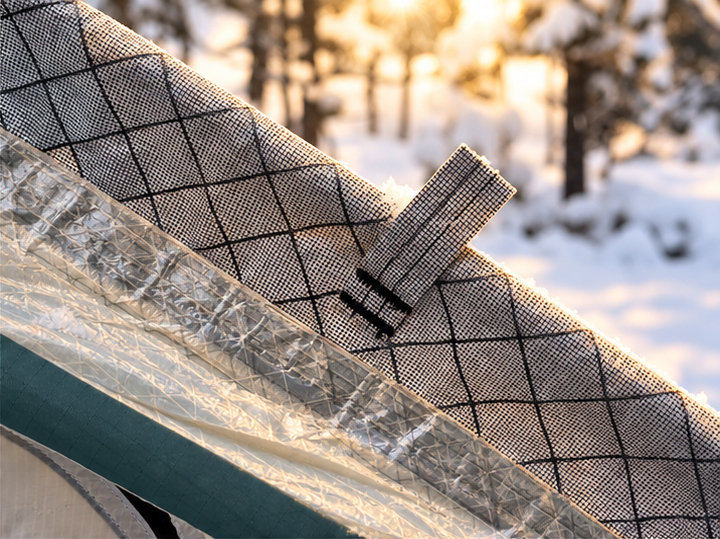

Technical fabrics are often classified by material family, including DCF, Ultra, X-Pac, ECOPAK, silpoly, and silnylon. That level of classification is useful, but it is not sufficient for material selection for specific product use cases. Individual constructions within the same family can differ substantially in mass, tear strength, abrasion resistance, waterproofness, dimensional stability, and construction method.
The tables below separate three major applications: packs, shelters, and storage systems. Each application imposes a different set of mechanical and environmental demands.
How to Read These Tables
Published test values are only directly comparable when the test methods are sufficiently similar. Tear, puncture, abrasion, and waterproofness results can vary with specimen geometry, test standard, loading method, and manufacturer protocol.
Where manufacturers publish compatible test data, the values provide useful comparative information. Where they do not, the table reports the available specification without implying equivalence. Where no useful value is published, the table states Not published.
Values produced using different test methods or manufacturer protocols should not be treated as directly equivalent.
Fabric Families and Construction Types
The materials in these tables use several different construction strategies. Understanding those constructions helps explain differences in weight, stiffness, tear resistance, abrasion resistance, waterproofness, and manufacturing requirements.
Dyneema Composite Fabric (DCF)
Dyneema Composite Fabric uses nonwoven Dyneema fibers arranged primarily in 0-degree and 90-degree orientations and bonded between thin film layers. The resulting laminate has very low stretch, low water absorption, high tensile strength for its mass, and high waterproofness. Lighter constructions are commonly used in shelters and ultralight storage products, where low mass and dimensional stability are priorities. Their principal limitations include relatively low puncture resistance in the lightest constructions and an exposed film surface that provides less abrasion protection than a woven-faced composite.
DCF Hybrid constructions add a woven face fabric to the composite structure. The face improves abrasion resistance and handling durability while increasing mass. Dyneema also now produces woven composite constructions in which a woven Dyneema face is bonded to the composite core.
Challenge UltraWeave
UltraWeave is a woven composite developed primarily for packs and other high-load applications. The face combines UHMWPE, marketed by Challenge as Ultra-PE, with high-tenacity polyester and is laminated to a waterproof film. Current UltraX constructions also use Ultra-PE CrossPly reinforcement.
UltraWeave differs fundamentally from DCF. Its woven face carries structural loads and provides substantial abrasion resistance, while the film provides waterproofness and dimensional support. Ultra100X, Ultra200X, Ultra400X, and heavier versions primarily differ in face-fabric denier, mass, and mechanical durability.
UltraWeave specifications are from Challenge Outdoor’s current UltraWeave Collection page; legacy/alternate Challenge pages may show different nominal weights.
Challenge UltraTNT
UltraTNT is an ultralight film laminate intended primarily for tents, tarps, and other low-mass structures. It uses polyester film layers reinforced with UHMWPE yarns rather than a conventional woven face fabric. This produces a light, dimensionally stable, waterproof material, but with different abrasion, puncture, and construction characteristics than UltraWeave.
Challenge ECOPAK
ECOPAK is a family of laminated pack fabrics that combines woven face fabrics with reinforcement and waterproof backing structures. EPX constructions use a woven face, reinforcement structure, waterproof film, and woven backing. EPLX constructions remove some structural layers to reduce mass and bulk. These materials represent a more conventional sewn-laminate architecture than UltraWeave and generally provide predictable stitch support and handling characteristics.
Challenge TX Ultra
TX Ultra constructions combine lightweight woven or composite reinforcement with a laminated structure intended for lower-mass applications such as pack liners, accessory bags, and storage systems. They occupy a design space between very light film composites and heavier structural pack laminates.
X-Pac
X-Pac is a family of laminated technical fabrics derived from sailcloth manufacturing methods. The family includes several distinct constructions rather than one material type.
X3 fabrics generally combine a woven face fabric, X-PLY reinforcement, and a polyester film backing. X4 constructions add a woven backing layer. LiteSkin, or LS, fabrics use a nonwoven polyester exterior face with a UV-resistant coating, waterproof film, and woven backing. The LS series is designed to provide high surface abrasion resistance with a different exterior structure than conventional woven-face X-Pac.
X-Pac hyperTEC uses high-modulus fibers for lower stretch and higher strength-to-weight performance. Current UX constructions use a 100 percent Ultra-PE woven face with Ultra-PE X-PLY reinforcement. These fabrics should be considered separately from conventional nylon-faced X-Pac constructions because their fiber system and mechanical behavior are substantially different.
Silnylon
Silnylon is woven nylon fabric impregnated or coated with silicone. It remains widely used in shelters because it provides low mass, good tear resistance, flexibility, and reliable waterproofing. Nylon absorbs more moisture than polyester and can elongate under wet conditions, which may reduce shelter tension during prolonged rain.
Silpoly
Silpoly uses woven polyester rather than nylon as the structural fabric, typically with silicone-based waterproof coatings. Polyester absorbs less water and generally changes dimensions less when wet. This can improve pitch stability in shelters. Mechanical properties vary substantially with yarn size, weave, coating formulation, and finished fabric weight, so silpoly should not be treated as a single standardized material.
ALUULA Composites
ALUULA produces thermoplastic composite fabrics that use high-strength fiber reinforcement bonded to polymer films without conventional adhesive lamination. Graflyte is oriented toward high-strength, abrasion-resistant technical products, while Aeris X is designed for lightweight tensioned structures such as shelters.
These materials differ from conventional sewn laminates because some constructions can be thermally bonded or welded. This can change seam design, reinforcement methods, and waterproof construction. Public comparative mechanical data remain less complete than for several longer-established fabric families, so direct quantitative ranking should be made cautiously.
Pack Fabrics
Pack fabrics must resist sustained loads, concentrated stitching loads, abrasion, puncture, and repeated flexing. Material selection therefore requires more than a comparison of nominal strength.
The primary variables are mass, tear strength, abrasion resistance, stitch support, structural stability, waterproofness, and long-term laminate durability. These properties are not necessarily correlated. A lighter fabric may provide exceptional tear strength while offering less surface abrasion resistance. A heavier laminate may provide better stitch support and surface durability at a substantial mass penalty.
Differences within a single material family can also be large. X-Pac constructions, for example, vary substantially in face fabric, reinforcement structure, backing, weight, abrasion resistance, and tear strength. Ultra constructions likewise span different weights and durability levels.
From a design perspective, the optimum pack fabric is not necessarily the strongest. Which construction provides the required combination of strength, abrasion resistance, sewing performance, durability, and mass for the intended part of the pack must be considered.
Material Technology Comparison - Backpack Fabrics
| Material | Weight | Construction | Tear strength* | Abrasion | Waterproofness | Construction notes | Best use | Primary limitation |
|---|---|---|---|---|---|---|---|---|
| ROBIC — 210D ROBIC Ripstop Nylon | 4.4 oz/yd² (124.7 gsm) | 210D ROBIC nylon 6; 3 mm ripstop; UTS backside coating; DWR face | Not published | Not published | Not published | Easy to sew; conventional seam construction. | Conventional pack bodies, pockets, and bags where sewing simplicity matters | Lacks current public quantitative tear/abrasion/HH data for rigorous comparison |
| X-Pac X4 — VX21 | 6.2 oz/yd² (210 gsm) | 210D nylon face; polyester X-PLY at 22 deg; 0.25 mil polyester film; 50D polyester taffeta backing | 24.4/17.2 lb warp/fill; method not stated | 500 cycles; ASTM D3884 | 200 psi; 13.8+ bar | Good stitch support; sew and optionally seam-tape. | General-purpose structured pack bodies | Heavier than newer high-modulus laminates for its tear strength |
| X-Pac X3 — X21 | 5.2 oz/yd² (177 gsm) | 210D nylon face; polyester X-PLY at 22 deg; 0.5 mil polyester film backing | 16/12 lb warp/fill; method not stated | 900 cycles; ASTM D3884 | 200 psi; 13.8+ bar | Reinforce concentrated stitching; sew and optionally seam-tape. | Lighter waterproof pack bodies and panels | Less stitch-supporting backing than VX21 |
| X-Pac LS — LS21 | 6.3 oz/yd² (214 gsm) | Nonwoven polyester LiteSkin face with UVt coating; 0.5 mil polyester film; 210D nylon backing | 9.3/6.3 lb warp/fill; method not stated | 2,000 cycles; ASTM D3884 | 200 psi; 13.8+ bar | Good stitch holding; sew and seam-tape as needed. | High-abrasion pack panels and bags | Low published tear values for weight compared with high-modulus alternatives |
| X-Pac hyperTEC — UX10 | 85 gsm | 100% Ultra-PE woven face; Ultra-PE X-PLY at 22 deg; polyester film backing | 61.8/50.4 lb warp/fill; method not stated | 500 cycles; ASTM D3884 | 200 psi; 13.8+ bar | Reinforce high-load points; sew and seam-tape. | Ultralight high-strength pack panels with reinforced load points | Only 500 abrasion cycles; limited public long-term flex/stitch durability data |
| ECOPAK EPX — EPX200 | 6.4 oz/yd² (216 gsm) | C0 DWR 200D recycled polyester face; 45 deg Blue CrossPly; 70D ripstop backing | 33.1/34.6 lb warp/fill; ASTM D2261 | 500 cycles; ASTM D3884 | 200 psi; 13.8+ bar | Good stitch support from woven backing. | Conventional sewn pack bodies needing strong stitch support | Heavier than film-backed EPLX200 at same face denier |
| Dyneema Composite Hybrid — DCH 3.2 (CT5K.18/blkwov4) | 3.1 oz/yd² (104 gsm) | 50D woven polyester face / 0-90 Dyneema fiber / polyester film | Slit tear: 42 lb, Mil-C-21189 | Not published | 20000 mm H2O; AATCC TM127 | Woven face improves handling; reinforce high-load stitching. | Very light pack bodies and accessories needing a woven face | No standardized abrasion-cycle value published in Fabric Finder |
| UltraWeave — Ultra100X | 3.6 oz/yd² (122 gsm) | 100D Ultra-PE/high-tenacity polyester face; Ultra-PE CrossPly; 0.75 mil film backing | 69.4/89.6 lb warp/fill; ASTM D2261 | 3,600 cycles; ASTM D3884 | 200 psi; manufacturer | Reinforce high-load stitching; PSA tape compatible. | Ultralight pack bodies and accessories | Film-backed stitch/flex behavior needs construction discipline |
| UltraWeave — Ultra200X | 4.6 oz/yd² (155 gsm) | 200D Ultra-PE/high-tenacity polyester face; Ultra-PE CrossPly; 0.75 mil film backing | 103.1/133.2 lb warp/fill; ASTM D2261 | 4,400 cycles; ASTM D3884 | 200 psi; manufacturer | Reinforce concentrated stitching; PSA tape compatible. | Primary high-performance pack bodies | Higher cost; film-backed construction requires careful seam/load design |
| UltraWeave — Ultra400X | 6.14 oz/yd² (208 gsm) | 400D Ultra-PE/high-tenacity polyester face; Ultra-PE CrossPly; 0.75 mil film backing | 187.7/161.1 lb warp/fill; ASTM D2261 | 8,800 cycles; ASTM D3884 | 200 psi; manufacturer | Robust face; reinforce concentrated film-side loads. | High-abrasion / hard-use pack zones | Overbuilt for many ultralight applications; cost/stiffness |
| ALUULA Graflyte — Graflyte V-78 | 78 gsm | ALUULA Core fused to V-film without glue; 100% PE family architecture per manufacturer | No public quantitative tear method/value located | Not published | Waterproof; quantitative HH/pressure value not published | Heat-weldable; can reduce reliance on stitched seams. | Welded waterproof pack components and experimental pack bodies | Public quantitative tear/abrasion/HH data are insufficient for direct ranking |
Published tear and abrasion values are useful screening metrics, but they do not determine pack durability by themselves. Nearly all pack failures I have experienced outside of incidental punctures or mesh tears, the failure is most often localized. Shoulder-strap anchors, hipbelt interfaces, compression points, bottom panels, seam intersections, and repeated fold lines experience much higher stresses than the average panel.
This is why a material with exceptional laboratory tear strength can still require careful reinforcement and load spreading. Conversely, a heavier fabric with more modest “headline” (raw fabric) strength may perform very well if its woven backing, stitch support, and surface durability are better matched to the structure.
For pack design, I generally care less about identifying the strongest fabric than about identifying the lightest construction that preserves adequate margin at the actual failure points.
Shelter Fabrics
Shelter fabrics are governed by a different set of requirements. Important properties include mass, waterproofness, tear resistance, puncture resistance, dimensional stability, wet stretch, UV durability, and seam construction.
Low mass alone is not a sufficient design objective. A shelter fabric must also maintain geometry under sustained tension, resist localized damage, tolerate repeated packing, and retain adequate waterproofness over its service life.
The distinction between silpoly and silnylon illustrates the importance of dimensional behavior. Fabrics of similar weight and waterproofness can respond differently to moisture. Polyester generally absorbs less water and exhibits less wet stretch than nylon, which can reduce shelter sag in wet conditions, but this is not a universal rule that can be applied to all silnylon vs. silpoly comparisons.
DCF occupies a different design space. It provides low mass, low stretch, and high waterproofness, but the lightest constructions provide less puncture and tear margin than heavier versions. Increasing DCF weight can produce a substantial increase in mechanical durability.
Shelter material selection should therefore consider both initial weight and the durability margin required for the expected loading, weather exposure, construction method, and service life.
Material Technology Comparison - Shelter Fabrics
| Material | Weight | Construction | Tear strength* | Puncture | Waterproofness | Wet stability | Seam method | Best use | Primary limitation |
|---|---|---|---|---|---|---|---|---|---|
| Silnylon — RBTR 1.1 oz Silnylon | 1.24 oz/yd² (42 gsm) | 20D x 20D ripstop nylon; silicone/PU impregnated both sides | Not published | Not published | 2000 mm H2O; supplier value | More water uptake and wet sag than comparable polyester; no quantitative value published. | Sewn; seam sealing required for waterproof finished article | Conventional lightweight shelters where supple handling matters | Wet stretch/sag and water uptake relative to polyester/composites; lower HH than film laminates |
| Silpoly — RBTR 1.1 oz Silpoly | 1.24 oz/yd² (42 gsm) | 20D x 20D ripstop polyester; silicone/PU impregnated both sides | Not published | Not published | 2000 mm H2O; supplier value | Lower water uptake and wet sag than silnylon; qualitative supplier claim. | Sewn; seam sealing required for waterproof finished article | Conventional lightweight shelters where low wet sag matters | Lower puncture/abrasion margin than heavier fabrics; HH far below film laminates |
| Dyneema Composite Fabric — DCF 0.55 (CT1E.08) | 0.55 oz/yd² (19 gsm) | Polyester film / 0-90 Dyneema fiber / polyester film | Slit tear: 14 lb, Mil-C-21189 | 1.8 lb; ASTM F1342 Probe B | 15000 mm H2O; AATCC TM127 | Very low stretch; low water absorption; resists material sagging per manufacturer | Bond/tape or sew + tape depending design; construction-specific | Minimum-mass bonded/taped shelters | Low puncture margin and exposed-film durability at 19 gsm |
| Dyneema Composite Fabric — DCF 0.75 (CT2E.08) | 0.75 oz/yd² (25 gsm) | Polyester film / 0-90 Dyneema fiber / polyester film | Slit tear: 18 lb, Mil-C-21189 | 3.1 lb; ASTM F1342 Probe B | 20000 mm H2O; AATCC TM127 | Very low stretch; low water absorption | Bond/tape or sew + tape depending design | DCF shelters needing more puncture margin | Still puncture- and abrasion-limited relative to woven-faced laminates |
| UltraTNT — UltraTNT 0.94 | 0.94 oz/yd² | Ultra-reinforced thin-film shelter laminate | Not published | Not published | 200+ psi; manufacturer | Dimensionally stable; does not absorb water per manufacturer | PSA seam/reinforcement tape system; use manufacturer-recommended widths. | Very low-mass taped shelter construction | Manufacturing (cut and sew) precision tooling and process critical |
| ALUULA Aeris X — Aeris X AX-33 | 32.9 gsm | 100% PE reinforced 0/45/45 X-weave architecture; heat-weldable | Third-party relative strength/tear claims only; no absolute method/value on product page | Not published | Not published | Designed for stretch/tear resistance; low water uptake expected from PE but do not infer numeric behavior | Heat weldable / thermoformable; construction-specific | Emerging welded ultralight shelter construction | Absolute public test values and field history are limited compared with mature shelter fabrics |
I don’t look just at waterproofness or tear strength for shelter fabrics. I’m interested in how the material behaves while continuously tensioned, repeatedly packed, exposed to UV, cycled wet and dry, and loaded by wind.
A very low-stretch laminate can maintain excellent geometry but transfer more load into seams, reinforcements, and attachment points. A woven fabric may deform more, but some of that deformation can distribute transient loads. Neither behavior is inherently superior. The design has to account for it.
Storage-System Fabrics
Storage systems should be evaluated as a separate application class. Stuff sacks, zip bags, pack liners, dry bags, food bags, and organizers experience different loads than either packs or shelters.
These products generally carry lower structural loads than pack bodies, but they are subjected to repeated folding, rolling, compression, closure cycling, localized puncture, and frequent handling. These demands change the relative importance of material properties.
Relevant variables include mass, puncture resistance, flex durability, abrasion resistance, waterproofness, closure compatibility, seam construction, stiffness, and packing characteristics.
Several material strategies are common:
- coated woven fabrics that provide flexible handling and conventional sewn construction;
- lightweight film composites that minimize mass;
- woven-faced composites that improve abrasion and surface durability;
- thin tapeable laminates used for liners and ultralight storage products; and
- weldable composites used where waterproof construction is a primary requirement.
Closure and seam design are particularly important in storage products. The base fabric may not determine product life. Zippers, roll-top closures, fold lines, seam tape, stitching, and repeated flexing can become the dominant failure points.
Material Technology Comparison - Storage Bag Fabrics
| Material | Weight | Construction | Tear strength* | Puncture | Abrasion | Waterproofness | Handling & construction | Best use | Primary limitation |
|---|---|---|---|---|---|---|---|---|---|
| Silpoly — RBTR 1.1 oz Silpoly | 1.24 oz/yd² (42 gsm) | 20D x 20D ripstop polyester; silicone/PU impregnated both sides | Not published | Not published | Not published | 2000 mm H2O; supplier value | Supple and easy to pack; works well with drawcords, zippers, and roll-tops; seam-seal for waterproofing. | Stuff sacks and organizers where suppleness matters more than minimum mass | Lower puncture/abrasion margin than heavier fabrics; HH far below film laminates |
| ROBIC — 210D ROBIC Ripstop Nylon | 4.4 oz/yd² (124.7 gsm) | 210D ROBIC nylon 6; 3 mm ripstop; UTS backside coating; DWR face | Not published | Not published | Not published | Not published | Supple, durable, and easy to sew; excellent zipper/drawcord/roll-top compatibility. | Durable stuff sacks, zip bags, and organizers | Lacks current public quantitative tear/abrasion/HH data for rigorous comparison |
| X-Pac X3 — X21 | 5.2 oz/yd² (177 gsm) | 210D nylon face; polyester X-PLY at 22 deg; 0.5 mil polyester film backing | 16/12 lb warp/fill; method not stated | Not published | 900 cycles; ASTM D3884 | 200 psi; 13.8+ bar | Moderately stiff; works with zippers and roll-tops; film side can be seam-taped. | Waterproof zip/roll-top bags with conventional sewing | Less stitch-supporting backing than VX21 |
| ECOPAK EPLX — EPLX200 | 4.8 oz/yd² (162 gsm) | C0 DWR 200D recycled polyester face; 45 deg Blue CrossPly; 0.5 mil RUV matte film | 21.3/24.2 lb warp/fill; ASTM D2261 | Not published | 500 cycles; ASTM D3884 | 200 psi; 13.8+ bar | Light film-backed laminate; good for liners, pouches, and roll-tops; PSA tape compatible. | Lightweight pouches, liners, and roll-top bags | Lower stitch-holding than backed EPX; reinforcement required at high-load stitching |
| Dyneema Composite Fabric — DCF 1.6 (CT5K.18) | 1.6 oz/yd² (53 gsm) | Polyester film / 0-90 Dyneema fiber / polyester film | Slit tear: 34 lb, Mil-C-21189 | 5.2 lb; ASTM F1342 Probe B | Not published | 20000 mm H2O; AATCC TM127 | Very light and crinkly; well suited to taped/bonded stuff sacks and roll-tops. | Minimum-mass stuff sacks and dry-bag-style storage | No published abrasion-cycle metric; film surface can be damage-sensitive |
| Dyneema Composite Hybrid — DCH 3.2 (CT5K.18/blkwov4) | 3.1 oz/yd² (104 gsm) | 50D woven polyester face / 0-90 Dyneema fiber / polyester film | Slit tear: 42 lb, Mil-C-21189 | 7.3 lb; ASTM F1342 Probe B | Not published | 20000 mm H2O; AATCC TM127 | Woven face improves handling and surface protection; good zipper and roll-top compatibility. | Light woven-faced zip bags and pouches | No standardized abrasion-cycle value published in Fabric Finder |
| UltraWeave — Ultra100X | 3.6 oz/yd² (122 gsm) | 100D Ultra-PE/high-tenacity polyester face; Ultra-PE CrossPly; 0.75 mil film backing | 69.4/89.6 lb warp/fill; ASTM D2261 | Not published | 3,600 cycles; ASTM D3884 | 200 psi; manufacturer | Light and crisp; strong pouch/roll-top candidate; PSA tape compatible. | Ultralight durable pouches and roll-top storage | Film-backed stitch/flex behavior needs construction discipline |
| UltraWeave — Ultra200X | 4.6 oz/yd² (155 gsm) | 200D Ultra-PE/high-tenacity polyester face; Ultra-PE CrossPly; 0.75 mil film backing | 103.1/133.2 lb warp/fill; ASTM D2261 | Not published | 4,400 cycles; ASTM D3884 | 200 psi; manufacturer | Crisp and robust; suited to hard-use pouches and roll-tops; PSA tape compatible. | Robust technical storage and hard-use pouches | Higher cost; film-backed construction requires careful seam/load design |
| TX Ultra — TX70 Ultra | 2.9 oz/yd² | 70D recycled polyester ripstop face; 45 deg Ultra CrossPly; 0.25 mil PET film | ASTM D2261: manufacturer reports does not tear (no numeric value) | Not published | 500 cycles; ASTM D3884 | 200 psi; 13.8+ bar | Very light, thin laminate designed for small bags and liners; tapeable seams. | Small bags, pack liners, and accessories | Not intended for concentrated pack loads without reinforcement |
| UltraTNT — UltraTNT 0.94 | 0.94 oz/yd² | Ultra-reinforced thin-film shelter laminate; | Not published | Not published | Not published | 200+ psi; manufacturer | Extremely light film laminate for bonded/taped sacks; crease durability remains an evidence gap. | Experimental minimum-mass taped sacks or liners where flex/crease durability is acceptable | Current quantitative product specs need a direct manufacturer sheet before publication |
| ALUULA Graflyte — Graflyte V-78 | 78 gsm | ALUULA Core fused to V-film without glue; 100% PE family architecture per manufacturer | No public quantitative tear method/value located | Not published | Not published | Waterproof; quantitative HH/pressure value not published | Soft hand with strong welding/bonding potential; attractive for welded waterproof storage. | Welded dry bags, pouches, and waterproof storage | Public quantitative tear/abrasion/HH data are insufficient for direct ranking |
In storage products, I’ve learned that the strongest fabric may not produce the longest-lived product. Repeated rolling, folding, zipper cycling, seam-tape flexing, and crease formation can dominate service life. For very light laminates, I would treat flex durability as a first-order design variable rather than an afterthought.
Interpreting the Comparison
Technical fabrics should not be ranked on a single performance axis. Material selection is a multi-variable engineering decision.
A fabric that improves tear strength may increase stiffness or cost. A construction with high abrasion resistance may carry a significant weight penalty. A very light laminate may reduce system mass while providing less puncture tolerance or more demanding seam requirements.
Fiber type also does not determine finished-fabric performance by itself. Face fabric, film structure, reinforcement architecture, coatings, adhesives, backing layers, and seam construction all affect the behavior of the finished material.
The most useful comparison is therefore application-specific. The objective is to identify the construction that provides sufficient strength, durability, waterproofness, dimensional stability, and manufacturability at the lowest appropriate mass for the intended use.
A Practical Material-Selection Framework
I evaluate technical fabrics in this order when I’m shopping for gear or specifying materials for an MYOG project:
- Identify the dominant failure modes for the product and the specific panel or component.
- Determine the minimum required strength, abrasion, puncture, waterproofness, and dimensional stability.
- Evaluate how the material interacts with seams, bonding, reinforcement, and load transfer.
- Add durability margin for uncertainty, contamination, aging, field repair, and manufacturing variability.
- Only then optimize for weight reduction.
Related
Advances in Materials and Manufacturing in Ultralight Backpacks – A detailed technical assessment of ALUULA Graflyte, DCF, woven UHMWPE laminates, seam construction, fusion bonding, delamination, and the engineering tradeoffs shaping newer ultralight packs.
Market Report – Pack and Shelter Fabrics – Ultra-light backpack and shelter fabrics: Explore materials, performance, and construction. Nylon, polyester, UHMWPE, coatings & more.
Online Course – Fabric Technologies for Shelters and Backpacks – A broader educational treatment of material selection, construction, and performance tradeoffs.
Online Course – Dyneema Composite Fabrics – A deeper dive into DCF construction, bonding, seam design, and applications.


Discussion
Become a member to post in the forums.
Companion forum thread to: Technical Fabrics for Backpacks, Shelters, and Storage Systems: A Comparative Guide
A technical comparison of modern fabrics used in backpacks, shelters, and storage systems, including DCF, Ultra, X-Pac, ECOPAK, silnylon, silpoly, and ALUULA. The tables compare weight, tear strength, abrasion resistance, waterproofness, dimensional stability, construction, and key tradeoffs using current manufacturer data.
Become a member to post in the forums.