


Introduction
The Tarptent Aeon Li is one of the lightest solo (1-person) ultralight backpacking tents available. Made with Dyneema Composite Fabrics (DCF), the Aeon is a single-wall design featuring a zippered side-entry with a vestibule. The Aeon requires 4-7 stakes and is pitched with a single trekking pole.
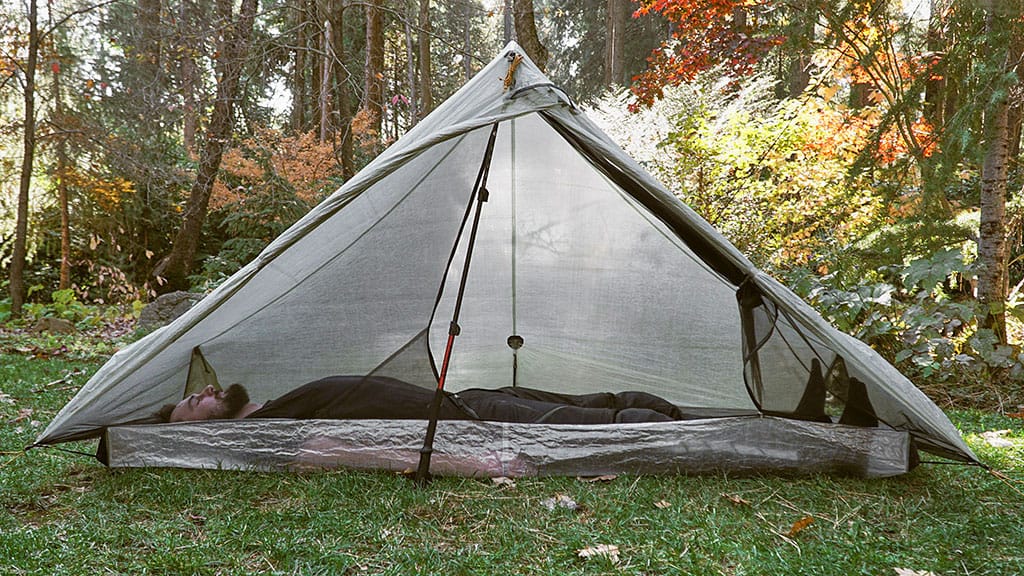
See my review of the Tarptent Notch Li, which discusses some of the features that the Notch Li has in common with the Tarptent Aeon Li, including PitchLoc corners, Dyneema Composite Fabrics, and magnetic door closure tabs.
The following video provides an in-depth analysis of the Tarptent Aeon Li:
(note: due to some wind noise, keep your finger on your volume control if needed so you can hear the narration during wind gusts):
Features
- Single trekking pole support, no pole in your living space
- Front vestibule can be completely rolled back with no apex guyline required
- Fits people up to 7 ft / 213 cm tall (claimed)
- Generous vestibule for excellent gear storage space
- Rollaway vestibule doors for ventilation, views, and moisture management
- PitchLoc™ foldable carbon fiber strut corners on back wall with integrated line tighteners for taut pitch
- Trekking pole handle can be pitched up or down
- Reflective spectra cord guylines
- Catenary ridgeline seams
- MSRP $535
Specifications
- Fabrics: Dyneema Composite Fabrics (DCF) – 0.51 oz/yd2 (canopy), 1.0 oz/yd2 (floor); fully taped and waterproof to 8,000+ mm hydrostatic head pressure rating
- Sleeps: 1 (floor area ~ 18.3 sq. ft.; vestibule area ~ 8.6 sq. ft.)
- Seasons: 3+
- Weight: 15.8 oz / 448 g tent body (includes guylines, struts, and stuff sacks) + 1.7 oz / 48 g stakes (included)
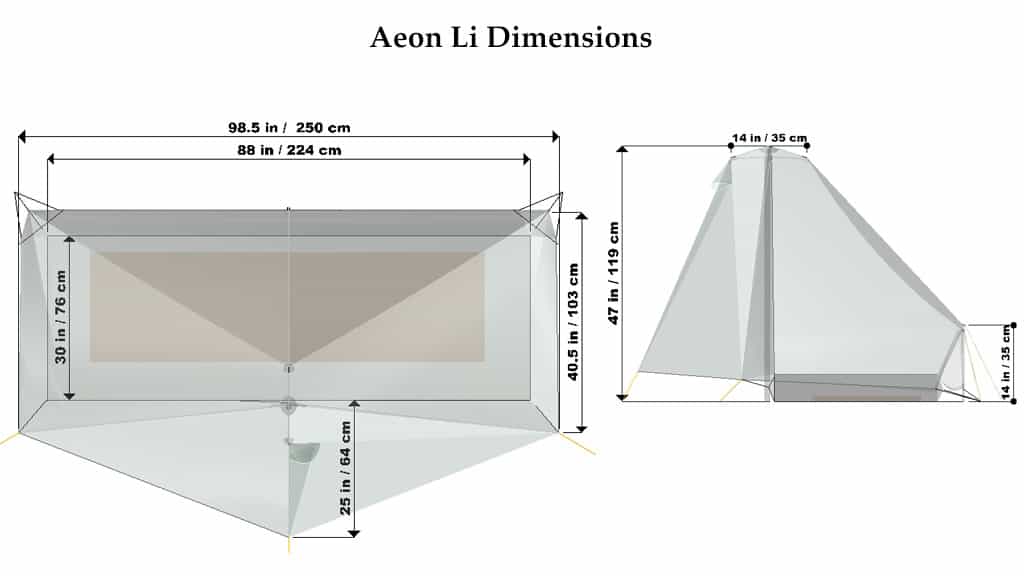
- Interior Height: 47 in / 119 cm
- Floor Width: 30 in / 76 cm
- Floor Length: 88 in / 224 cm
- Stakes: 6 x 6 in / 15 cm Easton Nanos (included)
- Packed size: 14 in x 4 in / 36 cm x 10 cm
Commentary
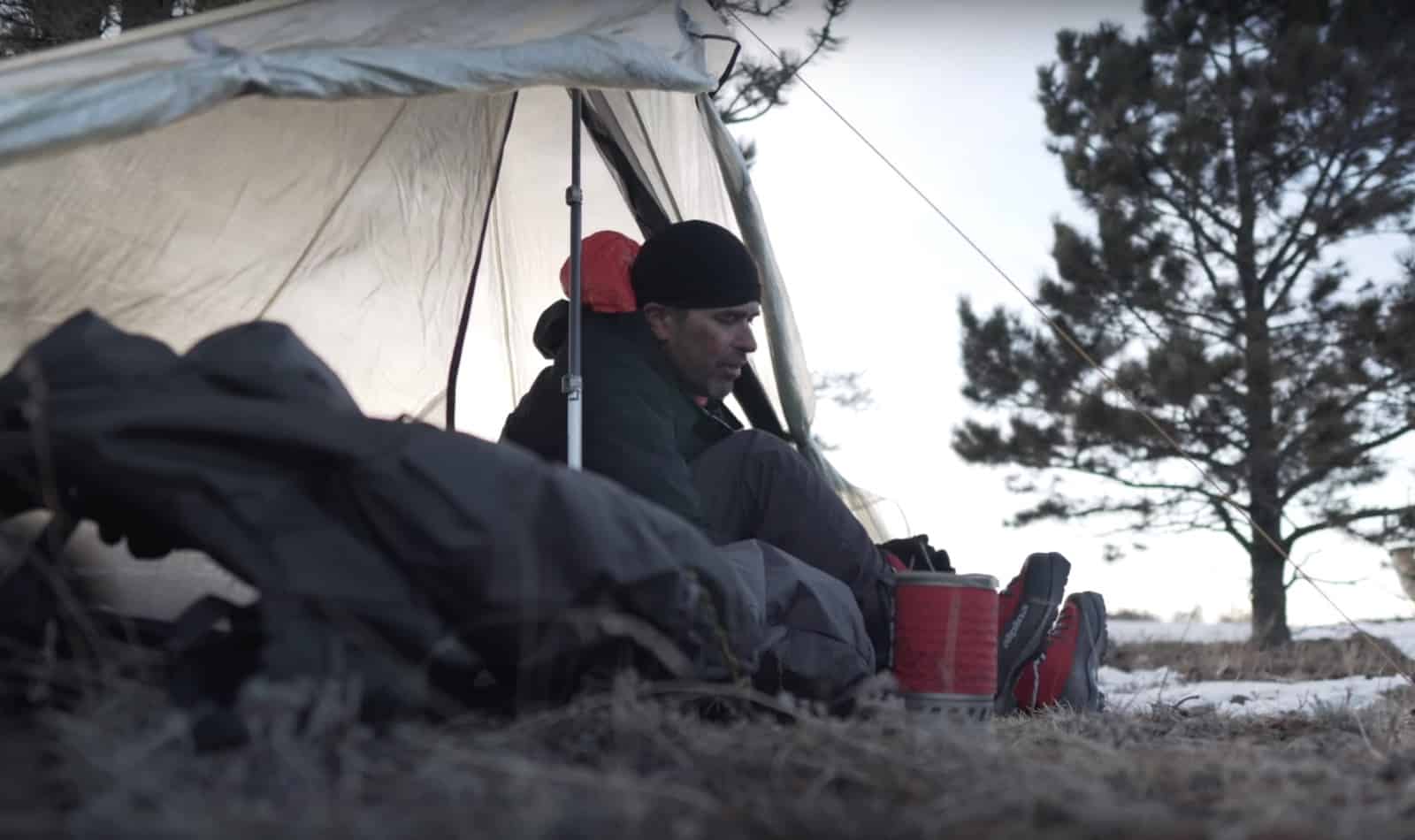
What’s Unique about the Tarptent Aeon Li?
The market for lightweight solo tents weighing less than two pounds is quite crowded, comprised of dozens of both single- and double-wall designs from both cottage and larger manufacturers.
While it’s tempting to use the metric of weight for delineating product categories, it’s probably more appropriate to look at functional metrics when comparing products to each other.
In that context, these features characterize the Tarptent Aeon Li:
- 1-person capacity.
- Trekking pole-supported structure.
- Fully-enclosed shelter (i.e., includes integrated walls and floor).
- External vestibule.
These features allow us to narrow the product category and excludes shelters requiring shock-corded pole sets, 2+ person capacity shelters, and floorless shelters such as tarps and pyramids.
Other important criteria include:
- Single-wall design.
- Dyneema Composite Fabric (DCF) materials.
That leaves a limited number of shelters meeting these functional criteria, with the most obvious competitor being the ZPacks Plexamid.
So what makes the Tarptent Aeon Li unique among this field of competitors?
1. Carbon fiber support struts.
The two back corners of the tent are each supported by two carbon fiber struts in an inverted-V configuration (Tarptent calls this a “PitchLoc” corner). A third (vertical) strut along the midpoint of the back wall, combined with the PitchLoc corners, help create a vertical wall along the back of the tent.
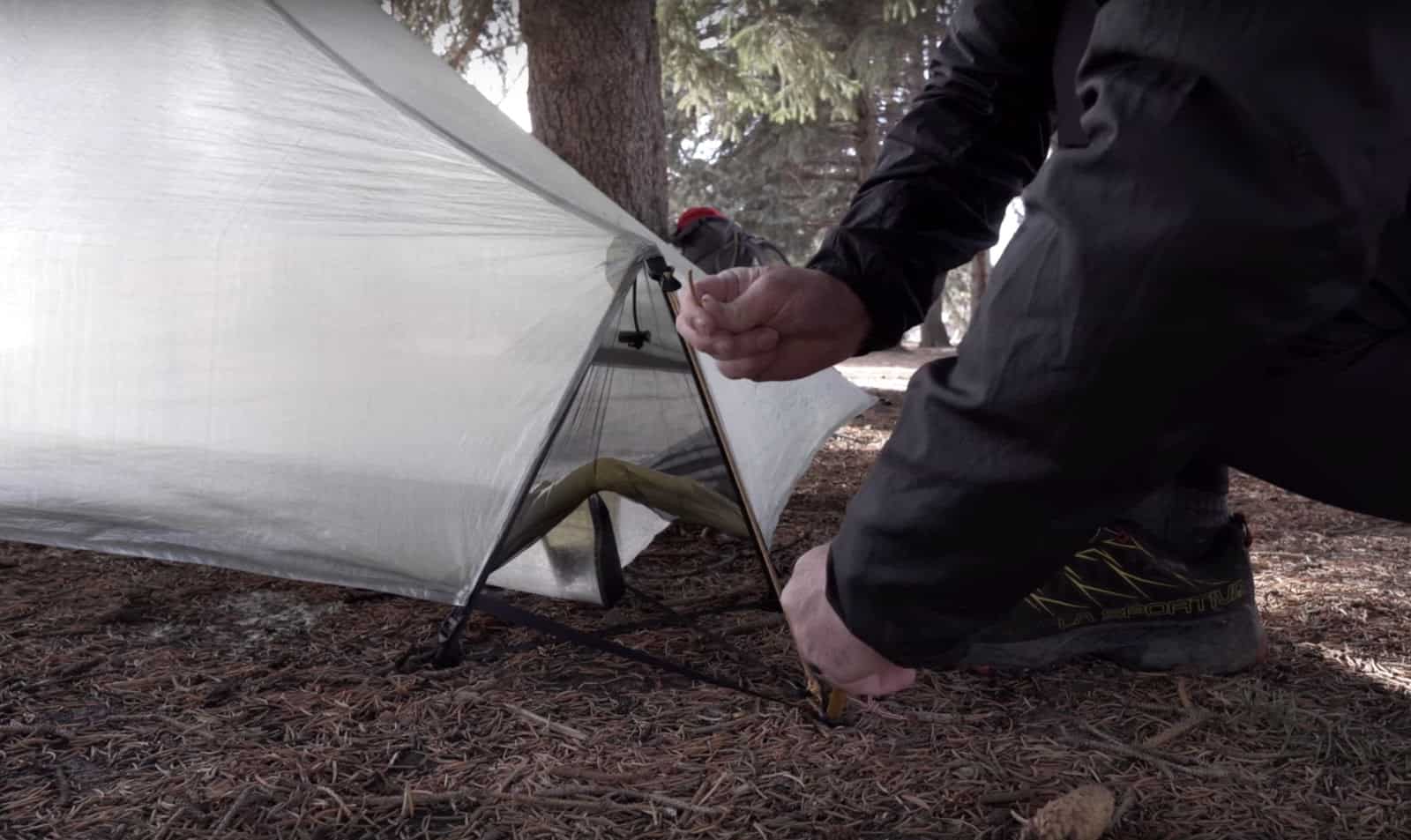
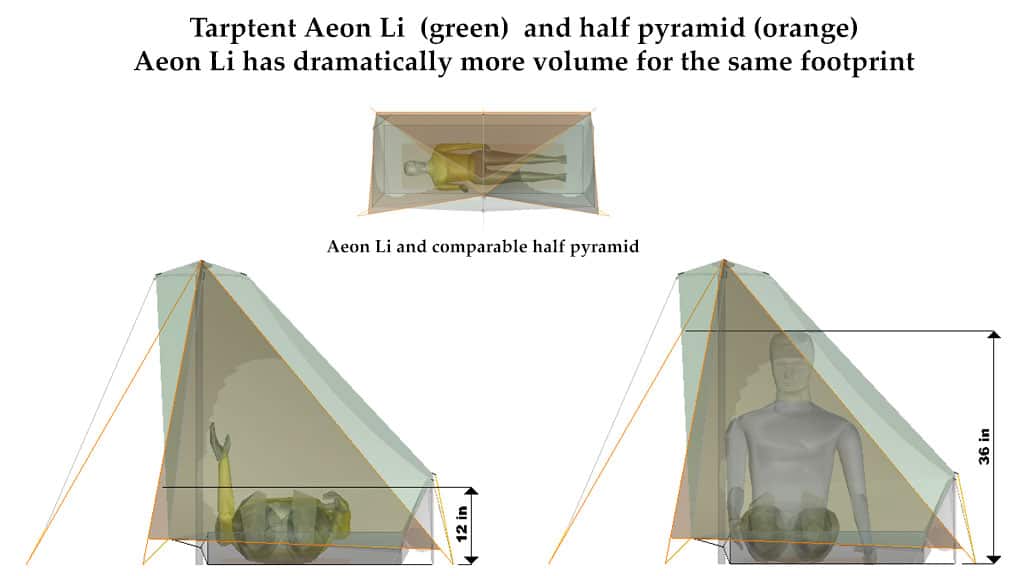
The presence of the struts creates the effect of a raised canopy, thus minimizing the chance that your sleeping bag will contact the lower edges of the sidewalls. A conventional pyramid design achieves the same effect without the struts – it just requires a larger canopy and larger pitched footprint. Thus, the geometric benefit of the struts is their ability to allow the tent to pitch with a smaller footprint (i.e., stakes closer to the tent).
The most impactive benefit of the strut system (and specifically, the PitchLoc corners), is that the PitchLocs create triangular structural elements that make the tent more wind resistant and more resistant to deformation as a result of snow loading. The difference in wind resistance and snow loading capability between a conventional pyramid shelter and the Tarptent Aeon is noticeable. It makes me wonder why manufacturers of conventional tarps and floorless pyramids aren’t incorporating structural elements into their designs. Maybe we will someday see tarps and pyramids incorporating the PitchLoc elements brought to market by Tarptent.
2. Carbon fiber peak strut
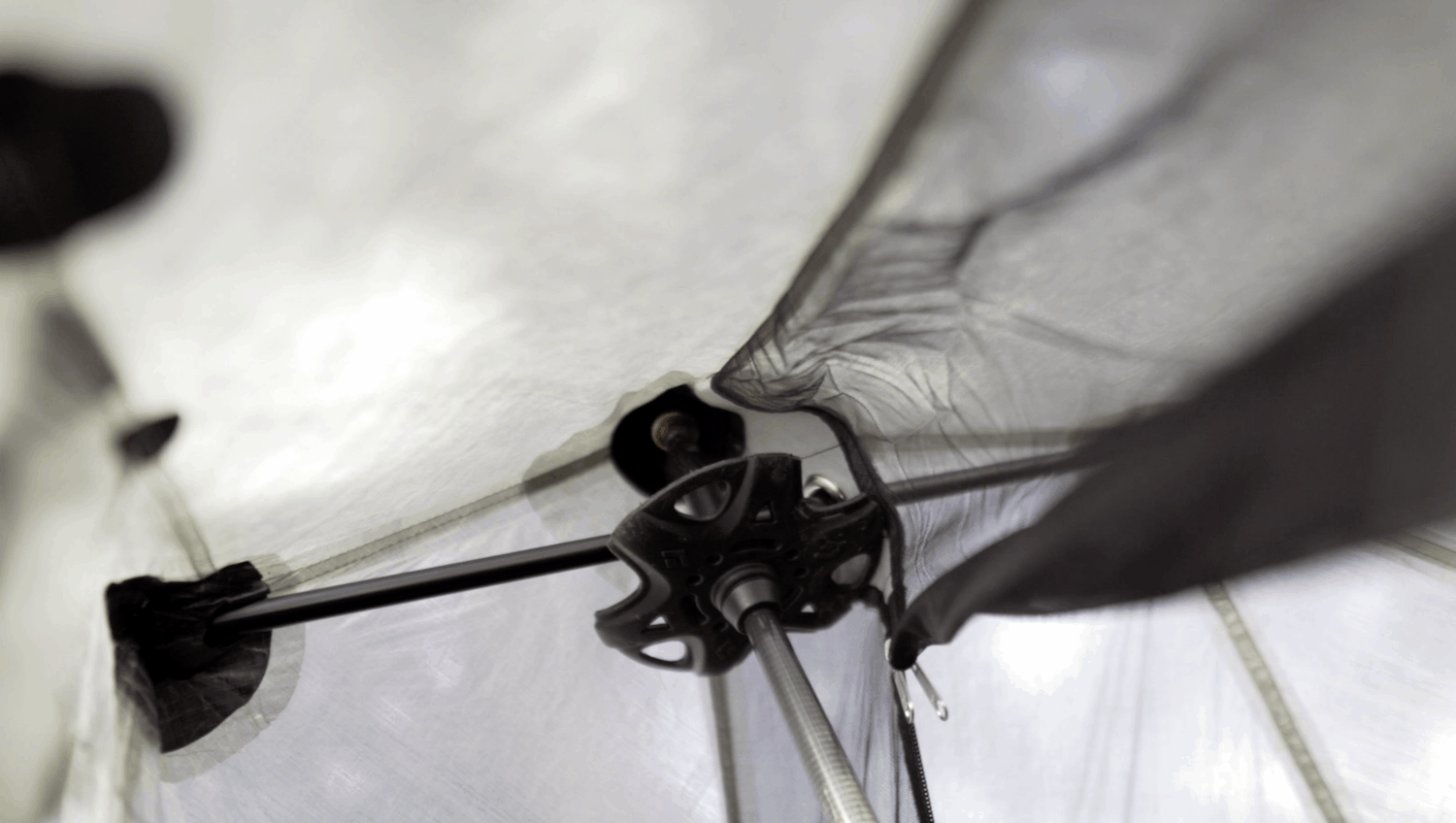
A carbon fiber strut situated horizontally at the peak of the tent, when combined with the vertical support pole (e.g., a trekking pole), creates a “T”-shaped structural element. When tension forces from the front and rear corner guylines are exerted on the T, the T provides resistance to torsional motion that allows the tent to be supported without the need for a front guyline. This type of structure is in contrast to typical pyramid designs, which require the front corners to be situated well in front of the top of the support pole. You can thus pitch the Aeon with a wide, nearly-vertical front opening (when both sides of the vestibule are rolled away) for expansive views and no guyline tripwires.
3. Precision design, cut, and sew (treat each of these individually)
The Tarptent Aeon Li is designed by a talented engineer (Henry Shires) who has an acute understanding of material properties (including DCF) and structural design. As such, the cut-and-sew (and bonding) processes have already taken into consideration a careful analysis of force distribution and aesthetic quality, resulting in a finished product that not only looks beautiful (when pitched properly), but also remains surprisingly stable in response to high wind and snow loads (considering that this is a one pound shelter).
Strengths
- Generous interior volume for sitting up, moving around, stowing gear, and avoiding sleeping bag contact with sidewalls of shelter.
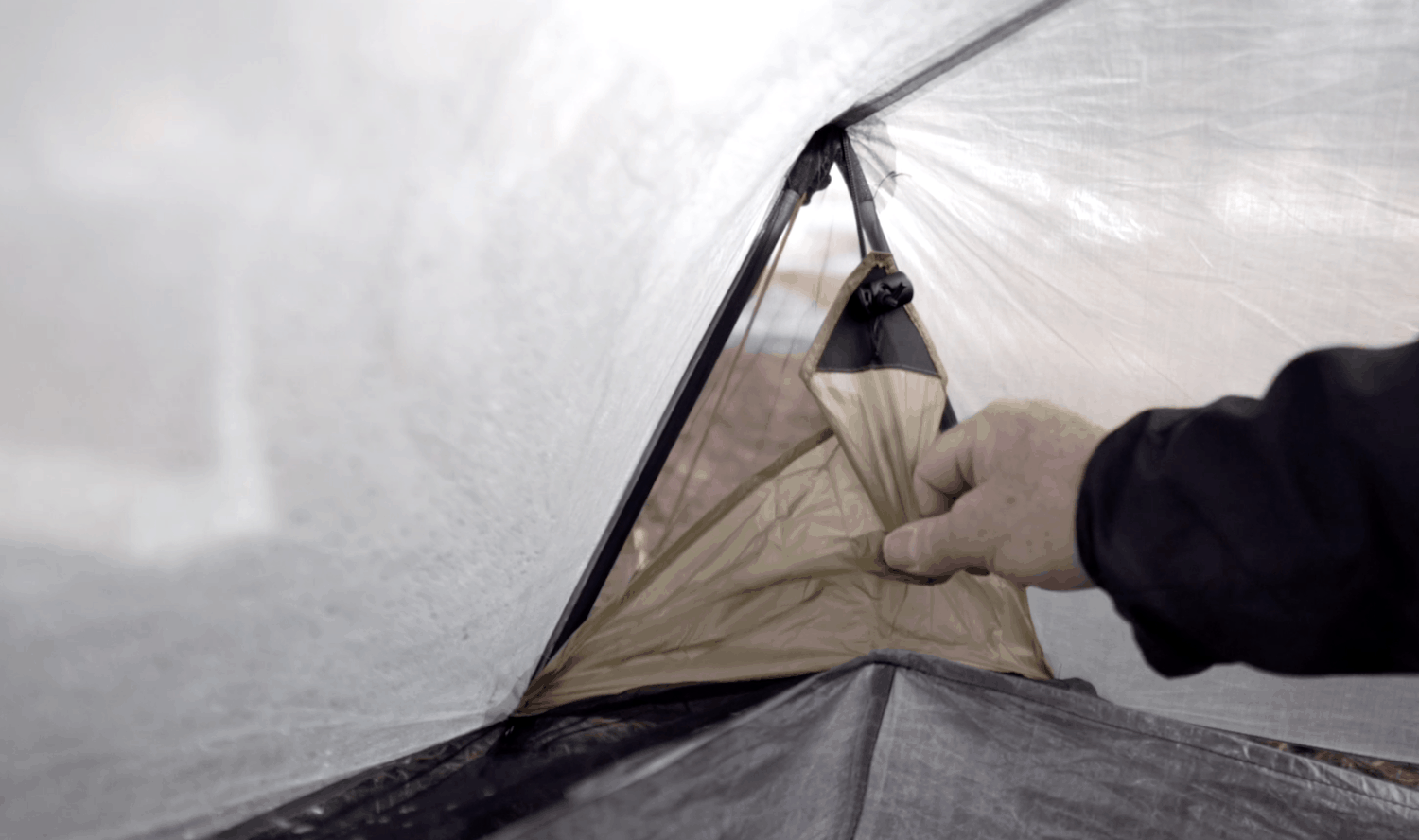
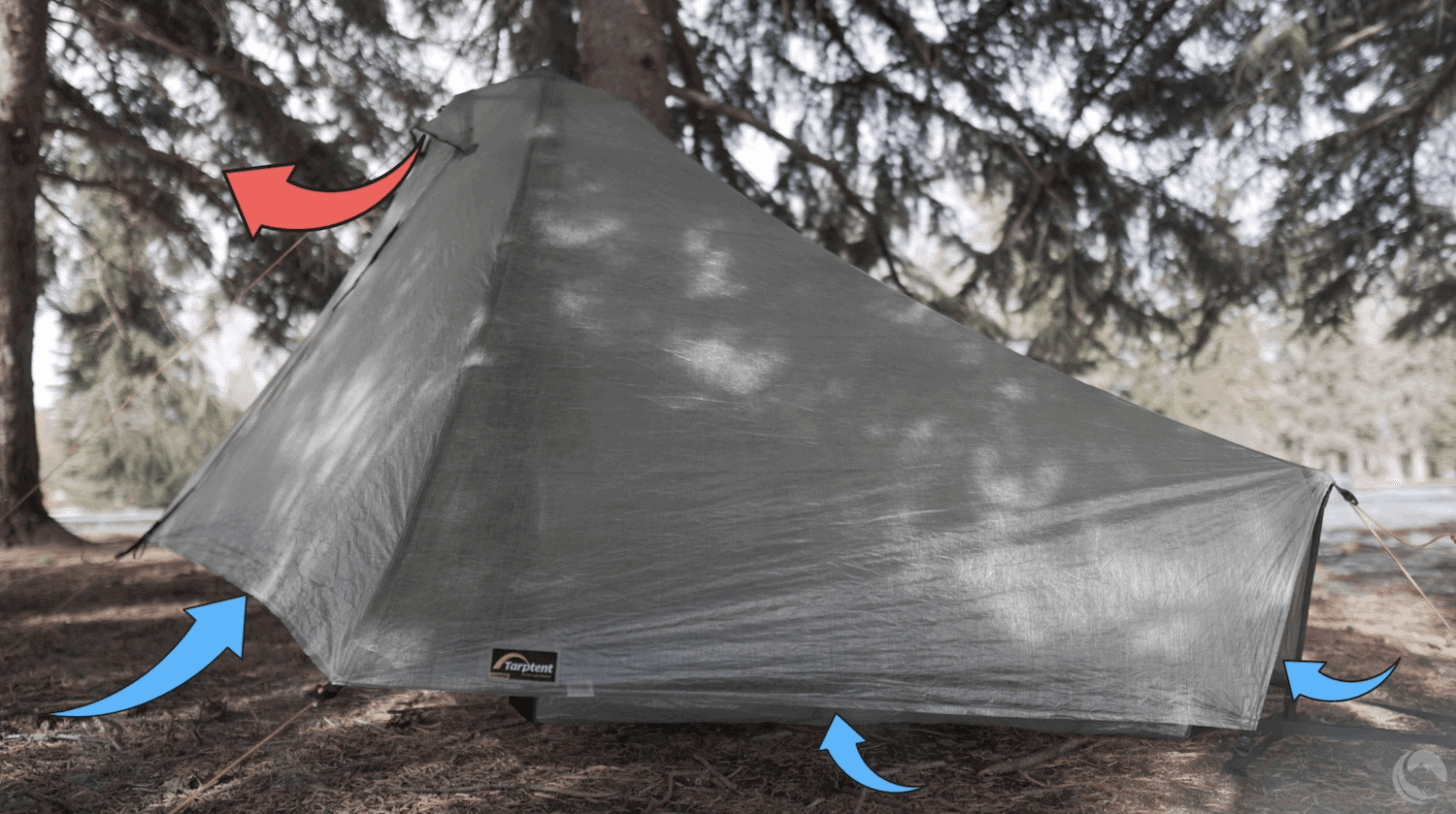
- Well-ventilated: includes perimeter mesh around bathtub floor, two large (adjustable) interior vents, full front mesh door, rollaway vestibules, and peak vent.
- Resistant to wind and snow loading, owing to structural elements formed by carbon fiber struts (total of 6 throughout shelter), and adjustable height.
- Resistant to heavy rain and moderate spindrift, due to adjustable pitch height, bathtub floor, and overlapping vestibule doors.
- Magnetic loops that secure zippered door and overlapping vestibule doors are much easier to use than toggles or hook-and-loop straps.
- Peak strut allows the tent to be pitched without a front guyline, so when the vestibule doors are rolled back there are unrestricted views and no guyline to trip over.
- Vestibule peak provides several inches of overlap over vertical front mesh tent door, so rain doesn’t enter tent if vestibule is open/rolled away (unless there’s wind driving rain towards the inside of the tent).
- The generous vestibule is large enough for an expedition pack and gear.
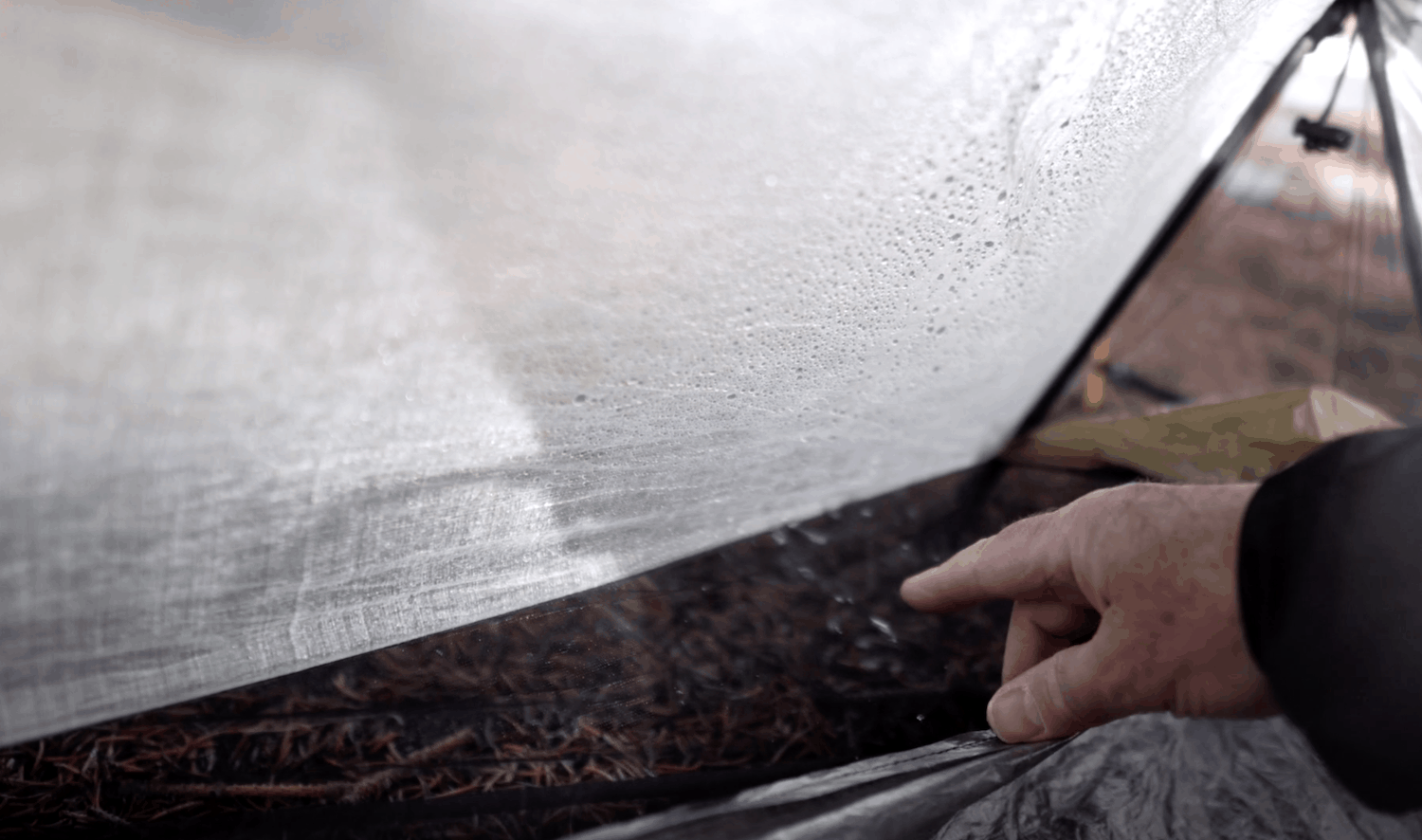
- Downward sloping mesh from top of bathtub floor to bottom of shelter canopy keeps condensation droplets from gathering on the shelter floor.
- PitchLoc structures at back corners reduce footprint size, so the tent can be pitched in more compact spaces that pyramids of similar interior usable volume.
- Dyneema composite fabrics (DCF) fabrics are easy to repair, maintain tension in cold and wet conditions, and provide a high tear-strength-to-weight ratio.
- DCF fabrics may be more condensation-resistant than nylon and polyester fabrics because of lower material emissivity.
- Seam strength and strong, non-stretch fabrics combined with longer, stronger tent stakes, allow for staking the tent at extremely high levels of tension (20+ pounds per stake), which dramatically improves its wind resistance.
Limitations
- Magnetic loops that secure doors could be extended with a pull-tab for easier one-handed operation, especially with cold-weather gloves or mittens.
- Hook-and-loop patches on overlapping vestibule doors are not as easy to use as a zipper, but generous overlap and bottom clip (that clips both doors together) provide good wind and rain protection.
- Setup and configuration are quite easy but requires some geometric adjustments if pitched on uneven ground (as do most pyramid-style designs) to maintain proper tension between the stake-out points and shelter peak.
- Struts prevent the tent from being packed horizontally inside a backpack. Removing the struts is possible, but requires extra time when pitching and striking the tent.
- Dyneema composite fabrics (DCF) fabric used in the canopy is a lighter weight fabric (0.51 osy) that is prone to puncture if the shelter is pitched near sharp twigs or poky desert plants.
Compared To
Tarptent Aeon vs. Floorless Pyramid
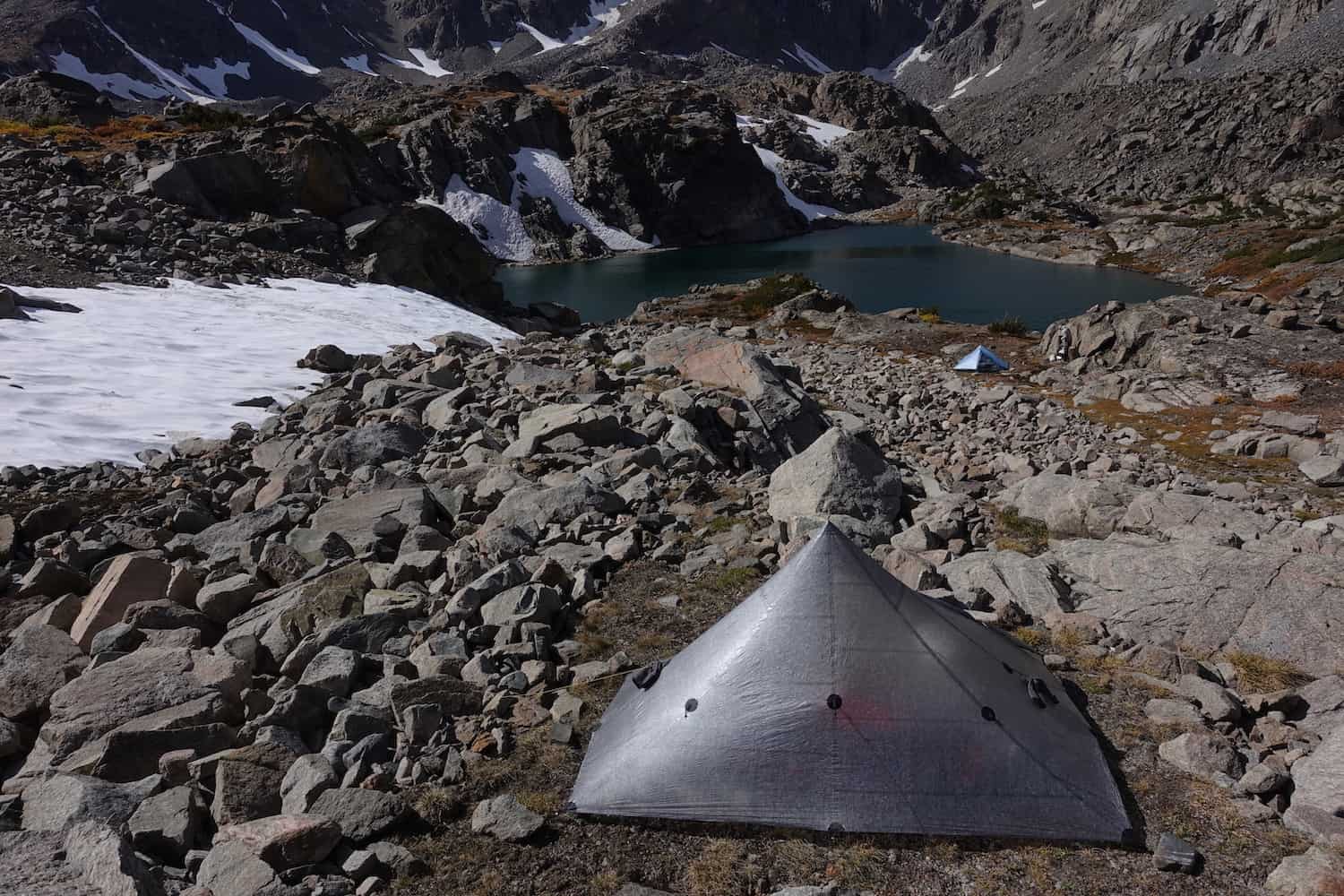
- For similar interior volume, the Aeon requires a smaller footprint.
- The Tarptent Aeon with the integrated single-wall inner tent is a lighter combination than a pyramid tarp with a separate inner tent.
- A pyramid tarp with a separate mesh inner tent is better at managing condensation under most circumstances. A pyramid tarp with a separate fabric inner tent is better at managing cold winds and spindrift.
- A pyramid tent is typically easier to pitch but requires more stakes than the Aeon to provide similar wind stability.
- The Tarptent Aeon is better at managing heavy snow loads.
- The Tarptent Aeon pitches with no support pole in the sleeping area.
Tarptent Aeon vs. Double-Wall Tent
- Tarptent Aeon is lighter.
- Tarptent Aeon is simpler to set up and take down.
- Double-wall tents generally provide better condensation management.
For a double-wall tent that has a single side entrance, and single vestibule, check out the REI Quarter Dome SL 1, which I discuss in this video, or my review of the Tarptent Notch Li.
Tarptent Aeon vs. A Dual-Trekking Pole Supported Shelter
- Tarptent Aeon may be simpler to pitch, and lighter since it’s built around just one support pole.
- Tarptent Aeon may be the better option for users who do not use trekking poles, or who may only use one. If you’re not a trekking pole user, you can purchase a 4.2 oz pole (fixed length) from Tarptent, or an adjustable carbon fiber pole from Ruta Locura (I recommend a 3-section 0.450 pole with max length of 48-49 in). The max height you can pitch the Aeon is about 47 in (199.4 cm), but a slightly longer pole is useful if the ground is uneven.
- A dual-trekking pole shelter may be more wind-stable than the Aeon, but this is highly dependent upon the shelter.
- A dual-trekking pole shelter may offer better livability in terms of wider floor area, dual side entrances, and dual vestibules.
For a dual-trekking pole shelter, see my review of the Tarptent Notch Li.
Tarptent Aeon Li (DCF) vs. Shelters Made with Other Fabrics
- DCF may be more resistant to the formation of condensation over a wider temperature range due to DCF having a lower emissivity than nylon or polyester.
- DCF doesn’t stretch as much as nylon or polyester and tends to be more wind-stable.
- DCF’s lack of stretch allows it to maintain tension across a wide range of temperatures and moisture content than nylon or polyester, so once the tent is tensioned properly, it’s not likely to sag over the course of a cold, wet night.
- DCF manufacturing requires high levels of precision in terms of engineering design, fabric cut and sew, and seam bonding, so mistakes in manufacturing are magnified in the form of uneven stress distribution across fabric panels and seams that can lead to flapping in the wind and structural failure.
Tarptent Aeon vs. ZPacks Plexamid
| Tarptent Aeon | ZPacks Plexamid | |
| Canopy material | 0.51 osy DCF | 0.51 osy DCF (customizable fabric options) |
| Floor material | 1.0 osy DCF | 1.0 osy DCF |
| Inner tent floor dimensions | 30 in (76 cm) x 88 in (224 cm) | 28-38 in (71-97 cm) x 90 in (230 cm) |
| Inside peak height | 47 in (119 cm) | 48 in (122 cm) |
| Vestibule area | ~ 8.6 sq. ft. | ~ 6.4 sq. ft. |
| Bathtub floor height | 4 in (10 cm) | 8 in (20 cm) |
| Downward sloping mesh perimeter screen for condensation management | yes | yes |
| Stakes required (recommended) | 4 (7) | 6 (10) |
| Guylines required to increase interior volume | no | yes |
| Vestibule door closure | Hook-and-loop, metal clip at bottom | Toggle, metal clip at bottom |
| Canopy overhangs bathtub floor inner screen door | yes | yes |
| Inner door zipper style | J, door ties away at side | Rainbow, door falls downward |
| Packed size | 4 in (10 cm) x 14 in (36 cm) | 6 in (15 cm) x 12 in (30 cm) |
| Weight (not including stakes) | 15.8 oz (448 g) | 14.8 oz (420 g) |
| Stakes included? | yes | no |
| MSRP | $535 | $549 |
Recommended For
Hikers who want the lightest possible shelter that also includes:
- protection from biting insects
- reasonable storm resistance
- high quality engineering and manufacturing
Not Recommended For
Hikers who:
- want to spend less money on a tent and don’t want an expensive, state-of-the-market leading model
- are taller than 6′ 6″ and prefer as much interior length as possible
- need a tent for very cold, snowy environments
- need a tent for very humid environments
Where to Buy
- Buy the TarpTent Aeon Li here.
Related Content
- The Tarptent Notch Li shares many of the Aeon’s features, but sets up with two poles and sports two vestibules and two doors.
- Want to learn more about DCF? Check out the BPL podcast: we do a deep dive into the fabric’s strengths, limitations, and best uses.
Product Review Disclosure
Updated September 15, 2018
- How we acquired these products: Product(s) discussed in this review were either acquired by the author from a retailer or otherwise provided by the manufacturer at a discount/donation with no obligation to provide media coverage or a product review to the manufacturer(s).
- We do not accept money or in-kind compensation for guaranteed media coverage: Backpacking Light does not accept compensation or donated product in exchange for guaranteed media placement or product review coverage.
- Affiliate links: Some (but not all) of the links in this review may be “affiliate” links, which means if you click on a link to one of our affiliate partners (usually a retailer site), and subsequently make a purchase with that retailer, we receive a small commission. This helps us fund our editorial projects, podcasts, instructional webinars, and more, and we appreciate it a lot! Thank you for supporting Backpacking Light!


Discussion
Become a member to post in the forums.
My only major hesitation on this is the thinner fabric. I am certainly not an expert but it seems like the manufacturers I trust more than Zpacks (MLD, HMG and YMG) all use the higher thread count.
I am going to buy one based on the design as it seems to fit all my needs and be very careful with it and see how it holds up.
“I am going to buy one based on the design as it seems to fit all my needs and be very careful with it and see how it holds up.”
I’ve had my Duplex for at least a couple of years now, (I think more), and have never really babied it (other than using a polycryo ground sheet) and it’s held up very well.
Aeon Li orders open April 17 at 11 am Pacific time.
Next, larger order window in mid-May.
According to Tarptent email notice.
— Rex
You know Rex, you could have posted that at, like, 11:30 tomorrow….
:-)
11:00 am Orders start
12:30 pm Four tents left
1:45 pm
Should see more first looks after they start shipping next week.
— Rex
This is the third batch. However the second was only for 20 .
thanks for the review!
I bit the bullet and ordered one yesterday; this shelter appears to check the boxes I’m wanting in a solo shelter
look forward to putting it through its paces
Fantastic review and it did sway my decision to purchase an Aeon over the Plexamid. I just wanted to share a couple of photos of possible door configurations opposed to either fully open or closed.
I can see that first configuration being very useful :)
well as luck would have it, my Aeon showed up at my door literally 10 minutes before I was out the door Friday heading for Birch Ck for the Bob Marshall Open; looked at the instructions & set it up, pulled my other shelter out and threw the Aeon in
night one it rained the entire night, the shelter was sagged slightly in the morning (possible the pitch could have been better???), but I was very snug and dry; no condensation issues
not much in the way of wind, so will reserve judgment on that, but it’s quick to setup/take down, very roomy (including the vestibule) and very light- mine weighed 16.3 oz w/ stakes
thus far a two thumbs up :)
Useless commentary unless we know how tall you are. :-)
whoops- 6′, slightly wide :)
I received the 2020 version and used it on a number of trips this season. Updates in 2020 (from the TT website):
I’ve used it in the Uintas (UT), on the Ruby Crest Trail (NV), the Eagle Cap Wilderness (OR) and trips in the Grand Canyon from the North and South rims and am quite happy with it. It has worked well in moderate rain and wind. I’m 69 inches tall (175 cm) and find it roomy with enough length to keep my boots at the foot of my sleeping bag. I find it easy to roll it tight enough such that it fits in the factory stuff sack with my double-layer polycryo ground cloth. My only minor complaint is that the door and the fly unroll easily when held by their magnetic ties. But I have the same problem with the ties on my Big Agnes Copper Spur HV UL1 so maybe it’s just me.
Just picked up a used 1st generation Aeon Li. I am really digging the simplicity of pitching and it’s ability to not have the apex guyed out-this is great for tight sites. At 6’2″ I am probably at the limit with 2.5″ pad and 30f quilt. This is nothing new to me-my other 1p tents are similar-Plex Solo, The One. My question is, has any one added a stick on guy out point at the head end(general area circled in red) to give a bit more headroom? I use these points on the Plex Solo and they work very well when you use a hiking pole or stick to lift up and out. Seems like it would work here on the Aeon Li also-
Brad, I would worry that the stick would poke through the fabric. I do similar with my tarp to hold up the middle, using a hiking staff. However, this is around a 1″ diameter staff (actually it is my wife’s staff.) You could do this from the outside with a sticky patch and a loop. After the patch has dried, you can use a found stick to hold it up and stake it out. Don’t worry about left and right pressure, it seems OK with a single staking point.
Next would be to simply use your pack. You are quite tall, so this may not be an option.
The other thing of a more minor concern, is the change in geometry, due to the lifted corner. DCF does not stretch easily, so, any support would likely change the entire geometry of the tent. You have a little to play with, but not much. It could make the door come loose at the bottom or create a puddle or wrinkle in the canopy if it is too high. A 3″ or 4″ lift will likely not effect things, though. The end will want a small triangular piece sewn in, similar to other Tarptent models, to compensate for the geometry change with more lift.
@James Marco thanks. I should have worded my question better- I was intending to use a Zpacks stick on loop. Them attach a thin guy line as needed and my other hiking pole to lift up and out on the line. Not a severe amount of tension.
<p style=”text-align: left;”> I noticed when pitched those areas have a little give. I can gently push up with my finger above my head and gain 2-4” with out much geometry distortion. That’s of course looking from the inside.
I just found an old Reddit post from a Tarptent employee that gave a reason they don’t add mid panel guy outs. https://www.reddit.com/r/Ultralight/s/6pmkuP6PI7</p>
I asked about some additional guy outs for my Aeon, Henry responded and didn’t think it was a good idea. This was for additional strength in high winds. I think one low to make just a bit more head room is a little different and would probably be fine.
Tarptent recommended an X pattern -seem to seem-using dcf tape on said panel to keep distortion of material from happening. I think Dan Durston mentioned this strategy also on another tent.
As you said this wouldn’t be pulling very hard on the panel and I’ve seen no distortion on my Plex Solo which has the guy outs and no reinforcements.
Become a member to post in the forums.