

Introduction
Among long-distance hikers, the phrase stealth camping is often used colloquially to describe camping outside of designated sites – usually without a permit, or just off-trail to avoid campground fees, rangers, or crowds. In this sense, “stealth” implies informality or discretion in site selection rather than genuine concealment. Most of these sites are not hidden at all; they are frequently visible from trails and close to water sources and other high-use corridors. On heavily traveled long-distance routes, such as the Appalachian Trail or the John Muir Trail, this practice has contributed to the proliferation of unofficial campsites. The effect has been amplified by GPS-based navigation platforms (e.g., FarOut) and social information-sharing, which catalogue and distribute the locations of these informal sites. The result is increasing ecological pressure on narrow trail corridors where soils, vegetation, and water resources were never intended to absorb concentrated, repeated camping use.
Such impact is easily noticeable in my local hiking areas. Along the Continental Divide Trail in the Never Summer Wilderness near Grand Lake, Colorado, I counted more than forty individual campsites impacted by shelter pitches and trampling in a single five-mile trail corridor. All campsites were within twenty yards of the trail, and all of them were easily visible by a passing hiker.
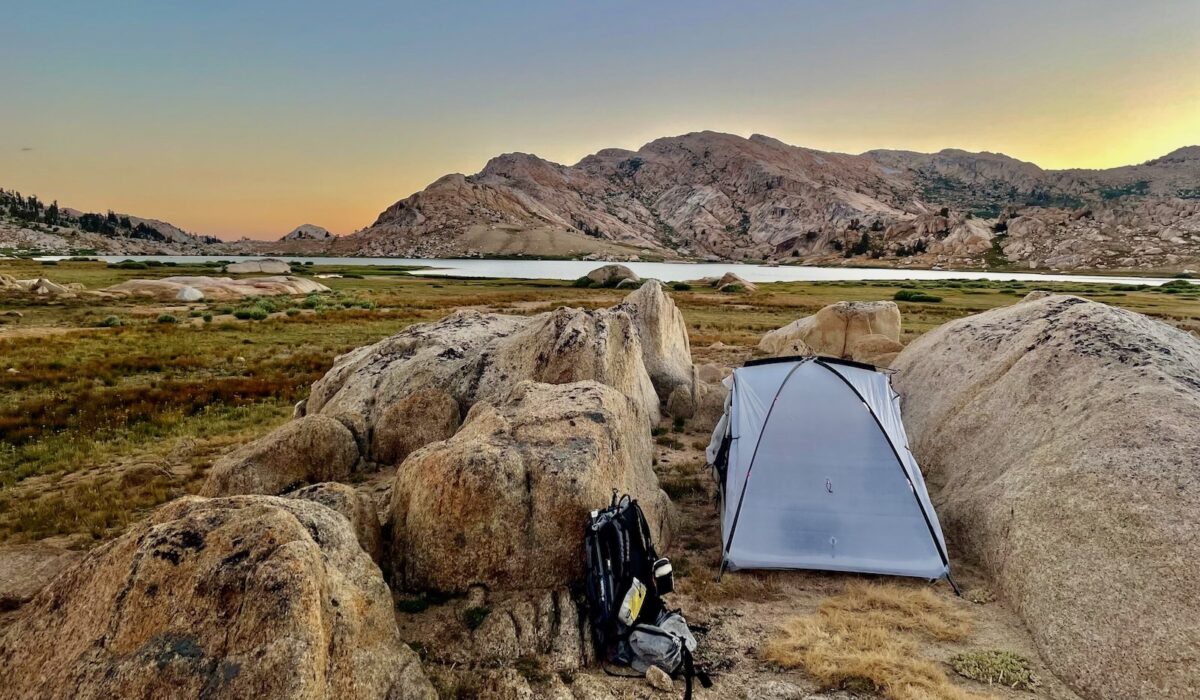
In this article, I describe a different type of stealth camping, with the aim of increasing awareness about the problematic practice of stealth camping as it is often practiced by long-distance hikers, versus stealth camping as a practice that minimizes ecological and social impact. Here, stealth camping is not about skirting regulations or saving money; it is about the technical discipline of becoming invisible in a landscape. This version of stealth is rooted in fieldcraft: the deliberate use of terrain, light, sound, and behavioral discipline to reduce detection probability to near zero. The differences here are notable: one is convenience camping under a euphemism; the other is a practiced skill with roots in scouting, military reconnaissance, and minimalist wilderness travel.
This article is about the latter – the art of not being seen.
Terrain and Site Selection
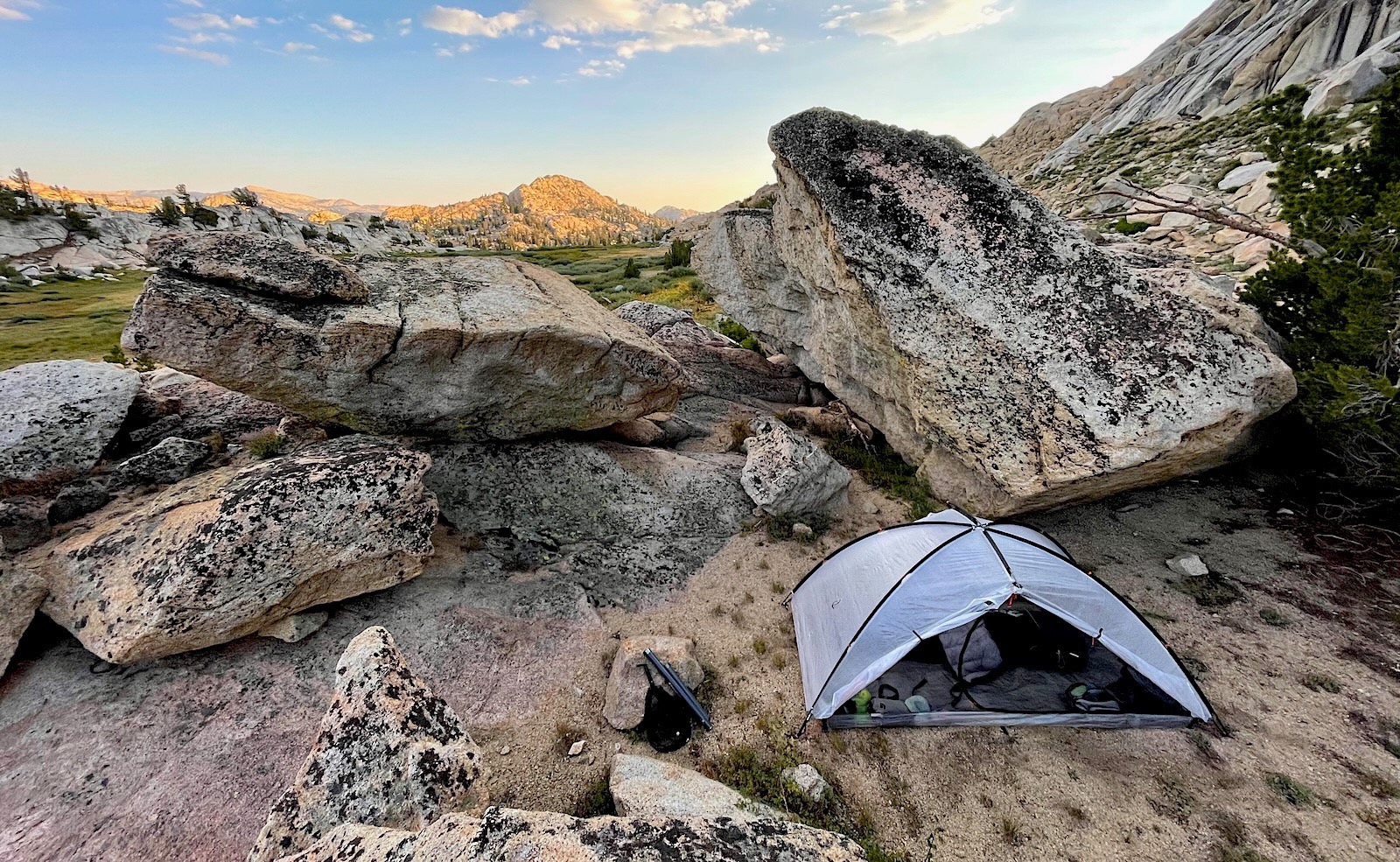
The foundation of concealment lies in terrain analysis. Landscape morphology determines whether a shelter blends seamlessly into its surroundings or stands out as an anomaly. Flat, open, or linear features (e.g., trails, meadows, ridgelines, and shorelines) are intrinsically high-visibility environments. These locations channel human movement, concentrate sightlines, and offer little background disruption. A tent pitched in such a setting becomes a landmark!
Member Exclusive
A Premium or Unlimited Membership* is required to view the rest of this article.
* A Basic Membership is required to view Member Q&A events


Discussion
Become a member to post in the forums.
I briefly, unsuccessfully searched for the article, I’ve posted it before
She was looking at Wilderness areas in the Western U.S. Higher altitude.
This isn’t the one I was thinking about, but another study with the same conclusion
https://www.fs.usda.gov/rm/pubs_int/int_rp284.pdf
“The common assumption that deteriorated campsites are a result of overuse is true by definition; their
deteriorated conditions are a result of “too much” use. This study shows, however, that on the campsites studied, even a few nights of use per year are usually “too much,” because this use causes most of the change which is likely to occur on a campsite. ”
This was in Eagle Cap Wilderness in northeast Oregon. Fairly high altitude.
Thank you for the reference. Very clearly, the environment shown in that study does not match the environment where we go. The vegetation in our alpine areas is very different from the study area. As I said, it would be hard to see where our tent was a day later.
That’s the trouble with generalisations. They are generally wrong. (Pun, sorry.)
Cheers
Based on that and other studies, another thing is you need to study it carefully. Count how many plants there are, measure the depth of duff,… It may not be immediately obvious that there is damage.
And, their point, is that for areas that see heavier use, it’s better if people camp at the same spot as much as possible. Have a side trail to a good campsite and trail to drinking water. Yeah, it’s “trammeled” by man, but the Wilderness act has recreation as one of the objectives, and this is a way to minimize the trammeling.
Green Lakes in the Three Sisters Wilderness has designated sites marked with a post, side trail to campsite. That works pretty good. Popular areas in the Olympics do this also.
In lighter use areas then it’s best to disperse sites and leave it so you can’t tell someone has camped there.
Although I certainly agree that our campsite choices should impact the land lightly, I find it impossible to get too worked up about this. The effect of all the backpacker sites combined in any given area are trivial as compared to the impact of a single logging road or OHV track.
So, yeah, I avoid over-camped lakes etc, but otherwise I think this is close to a non-issue.
Accessibility by foot trail is important for increasing advocacy. Though some might say the same about OHV trails.
When it comes to using apps for campsites, some camps do fall out of favor. Maybe officials but flood damage is a natural culprit. Rodent-infestation vs a popular viewpoint? Some hikers will take that bet (and lose).
Along “thru-hiking” trails, ifland managers ever get enough money again, think they should get an outside mapping/trail crews to clear some appropriate campsites. Thru hikers tend to “pack” together for various social-psychological reasons (from shared experiences to just working out logistically between resupply points). That said many in often dry PCT country “cowboy” or bivy camp, while the AT prefers hikers use the roofed/walled shelters. Think all may need more supervision.
Monte mentioned..
Think one piece isn’t going overboard. I’ve been using camo or geometric design shorts for a bit, .. would love a UL version. Hadn’t thought about brown or dk oliveg though. Believe the trend now is for earth-tone “3-season” gear. Definitely practice that though if ever getting back into actual winter (not metro Arizona “winter”) I’ll go high viz.
“Thru hikers tend to “pack” together”
That’s what I’ve observed. A number of times I’ve camped somewhere and then a bunch of thru hikers camped very close.
Non thru hikers are more likely to want privacy.
If I’m camping on the PCT in July and August in PNW, I’ll sometimes try to find a spot further from the trail to avoid a crowd.
Thru hikers tend to arrive late and leave early so it’s not a big deal. Interesting to chat with them.
I also find that the through hikers who bunch together often totally ignore LNT principles, as if they don’t apply to them. Pitching tents right next to trails and water, trash everywhere, disgusting toilet paper piles, etc. Especially true on the Colorado Trail, which is full of ignorant first-time backpackers. I can’t tolerate hiking along that trail even for a few miles, it just puts me in a terrible mood.
There’s the urge to see familiar faces if only to verify one’s pace. Avoided those other snorers though.
Dan said:
Groups, especially trail families, are pretty much a given (see above) but in terms of trash/tp, my experience along the PCT is different, as it’s hiker (and horse) only while the CT is multi-use. The PCT “weeds out” quite a few %-wise in the southern desert. Not saying their LNT behavior 100% but I also noted most of the TP blossoms, trash, etc.. was associated with road crossings with trail access (“day users”). Believe there was a university study (actually sending hiking trash counters) that confirmed this. The worse was Oregon where I met up with a few Fs workers with small shovels burying but that tended to be aggregated within a few miles of highway junction trailheads (some with at least outhouses too).
Should be noted the PCT requires LNT video viewing before a permit is approved and there’s the California fire(/backpacking stove) permit videos/online quiz too.
Terrain makes a big difference: A few years ago, three of us plus a guide did a 6-night backpack in a section of Alaska’sWrangle-St Elias N. P. that only sees a few parties a year. When walking on the tundra, the guide had us spread out and not walk in each other’s footsteps, to avoid leaving a mark. But when moving through the high, dense brush we followed each other closely. It made us less likely to get lost, and the brush was so thick (and sprung back immediately) that she wasn’t worried about creating a trail.
Disregard for LNT is simply due to lack of breeding. Go to any outdoor event and the next day you’ll see litter strewn all over the ground. Volunteers and/or paid staff then have to pick it up. You’d think people would have the decency to either properly discard their refuse or pack it out, but many don’t because they haven’t been taught any better…..they’re trashy. Same principle applies on the trail. For many hikers everything is about them and being considerate of others just doesn’t cross their minds. Digging a cat hole isn’t always easy and it requires a good camp trowel to do it, but for the love of God I wish everyone would bury their bowel movements and TP deep enough. https://vargooutdoors.com/products/dig-dig-tooltm
I look for virgin spots where nobody has camped for a long time and not the easy to get to locations everyone else goes for. I don’t want to be bedded down in a place where a lot of other people have released their bodily functions or maybe left food scraps which makes bear want to visit often. What’s more when the ground has been trampled down it will get far muddier when it rains.
More effort is required to find a good stealth spot, and again a small footprint makes the task much easier.
Walk stealthy but carry a bright tarp.
Not for pitching on the bluff. For emergency. To roll out when you’re hanging off the side of a cliff. Old CD’s make good signalling devices. When it’s pouring down rain, stealth takes a back seat. It’s often better to be seen. I think for harsh conditions, brighter is often better.
“Disregard for LNT is simply due to lack of breeding. Go to any outdoor event and the next day you’ll see litter strewn all over the ground. Volunteers and/or paid staff then have to pick it up. You’d think people would have the decency to either properly discard their refuse or pack it out, but many don’t because they haven’t been taught any better…..they’re trashy. Same principle applies on the trail.”
Japanese pitcher and World Series MVP was raised differently . . .
Dodgers Superstar Cleaned Trash in Dugout After Historic World Series Game
I usually pick up trash when I’m backpacking, but all I ever find is an occasional rubber band, corner of a package, or cigarette butt.
People are quite good about LNT. In forests in Oregon, Washington, and northern California.
There are exceptions, like at trailheads. Or the beach of the Olympic Peninsula – trash washes up with the tide and there are a lot of non regular LNT hikers.
It’s surprising how far into the wilderness a mylar balloon can travel.
On oregonhikers.org there are 39 pages of reports of mylar ballons that have drifted into the wilderness
https://www.oregonhikers.org/forum/viewtopic.php?f=31&t=24387
Yeah–I’ve lost count of the number of mylar balloons I’ve packed out of the wilderness. At last dozens…
“It’s often best to be seen. I think for harsh conditions, brighter is often better”
For sure in frigid winter conditions or on daring mountain expeditions where being seen could save your life, but for everything else, no.
Stealth also means blending into nature and not erecting a loud orange eye sore. For many people seeing an obnoxious red and purple tent against the backdrop of beautiful natural scenery is a total buzz kill. Depends on one’s taste and perspective mind you. Earth tone shelters are more popular in Europe and always have been. Just look at any of the European gear makers and/or retail websites and you’ll see mostly green and brown colors. The trend has been catching on a lot more in North America over the past few years. Even the biggest mainstream companies like Big Agnes and MSR are now putting out earth tone tents and they basically never did before. The 2025 X-Mid’s and X-Domes are also stealthy.
Sage greens or greys can blend in well throughout places like the Sierras and Rockies.
Bright tents do have some advantages.

Cheers
Become a member to post in the forums.