

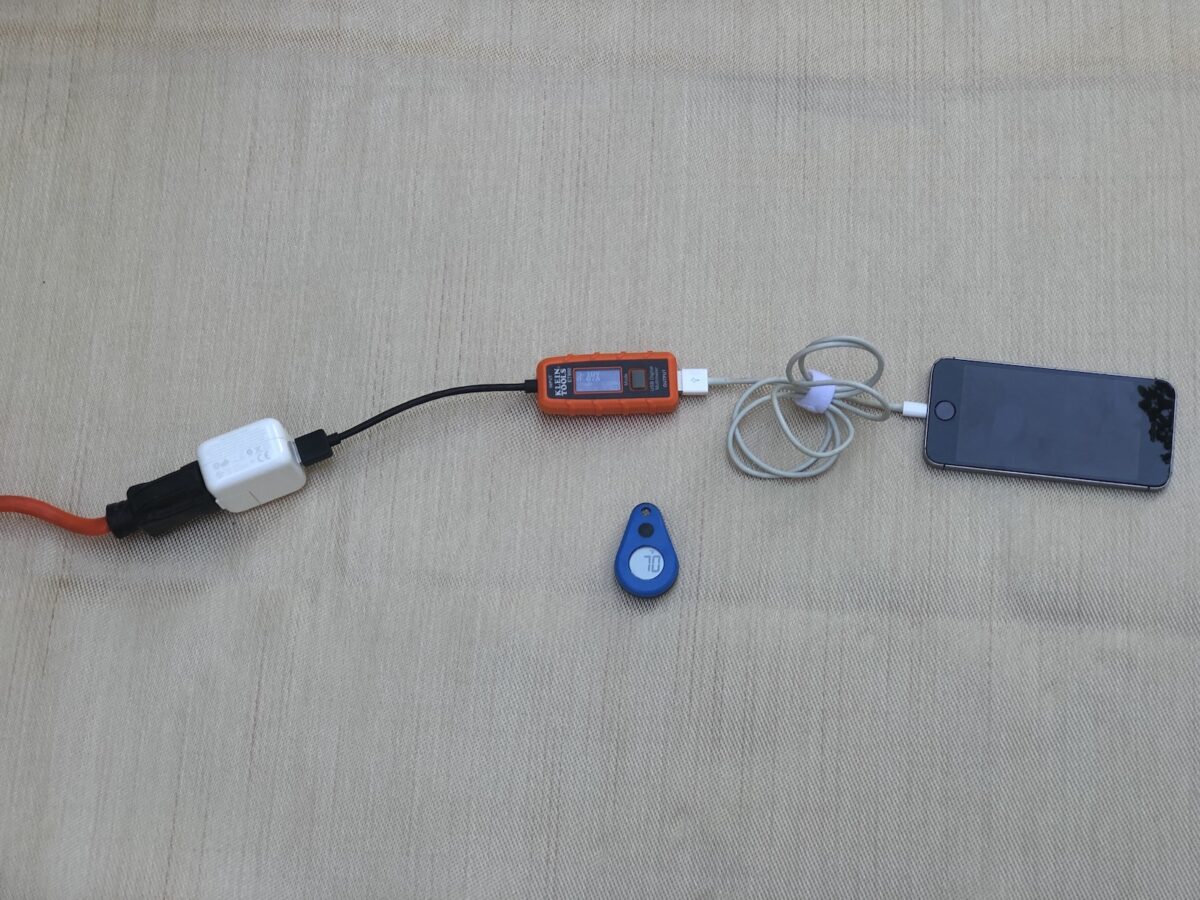

Introduction
My new Simple Gear Test columns were born from frustration with backpacking industry standards, testing, and marketing. So I decided to start measuring gear myself. These tests might not be accurate to the nearest degree, gram, or millimeter, but they are good enough to decide if Product A meets my needs better than Product B before heading into the backcountry.
“We Don’t Trust Manufacturers’ Product Specs. You Shouldn’t Either.” – appropriate title from a Wirecutter story.
I want these tests to cover important product features, and be low-cost, easy to run, easy to understand, fast enough, and gentle enough to return gear that doesn’t measure up. I decided to begin with USB rechargeable devices.
To start off, I’ll describe general “Tips Before Testing,” then explain how I measured USB recharging for a smartphone, headlamp, satellite messenger, and battery bank.
Tips Before Testing
Here are some tips that help me choose good enough gear before testing.
- Decide which product features are important, including cost. Then mark them High, Medium, and Low priority. Focus on the High items first to narrow choices.
- Don’t fall into the trap that lightest is best. Lightest is walking naked into the wilderness. Same for most expensive is best. Even Jeff Bezos knows better.
- Good reviews should describe the reviewer’s backpacking experience with similar products. And they should cover relevant testing conditions, often including weather, location, elevation, miles (km) hiked, and feet (m) climbed.
- Be skeptical of specifications and test results coming from the company that made the product. Trust but verify.
- Even simple specs might get exaggerated, like the dimensions of a tent.
- Beware spec numbers that conveniently end in 0 or 5 – actual measurements rarely produce values that charming.
- Don’t buy expensive gear based solely on a skimpy web page with just a couple of specs plus glamor photos.
- Don’t give much credibility to customer ratings found on large retail websites. Paid postings and inexperienced users can distort those opinions.
- Purchase from companies with long-enough return windows and good-enough return policies.
USB Recharging
A larger smartphone battery might hold 3,000 mAh (milliamp-hours), while many USB battery banks claim 10,000 mAh. Unfortunately, that’s like knowing a stove canister holds 3.9 ounces (110 g) of fuel – it doesn’t tell me how long my stove will burn or how many meals I can cook.
Member Exclusive
A Premium or Unlimited Membership* is required to view the rest of this article.
* A Basic Membership is required to view Member Q&A events


Discussion
Become a member to post in the forums.
Companion forum thread to: Simple Gear Tests and USB Recharging
In his new column, Simple Gear Tests, Backpacking Light author Rex Sanders provides suggestions for at-home gear tests you can do with minimal time and expense. First up – a plan for verifying the capacity of your USB-rechargeable devices.
Nice work…thanks Rex.
During preparation for an unsupported FKT attempt, I tested 5 different Chinese power banks from Amazon to see if their advertised capacity matched their actual capacity, using this same method. 4 of the 5, advertised as 26,800 mAh, were actually 20,000 mAh. The only one that advertised capacity honestly was a $90 battery. Most $20-$30 batteries falsely advertise higher than their true capacity because there is no accountability for these companies on Amazon.
good testing, thanks, interesting results
Charging slows down as the device nears 100% charged. For example, maybe it takes 1 hour to charge to 80% and another hour to charge the rest of the way to 100%.
I wonder if efficiency drops as you near 100%.
For example, if you just charge to 80%, could you extend the number of days you could do with the same USB power bank?
Nice review, Rex.
Just a detail note on both Klein meters, from the manufacturer:
“This meter will NOT display current below 50 milliamperes, even if it is allowing this to pass through. NOTE: The display will show zero current.”
James: (Clutches his chest) You mean some gear makers don’t tell the truth? Seriously, this is why I’m working on Simple Gear Tests so more backpackers can find out for themselves. Can’t test and compare a gazillion cheap, gone-tomorrow whatevers on Amazon and other wild-west marketplaces.
Jerry: I’ve wondered about efficiency dropping, too. But from what I’ve observed during this testing and what I’ve read elsewhere, smart devices like iPhones in effect “lift off the gas pedal” and pull fewer watts over 80% charge, to extend internal battery life. They also start slow near 0% and ramp up at about 20%. I don’t think this has a big impact on efficiency. Might be worth testing.
NoCO-Jim: If a device is consuming 49 millamps at roughly 5 volts (but showing 0 mA on the Klein), that’s about 1/4 watt. My dad used to say: “Don’t sweat the small stuff.” Many years later I added: “… unless it adds up to make a real difference.” I plan to test overnight recharging for several devices and see if it does.
— Rex
Thanks for this review. Very helpful, especially the observation that wire connectors take up some amperage as well as heating a battery via charging.
I have two chargers, a smaller one rated 4,00 MaH and a larger smart phone-sized one at 10,000 MaH.
Both can charge my Phone 10C from 20% to 80% in less than an hour.
Hi Eric
Pedantic: I think you meant 4,000 mAH and 10,000 mAH?
A capital M means Mega, which is a bit different.
The wire cables cause some voltage drop.
Cheers
Become a member to post in the forums.