


Introduction
In this article, we make the case for spending a few extra ounces on raingear that offers more ventilation features and durability than typical ultralight rainwear styles.
We already know that raingear made with ultralight fabrics sacrifices durability and waterproofness when backpacking in heavy, sustained rain. However, ultralight raingear also makes other compromises, including simpler designs that sacrifice ventilation, limiting one’s ability to control thermoregulation when one’s exertion level is high.
Because weight, durability, and ventilation are often at odds with each other, we’ll discuss the use cases where spending a few extra ounces may be worth it.
Updated May 17, 2026: Expanded info in light of advances in DWR and membrane tech. Added a new section about use cases and ultralight market context. Updated terminology around heat and moisture transfer processes; discussions reorganized and expanded to improve clarity, including addressing some forum comments prior to this update date; product recommendations updated to reflect current state of the market.
Why is layering important?
Layering various combinations of clothing pieces helps hikers manage thermal comfort and moisture in response to changes in activity level and environmental conditions.
Generally, layers for backpacking should be hydrophobic (so as not to absorb excessive moisture, whether from perspiration or precipitation), quick to dry, and lightweight.
Clothing that absorbs as little moisture as possible (i.e., is hydrophobic and lightweight) dries faster and remains lighter if you have to stow it back in your pack. In addition, the less moisture that is absorbed in your clothing, the less likely you will be chilled by evaporative cooling. Evaporation of moisture in clothing requires body heat. Excessive loss of body heat can be uncomfortable or unsafe in cold conditions.
Traditional layering systems for inclement weather are based on their ability to serve three primary functions:
- Wick perspiration away from the skin surface.
- Keep you warm via insulation and wind-blocking.
- Keep you dry and protected from precipitation.
Limitations of traditional three-layer systems
These three functions are addressed by what is commonly referred to as the three-layer system.

The layering system illustrated above includes three popular garments and weighs a total of 31.3 oz (887 g):
- Patagonia Capilene Midweight Crew (6.2 oz / 176 g)
- Patagonia R1 Fleece Pullover (11.2 oz / 332 g)
- Patagonia Torrentshell Rain Jacket (13.9 oz / 394 g)
In the three-layer model, the wicking layer is worn in warm conditions, the warmth layer is added in cold and dry conditions, and the wind/rain jacket is layered over either the wicking layer alone (e.g., in cool and drizzly or dry, cold, and windy conditions) or over both the wicking and warmth layer (e.g., in very cold, wet, and windy conditions).
Author’s Note: An ultralight backpacker will look at the specific three-layer system example above and be appalled at the weight! For example, my mid-summer alpine hiking layers in the central US Rocky Mountains often includes a 115 gsm (gram per square meter) merino base layer (4.1 ounces / 116 g), a 60 gsm Polartec Alpha Direct hoody (3.5 ounces / 99 g), and a 7D waterproof trail running smock (3.1 ounces / 88 g), for a total system weight of 10.7 ounces (303 g): a system that’s about a third of the weight of the one illustrated in the image above.
Lighter layers = easier moisture management
The purpose of layering is not to save weight; it’s to increase comfort and versatility in response to changing activity levels and environmental conditions. However, selecting the lightest possible layers to accomplish this objective makes obvious sense. Lighter layers (less material) absorb less water and dry faster. Lighter layers provide less material resistance in response to body movement and feel more comfortable. And, of course, when stowed in your pack while not in use, lighter layers are, well, lighter.
Layering challenges during shoulder seasons
Shoulder season refers to spring and fall when the weather is predominantly characterized by wet, cold, and windy conditions (as opposed to the dryer and warmer conditions of summer and the dryer and colder – subfreezing – conditions of winter). I find it easier to stay comfortable during the snowy subfreezing cold of winter than during the wet, cold, and windy conditions that occur between Labor Day and Thanksgiving or between Easter and Juneteenth (at least where I do most of my hiking in the Colorado, Wyoming, and Montana Rockies). In addition, backpacking during shoulder seasons brings fewer daylight hours and more time spent in camp, where it’s harder to stay warm while inactive.
The three-layer system presented above starts to break down in shoulder season conditions, especially when precipitation starts to fall.
Raingear performance synergy and the wind-cold-rain trifecta
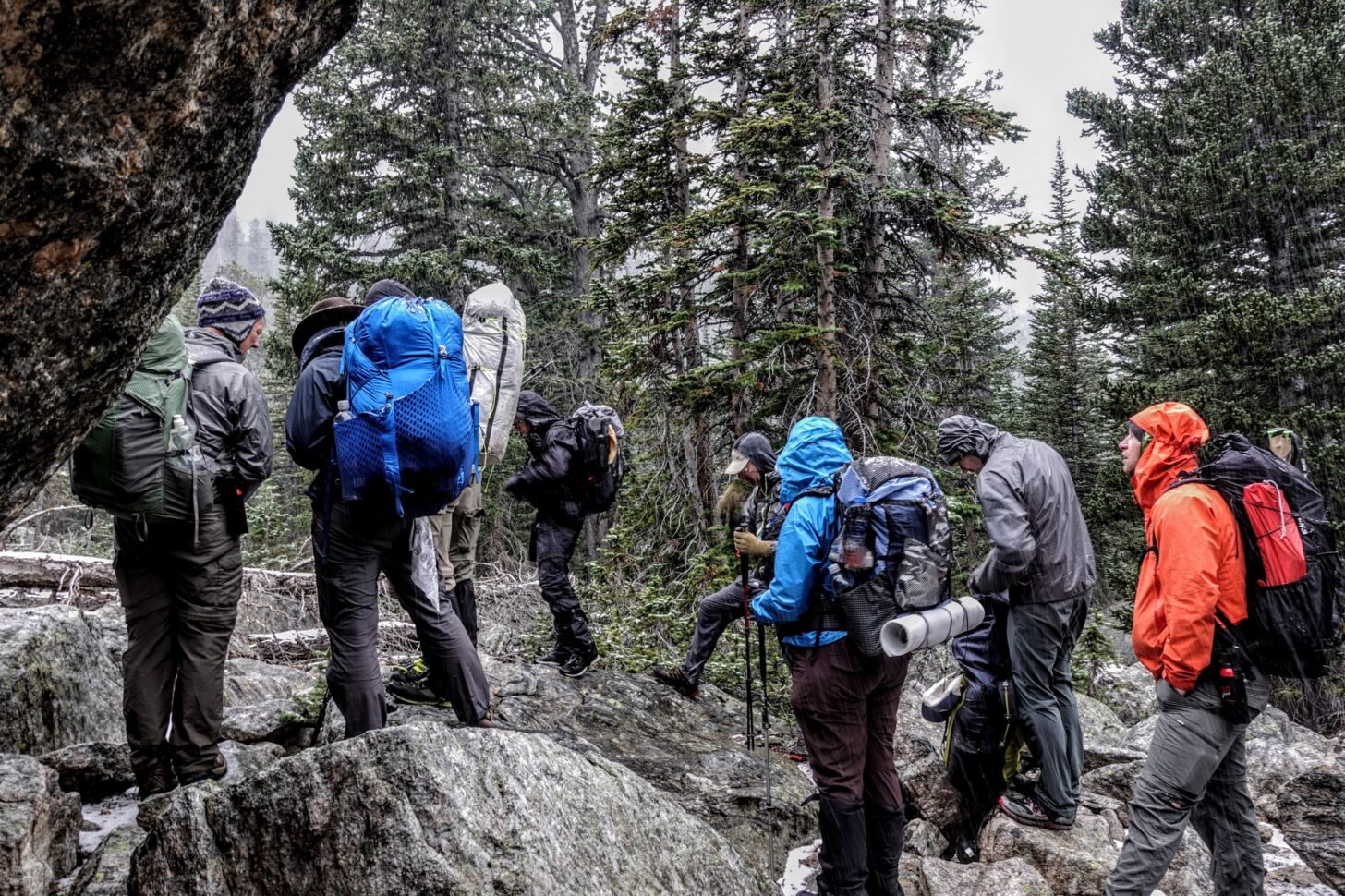
During the summer in the mountains of the Northern Rockies (MT, WY, and Northern CO), in the Pacific Northwest (WA and OR), and in the Inland Northwest (e.g., Idaho Sawtooths, Uintas), shoulder season conditions can occur any time of year on a regular basis. If you are hiking in any of these areas on extended trips where you can’t accurately forecast the weather, plan on preparing for shoulder season conditions.
Barring any unusual weather patterns, most of the other mountains of CA, UT, NV, AZ, and the entire Appalachian corridor are characterized by warmer temperatures where a typical three-layer system will suit most hikers just fine.
The risk of discomfort and even hypothermia goes up significantly when the combination of cold temperatures (in the 50s °F / 10s °C or lower), heavy or sustained precipitation, and even just light winds (greater than about 10 mph / 16 kph) are coming at you during the day when you are facing several hours of hiking. I bring this up because the combination of cold, wet, windy conditions is something every hiker should be sensitive to, regardless of their geographic location or date.
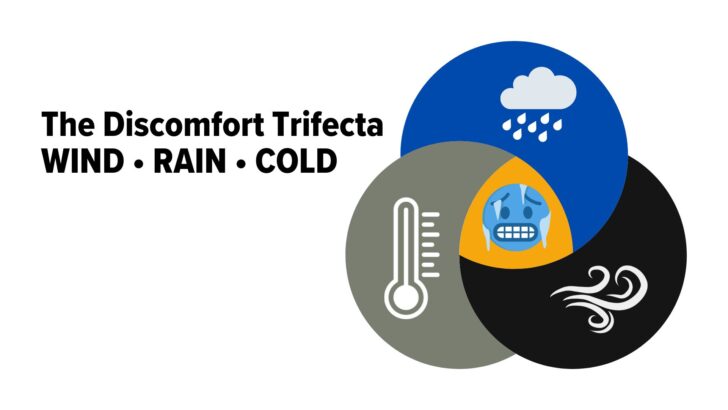
When hiking in the cold-wet-wind trifecta, one of the biggest issues hikers face is that of overheating while wearing a waterproof shell. Let’s address that issue now.
Member Exclusive
A Premium or Unlimited Membership* is required to view the rest of this article.
* A Basic Membership is required to view Member Q&A events


Discussion
Become a member to post in the forums.
Yes.
If the PU-WPB layer is on the outside, it would be more suceptible to damage, is this a problem I wonder…
I have not worn these things and there are online reports of failure and good durability. I guess the question is compared to what? I have to believe it is more durable than light-weight shells with 7 or 10 denier fabrics. How would it compare to 20, 40, or 100 denier? I did a simple little test shown below:
I abraded the polyurethane coating on the Reign jacket 50 times with a cheese grater. For the most part, the membrane was damaged but not destroyed, as seen in the area with the word Damage. One significant hole was produced. Now, you have a standard test for durability that you can try on the jacket of your choice! I would judge this t0 be pretty durable but not bomb proof. I expect the thicker urethane coating on the Reign no Shine or Whistler’s peak versions would be more durable. The outer surface is smooth so it offers less opportunity for snags than the relatively rougher surface of the Reighn that is produced by the underlying weave pattern.
Jerry-by the way, my new article has been published for your reading pleasure.
The question is: what have they sacrificed in breathability to still get a waterproof layer but one that is also durable?
Woubeir: Given the results of the two current models I have tested, I would say yes. My guess is they reduced breathability by increasing coating thickness. I presume this was to get better durability. This will reduce reduce MVTR. Unfortunately, I probably cannot get one of the old models to examine and be more certain about what was changed.
Breathability is easy to shortchange. There is no definition of breathability. Furthermore, manufacturers can select the breathability test that provides the best possible results. So manufacturers can claim “high breathability” without providing test evidence.
Thanks for your new article, very pleasurable :)
Maybe I need to read it on my pc screen. Very dense. Well thought out. Answers some questions. Need more time with it :)
Stephen, I don’t remember but did you test both Outdry Extreme-models for their MVTR?
I have tested 8 Outdry models since they were introduced in 2015. The two currrent models I tested, at 320 g/meter2/24 hours are, by far, the lowest yet.
Not entirely surprising, since this more consistent and thicker coating probably didn’t do any good to that.
Become a member to post in the forums.