


Introduction
In this article, we make the case for spending a few extra ounces on raingear that offers more ventilation features and durability than typical ultralight rainwear styles.
We already know that raingear made with ultralight fabrics sacrifices durability and waterproofness when backpacking in heavy, sustained rain. However, ultralight raingear also makes other compromises, including simpler designs that sacrifice ventilation, limiting one’s ability to control thermoregulation when one’s exertion level is high.
Because weight, durability, and ventilation are often at odds with each other, we’ll discuss the use cases where spending a few extra ounces may be worth it.
Updated May 17, 2026: Expanded info in light of advances in DWR and membrane tech. Added a new section about use cases and ultralight market context. Updated terminology around heat and moisture transfer processes; discussions reorganized and expanded to improve clarity, including addressing some forum comments prior to this update date; product recommendations updated to reflect current state of the market.
Why is layering important?
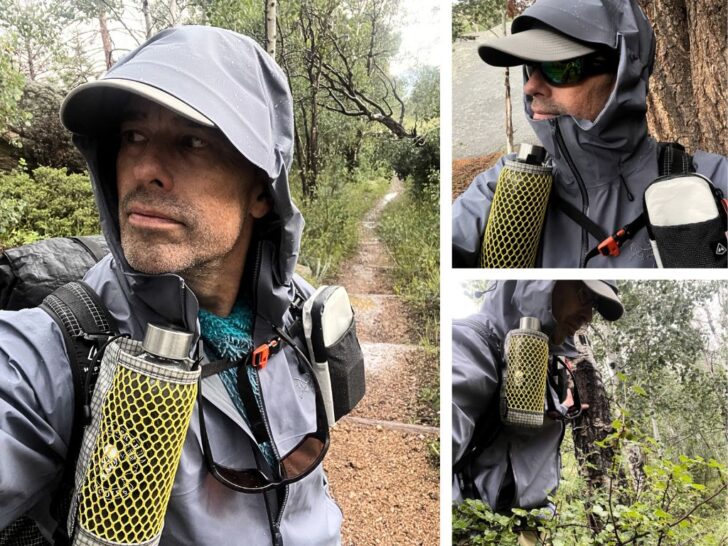
Layering various combinations of clothing pieces helps hikers manage thermal comfort and moisture in response to changes in activity level and environmental conditions.
Generally, layers for backpacking should be hydrophobic (so as not to absorb excessive moisture, whether from perspiration or precipitation), quick to dry, and lightweight.
Clothing that absorbs as little moisture as possible (i.e., is hydrophobic and lightweight) dries faster and remains lighter if you have to stow it back in your pack. In addition, the less moisture that is absorbed in your clothing, the less likely you will be chilled by evaporative cooling. Evaporation of moisture in clothing requires body heat. Excessive loss of body heat can be uncomfortable or unsafe in cold conditions.
Traditional layering systems for inclement weather are based on their ability to serve three primary functions:
- Wick perspiration away from the skin surface.
- Keep you warm via insulation and wind-blocking.
- Keep you dry and protected from precipitation.
Limitations of traditional three-layer systems
These three functions are addressed by what is commonly referred to as the three-layer system.

The layering system illustrated above includes three popular garments and weighs a total of 31.3 oz (887 g):
- Patagonia Capilene Midweight Crew (6.2 oz / 176 g)
- Patagonia R1 Fleece Pullover (11.2 oz / 332 g)
- Patagonia Torrentshell Rain Jacket (13.9 oz / 394 g)
In the three-layer model, the wicking layer is worn in warm conditions, the warmth layer is added in cold and dry conditions, and the wind/rain jacket is layered over either the wicking layer alone (e.g., in cool and drizzly or dry, cold, and windy conditions) or over both the wicking and warmth layer (e.g., in very cold, wet, and windy conditions).
Author’s Note: An ultralight backpacker will look at the specific three-layer system example above and be appalled at the weight! For example, my mid-summer alpine hiking layers in the central US Rocky Mountains often includes a 115 gsm (gram per square meter) merino base layer (4.1 ounces / 116 g), a 60 gsm Polartec Alpha Direct hoody (3.5 ounces / 99 g), and a 7D waterproof trail running smock (3.1 ounces / 88 g), for a total system weight of 10.7 ounces (303 g): a system that’s about a third of the weight of the one illustrated in the image above.
Lighter layers = easier moisture management
The purpose of layering is not to save weight; it’s to increase comfort and versatility in response to changing activity levels and environmental conditions. However, selecting the lightest possible layers to accomplish this objective makes obvious sense. Lighter layers (less material) absorb less water and dry faster. Lighter layers provide less material resistance in response to body movement and feel more comfortable. And, of course, when stowed in your pack while not in use, lighter layers are, well, lighter.
Layering challenges during shoulder seasons
Shoulder season refers to spring and fall when the weather is predominantly characterized by wet, cold, and windy conditions (as opposed to the dryer and warmer conditions of summer and the dryer and colder – subfreezing – conditions of winter). I find it easier to stay comfortable during the snowy subfreezing cold of winter than during the wet, cold, and windy conditions that occur between Labor Day and Thanksgiving or between Easter and Juneteenth (at least where I do most of my hiking in the Colorado, Wyoming, and Montana Rockies). In addition, backpacking during shoulder seasons brings fewer daylight hours and more time spent in camp, where it’s harder to stay warm while inactive.
The three-layer system presented above starts to break down in shoulder season conditions, especially when precipitation starts to fall.
Raingear performance synergy and the wind-cold-rain trifecta
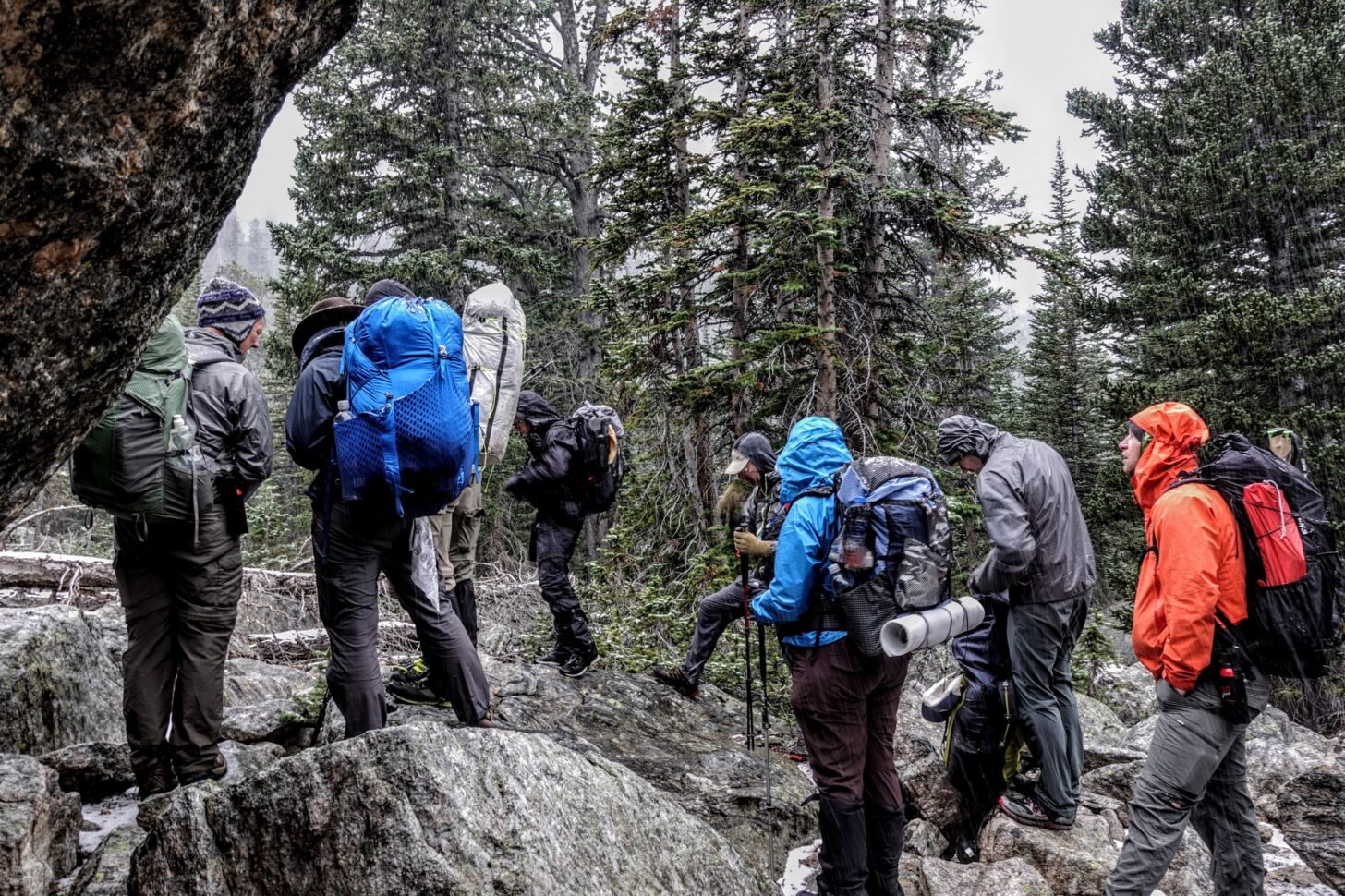
During the summer in the mountains of the Northern Rockies (MT, WY, and Northern CO), in the Pacific Northwest (WA and OR), and in the Inland Northwest (e.g., Idaho Sawtooths, Uintas), shoulder season conditions can occur any time of year on a regular basis. If you are hiking in any of these areas on extended trips where you can’t accurately forecast the weather, plan on preparing for shoulder season conditions.
Barring any unusual weather patterns, most of the other mountains of CA, UT, NV, AZ, and the entire Appalachian corridor are characterized by warmer temperatures where a typical three-layer system will suit most hikers just fine.
The risk of discomfort and even hypothermia goes up significantly when the combination of cold temperatures (in the 50s °F / 10s °C or lower), heavy or sustained precipitation, and even just light winds (greater than about 10 mph / 16 kph) are coming at you during the day when you are facing several hours of hiking. I bring this up because the combination of cold, wet, windy conditions is something every hiker should be sensitive to, regardless of their geographic location or date.
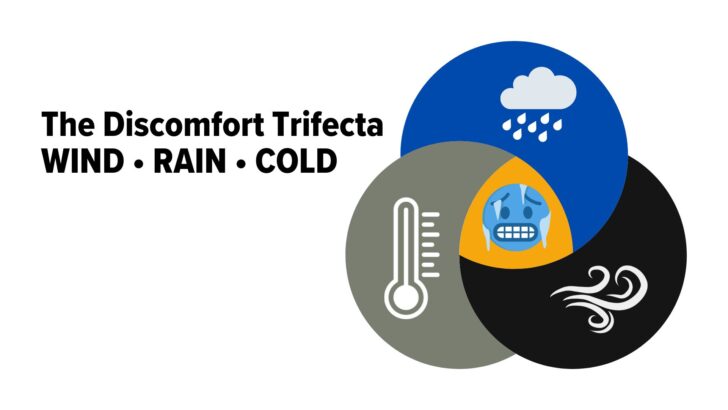
When hiking in the cold-wet-wind trifecta, one of the biggest issues hikers face is that of overheating while wearing a waterproof shell. Let’s address that issue now.
Member Exclusive
A Premium or Unlimited Membership* is required to view the rest of this article.
* A Basic Membership is required to view Member Q&A events


Discussion
Become a member to post in the forums.
In May of this year (2024) I was adventure racing in Croatia, doing the full five day expedition race of AR Croatia where with favourable forecasts at the start of the race I had taken my Montane lightweight rain jacket. The weather in Croatia apparently is very changeable because on the fourth on the 100 km MTB stage we got caught by a big thunderstorm that really made me regret to not have taken my Rab jacket. The Rab jacket being heavier, but also much more able to keep me relatively comfortable in such conditions.
In the Montane jacket I got quite soaked, wet and miserable, which I guess is part of the joy of adventure racing. Afterward I contacted Montane about the fact that on the shoulders the jacket was delaminating, which was quite disappointing because this was actually a replacement jacket that they had given me after the first jacket started delaminating, and their reply was that I had not properly maintained the jacket. The jacket had hung in my wardrobe for about two years, not being used except for two or three times, but according to Montane the reason that it delaminated was because I had not washed it often enough. I call bullshit, but according to Montane even a jacket that hangs unused for months requires to be regularly washed for it not to delaminate, claiming that the delaminating came from the build up of my sweat in the jacket that caused the glue to dissolve within the laminate.
@einsteinX
what rab jacket do you have?
separate note and feel free to PM since this question is a bit off topic, but where do you adventure race and were are you located?
I’ve had an Arc 40d beta LT, I have an OutDry Ex (8oz), and montane minimus 777 (5.3oz), a gortex pro rush (18 oz) and the 13d Arc Norvan (non-shakes now 5oz). The OutDry just seems to perform better than anything else in terms of protection and moisture management once things wet out. Having said that I picked up the beta SL because I’ve read bad things about the OutDry in sustained backpacking. I’ve never had sustained rain over 24 hours outside of Denali (in which my 2.5 layer failed and I was wearing an emergency poncho) so maybe I’m actually not prepared for 6 days of rain with any of my jackets hence the purchase (yes not carrying the rush on a backpacking trip). Obviously the science suggests OutDry doesn’t breath well and there’s tons of variables. Still, this perplexes me as to why this jacket give me better comfort then my highly breathable 3l fabrics.
The science supports your observation, Hanz. Membrane on the outside is more effective than any known DWR because it can never wet out. Outdry is my choice for heavy or prolonged rain, too.
There are tradeoffs, however. Membranes are delicate, so either they need to be thick and heavier (like current Outdry offerings) or they will be prone to abrasions and punctures (ShakeDry). If you want your rain jacket to endure bushwhacking, as Ryan points out, then a face fabric may be necessary.
Your lightweight Outdry is a nice balance. As far as I know, Columbia isn’t currently making anything that light (although they don’t consistently list weights so it is hard to know for certain). Take good care of it. :)
Yes mine is 4 years old. But excited to consider my beta SL as one of 3 options: 777 / OutDry / Beta SL. These three should cover all of my adventures … until Ryan writes another convincing article lol.
Excellent article Ryan. The balance of mission objective / conditions should always be a consideration when selecting gear for the trip.
One of the most miserable backpack trips I ever took was a 5 day trip in Ansel Adams Wilderness in the early 1990s as a Boy Scout. It rained every day except the last. I was soaked to the bone. This was before WPB fabrics were really a thing that ordinary people were equipping themselves with.
I’ve thought a lot about modern equipment and how it would have helped with that scenario. A lot of the conclusions in this article are spot on. But in my experience the limitations of “wetting out” are such a huge problem that a WPB rain jacket feels like an inadequate tool by itself. Either paired with a poncho or umbrella, that becomes more workable.
Nit: as of 2026, the Montbell Versalite advertises as a 3 layer jacket.
Thanks Andrew – Montbell product info updated. Looks like they updated to a 3L 7d for ’26. That’s a much nicer fabric than the old one.
Nice article, nothing new for me.
A long time ago, I wrote down what would be my perfect rain/storm jacket. 3 pages about the materialschoice, construction, design and features. Needs and update. Already know one thing: still nothing on the market today that ticks all boxes.
Why not bring an umbrella for when it rains? Best method to keep dry.
Interesting article that showed up in my e-mail inbox this weekend.
Now, keeping this is context of 2026, and what we’re able to buy now & soon going forward, since PFC’s & PFA’s are now being banned…
What wasn’t discussed then, nor have I been able to glean much information about (even here on BPL) is the choice of face fabric & it’s tendency to wet-out, or not. Most jackets use Nylon for the face-fabric. I suspect for the greater strength & abrasion resistance. However Nylon is hygroscopic, which seems counterintuitive for a layer that you’re wanting to shed & not absorb water…
Polyester face-fabric WPB jackets seem limited to (2) categories. 1) Lower-end “stretch” jackets with less room, missing features, or 2.5 Layer construction. Or, 2) Jackets approaching the $500 mark, that all seem to feature GoreTex ePe membranes + polyester face fabrics.
But, nobody has been able to explain weather the Polyester face fabrics are superior to Nylons, in regards to wetting out… (Including the customer-service folks at Patagonia, Outdoor Research, and Mountain Hardwear…) My assumption is that Polyester would be more resistant to wetting out. I would even hazard a guess (very ignorantly) that perhaps an un-treated Polyester face fabric would be more resistant to wetting-out, than a DWR treated Nylon…
I asked the question a few weeks ago here on BPL, and the conversation quickly turned to polypropylene – not entirely helpful as it doesn’t seem to be commercially available at the moment…
https://backpackinglight.com/forums/topic/waterproof-breathable-rain-jacket-construction/
I’m still curious to hear – if anyone knows, or has experience or testing with – if Polyester as a face fabric is more resistant to wetting out than Nylon face fabrics… DWR treated, or not…
Columbia OutDry sounds very neat, but it seems unfortunately that they change models quicker than I change underwear. Limited stock, lack of features on different models, and dull colors kind of inhibit picking and trying one. (I need bright, visible colors for my specific use-case – working road-side in inclement weather, when overall visibility is reduced…)
A good but minor update to an older article. I did not re-read the past 4 years’ worth of comments. Based on anecdotal evidence found online, the modern DWR replacements are less durable and wet out quicker than the old C8 and C6 DWRs that used to be available on the market.
Remember when we were all excited by Permanent Beading Surface jackets? Aka the Gore Shakedry and Columbia OutDry Ex materials? I still have my OutDry Ex Lightweight jacket, but it needs pit zips. I see that their latest offering offers pit zips.
For general backpacking, I think my ideal rain wear for moderate weather would be a lightweight Columbia OutDry Ex jacket with pit zips and pockets, and a rain skirt. However the rain skirt MUST have sufficient pleats to allow me to extend my stride and to step up or down without feeling like my legs are restricted. Years ago, I purchased one of the original ZPacks rain skirts and I quickly grew to dislike it. The straight cut and weak velcro closure on the bottom caused it to pop open regularly on rough terrain, and the ultralight DCF fabric then caught the wind and flapped around. Somewhere I have a photo of my friend and I standing on the top of Mt Marcy in the Adirondack High Peaks on a wet and windy day. I was wearing that ZPacks rain skirt, which had separated at the back and was blown open and flapping in the wind. It was totally ineffective at keeping me dry.
For true mountain weather, I’d still reach for my high end GoreTex jacket and pants with zips.
@RyanJordan is BPL really going the way of AI slop… Please oh please tell me “No” and that this was just a glitch…
Bear with us. this is an experiment only, this post is supposed to be visible only internally to staff for reviewing quick summaries of forum threads. Not for the public.
I found the limit of my beloved sea to summit poncho tarp doing Heavens Gate a couple weekends ago.
I was caught in a surprise hailstorm at 5c followed by all day cold rain. It kept me nice and dry and my core warm
I solve the flapping and can’t see my feet issues by using a lightweight bum belt in front cinched around my lower waist and below my hip belt. No problem with a lot of moderate bushwacking
Problem was that eventually I lost feeling and strength in my thumbs because of the exposed forearms. Didn’t notice until doing camp chores where they were useless until I popped on the fleece liners
I just received a 3ful sleeved poncho with front zipper. A poor man’s Packa at a much nicer weight. I’m hoping this is the best of all worlds. Size large is 8.6oz, we’ll see how it works out. I would have taken it to Heavens Gate but there was a several week delay in China, so don’t count on one if in a rush
I have a 2.5 layer wpb pit zipped black diamond rain jacket that’s never left the closet
Silnylon poncho over Taslan windshirt.
A SUMMER trip near Chamonix, Europe.
Cheers
PS: cold thumbs – yeah, I used to have trouble with my left hand in the snow. Gave up wearing a wrist watch on my left wrist: problem solved.
Reminds me of my 3 “spring” excursions this year
First featured picking off ticks while it was snowing
Second a hard driving hail storm and almost being hit by lightning
Third hitting tons of snow and ice at elevation due to a very late spring, and leaving the microspikes home to save weight
It’s never boring!
The Packa weighs 11 oz or less in 15D sil/sil nylon. For the extra 2.4 oz, you get some refinements:
Roger started a great trend with his Mountain Poncho. Now we have a couple of commercial sources for similar designs. Recently I have seen other sleeved ponchos on Amazon. Imitation is the sincerest form of flattery. :)
What suggestions to restore DWR? I have tried a couple of commercial products and found them unsatisfactory
That has been my experience as well. For that matter, I find factory DWR unsatisfactory. The factory has a much better chance of doing the job well, with carefully controlled temperatures.
That said, some people report success. I suspect it depends on the garment itself, what DWR was originally applied, and finding a similar kind of after-market DWR treatment. There would be some luck involved.
This year, it’s hard to buy fluorocarbon DWR. Nikwax has several new formulations. Be careful, though: some of those formulations will increase water rejection while simultaneously reducing the breathability that you paid so much for in the first place!
Personally, I don’t bother. DWR doesn’t do anything that matters, in my experience. At least not for more than half an hour in hard rain.
For extended and/or heavy rain, Outdry or fully waterproof.
One thing I do that I don’t see suggested often is to pair a light WPB jacket with a poncho (even an emergency poncho). The WPB jacket is more comfortable in light, intermittent, rain (or when it is not raining). The poncho goes on/off quickly and provides more serious protection from heavy weather. The weight penalty is 1.5 to 4-ish ounces, depending on which poncho I choose.
I had a rsbtr wpb fabric that wetted out in even light rain.
Then, I used gear aid rivivex durable water repellent. Washed fabric. Sprayed on revivex when it was still wet. Dried in drier.
Then, it was much better in the rain.
But, that fabric isn’t very good. Wets out in heavy rain, then there’s condensation inside. They haven’t sold it for a while.
My one disappointment with the 3ful is that its about 4″ shorter than my sea to summit poncho tarp, with the front coming down just below the knees and the back to the knees where the s2s is mid calf
Otoh, judging by the pictures online, the Packa is even 4 or more inches shorter than the 3ful. This doesn’t make sense to me, why optimize a poncho for cold weather by adding sleeves only to shorten it and expose the legs?
Looking forward to trying the 3ful, wish it was longer, but the Packa is too short for my liking
Retried with my taller kakwa 55 pack and side and back the 3ful only comes down to 4″ above my knees. directly in front it comes to my knees. s2s ultrasil poncho tarp comes down to 3″ below my knees all around. So the s2s doesn’t protect arms in cold, 3ful doesn’t protect lower legs in cold.
In fall 2007 Dead Bird had their SV-jackets and pants designed with a polyester face fabric:
Well, that was the intended idea early 2007 in their workbook. When the garments were actually for sale later that year, the polyester face fabric was replaced with the usual nylon.
This past weekend I used some down time to conduct some super scientific testing on a handful of WPB jackets, after a not so pleasant saga of buying, warranty replacements, retail replacements, etc…
In the test, from left to right, are…
-REI Rainer 2.5L Jacket
-Non WPB stretch jacket, DWR treated (We’ll call this the “Control”) LOL
-Outdoor Research Foray 3L
-Patagonia Granite Crest (3L)
-Patagonai Triolet (3L Goretex ePe + 70d Polyester face fabric.)
-Columbia Whistler Peak, OutDry Extreme
The right (3) jackets were placed outside for roughly 30 minutes in light rain. The left (3) jackets were added as an afterthought, then all of chem checked on after roughly 60/30 minutes. This “test” simply examined the face fabrics’ resistance to wetting out under light rain conditions. Which ones held onto water that could not be shaken free…
My theory about Polyester being a superior face fabric was incorrect, at least anecdotally. The Patagonia Triolet – the only jacket with a GoreTex proper branded membrane – ePe membrane + 70d polyester face fabric to be exact – performed the 2nd worst of the bunch. Only the REI Ranier showed more saturated face-fabric. (And by quite a wide margin.)
To be fair, who knows how long this Triolet jacket has been hanging on the retailer’s rack. It’s quite possible that a wash, dry, and reapplication of DWR could have made a significant difference. Given it’s cost however, it’s not so bright color, and overall heavier construction (not a deal breaker on it’s own,) I decided this one wouldn’t be the winner, for the several aforementioned reasons.
This of course brings up an objective difficulty in such a test. The only way I feel to get a “fair” test would be to get each jacket – of unknown age since manufacture – and then perform a wash, dry, and re-treatment of DWR per the brand’s recommendations. Then perform such a “test” again. (Ideally with a stationary sprinkler, and with a rain gage.)
Interestingly, the REI Ranier did terrible. This jacket being my daughter’s, has been washed/dried, and treated with Nikwax TX.direct spray-on not even two months ago. After this tests’ poor performance, I dried, and then re-applied the DWR. And unfortunately, it showed absolutely no improvement, whatsoever…
Most interesting to me was the Columbia Whistler Peak jacket. I was surprised to find this jacket on the clearance rack, and was excited for a chance to try it out. Initially, I thought I didn’t find it comfortable, but after some more trials, I liked its fit. Of course with no face fabric, water beaded on the outer surface the entire time. It has pit zips, and the pockets are mesh-lined for extra breathability when open. I have some durability concerns, just based on reading some past Reddit posts on Columbia OutDry jackets, but not enough to prevent a purchase. Overall I liked this jacket a lot. If it were available in bright colors, I would have kept this one for sure.
The Outdoor Research Foray 3L has lots of great features, is a fine jacket overall, and was my initial purchase in the category. Unfortunately, (2) consecutive jackets, of different colors interstingly, showed the same “bubbling” issue where the face fabric is delaminating from the membrane layer. There seems to be no issue with “performance” but eventually this will lead to a construction failure. To their credit, OR has been helpful. Repellency of both jackets is very good, right out of the package.
The “winner” of this test is the Patagonia Granite Crest.
Actually, no – the winner of the “Test” is the Columbia Whistler Peak OutDry jacket. It cannot, nor did it wet out.
But, the Patagonia Granite Crest won the day… It comes in bright colors, shows the best water repellency “from the factory” of the 2.5-3 layer jackets tested, and has outstanding, perhaps the best overall comfort. It showed the best repellency (aside of course the Columbia OutDry jacket) and wins on it’s other merits as well.
Were the Columbia Whistler Peak available in bright colors (for working in bad weather near traffic) I would have chosen to keep it. It is very cool to see absolutely no wetting out of the face fabric, and I would have been fine gambling on the durability long-term. Outside of that though, the Patagonia Granite Crest looks like it will be a fine choice for the long run.
Anyway, I found all of this kind of interesting, and given my recent frustrations with researching, buying & selecting a WPB jacket, I thought you all might enjoy all of this as well.
Become a member to post in the forums.