


good test, thanks
30/60 minutes in light rain is a low exposure but if something wets out then, it’s not very good
what fabric do foray and granite crest use?
Topic
Become a member to post in the forums.
 .
.
good test, thanks
30/60 minutes in light rain is a low exposure but if something wets out then, it’s not very good
what fabric do foray and granite crest use?

OR Foray is 40d Nylon “with mechanical stretch.”
Patagonia Granite Crest is 30d, 3-oz ripstop nylon.
I should have mentioned, while not advertised as such, the OR Foray’s hood is generous enough to allow a large helmet AND attached earmuffs underneath, comfortably. Helmet in question is a Petzl Vertex, which is a larger suspension helmet typical of arborists, and rope-access workers. A typical foam/shell climbers’ helmet is even smaller, and will fit no problem. In fact, fitting the Petzl Vertex + attached muffs, means that an Arborist or similar could wear their work helmet with comm’s and still use the hood. Two weeks ago, I used the OR Foray during a moderate rain event and was able to wear my typical baseball hat + ear muffs (hearing protection) under the hood, comfortably – including room enough to turn my head both ways. This would be an awesome choice for an at-height worker like an arborist, or windmill tech, etc…
I’ll try the Patagonia Granite Crest later to see if the same helmet fits under the hood, or not.
so, foray and granite crest don’t have WPB membranes?
I wonder how they would do with when it rains – a membrane is supposed to be required to prevent the force of the drop misting through the fabric.

Nice experiment.
I just pulled out my only polyester WPB jacket. It is made by Patagonia. The 40-denier face improves MVTR compared with heavier face fabrics. I used it for skiing for a couple of seasons and retired it due to undersized pit zips and poor zipper operation. It has not been washed much. It has dirt spots that are probably the result of skin oils, possibly from sweat dripping into the fabric around my neck or face. Wherever there is discoloration, water drops soak into the fabric. PFAS were hydrophobic and oleophobic. C0 DWR is not typically oleophobic. My experience with this kind of dirt is that once present, it is hard to remove and it will not take aftermarket DWR. Non-soiled parts of the jacket seem to bead very well.
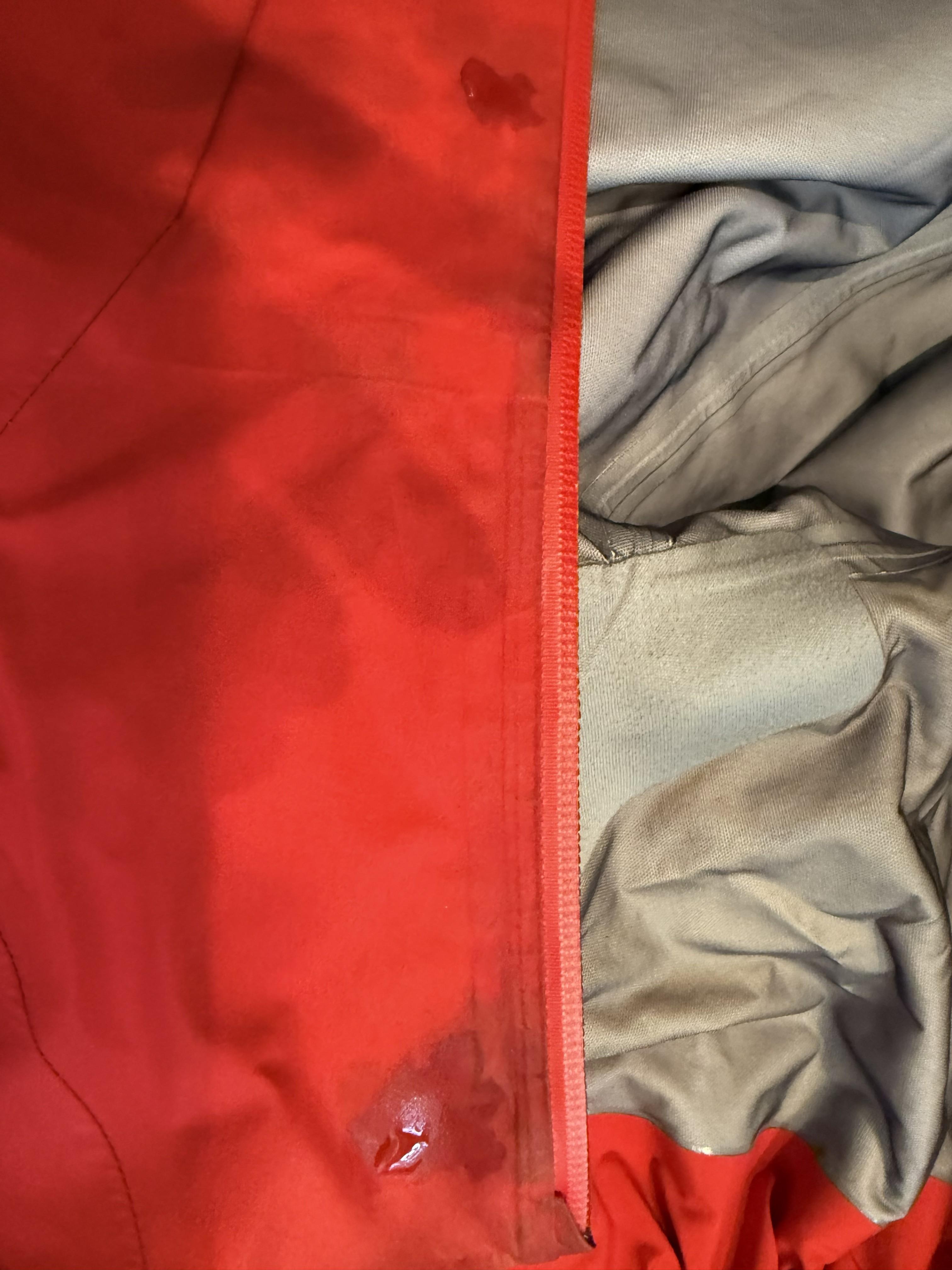
When you see heavily discolored fabric from failed DWR, that typically means that water has entered air spaces within the weave or knit and within the yarns. On WPB jackets, the face fabric must protect the membrane while allowing moisture vapor to escape through the membrane and face fabric.
That means, you will have plenty of voids in the fabric that, in the presence of not very high pressure can permit water to enter the voids. This will be the case for polyester or nylon woven or knit face fabric. Add body oils or trail dirt and you have a recipe for water absorption. The membrane won’t let water in, but the jacket may get heavy and cold.
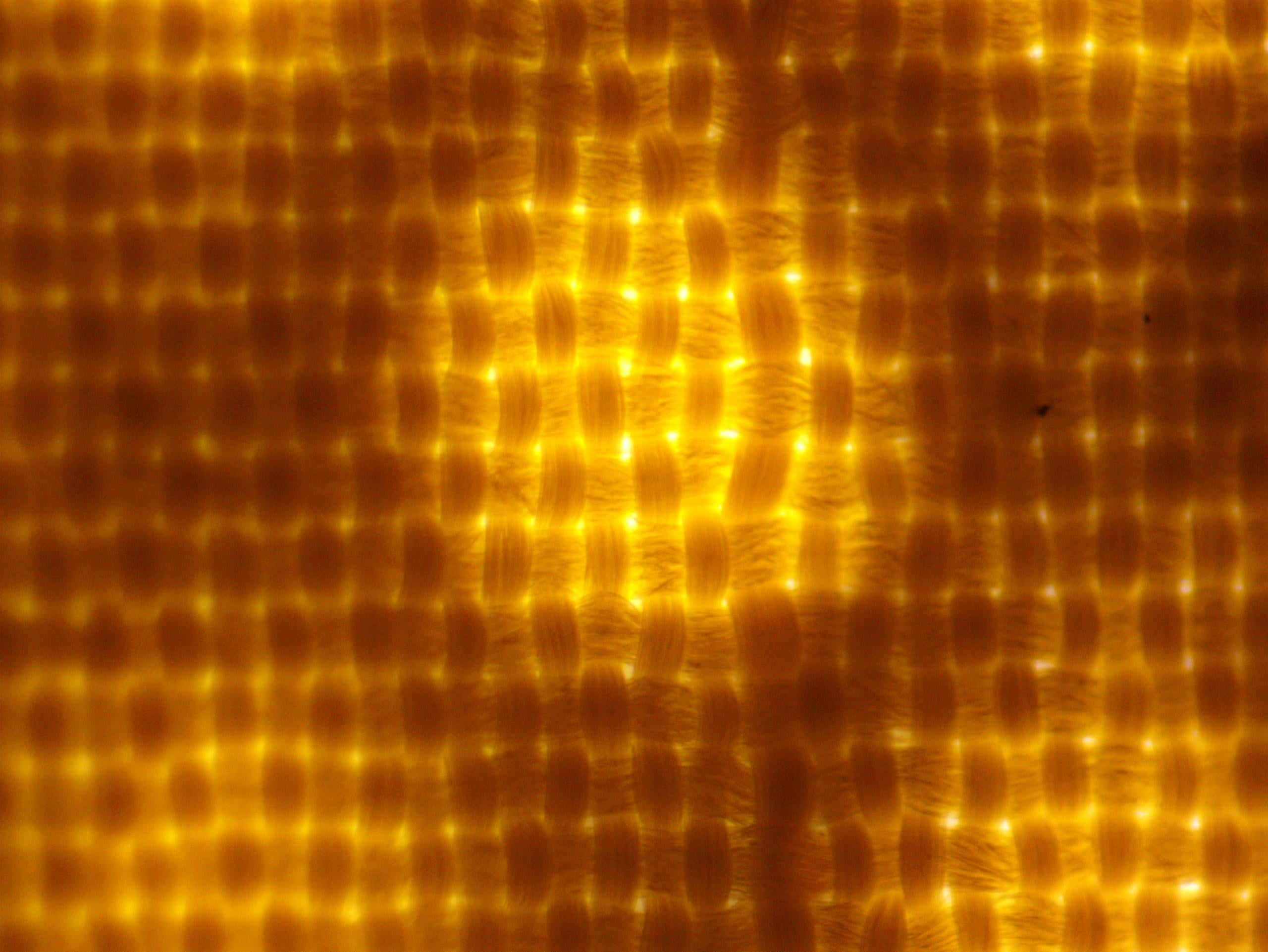
The openings in this 70-denier face fabric on a Gore membrane are about 1,400 square micrometers. A pressure of about .17 psi on the face fabric will push water into the weave intersections, even if the DWR is intact. The yarns show no twist, so they also ofter opportunities for water penetration at higher pressures or more degraded DWR.
All of these jackets have a story to tell as to why they fail. Usually, we just know that they do.
The Columbia Extreme jackets have definately improved. In older models, the polymer they painted on the face fabric was so thin that when viewed under the microscope you could see the pattern of the underlying yarns. In the recent models I have looked at, the coating is thicker and its surface is highly uniform. This means less chance of exterior water getting through. It also means that vapor has a harder time getting out. Fortunately, they have servicable pit zips. I have a small collection of these jackets because they often go on sale at very low prices.
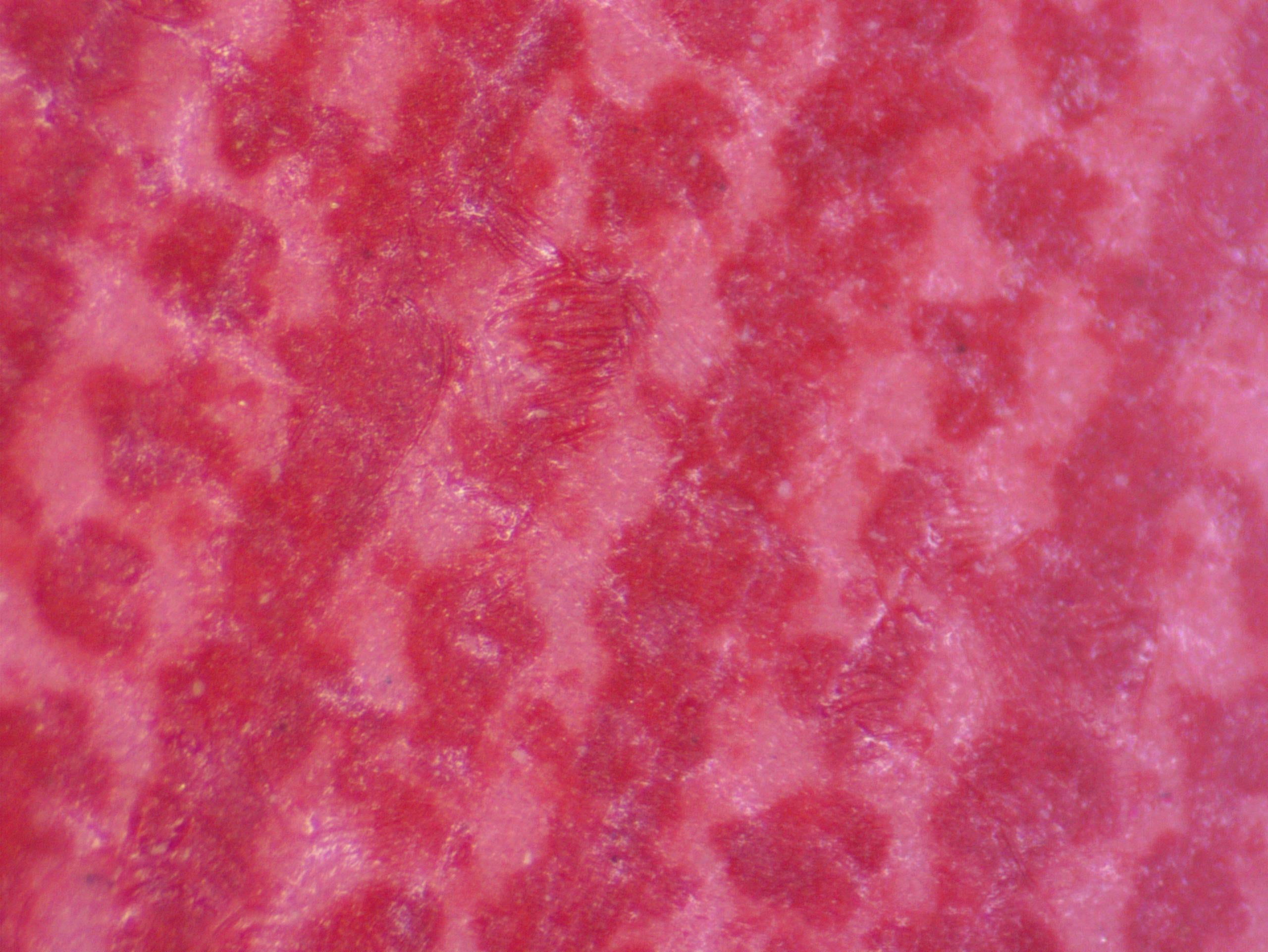

The red fabric is a jacket that might be 5-7 years old. The tan fabric is from a current jacket. The coating on the older jacket reminds me of Epic coatings that used to be applied to the interior of woven wind shirts. The fabric performance seemed to be highly dependent on who ladled the stuff during production.
I don’t think the increased hygroscopic fiber absorption of nylon compared to polyester makes a significant difference in DWR performance. What really matters is how easily rain can enter the large volume of air spaces present in the knit or woven face fabrics as DWR degrades. I suspect that the industry in general has more confidence in working with nylon fabrics and the available solutions for bonding membranes and sealing seams than in the possible benefits of polyester face fabrics.
Paramo does produce jackets exclusively, I believe, with polyester face fabrics. In the article I wrote about Paramo, I find that the old, soiled jacket I tested worked well. As a specialty item, I imagine the Paramo folks, working for Nikwax, put a lot of effort into finding the right combination of polyester fabric qualities and the application of their DWR and cleaning products.
Jerry: Both jackets have proprietary WPB membranes.
Sorry Jerry, but …
is supposed to be required
The problem here is that typically there is zero reliable experiment-based authority behind any such statement. All very myth, rumour and snake oil. And marketing.
Have a look at Ventile as a counter-example. Cotton of all things! And yet, a full-body Ventile suit could save a fighter pilot from getting wet, let along freezing to death, when he had ditched in the North Sea during WW II. Cotton and NO membrane. Yes, the SURFACE of Ventile gets wet.
The arguments about ‘water-proof breathable’ jackets are much older than BackpackingLight. They are almost as old as backpacking itself. The reality is that water-proof breathable does not exist on the outdoors market (or anywhere else). My proof of this? A distinct LACK of any good examples! Except as marketing spin of course.
Why is this so? If you take a microscopic look at the nature of fabric, you can see the gaps between the threads. And if you can’t see any gaps, you can be very sure the fabric is NOT breathable. Think PVC yachting spray jackets for example.
Alternately, treat it as the holy grail of marketing: delivering promise, not performance. And, of course, you have to have something even better to sell next year. The shareholders demand it. Sell the dream.
Cheers
Jerry, my apologies. I assumed you were asking only about the face fabrics. Both are 3-layer fabric construction.
OR Foray is 40d Nylon face fabric with “mechanical stretch.” They make no mention as to the chemistry of the membrane or inner layer, though their marketing calls it “AscentShell” and that it uses a special factory application of NikWax. It does seem to shed water well.
https://www.outdoorresearch.com/products/mens-foray-3l-jacket-322088
Patagonia’s Granite Crest is 30d ripstop face fabric. They don’t make mention of the membrane chemistry, but point out a jersey backer/inner layer. This jacket wears very comfortably, and doesn’t have a stiff or “plastic-y” feel that I’ve noticed with other shell jackets. Their marketing calls several of their jackets “H2No”…
One nice thing about Patagonia’s jackets, is that they give very simple instructions for care. Wash cold, avoid fabric softeners, dry on low heat. Reapply DWR as needed.
OR on the otherhand specifies a wash-in DWR product, which I don’t love. First, I can’t see how this is a great idea, since the DWR will be “applied” to every surface of the jacket, including the inner layer fabric, and inner membrane surface. That can’t be good for breathablility. Second, I really don’t want that inside my washing machine, which means hand-washing, which becomes a hassle.
I appreciate the simpler wash/care routine of the Patagonia. Also the fact that they repair items. And their customer service people have been very sweet and helpful the couple of times that I’ve called – probably the most pleasant experiences in quite a while. All other things being (nearly) equal, I feel like that Granite Crest jacket will be a solid choice for the long term. There may be better technical options out there, but I think it would take the splitting of hairs to find it. Juice that’s not worth the squeeze, at least for my not so technical use case, of roadside work in bad weather… Altogether, I think I’ll be happy with the Granite Crest.
“The problem here is that typically there is zero reliable experiment-based authority behind any such statement. ”
Yeah, Seeber did some experiments that questioned how much water leaks through the fabric from the force of a rain drop hitting the fabric.
“The reality is that water-proof breathable does not exist on the outdoors market (or anywhere else). My proof of this? A distinct LACK of any good examples! Except as marketing spin of course.”
We are now repeating ourselves. Again… : )
In some conditions, mainly when it’s cool and I’m not exerting myself too much for that temperature, I stay pretty dry in Neoshell and I think Power Shield but that needs more testing.
If it’s warmer and I’m exerting myself more, my shirt inside the jacket will be totally wet, so in that case you could call WPB a total failure.
But I agree WPB is over hyped. Some WPBs are better and work pretty good in many conditions. Other WPBs aren’t as good and work pretty good in a smaller set of conditions.
It’s complicated
Is anyone making jackets with tough, actually waterproof fabrics like Ultra? I’m becoming less convinced that WPB exists (I have a Columbia Outdry for walking the dog, but don’t think it breathes) so would settle for something with some flaps/vents/pitzips etc. Tough enough to bush bash, scrape against a rock or tree (40D or more), but able to handle Tasmanian or New Zealand rain – cold and wet, like the US Pacific Northwest.
I’ve been impressed by my Bonfus pack (Ultra 200) which stays dry when my coat wets out completely (despite repeat DWR coating etc).
there are ponchos in waterproof material
I’ve tried them a little but there’s a lot of condensation inside so it defeats the purpose. At least with a good WPB, they stay dry under most conditions. I think outdry is supposed to be a better WPB.

there are ponchos in waterproof material. I’ve tried them a little but there’s a lot of condensation inside so it defeats the purpose.
Interesting. I use the S2S ultrasil poncho all the time. While some condensation can cling to the inside (like a tent) its by far the option that keeps my clothing and body the driest and most comfortable. It helps to occasionally undo your chest strap, grab the material and it pull it outwards to billows it in and out a few times to refresh the air inside. Requires no break in pace.
We need a Shakedry New Generation with much better durability.
Columbia OutDry is probably the closest thing to GoreTex “ShakeDry” on-sale for now.
Regarding Ponchos, I wonder if the undergarment isn’t a big factor in condensation management. I have an older Patagonia polyester “sweater” that has a super loose, porous weave. Breathes exceptionally well. I have some Merino wool sweaters that are similar.
My guess is that a very loose woven, long sleeve shirt under a poncho would do lots to help “breathe” condensation away from the poncho’s fabric, prevent the “clammy” feeling, and ultimately, sweating…
I use a poncho, of course. Silnylon, fully waterproof.
https://backpackinglight.com/myog_mntn_poncho/
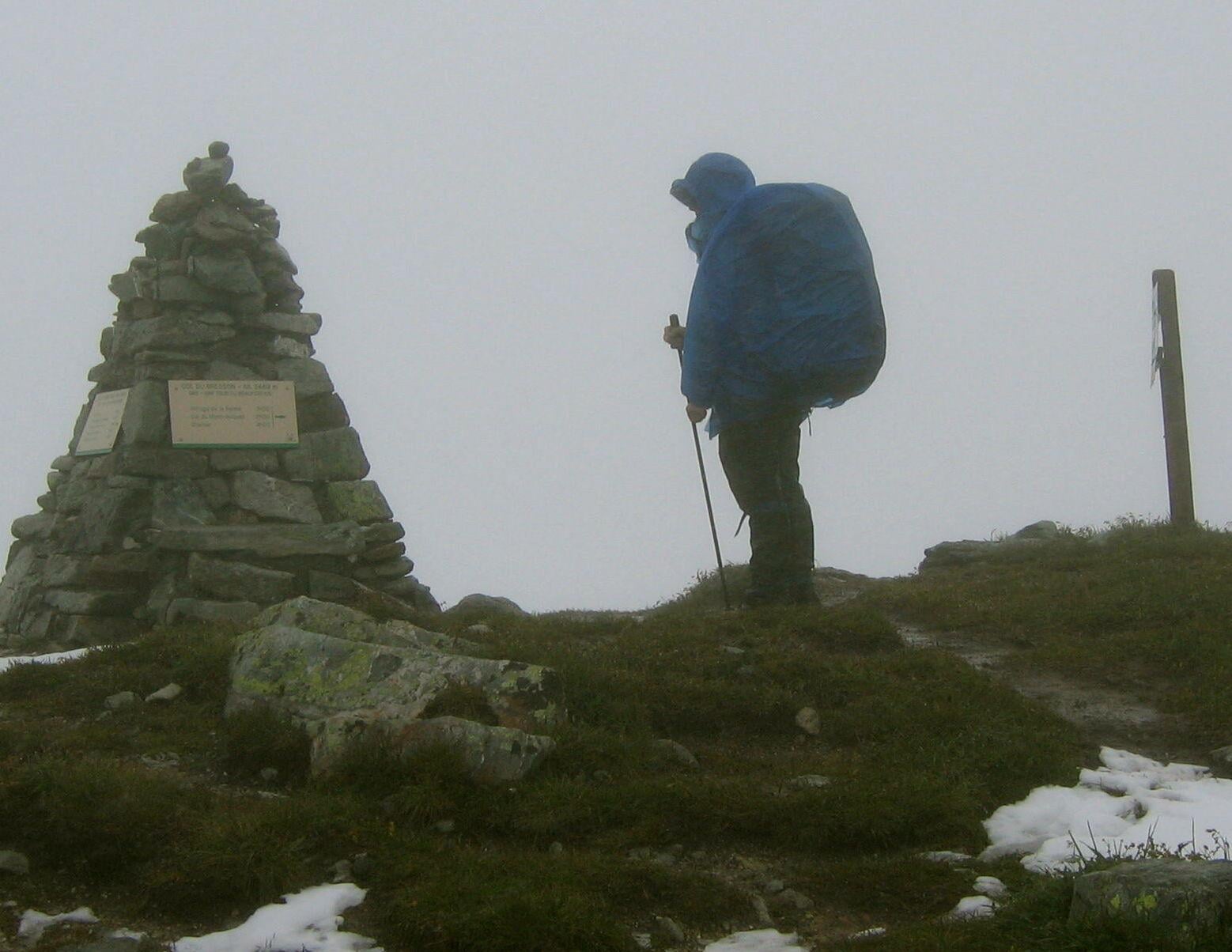
Most of the time, even in very heavy rain, the poncho goes over my pack so there is lots of air space around me. My back is not sweating any more than normal. Also, my arms are usually not in the sleeves, but are loose at my front. (Sue uses her sleaves more that I do.) That makes for more ventilation. Finally, unless the scrub is difficult, the front of my poncho is done up by only, say, two studs. It is not sealed.
To be sure, I might get a little bit damp inside, but I am always warm. It is warmth that matters, not dampness.
Cheers
“Regarding Ponchos, I wonder if the undergarment isn’t a big factor in condensation management. I have an older Patagonia polyester “sweater” that has a super loose, porous weave. Breathes exceptionally well. I have some Merino wool sweaters that are similar.”
Yeah, for example, I wear a fleece hat and even if the jacket gets wet on the inside from condensation, it doesn’t go from there inward – the fleece hat doesn’t “absorb” water. or adsorb or whatever…
On the other hand, a couple times I was heavy exerting, it was coolish like 50F, raining solidly. Everything inside was damp – my shirt and everything – it wasn’t just on the back, but everywhere seemingly uniformly. But like Roger said, I was plenty warm so it didn’t matter. When it stopped raining and I took off the jacket, the shirt dried pretty quickly.
Another complicating factor is just sweating from too much insulation and too much exertion. Then the waterproofness of the jacket is irrelevant. and breathability of the layers. (I’m repeating myself again : )
Then, what you need is a base layer that doesn’t absorb much water so it dries quickly like Stephen Seeber has talked about
So then, I must ask, (at the risk of showing my ignorance ) why wouldn’t a loosely woven, highly breathable base/mid layer, and then a WPB outer, be the ideal combination? The under layers would breathe, and keep moisture off the body. They WPB jacket would let some moisture permeate out, but keep rain from coming in…
Yes, there is a chance the WPB’s face layer could wet-out. But at that point, how would that be worse than an impermeable poncho, or the like…? A loose fit of the WPB, it’s pit zips etc. would mimic the loose fit of a poncho. If the DWR is maintained, you get the extra breathablility of the membrane. If it wets out, it’s still no worse than a poncho, right…?
The moist air needs somewhere to go. The WPB can’t move out the moist air fast enough so it just condenses on your skin
I haven’t tried it yet but I think the brynje under the poncho will be ideal in warm conditions by letting sweat vapour come off skin, moist air escape through all the ponchos gaps, and the mesh keep any moisture condensed on the inside of the poncho off my skin. I don’t usually carry the brynje in warm weather though. I have a trip to the Adirondacks in a few weeks and will try that out if it rains
The moist air needs somewhere to go.
Absolutely.
So I leave most the front of my poncho open and flap my arms a bit.
Works for me.
Cheers

So I leave most the front of my poncho open and flap my arms a bit.
Keeps the neighbors away🤠
Stirring the pot a touch more (and because I’m still strongly interested in the topic,) I keep seeing this add here on BPL, for Helly Hansen’s Polypropelene face-fabric jackets, branded “Lifa Infinity” and Lifa Infinity Pro.”

I bring this up, as Polypropelene was mentioned in this thread, and one of my previos threads asking about the Nylon vs. Polyester face fabric question. And then, I saw this HH add, highlighting DWR-free jackets using Polypropelene. Well, cool! A commercially available, for-sale product with the best tech, using the coolest materials, that solves the DWR treatment issue – sweet!
Well, until you actually try to buy one, that is…
The ‘normal’ “Lifa Infinity” products that are still in-stock – the “Verglas Infinity” jacket, actually uses Polyester construction, and still gets a DWR treatment… :/
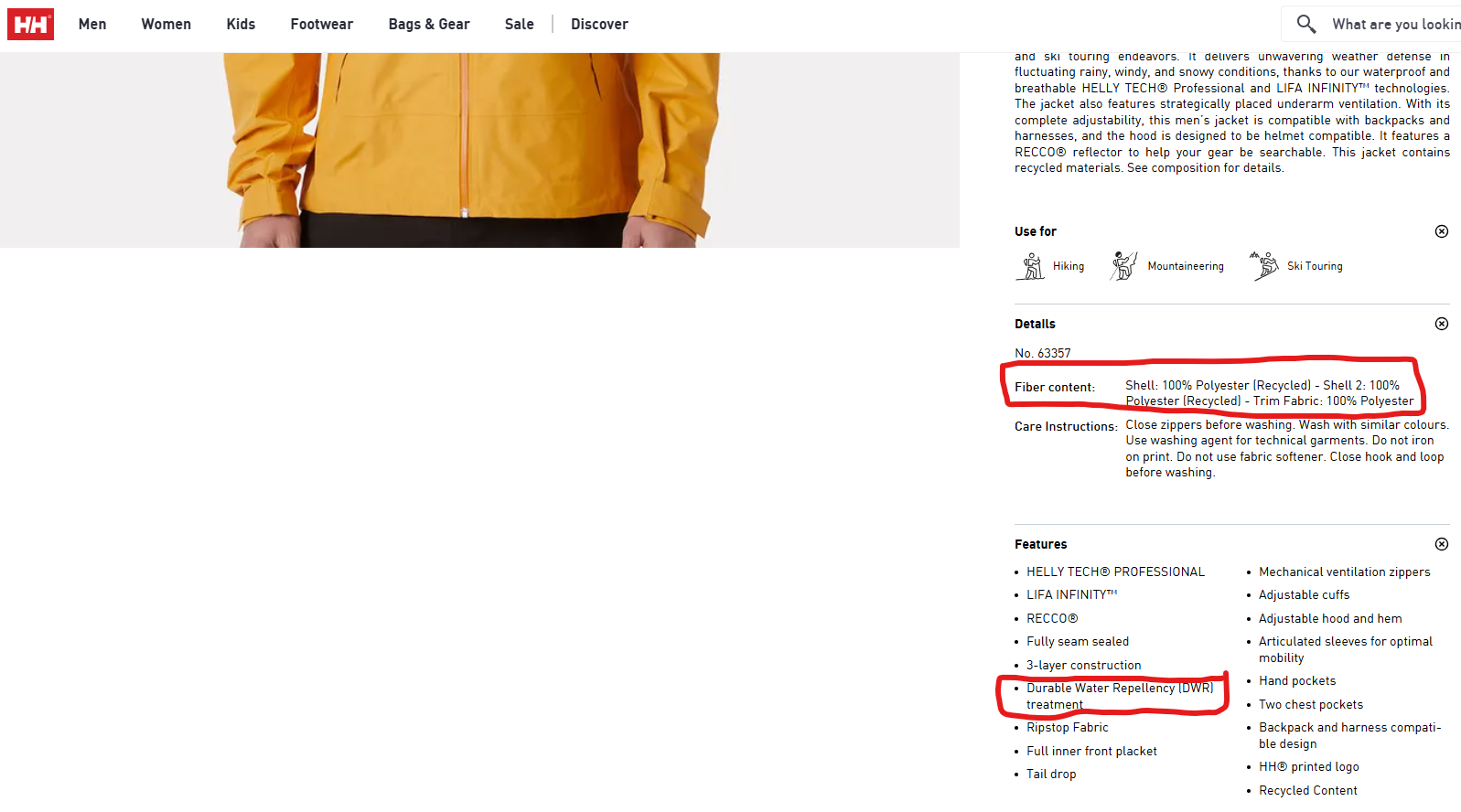
Their “Lifa Infinity Pro” products are almost completely sold-out, and if you find your size in-stock, their discounted price lies between $300-$420…
https://www.hellyhansen.com/shop/technologies/lifa-infinity-pro
Unless some of you are aware of other Polypropelene WPB jackets, these seem to be it for now…
Interesting, but what other properties have they given up for this (both on the PP and the fabric weave)?
The Columbia Extreme jackets have definately improved. In older models, the polymer they painted on the face fabric was so thin that when viewed under the microscope you could see the pattern of the underlying yarns.
Wait, does this mean that there is a fabric layer outside of the WPB-layer?

With regards to air movement. Maybe with how light our air pumps have become we no longer need wPB. Perhaps the most effective rainwear is 3 oz of a non-breathable with 4-5 oz of fan tech built in lol.
Woubier: The shell is a nylon weave to which a urethane coating is applied on the face. The inner surface of the nylon can be hydrophilic or hydrophobic judging from the jackets I have here. The hydrophilic version is a little slow to wet, but within 45 seconds or so, 50 ul drops absorb into the weave. On the other two jackets I have, which turn out to use identical fabric but have different features, the inner nylon weave is hydrophobic. Drops sit there until they evaporate.
Wait, the nylon fabric you talk about is coated with the actual PU-WPB-layer on the outside and there’s no fabric-layer on the outside of this PU-WPB-layer, right?
Become a member to post in the forums.
 Vaer C4 Tactical Field SolarDurable timepiece for wilderness users - 20ATM (200m) water resistance, 120-click bezel, 316L SS casing, sapphire glass, solar-powered, Epson VS-42 Japanese movement, C3 Lume, USA assembly.
 © Beartooth Media Group Inc.
 Loading...