

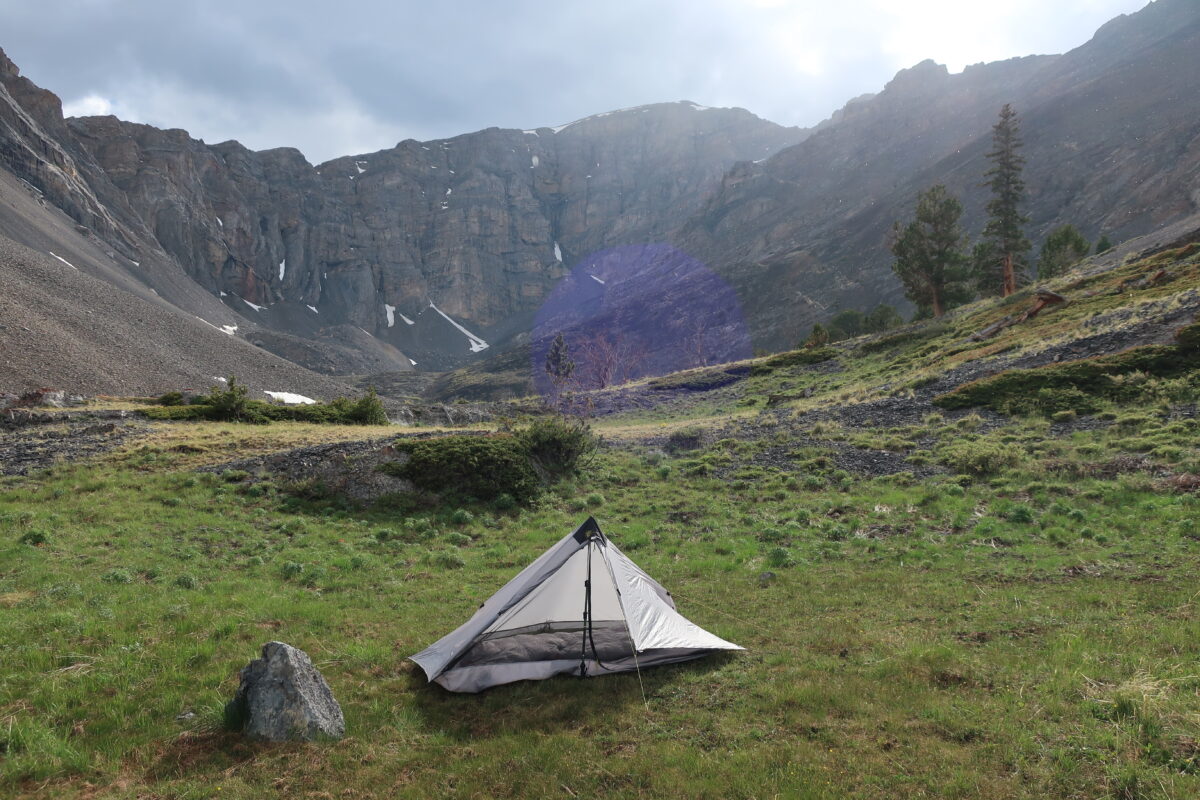

Editor’s Note: This account comes from Pat Dunn, a Backpacking Light Member who encountered a medical emergency in Jasper National Park. Pat and her husband Sam were carrying a Garmin inReach Mini and activated the SOS button. I invited Pat to share her experience for the rest of us, so we had some understanding of what happens when GEOS (a.k.a. the International Emergency Response Coordination Center, or IERCC) springs into action following an SOS activation of a satellite communications device. – Ryan Jordan
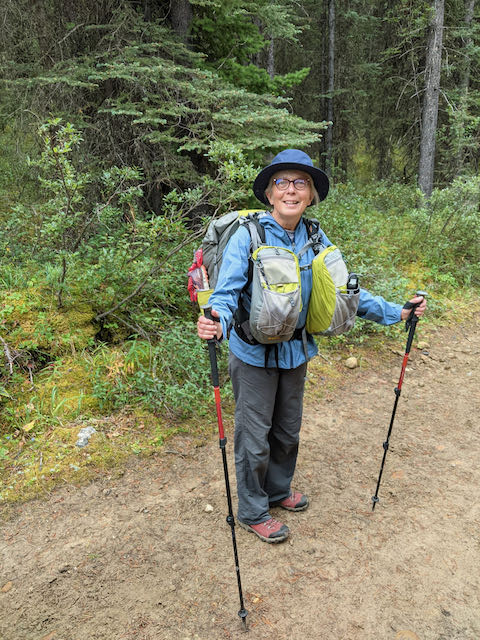
My long-time partner Sam and I were married in July and in August we undertook a honeymoon backpacking trip in northern Jasper National Park. We are seniors and are both experienced backpackers. We have backpacked in this area before but this time we had prepared for a longer trip than we’ve previously done.
Day 4 was wet with rain that turned to snow. When we pulled into camp we ate a quick light meal and then ducked into the tent for the night. The next morning dawned cold and wet and still snowing and raining. We decided to get up and get moving and had only a couple of granola bars as we packed up the tent.
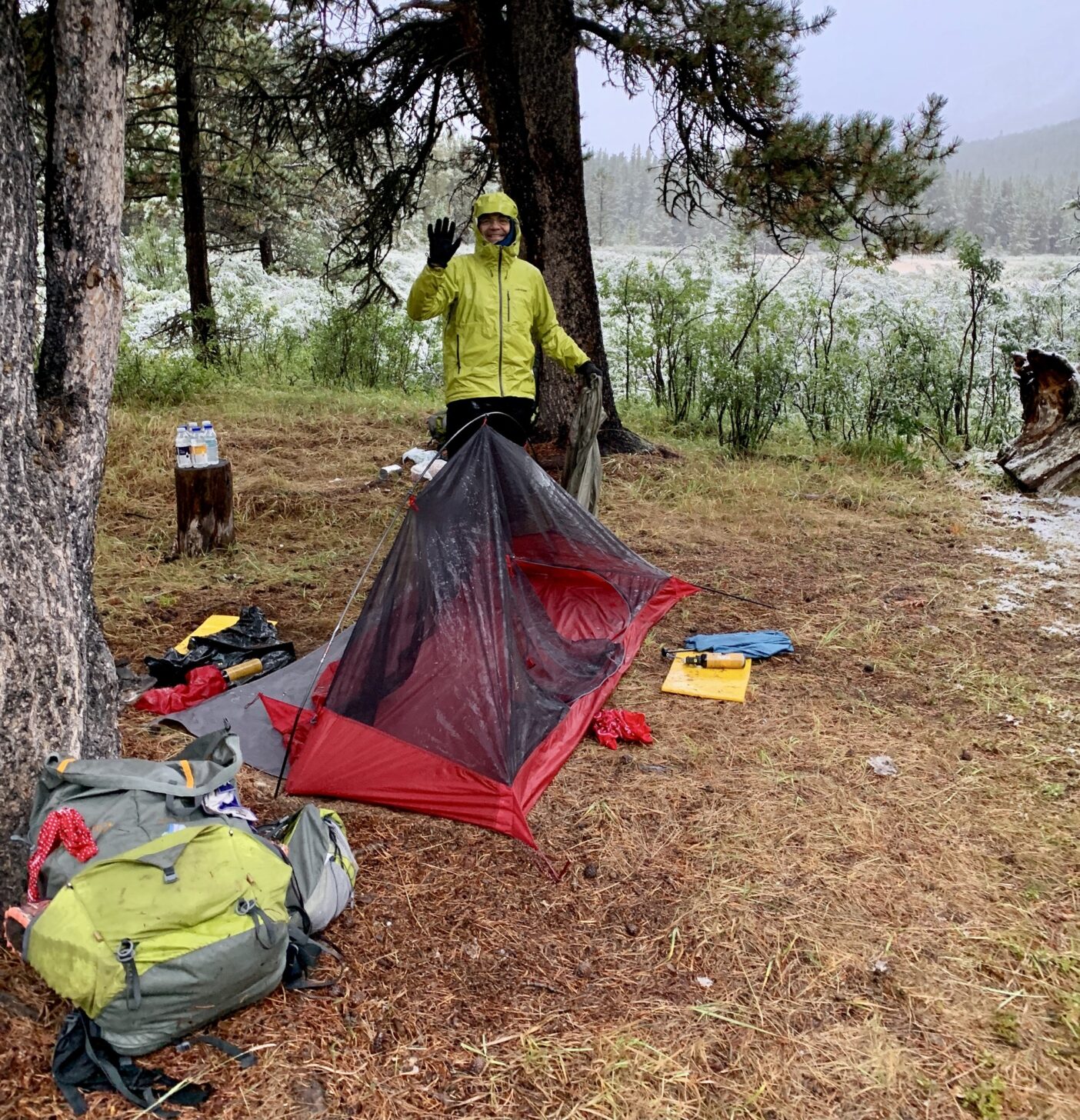
The first couple of hundred metres of the hike were in a knee-deep marsh, where we were hopping from tussock to tussock to cross to drier ground. Practically mid-hop I was suddenly seized by an inability to breathe: the world went black and I was bent over gasping for air, then passed out and collapsed, falling into the marsh.
I was out for a short moment, then Sam pulled me to my feet, and then I collapsed again. Sam got me on my feet again and helped me get to solid ground. He got out the stove and made a hot drink, and retrieved my pack. We waited to see how I would recover and how I was feeling. Although I began to get my breath back, I didn’t feel well. We were both in shock at the suddenness and violence of this collapse. We realized that I needed medical attention. We had been carrying the Garmin inReach Mini for years on trips primarily as a communications tool. We never thought we would use the SOS button and in fact, were not entirely clear what would happen once we pressed it. We had an idea of what we hoped would happen based on our experience in taking the Backpacking Light online course How to Use the Garmin inReach.

So we pressed the SOS button and a well-oiled process leapt into action. Very quickly we received a text back from GEOS (a.k.a. the International Emergency Response Coordination Center, or IERCC) asking about the nature of the emergency and what had happened.
This was where we realized that the one cell phone we shared between us had run out of battery life, and that phone – paired with the inReach Mini – would make it much easier to communicate with GEOS. So Sam dug in his pack for the portable battery charger, and plugged in the phone to charge it enough to boot it up. This delayed our response to GEOS by a few minutes.
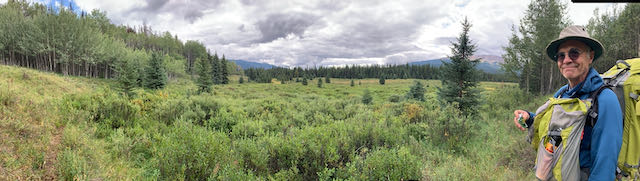
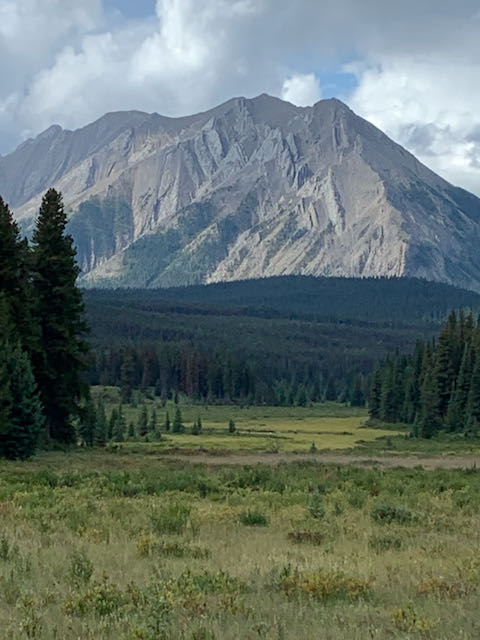
We replied with more information. They responded with the contact name and number of the public safety specialist in Jasper who they had alerted. GEOS asked to be advised when we knew that help was on its way. We were then in touch with Jasper, who requested information on the location and asked about a landing place for a helicopter. There was a large open meadow at this location.
Sam set up the tent for me. I waited under the warmth of a sleeping bag. The helicopter took about an hour to arrive. Flying conditions were not great as it continued to rain and snow. Meanwhile, both GEOS and Parks Canada alerted our two emergency contacts and kept them informed throughout the morning. We were all very grateful for this and very impressed with their communications. When the helicopter arrived I was able to walk to it and Sam quickly broke camp, packed up, and we flew out.
We felt that the decision to push the SOS button was the right one: we were four days from our vehicle and didn’t know if this was a life-threatening event. We didn’t know if it would happen again, or even what had happened. But I felt embarrassed at having to call for help because we value the feeling of self-reliance in the backcountry. In addition, rescue operations are expensive and they expose public safety staff to risk.
Editor’s Note: Wilderness medicine protocols as taught by the Wilderness Medicine Institute define instances where an evacuation is necessary, or whether the evacuation should be slow (self-assisted) or fast (emergency airlift). Difficulty breathing, fainting, Pat’s age, and no obvious pre-existing circumstances that could predict her behavior (i.e., heat exhaustion, sickness, or an allergic reaction) point to the high probability that this could have been a serious medical emergency (e.g., heart episode), and that activating the SOS signal on a satellite communications device was the right choice.
After the trip, I underwent a barrage of heart tests and was finally advised by the cardiologist that my heart is healthy. He suspected a vasovagal episode caused by what he called “a perfect storm” of metabolic conditions possibly including dehydration, hypoglycemia, and significant physical effort. We may never know what exactly triggered it and I should be able to ensure it is never repeated.
Things we learned/observations:
- Keep the cell phone charged.
- Worsening weather or lack of availability could have meant a long wait before a helicopter could arrive. Setting up the tent helped but we were wishing for heavier waterproof gloves and more robust rainwear. This is where our wish to keep our packs light runs smack into the need, sometimes, for heavier gear.
- The SOS request must be closed after the incident is resolved. GEOS had to remind us that it is done by holding the SOS for 3-5 seconds and then confirming the cancellation.
- The person who has triggered the SOS just has to sit around and wait for help, but their companions carry the burden of care while waiting for the rescue team. In an immediately life-threatening situation or where serious injuries have occurred, their ability to also communicate with GEOS and the rescue organization would be enormously helpful in supporting the hiking companions of the person needing help.

Related
- Interview: the Garmin inReach Mini has been upgraded to version 2 – learn more in Ryan Jordan’s recent interview with Garmin
- Gear: Research & discover more about the Garmin inReach Mini 2 in the Backpacking Light Gear Shop.
- Learn: Enroll in the How to Use the Garmin inReach Mini Masterclass
DISCLOSURE (Updated April 9, 2024)
- Backpacking Light does not accept compensation or donated/discounted products in exchange for product mentions or placements in editorial coverage. Some (but not all) of the links in this review may be affiliate links. If you click on one of these links and visit one of our affiliate partners (usually a retailer site), and subsequently place an order with that retailer, we receive a commission on your entire order, which varies between 3% and 15% of the purchase price. Affiliate commissions represent less than 15% of Backpacking Light's gross revenue. More than 70% of our revenue comes from Membership Fees. So if you'd really like to support our work, don't buy gear you don't need - support our consumer advocacy work and become a Member instead. Learn more about affiliate commissions, influencer marketing, and our consumer advocacy work by reading our article Stop wasting money on gear.


Discussion
Become a member to post in the forums.
After reading the account again and seeing the shortness of breath was immediately followed by passing out, I am reminded of my mother who had episodes of passing out. The heart docs were finding nothing, so my nurse sister asked them to leave the holter monitor on longer than usual. The heart monitor finally did pick up third degree heart block as the cause, for which an emergency pacemaker was put in.
Jscott: Yeah, bear not beer.
I’d go hungry a long time before eating omnivore (pig or bear) tartar due to the risk of trichinosis. Most of it ends up as bear stew (just like beef stew and it tastes the same because spring bear walks around on four legs eating grass) and pastrami.
Glad you’re okay. I have a very healthy friend who has passed out multiple times, which eventually turned out to be vagus nerve issues. Her teen son recently had the same thing happen to him. It turned out to be positional for her: she would be fine walking or running outside, but pass out on the treadmill when her head was tilted down to read.
Thanks Andy. I do seem to be as healthy as can be. I’ve had no recurrence or anything close. The plan is to tighten up on all the factors that might have possibly been insufficient – nutrition, fitness, hydration, maybe even salt intake. It’s a strange creature, that vagus nerve, and it’s no doubt all conglomerated by the inescapable fact that despite a lifetime of hiking I am just not young anymore.
Pat, was atrial fibrillation considered? Once the episode is over, the heart reverts to sinus rhythm and the episode leaves no trace. My first episode happened after three days of pretty intense nordic skiing at altitude. I had no idea what was happening. The docs concluded it was ‘idiopathic’ which means, they don’t know what caused the onset. But exercise over several days, in cold, with possible dehydration and electrolyte imbalance might suggest afib. Or not; I’m not a doctor. The vagus nerve is sometimes involved in afib. the vagus also gets blamed for a lot of idiopathic episodes.
Thanks for the account and all the useful information. Since you mention that you wish you’d had “more robust rainwear,” could you tell us what rainwear you did have, and what sort of gear you have in mind as an improvement?
Pat – were you wearing a Garmin or any other sports watch that does continuous heart monitoring? wonder if that could have given any clues as well.
Pat D: A strange creature indeed! And that applies to both sides of the autonomic nervous system. I’ve had a couple of instances when I was really hoofing it in a fairly short hill climb, but in hot weather. When I got to the top and stopped I became vasodilated and lightheaded and had to lie down flat for a minute to prevent fainting. The first thing I did on the ground was feel my pulse to rule out new onset atrial fibrillation. And yes, the relentless effects of aging do play a role.
Hi John, I was wearing a lightweight goretex shell jacket (can’t recall the brand). I had been pleased to find it as it is minimally constructed, with no pockets or excess fabric and packs small while still being waterproof/breathable. This was its first serious deluge-with-snow and it did not stand up to it: water soaked up through the elastic wrists and the zipper leaked so overall it was pretty damp and did not contribute to warmth. I’ll be looking for something with sealed zippers and heavier construction, velcro wrists probably, there are several to choose from but I haven’t made up my mind yet.
Hi Murali, no I wasn’t wearing a sport watch but I am starting to wonder if I should. It’s amazing what information they can capture.
Thanks, that’s interesting. You say “your first episode” – it has happened again then? Can you share a little on what you do to manage and prevent these episodes? For me I am ramping up my fitness … and considering a smartwatch.
A strangely familiar story posted today:
What Happens When You Hit the SOS Button on Your GPS Device?
https://thetrek.co/continental-divide-trail/sending-out-an-sos-what-happens-when-you-hit-the-sos-button-on-your-gps-device/
A solo hiker was rescued by two helicopters (in succession) after a serious episode of not-previously-diagnosed supraventricular tachycardia (SVT) finally convinced her to push that small, covered button on an inReach Mini. Good step-by-step description of the process from the backpacker’s perspective, including very mixed feelings. Concludes with excellent recommendations for all backcountry trekkers, including the new-to-me Rule of Three.
I’ll repeat my old advice :
If you get into serious trouble, call for help now.
Worry about money later.
— Rex
Thanks for sharing that Rex. She writes so well about something I didn’t know how to share: the sense of shame and embarrassment at having to ask for help. I retired a few years ago from a long career with Parks Canada (not in SAR) so I knew what level of effort and resources would be triggered on Parks Canada’s part and also that former colleagues would probably hear about it. Would I be judged? And we had to bail on a much-anticipated honeymoon trip in a beautiful area that we love but we will go back there. Lots of emotions! But I think as has been said here a few times, when you have to push the button, it’s the best option there is and we are lucky to have it. I think there is also a point here to pay attention and do a little homework on the jurisdictions we will be travelling in, as rescue availability and financial coverage may well vary along a trip, especially on long routes.
Always remember that SAR people prefer live rescues to body bags.
Cheers
Become a member to post in the forums.