

Episode 137 | The Risk Control Continuum
Episode Summary
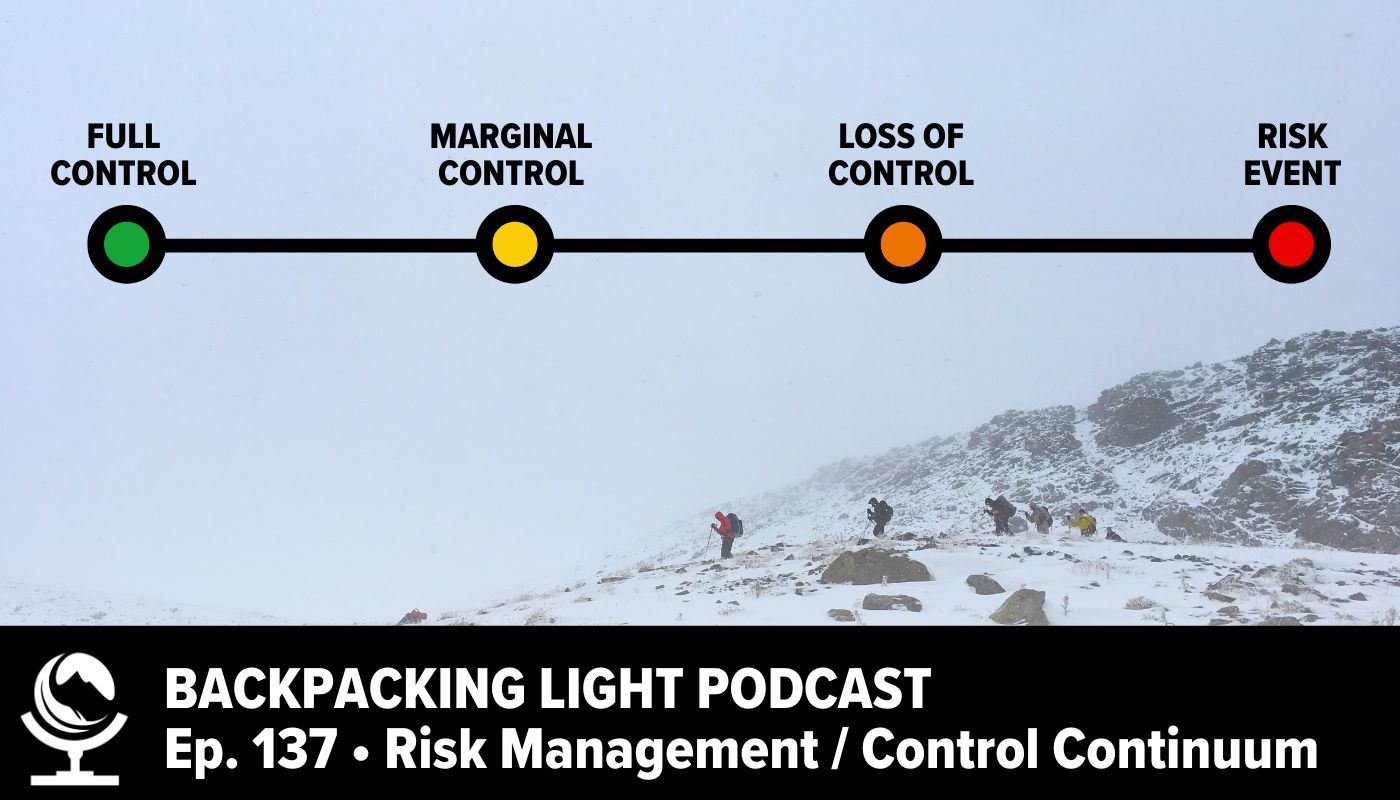
In this episode, we introduce the Risk Control Continuum - a practical, evidence-based framework for managing risk in the backcountry. We explore how environmental, psychosocial, and operational hazards trigger physiological, functional, and cognitive drift, leading to cascades of failure. Listeners learn the HEAT and ECG checklists for detecting and reversing control loss, and how structured decision gates and route planning maintain safety, awareness, and performance in adverse environments.
Listen Now
together with Arms of Andes
Today’s episode of the Backpacking Light Podcast is sponsored by Arms of Andes. Experience nature sustainably with biodegradable alpaca wool clothing, ethically produced in Peru for high-performance outdoor activities.
Show Notes:
What’s New at Backpacking Light?
- Masterclass: Thriving in the Winter Wilderness: Staying Warm and Happy when Winter Hiking and Camping – November 19, 2025
- Masterclass: Leave No Trace and Ultralight Backpacking: Revisiting Best Practices Based on Advances in Recreation Ecology Science – November 24, 2025 – If you are a member or employee of a nonprofit organization that promotes trail advocacy or public lands conservation, or an employee of a government land management agency, please contact us to receive a free ticket and access to this event.
- Masterclass: Fringe Season Backpacking – New in the Archives!
- Find information about all of our upcoming Member Q&A’s, Webinars, Live Courses, other live events, and more on our Events Calendar Page.
Featured Brands and Products

The Arms of Andes 160 Ultralight Alpaca‑Wool Crew‑Neck Base Layer T‑Shirt is made from 160 g/m² of 100% royal alpaca wool, features a PFAS‑free finish, short‑sleeve crew design, natural odor resistance, moisture‑wicking and temperature‑regulating properties, and is crafted in Peru with no synthetic fibers.

A lightweight line of 100% alpaca-wool apparel built for comfort and versatility, ideal for layering or warm-weather excursions. The collection features minimalist everyday essentials, T-shirts, hoodies, and tank tops designed to wick moisture, regulate temperature, and resist odors naturally.

Arms of Andes offers lightweight, breathable merino wool sun hoodies designed for hiking and travel. They provide UV protection, moisture wicking, and natural odor resistance for comfortable performance in any climate.
The Risk Control Continuum
- Risk in the backcountry is an evolving process, not a single event – control stability changes constantly.
- The Control Continuum describes four stages of stability: stable → marginal → eroding → lost control.
- Two key terms: drift (early, subtle loss of control – cheap to fix) and cascade (compounding losses – expensive to fix).
- Hazard triggers load the system and initiate drift; they fall into three categories: environmental, psychosocial, and operational.
- All hazard triggers increase task time, cognitive load, and stress – if ignored, drift becomes a cascade.
- Control is expressed through three integrated layers: physiological, functional, and cognitive.
- Physiological control involves fatigue, temperature regulation, hydration, and nutrition – small slips here can impair focus and memory.
- Functional control governs physical execution – dexterity, balance, coordination, and metabolic efficiency decline as physiology degrades.
- Cognitive control shapes awareness, judgment, and decision quality; stress chemistry can temporarily suppress rational thought (Arnsten, 2009).
- Use the HEAT checklist (Hands, Energy, Awareness, Thermometer) for rapid self-assessment to detect drift early.
- Apply the ECG checklist (Escape, Charge, Gate) to act quickly: escape exposure, restore energy balance, and execute decision gates.
- Effective risk management relies on structure, not toughness – monitor continuously, honor your gates, protect transitions, and make decisions early while they’re still cheap.
Links, Mentions, and Related Content
- Dispatch: Risk Management for Fringe-Season Backpacking
- Podcast: Episode 136 | Fringe Season Layering
- Research: Arnsten, A. F. T. (2009). Stress signalling pathways that impair prefrontal cortex structure and function. Nature Reviews Neuroscience, 10(6), 410–422.


Discussion
Become a member to post in the forums.
Companion forum thread to: Episode 137 | The Risk Control Continuum
Learn how to manage backcountry risk using the Risk Control Continuum framework: use hazard triggers, control layers, and field tools like the HEAT and ECG checklists to detect drift, make better decisions, and stay safe in the backcountry.
Share your experiences where an emergency or incident in the backcountry was traced back to a cascading series of events.
Become a member to post in the forums.