

Episode 136 | Fringe Season Layering
Episode Summary
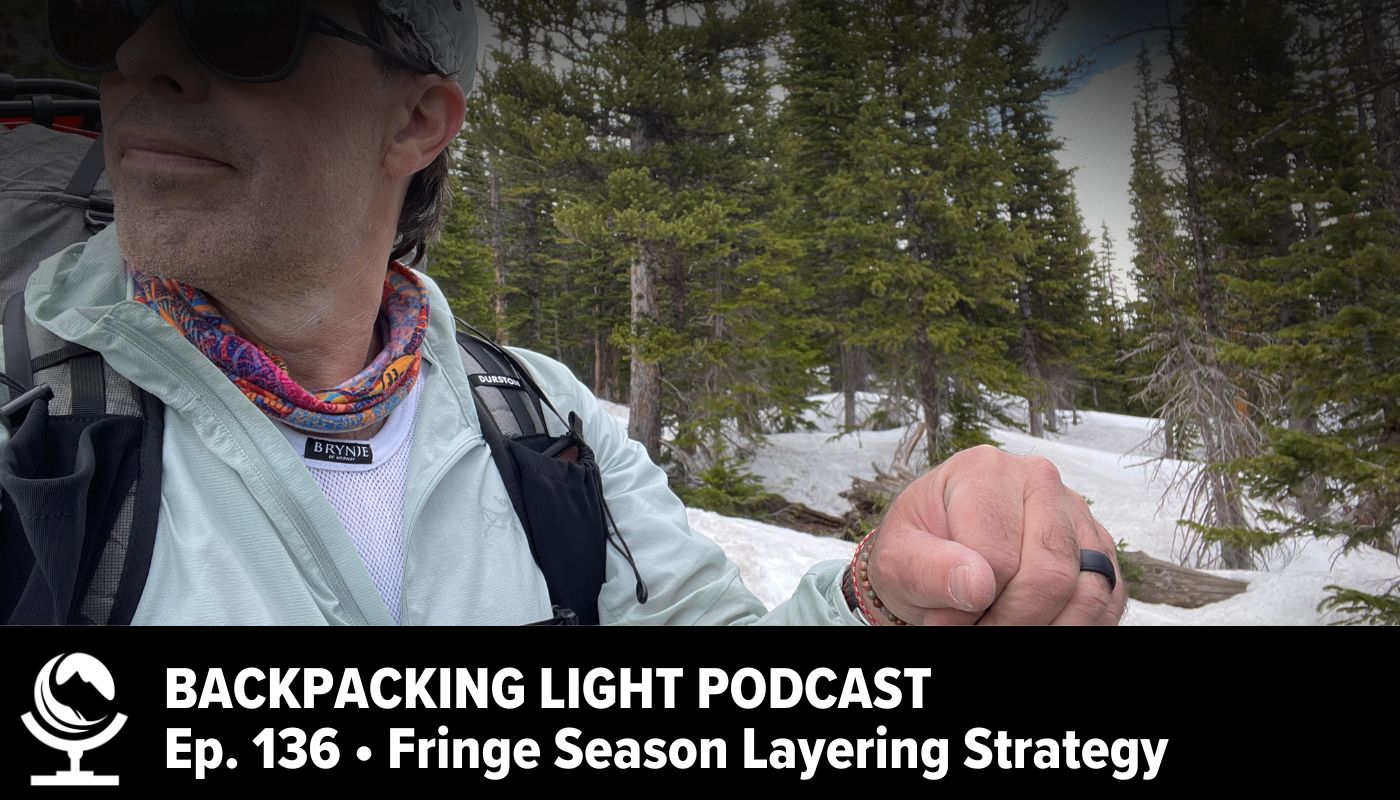
What is the difference in layering strategy from summertime to the fall-winter transition? In this episode, Ryan Jordan discusses how the environment of the fringe season (colder temperatures and stormier weather) demands different types of layers and a different approach to layering.
Listen Now
together with Brynje USA

Today’s episode of the Backpacking Light Podcast is sponsored by Brynje, home to the most sophisticated and effective baselayers available - modern fishnet fabrics made with polypropylene or merino wool.
Show Notes:
What’s New at Backpacking Light?
- New Masterclass: Fringe Season Backpacking Masterclass
- Find information about all of our upcoming Member Q&A’s, Webinars, Live Courses, other live events, and more on our Events Calendar Page.
Featured Brands and Products
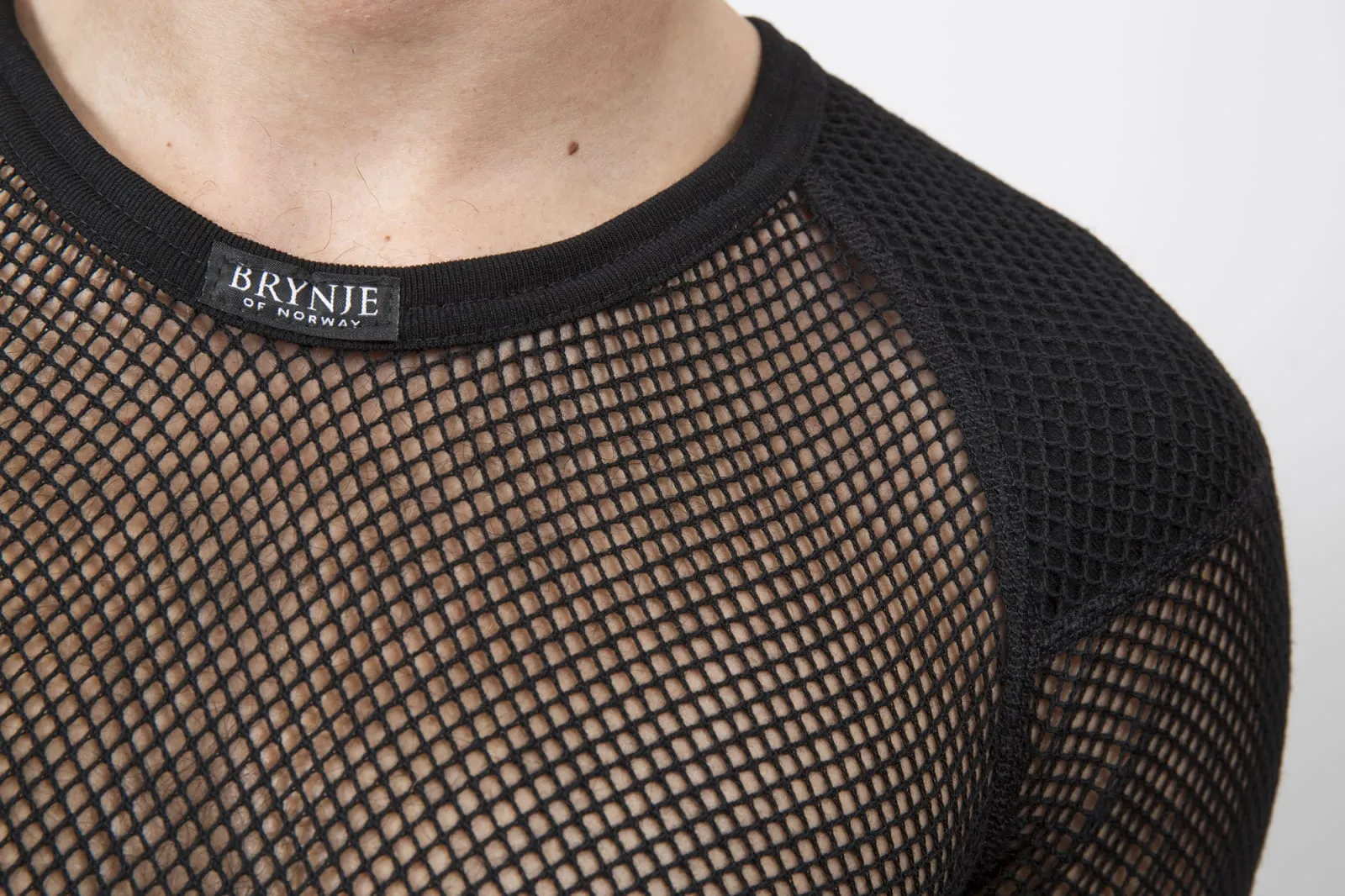
Brynje of Norway makes both synthetic and merino wool fiber fishnet base layer apparel for outdoor adventures. Fishnet construction is more breathable, lighter, and faster-drying than conventional knits.
Fringe Season Layering
- Summer layering prioritizes evaporative cooling, sun protection, and minimal weight since most garments are carried rather than worn.
- As temperatures drop in the fringe season, continuous wear replaces intermittent use, requiring greater durability, vapor control, and thermal balance.
- Evaporation shifts from a cooling benefit to an energy cost, increasing body heat loss in cold and humid conditions.
- Thermoregulation functions as an energy-management system balancing metabolic heat production and environmental heat loss.
- Wicking fabrics redistribute moisture but fail to remove it, increasing evaporative heat loss in cool, damp environments.
- Hydrophobic and open-mesh base layers (e.g., polypropylene fishnet) maintain a drier microclimate by resisting moisture absorption and promoting vapor flow.
- Layering in the fringe season emphasizes tuning airflow, vapor transport, and insulation rather than simply adding warmth.
- Wind shirts, active insulation, and shell combinations provide fine control over convective and evaporative heat loss.
- Effective thermoregulation depends on timely adjustments — venting before sweating and insulating before cooling.
- Success in fringe-season layering is measured by energy efficiency and temperature stability, not by the lowest pack weight.
Links, Mentions, and Related Content
- Wilderness Skills: Risk Management for Fringe-Season Backpacking
- Wilderness Skills: The Dirt Catwalk: Modern Layering Ensembles for Backpackers
- Masterclass: Winter Backpacking: Strategies for Staying Warm, Dry, and Comfortable


Discussion
Become a member to post in the forums.
Companion forum thread to: Episode 136 | Fringe Season Layering
Debunk wicking myths, optimize thermoregulation with hydrophobic base layers & utilize shell layers effectively to help with fringe season layering in the backcountry.
What changes do you make to your layering system between “summer” (warm days and nights above freezing) and the “fringe” season (cooler days but still above freezing, nights below freezing)?
1) As mentioned, I choose heavier shells in cooler weather. Lack of pockets on UL shells are less convenient, and heavier fabrics can sometimes breathe better (and usually resist weather better). (Also I’m not a fan of “trim fit” in shells, ever).
In cooler weather, I count the extra few ounces as “insulation”.
2) I’m more likely to wear SealSkinz socks and/or WPB boots in cooler weather. The boots are clearly a weight tradeoff, but they resist rain and snow better than anything I’ve found for warm weather. I mostly just get my feet wet in warmer weather, or use UL MYOG waders for muddy swamp crossings.
3) I use a pair of long buffs as “legs” for my shorts in shoulder seasons. KamSnaps or a shock cord to keep them up.
(Kuhl changed the Renegades this year, so the REI Saharas are the only convertibles that I am aware of with a vertical zipper for easier on/off.)
4) When the weather is consistently below about 45F (7C), I switch from an OR Echo to last-year’s MH Airmesh (83? gsm) as my base layer shirt. I may add a Brynje underneath the Airmesh, although I consider it optional.
(There’s a gap in the market this year: the new Airmesh is heavier, and I don’t see anything else as perfect as the old Airmesh Half-Zip for a shirt. ZPacks is the closest, but the hood and kangaroo pocket make it less ideal as a shirt. Still, it’s the only half-zip I see in that excellent fabric.)
Otherwise, it’s all the same: Layers.
A topic near and dear to my heart.
I don’t like to slow down except for breaks so my layering is optimized to reduce water retention and maximize breathability with warmth. Wind shirts and alpha/octa are used more sparingly. Here’s my system after a lot of trial and error.
It’s fairly generic in application, a hotter or colder traveler would have to adjust the temperate ranges accordingly.
It’s critical to bring another breathable fleece for stops. Puffs are near VBLs so I avoid them since I’m still dumping a lot of sweat when I stop regardless of temperature. I have 4 weights of Decathlon fleece and bring the right one for the temps.
An interesting finding as I dialed this in was that as your core gets colder, you’ll notice it in the hands far before you notice it in your core.
Competing factors are at play: reducing water retention over the core layers by reducing insulation there makes your hands cold first, so I wear silk glove liners ~ 5C, switch to fleece liners and wristies at ~ 0C, swap those below ~ -5C for wool glomitts with a long gauntlet then add fleece liners as temps go down, weight depending on temp. I think I have 6 different liner weights: I got obsessive after I came home from a 25km -20C snowshoe day and couldn’t work my hands.
I add nitril VBL hand liners < ~ -10C so no water vapour at all gets in the glove system. This lets me push the core system to colder temps further reducing sweat build up in the layers and makes a big difference in overall layering system performance.
In the summer I am always prepared for temps down to freezing.
If it might go below freezing, I’ll add a down vest. And fleece fingerless mittens, balaclava, neck insulation
If it’s going to rain a lot I’ll switch from my lightweight RSBTR WPB rain jacket with a neoshell version
Great episode! Always nice to have your choices validated, although I mostly listen to garner new options. I’ll keep it short. I recently completed a SOBO thru hike of the AT. My layering system consisted of a Brynje Super Thermo short sleeve shirt, Senchi alpha 60 and Patagonia Houdini. Rain was managed with a Zpacks poncho and occasionally a Montbell Versalite. This system excelled in all sorts of weather from July in Maine through late November in the southern Appalachians. Anytime the wind kicked up, and the Brynje/Senchi combo was failing, the addition of the Patagonia wind shirt (occasionally with removal of the Senchi) handled things well. Towards the end, I added a down puffy for camp use, but never needed it on trail even with temps in the 30s.
Become a member to post in the forums.