

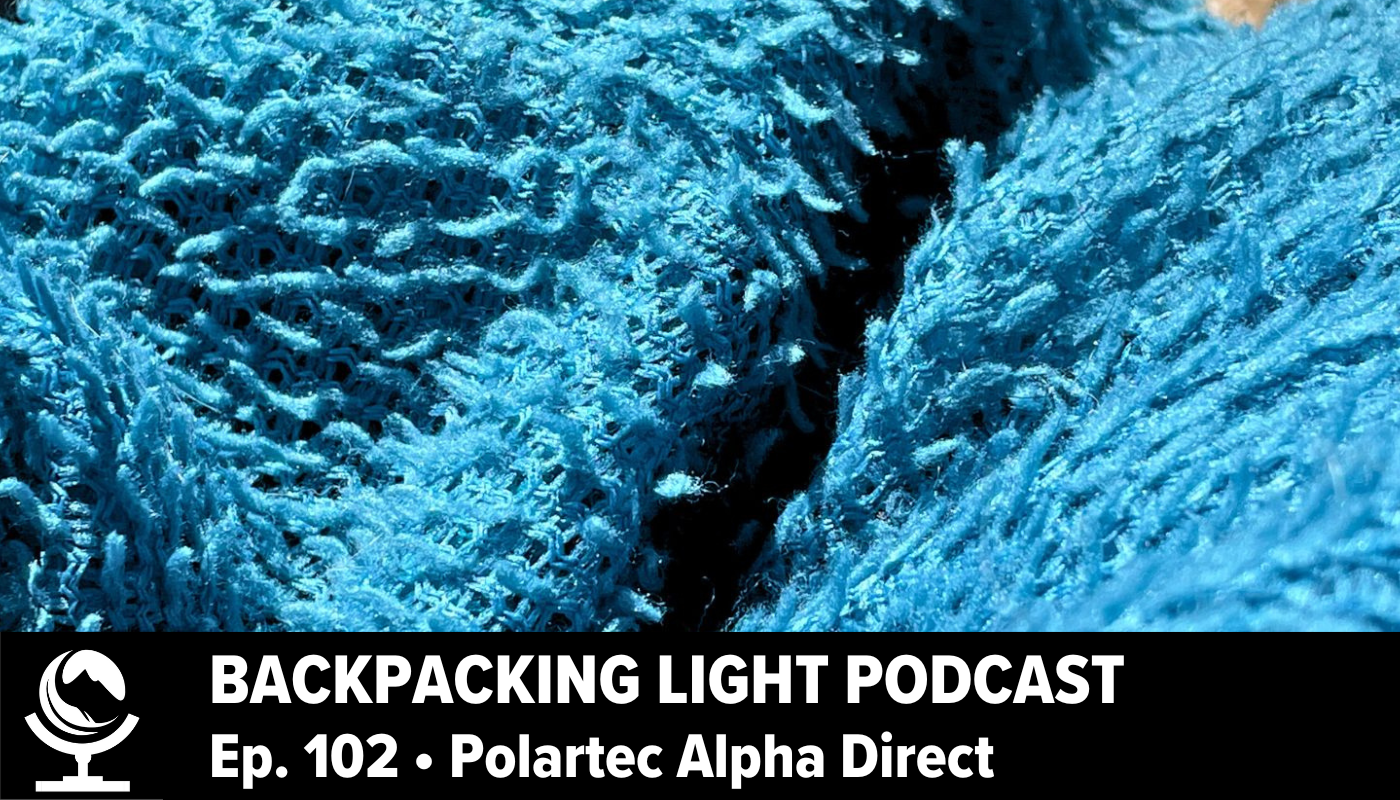
Episode 102 | Polartec Alpha Direct
Episode Sponsor

Today’s episode of the Backpacking Light Podcast is sponsored by Garage Grown Gear, your hub for all things ultralight. Garage Grown Gear is dedicated to supporting the growth of small, startup, and cottage brands. Today, we are featuring innovative products from those brands made with Polartec Alpha Direct, the lightest, most breathable, and most air-permeable fleece insulation available.

Discover the comprehensive selection of Polartec Alpha Direct hoodies, shirts, pants, socks, hats, and more from small, startup, and cottage brands.
Listen
Summary
In today’s episode of the Backpacking Light podcast you’re going to learn about the origin, evolution, and use of Polartec Alpha Direct in modern ultralight layering systems.
In this Episode:
Featured Brands and Products
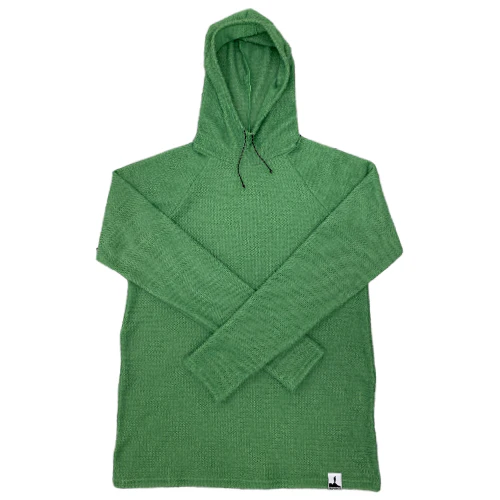
Polartec Alpha Direct fleece hooded midlayer with fitted hood and paracord drawcord, constructed from open-knit synthetic fleece in 60, 90, and combination fabric weights, with manufacturer-listed medium weights from 3.8 to 5.3 oz (108–150 g) depending on selected fabric configuration.

Note: Alpha Direct is commonly available in 60 gsm (grams per square meter), 90 gsm, and 120 gsm weights. Lighter weights are suitable for 3-season active insulating layers for hiking in cool conditions, or as pajama layers. Heavier weights are best used for inactive insulation (e.g., in camp) or during the winter. Alpha Direct is used in torso and pant layers, caps, and socks. Because of durability limitations, Alpha Direct socks should be relegated for sleeping and in-camp use only.
Discover the comprehensive selection of Polartec Alpha Direct hoodies, shirts, pants, socks, hats, and more from small, startup, and cottage brands.
Main Topic: Polartec Alpha Direct
- US Military’s PCU (protective combat uniform) and how it relates to outdoor clothing layering systems – lightweight undergarments, midweight undergarment, fleece, wind jacket, soft shell jacket and pants, wet weather jacket and pants, extreme cold weather parka and pants
- Comparing Polartec Alpha fabric (required to be stitched to unbreathable shell fabrics) with Polartec Alpha Direct (does not require to be stitched to unbreathable shell fabrics)
- The Polartec Alpha Direct as a multifunctional layering piece – as a warm insulated outer layer, as a base layer, as a warm insulated layer within a storm system, insulated layer within a breathable windshirt system
Links, Mentions, and Related Content
- Wilderness Skills: The Dirt Catwalk: Modern Layering Ensembles for Backpackers
- Gear Testing & Research: By The Numbers: Rethinking Fleece
Submit a Tip, Trick, or Question
Share your tips, tricks, and questions on the podcast – submit it via email to podcast@backpackinglight.com.
Go Deeper with Backpacking Light
- Sign up for the Newsletter.
- Become a Backpacking Light Member.
- Follow us elsewhere on the web: YouTube | Instagram | Facebook
How to Subscribe
Apple Podcasts | Spotify | RSS
More Episodes
Backpacking Light Podcast Index
Credits
Executive Producer - Backpacking Light; Show Director and Host - Ryan Jordan; Producer - Chase Jordan; Theme music: Look for Me in the Mountains written by Chris Cunningham and Ryan Jordan, performed by Chris Cunningham (acoustic guitar, lead and harmony vocals, harmonica), Chad Langford (upright bass), and Tom Murphy (mandolin), produced by Basecamp Studios in Bozeman, Montana.
Feedback / Tips / Questions
podcast@backpackinglight.com
More Backpacking Light
Sign up for the Newsletter. Become a Backpacking Light Member.
Disclosure
Sponsorship Policy: Backpacking Light does not accept compensation or donated/discounted products in exchange for product mentions or placements in editorial coverage, including any podcast episode content not excplicitly identified as sponsored content. Some (but not all) of the links in these show notes may be affiliate links. Learn more about affiliate commissions, influencer marketing, and our consumer advocacy work by reading our article Stop wasting money on gear.


Discussion
Become a member to post in the forums.
Companion forum thread to: Episode 102 | Polartec Alpha Direct
In episode 102 of the Backpacking Light podcast you’re going to learn about the origin, evolution, and use of Polartec Alpha Direct in modern ultralight layering systems.
I didn’t get to mention this in the podcast, but this winter I did experiment with a Mark Twight-style layering system with Alpha Direct in windy, cold weather:
I liked it, it was comfortable and nimble. I just started to try this towards the end of winter, but was curious to know if others had any experience with this type of system (fleece between the wind shirt and rain shell layer) using AD.
I wear my windshirt under my fleece layer on some occasions.
It adds another dimension to layering (cooler than Windshirt over fleece) And also enables the fleece layer to slide over the windshirt and give more freedom of movement. The latter is definitely welcome when wearing a waterproof layer as well as it can feel less restrictive when scrambling in more technical terrain.
It’s funny though because I’ll sometimes get companions saying “what are you doing? That’s pointless, you’re wearing it the wrong way around!”. You can lead a horse to water …
Edit.
I use a Polartec Alpha 90 hoody for all my backpacking for the last few years. It’s open and often windy in the UK. Just the Alpha fleece and a windshirt is quite a comfortable combination in a lot of instances.
Also, another instance of versatile layering, is wearing my baselayer (Rab Pulse Tee usually) over my Alpha hoody rather than under it.
It pays to experiment and be flexible.
I wear a base layer over the alpha. (Brynje) I’ll sometimes wear a very breathable R3 over that. While it doesn’t totally block wind, I believe by combining the different fabrics, there is no direct path. The wind doesn’t bounce off my skin, taking my heat. IDK. I do find it very comfortable under certain conditions. If it’s too windy, I might wear a tech face R1 instead. It all sheds water to some degree. Next or instead, I may wear a very light Pertex Shield shell (Luke’s), or perhaps a DAS (pertex shield) hoody.
As Mole said, “it pays to experiment and be flexible”. What I actually carry depends on the weather reports.
Alpha-direct works at about half the weight for cold-sunny to cold-rainy conditions for a small trade off (90gsm) in durability. Also for brief camp stops.
Still I layer a windshell over the alpha garment as the latter is more susceptible to get snagged, etc..
Yeah I’m the horse who doesn’t drink that water. Or maybe the mule…a windshirt over fleece or an R1 or whatever layers you have blocks wind–hence, the name–and provides protection from moisture. Meanwhile, the inner layer(s) is maintaining warmth and expelling moisture that the windshirt ideally allows to wick away. wind carries off warmth. cold wind carries off even more warmth. I wear a layer to retain warmth. Synthetics are pervious to wind. A windshirt blocks wind. How is this backwards?
Synthetics are pervious to wind. A windshirt blocks wind.
But my windshirt is synthetic.
Cheers
…I find fleece to allow wind and make me cold. A rain shell or a Houdini–a windshirt–blocks wind.
[edited – MK]
Acknowledging I did a little editing above to keep things on track.
Also, I’m a little bit confused about layering a windshirt under fleece too. Generally speaking, my understanding of AD is that it is a very breathable fleece which gives the user the ability to enjoy that breathability or to limit it with another garment over the top.
RJ suggests, essentially, that one could layer under and over an AD layer. I suppose that makes sense to me. It’s almost like making a jacket with a breathable but wind resistant inner, AD insulation in the middle, and a WPB exterior. Now that I have typed that out, I don’t have trouble accepting that this would be warmer than the fishnet baselayer + AD + WPB shell.
I can accept that if one was going to wear all four layers that the layering order can matter: fishnet + windshirt + AD + WPB sounds warmer than fishnet + AD + windshirt + WPB. In the latter version the outermost two layers seem redundant.
One of the main attractions of Alpha Direct over the original Alpha is the fact it can go “directly” against the skin (or thin base layer) without the need for an inner shell. Might as well just buy the much cheaper Alpha if you’re going to place a breathable nylon/poly layer underneath. Simplicity is a big appeal to Alpha Direct and making things complex with 4 layers seems to negate any small (possible) thermal gains. Kind of like an overengineered machine with way more unnecessary components than are needed. https://discoveryfabrics.com/products/polartec-alpha-insulation?variant=39934359994453
Yes agreed it seems to work well directly against skin.
I don’t think this is Ryan’s intention but it is certainly plausible that I would have all four of these layers present and that I would get cold and start putting everything on at once. Before I read this I would have probably gone base layer then AD then windshirt then rain shell. I don’t think the windshirt does much directly under the shell. Somehow I can see Ryan’s layering doing something more than that.
My recollection of Mark Twight’s original suggestion is a little fuzzy. Wasn’t he talking about fleece in general (rather than Alpha Direct)? I also seem to recall that he was discussing a quick-change use case.
Something like base+windshirt (which is my most-used combo), then add fleece if cold, then add hard shell if still cold. In that case, it makes sense — there is no reason to de-layer while working; just add layers to the system. It’s quicker (and warmer) than taking off the windshirt to add fleece, then putting the windshirt back on. Also, it allows the fleece to dump a little heat, which can be useful in some conditions. That works especially well with grid fleece which has less air permeability than Alpha Direct.
I specifically did not get the idea that he was recommending it as a normal way to use fleece. It was more of a special-case thing for rapid change with minimal interruption, IIRC.
Did I get any of that right? ;)
As Monte points out, I use AD next to skin or, in very cold weather, over Airmesh (optionally over Brynje). I wouldn’t bother to wear AD over a windshirt, and my AD fits snugger than my windshirt anyway. Grid fleece is a different matter — that could easily go over a windshirt, or even replace a windshirt, while active in cooler temperatures.
Or AD, windshirt, mesh, WPB.
Our solution (Sue and me) is a light fleece, a windshirt to block the wind and walk fast. Works fine even in the snow. But when we stop, THEN the down jacket goes on. Quite fast sometimes.
Cheers
Often my wind protection is my WPB. Then the idea of stripping down to my base layer to rearrange my clothing when I could simply put on a jacket isn’t that appealing. While the afore mentioned system may be more versatile in a variety of conditions, it seems rather unnecessary for singular conditions.
To Monte’s last point, and maybe more so Roger’s, what about carrying/wearing less overall layers and accepting a fractional amount of discomfort on either end of a shift in conditions? So long as you have the safety angle covered with protection from rain and cold (per Roger), there is value, and maybe skill, in knowing you’ll be OK with these more subtle changes in temperature. The body is pretty adaptable in this way.
I get this is an annoying position. I think about these layers every trip also.
Here’s frost build up inside my breathable-back but wind block front nordic skiing top shell after a long -25C day hike
I’ve also tried a newer Houdini @-30C as a top shell.
Showing this to illustrate that for me, a WPB shell just doesn’t breathe well enough for me at any temperature, it traps too much humidity from sweat.
Now, a Dooy is perfect. But at stops, I still need to throw on a fleece and if the wind is whipping, over layer the Houdini.
I’m allergic to down but still don’t use my synth puffy even at stops. I find fleece+Dooy+Houdini far more flexible and still the same or less weight. No puffy shell fabric is as breathable as a Dooy
So long as you have the safety angle covered with protection from rain and cold
This is where experience comes in, when you know your limits.
There have been a few times when we have both been shaking with the cold but not too fussed because we knew that we could be inside the tent very soon, out of the wind, and getting changed. Yes, that was pushing the envelop a bit, but we knew we could manage.
Although there was one time when Sue couldn’t get her wet clothing off: it was too sticky and she hadn’t the strength! That was soon fixed when I got into the tent.
Hum – maybe going solo means you have to be a bit more conservative? Could be wise.
Cheers
BTW, the audio quality on this podcast is great. I’ve had trouble hearing past podcast using my iPhone (I have a hearing loss) but the audio on this one was loud and clear enough to easily hear what was being said while I’m doing other things. Good job Chase!
Good point, Roger.
Yeah excellent point about being a little more conservative when going solo.
Jack Stephenson argued that a vapor barrier raises the skin humidity and lessens insensible perspiration. In my experience something akin to that does occur. If so, that first windshell barrier near the skin may work to lessen insensible perspiration, thereby lessening moisture buildup in outer layers in colder weather. Think puffy clothing, ready to go limp when warmed; wool, ready to be wet; and me surprised when I thought I was buying a cup of coffee at a ski area on day 4 of a winter trip above 6000′ in Montana intending to drive to a different trailhead to continue. I was not wearing a near-skin wind shirt on that trip.
Having hard time to understand if these podcasts are just adds or something useful
Ads that support small businesses while informing the consumer. I buy outdoor gear. I find them useful.
Become a member to post in the forums.