


Introduction
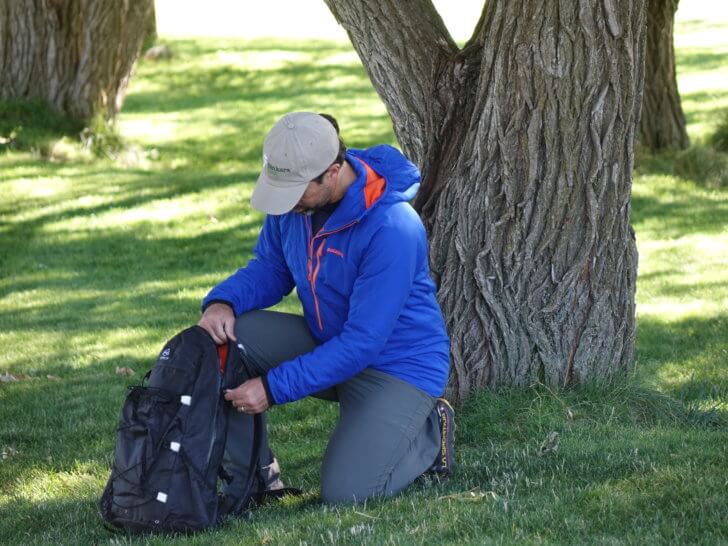
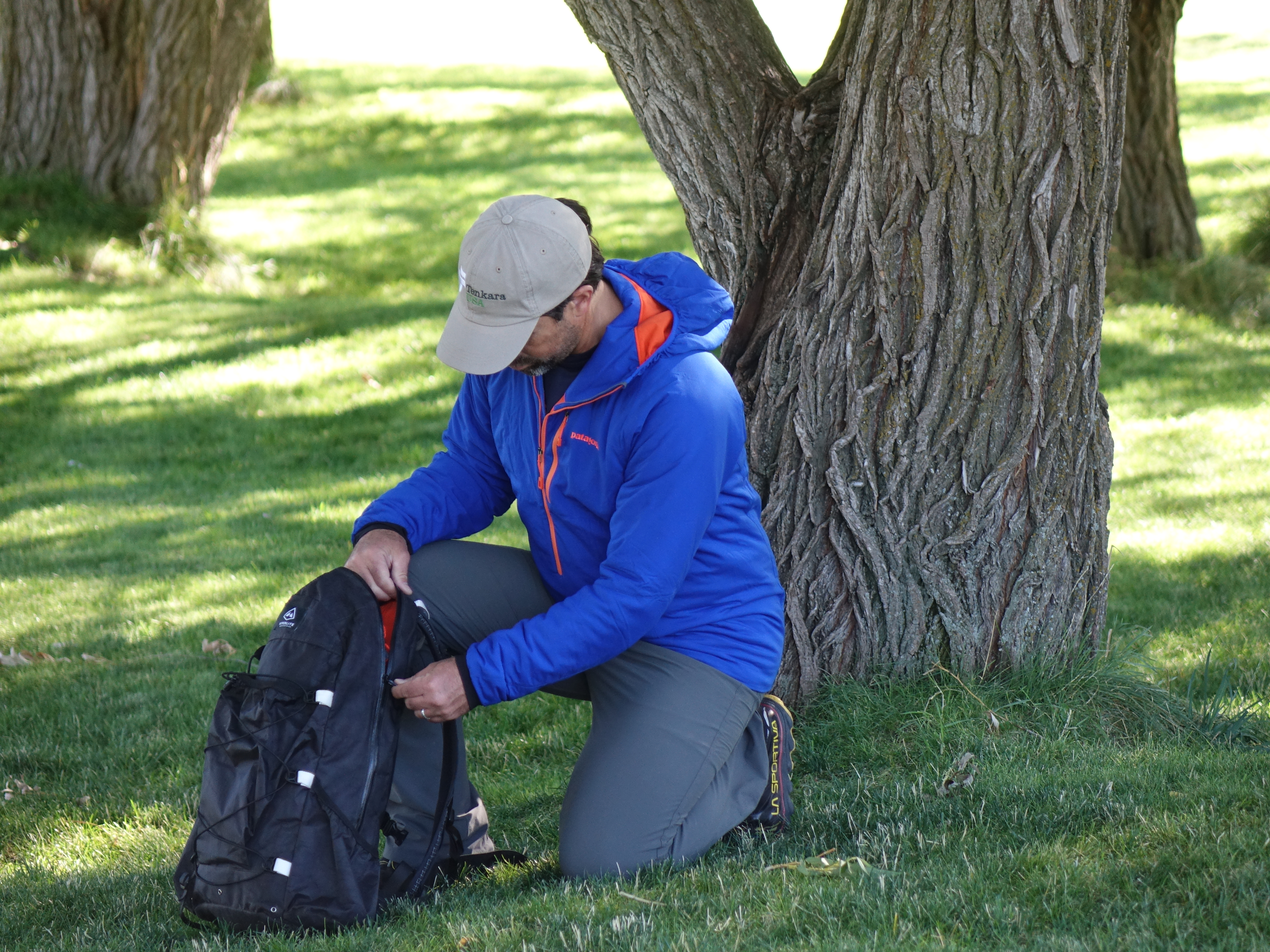
This Patagonia Nano Air Light Hoody Review takes a first look at a new product: a lighter iteration in the increasingly popular apparel category of “active insulation”.
These garments are insulated (usually with a synthetic fill). Instead of the insulation being sandwiched between layers of tightly woven (and often calendared) fabrics that enhance water resistance (but limit breathability), active insulation garments are shelled and lined with soft, stretchy woven fabrics that have very high levels of air permeability.
The Patagonia Nano Air Light Hoody is currently among the lightest of these garments, owing to its light insulation, light fabrics, and simple design – a pullover style with partial front zip, hood, one pocket, and no cuff or hem adjustments.
Applications
- Stop-and-go hiking at low-to-moderate levels of exertion in cold temperatures (e.g., fall/winter);
- Warm-up layer for hiking in the early mornings or when the temperatures dip for evening trekking;
- Light insulation layer under a shell for inactivity in typical two-to-three season conditions.
Features
- Slim, athletic fit;
- Minimal seams;
- Stretch fabric at wrist cuffs for snug but comfortable fit;
- Stretchy hood design can be pulled on or off without unzipping;
- Deep front zipper for ventilation;
- Single zippered chest pocket (exterior, left side);
- Hood fit for a normal head, not a helmet-clad head.
Specifications
- Shell: 1.6 oz/yd2 100% ripstop stretch nylon (30 denier);
- Lining: 2.0 oz/yd2 100% plain weave stretch nylon (50 denier);
- Cuffs: 4.7 oz/yd2 88% polyester/12% spandex stretch-woven;
- Insulation: 40 g/m2 synthetic fill with mechanical stretch;
- Air permeability: 70 ft3/min;
- Front zipper length: 18 in. (size M);
- Claimed Weight: 10.9 oz (manufacturer’s spec for size M);
- Measured Weight: 10.2 oz (size M)
Patagonia Nano Air Light Hoody Review: Commentary
I’ve experimented with several other “active insulation” pieces in the 13 to 17 oz weight range from Patagonia, Arc’Teryx, and Stio. I find them too warm to hike in for most backpacking conditions, even in the winter. But with the introduction of the Patagonia Nano Air Light Hoody, so-called “active insulation” tops are now in a similar weight class as hooded 50-100 weight fleece and ultralight, sewn-through-baffled down tops.
This may complicate gear selection for some, but those who spend a fair bit of time wearing a lightly insulated garment while trekking in cool and cold conditions should start paying attention to this category.
With a warmth-to-weight ratio higher than fleece, water-resistance that is markedly better than down, and a next-to-skin feel that is better than both, the Patagonia Nano Air Light Hoody could very well become a useful component in a lightweight backpacking clothing layering system.
This video captures my thoughts on the role of a lightweight active insulation piece in a backpacker’s clothing system:
While I think the Patagonia Nano Air Light Hoody would be a suitable primary insulation layer in summer conditions, I think its real strength is revealed as one of two insulating components for colder and/or inclement conditions trekking. One insulating layer would be optimized as an active layer while moving (i.e., the Patagonia Nano Air Light Hoody), and the other layer would be optimized for a maximum warmth-to-weight ratio (i.e., a high-fill down jacket). I plan to incorporate the Patagonia Nano Air Light Hoody into a four-piece torso layering system (where the Patagonia Nano-Air Hoody would effectively replace a 4 oz wind shirt) this fall as follows:
- Base Layer: Patagonia Merino 2 wool long sleeve crew (6.0 oz)
- Cold Weather Trekking Layer: Patagonia Nano Air Light Hoody (10.2 oz)
- Rain Jacket: Montane Minimus 777 Pullover (4.6 oz)
- Camp Insulation: Western Mountaineering Flight Down Vest (5 oz).
Of course, I think there is potential to incorporate an active insulation piece like the Patagonia Nano Air Light Hoody into a variety of different layering systems, and I’m looking forward to experimenting with it throughout the winter.
Strengths
- Lack of seams (creates a simple aesthetic, fewer failure points, and less binding, since seams don’t stretch);
- Mechanical stretch (allows for a slimmer design, less weight, and more comfort during active movement);
- Very lightweight considering its insulative value and wet weather resistance;
- Very high air permeability means that it can be used under a wider range of exertion levels, including cool-weather hiking, than synthetic or down insulating garments shelled and lined with tightly-woven nylon fabrics.
- Provides “insulated wind shirt” performance, similar to a wind shirt + fleece (e.g., “Pertex-and-Pile”) system, but with higher air permeability (system breathability).
Limitations
- High air permeability means that it must be coupled with a tightly woven shell garment (e.g., wind shirt or rain jacket) for extreme cold and wind.
- Slim fit may require upsizing for those with “bolder” (!) body types.
- Synthetic insulation not as durable over the long term as an similar wind shirt + fleece system.
Learn More
 More Info: More information about the Patagonia Nano Air Light Hoody is currently available at the Patagonia website. Also, stay tuned for a more in-depth review here at Backpacking Light.
Buy Online: Click this link to visit Patagonia.com to learn more or buy this product: Patagonia Men’s Nano Air Light Hoody.
Similar To: If you are looking for the slightly heavier full-zip version of this jacket, try the highly-rated Patagonia Nano Air Hoody, available from REI.com or Patagonia.com. This version would be more suitable for colder winter conditions, as a primary insulation piece for three-season conditions in the mountains, or for hikers who run colder and have a more difficult time staying warm.
Disclosure: The manufacturer provided a sample of this product to the author with no agreement, requirement, or obligation for media coverage of any kind. Thinking about buying this gear? You can support Backpacking Light in the process: if you click on the link to this product and make a purchase at the retailer website, the retailer will contribute a portion of the sale to help support Backpacking Light. It doesn’t increase your cost, and it helps us maintain our site, fund content development, and grow member services! Thanks!


Discussion
Become a member to post in the forums.
Montbell does not advertise here ?
Ha!
Just got the Nano Air Light and tested it out. IMO, after much comparing over the years, the following combination beats Patagonia and Montbell and pretty much anything else for breathability, comfort, weight to warmth ratio (in addition to being a whole lot more flexible ):
Base layer – Cap 4 (5.4)
Middle – Possum Down sweater (7.9oz)
Outer – Arcteryx Squamish 2014 version 50cfm (5.5) or Arc Incendo Hoody (3.3)
Insulation – Your pick. Mine is Nunatak Skaha vest (6.0 or Goosefeet down vest)
Shell – Your pick – mine is Arcteryx Norvan (6.4 or Arc Norvan SL 4.4)
Nano Air Light is cool, works well and looks good, but I would not replace it with a classic layer system. Wondering about this “review”…
I took a look at the Montbell alternative this week while in Japan, and while I have considerable respect for MB, their UL offering just looked and felt much cheaper (which it literally was at 12,000 yen vs 34,000 yen incl. tax for the Patagonia hoody), but to the point that I didn’t want to buy or wear it. So I went for the nano air light, but not without considerable financial misgivings. Being of ahem “bolder” ahem build than the athletic, I went for the XL, which at 5ft 8″ means the arms are a little long, and it wears more like an anorak (which I like). I chose the black over the blue, not least because it felt slightly thicker. Maybe my imagination. It might get a bit hotter on a sunny day, though. Dear Patagonia in Fukuoka, please become a tax free shop! I resent the extra tax!
Early impressions of the Nano Air Light – I really like it, but with my (elderly) metabolism, I find it can get too hot and at other times too cold; the range of temperatures it accommodates with comfort is (so far) not quite as wide as I’d hoped. That might be more a function of my individual case – aging, not so fit at present, climate here, local terrain etc. Still experimenting with suitable base layer. Early days – will have a much better idea in six month’s time. I’d like the zip to be a little deeper (longer) for even better ventilation when open. The stretchy hood is convenient. I dig its compact size in my pack and light weight.
I note also this is the “Light” version (I also have and love the old regular version); I’m wondering if one day we’ll see an “Ultralight” version – with less insulation value, lighter weight again, etc.
For anyone who actually owns the piece, how are you feeling about the sizing? I’m going to buy one, but I’m just not sure which size to order as I feel I’m either a medium or large. For reference, I’m male, 5’10, 165 pounds with a runners build.
I prefer the hoody not to be skin-tight or “painted on,” however, I obviously don’t want to swim in it either. I know – picky … haha!
I see that it has a trim, alpine fit, but Patagonia has been hit or miss for me in the past. Any help would be great, thanks!
I should note that I intend to use this Nano-Air Light primarily for multi-pitch ice/alpine climbing in the Adirondack high peaks as my ‘main layer’ until my lightweight hardshell is warranted to curb spindrift or high winds. I plan on wearing a Patagonia Lightweight Capilene long-sleeve shirt underneath the Nano-Air Light. At the belay, I will wear my Rab Neutrino Endurance for full wind/temperature regulation.
This will be my first “active insulation” piece and I’m just buying into the theory of using lightweight active insulation in place of my non-membrane softshell, which obviously weighs a lot more than the Nano-Air Light does.
Hope that clarifies my question a bit!
I think it is rather slim fitting, so you should upsize. I have an older (2014?) regular Nano Air that is Large, and I’m pretty sure I could wear it OVER the XL Nanon Air Light. I’m 5ft 8.5 inch height, and weigh too much (93 kg?); the Light fits quite well, except the sleeves are too long (but ok). The length of the garment is just as I like it – slightly on the long side, so good protection. My GUESS is that XL should fit you. Kindly don’t shoot me if I’m wrong. It’s possible the garments shipped to Japan have different fittings, but the size labels were definitely US, not Asian.
Mine fits snug – similar to arcteryx in fit rather than typical patagonia. It feels a bit tight when putting it on and taking it off since you have to wrestle it a bit since its a pull over. However, when on it feels good since the garment has a fair amount of stretch to it. I am 6’3″, 190lbs, and I have a size “L”. nano-air light hoody.
Cor blimey Bill, you must be wearing it like a T-shirt! Isn’t it short?
Here are two photos of size L. The body is a tad short but not too bad. Arms are fine due to the elastic material at the cuff. I have relatively long arms/legs compared to torso.
Thanks guys for the quick responses. Bill, you have me wondering again. Your size large looks like it fits you almost perfectly. I’m not as tall and weigh close to thirty pounds less at 165.
I tried on a Nano-Air Hoody at a gear store in both medium and large. The medium fit, but was a tad tighter than I normally like, but definitely manageable. I swam in the size large Nano-Air Hoody – way too big.
I’m wondering if the Nano-Air Light Hoody fit is close to the regular Nano-Air Hoody? Do any of you guys have the original Nano-Air Hoody for reference?
Thanks!
Sorry Christopher, I’ve never tried on a Nano Air Hoody (non-light version). In normal (non-slim) patagonia garments, I usually get a size L for the right arm length and shoulder width, but the waist/torso is a bit too baggy. I suppose if I were right between sizes I would recommend sizing down the NA light hoody since the material is a bit stretchy. I don’t recall if the normal NA hoody has stretch.
Chris, that was the point of my Oct 24 11:22pm post, the regular nano air sizing seems much larger than the nano air light sizing. My large size nano air hoody c. 2014 is a larger fit than my XL nano air light hoody! (Also I checked XL nano air lights in blue and in black, just to be sure, as I wasn’t expecting to fit an XL, and their sizing was consistent with each other. The large size nano air light hoody I tried on was too short, and a bit too close fitting.) But you should definitely try on the Light for yourself to make sure of the sizing. My opinion is that most jackets and parkas are too short; I don’t like the bomber jacket style for outdoor gear, which should provide better protection of the lower body.
Thanks, Robert. I apologize for the redundancy. Your text threw me along with your 93kg weight listing. When I read Nano-Air then Nano-Air Light in the same paragraph, I must have missed your intentions. I’m concerned about the possibility of an “Asian fit,” but you seem confident the sizing label on your Nano-Air Light is US.
<span style=”font-size: small;”>Chris, I specifically checked with the Fukuoka Patagonia store that it was US sizing, not Asian, and was assured it was. I attach photos of my black XL Light on top of my 2014 grey L Regular Nano Air, purchased in Seoul from DoBongSan Patagonia store (who also confirmed US sizing. I think this model was subsequently updated or superceded).</span>
<span style=”font-size: small;”>The body lengths are about equal, maybe the XL Light is a little longer at the back. The chest width of the L Regular is definitely greater than that of the XL Light. The arm lengths of both are similar.</span>
OOOOOPPPPPSSS !!!
They are both XL. I thought I had better check the label just in case, and quelle horreur…
Sorry to mislead anyone, nominations for my being idiot of the year will be welcomed. Exit stage right…
Robert and Bill, I’m blown away with all your help. Thank you so much for going out of the way to take photos. It didn’t go unnoticed or unappreciated! I think I will go with the large. If it’s too big, then I’ll simply exchange it for the medium.
I’m kind of surprised that no online retailers have this, or any other piece from the “High Alpine Kit” available. Patagonia.com is the only place to buy anything from that line. I wonder if Patagonia is doing this purposefully or they just haven’t caught up with inventory …
Robert, no worries man. I screw up all the time … You’re in good company!
Richard wrote: ‘Montbell (MB) is now selling their “Nano Air Light Hoody – Better Mousetrap” aka the UL Thermawrap Hoody.
The equally-resilient substantially-continuous MB Exceloft has ~twice the clo/oz; the MB is less weight at 9.3 oz. vs 10.2 oz.; the MB has similar high breathability face fabrics; and the MB costs only $165 vs $249.’
Richard, I really respect your experience, reviews and observations. If you could please expand on what makes these two garments comparable? Patagonia is claiming this new 1.6-oz 30-denier is more breathable than the original Nano Air’s 1.3-oz 20-denier shell fabric. I know you thoroughly tested the standard Nano Air so I’m curious about your observations here.
I am a fan of MB but the STRETCH Exceloft and Balistic Airlight sound proprietary and thus hard so to compare. I know you know what all the names align to with the actual material manufacturers as well so that would be great to know. I assume you tested this jacket since you refered to the specific clo value. I would be all over this MB jacket if the breathability is similar. I like the look and it’s lighter even with hand pockets. That is a huge trade off having no hand pockets. Thanks!
Bruce,
See my Nano-Air report https://backpackinglight.com/forums/topic/99527/
To condense this topic to its essence:
Thanks Richard,
I never pictured the Nano Air Light or other active insulation garments as an insulator that can also replace a wind shirt/WPB lightweight shell. I’m trying to gauge if this new generation of lofted active insulation jacket and or vests can provide more warmth and flexibility as temperatures drop. Especially when compared to an R3 Hoody or similar. They are much lighter than the R3 at ~19oz. If you are able to manage heat when hiking a lofted jacket would give you more warmth in camp. At .382 Iclo I’m thinking not. Thanks!
How does the R3 hoody compare with the Nano Air hoody (regular) in terms of clo value?
Paul,
The R3 is 184% the warmth of the Nano Air Hoody if you don’t wear a windshirt over the R3. With a properly sized windshirt over the R3, the difference is 206%.
I had a Nano Air jacket for a very short time and this looks like it resolves many of the issues that ultimately led to me returning it.
Trimmer fit on Nano Air Light is most welcome. The cut on the Nano Air was very boxy on my frame in a large. Was not a fan of how much material pooled around my waist.
The reduction in insulation should result in better and more comfortable layering under something like a Houdini or Ferrosi. The additional importance of this is the Nano Air fabric is very “grabby” so the reduced bulk should mean less bunching under for athletic cut softshell sleeves.
All around, I like what see in the Nano Air Light and will consider it when it comes time for gear replacement.
Anyone compared this to the Outdoor Research Deviator hoody?
Very different animals the Nano-Light and Deviator. I don’t think OR really has a competitor in their arsenal. Maybe the Vindoo hoody which will give you that more sweater like plush feeling. Or the Uberlayer, but that’s more of a competitor to the Nano-Air.
Become a member to post in the forums.