


Introduction
This Patagonia Airshed Pullover Review features a wind shirt made with fabric that is more breathable (i.e., higher air permeability) than traditional wind shirt fabrics. The shirt represents a shift in wind shirt design. It moves away from weather protection (e.g., resistance to light rain or snow). Also, it signifies a move towards maximizing breathability during high levels of exertion.
This review describes the design and feature set of the Patagonia Airshed Pullover. In addition, it compares the garment to a few other wind shirts on the market. It also provides some commentary about how it fits into an ultralight layering system, and summarizes my field experience to date.
Listen to this 3-minute audio Gear Brief for an overview of the Patagonia Airshed that discusses its most important feature: the breathability of the fabric.
Note: In the audio recording, I said that my sample of the Patagonia Airshed Pullover weighs 3.7 oz. This is an error – its actual weight is 3.4 oz (size M).

Features
- 100% nylon ripstop with stretch;
- DWR (durable water repellent) finish;
- Stretch fabric at cuffs and hem;
- Zippered chest pocket converts to stuff sack;
- 1/4-length chest zipper.
Specifications
- Body fabric: 1.3-oz 20-denier 100% nylon mechanical stretch ripstop with a DWR (durable water repellent) finish;
- Hem and cuff panels: 4.2-oz 79% nylon/21% spandex jersey;
- Weight: 3.7 oz (104 g) (as reported by the manufacturer).
Field Use and Review Context
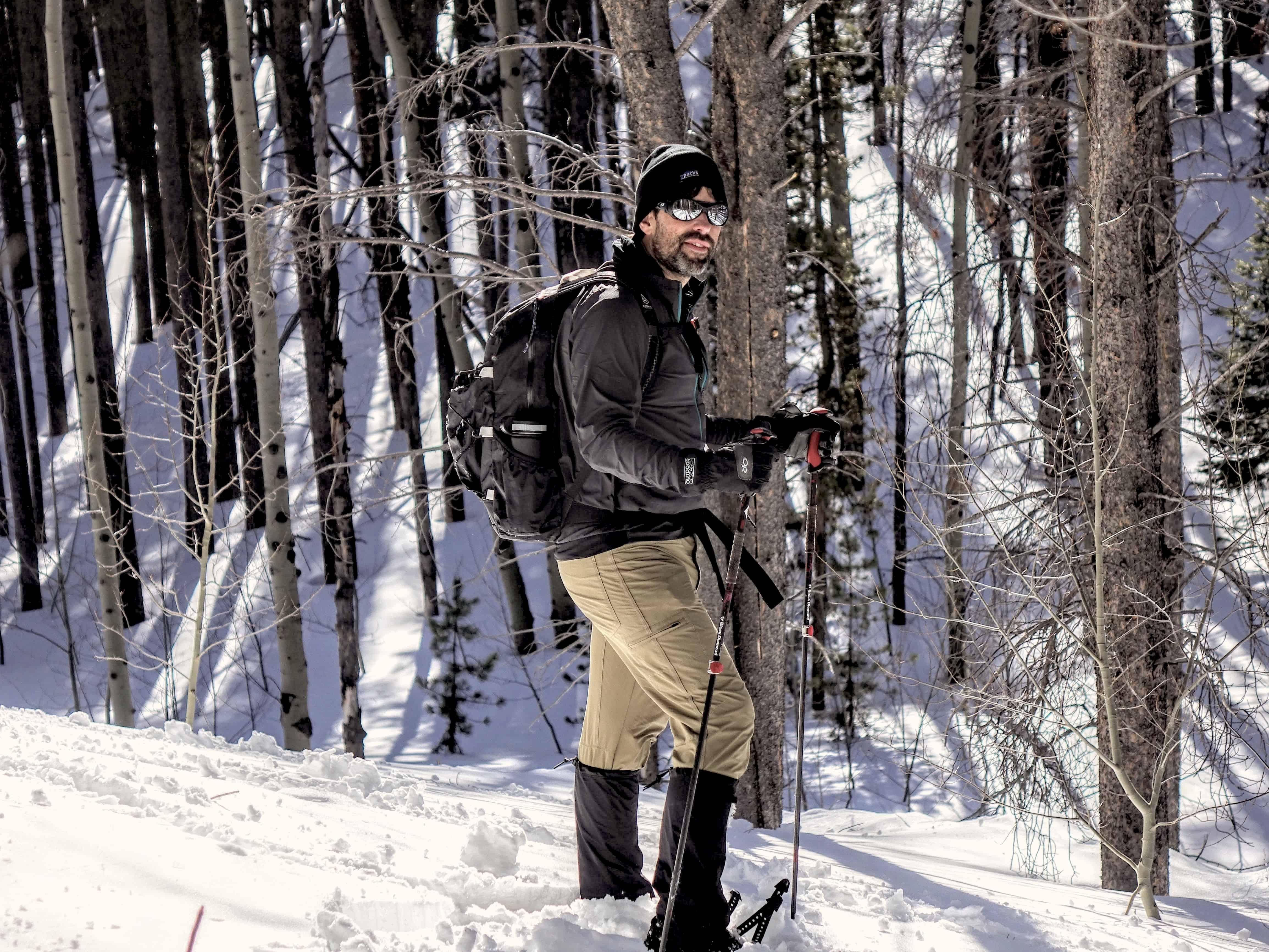
My field use of the Patagonia Airshed Pullover is limited to approximately 30 days of daily wear that includes snowshoeing and hiking in mountains of Southern Wyoming and the Medicine Bow National Forest. I’ve been a faithful wind shirt user for several years and I can’t recall any backpacking trips during the last decade where I haven’t taken and used a wind shirt.
My primary wind shirt of choice for the past three years has been the Patagonia Houdini Jacket (hooded). However, I’ve been experimenting recently with both the Patagonia Airshed Pullover and the ZPacks Ventum Jacket, so the latter two constitute my frames of reference for this review.
That said, without long term experience using the Patagonia Airshed Pullover, I’m unable to comment authoritatively on its durability and fabric wear nuances. In addition, my use has been limited to the dry weather (little to no precipitation), cool temperatures (20 to 45 degrees F), and the reliably breezy winter winds of southern Wyoming. Without long term testing and use in other seasons and environments, this review has thus been classified as a Flash Review (i.e., a gear review meant to introduce the reader to new or otherwise untested gear).

Compared To…
I compared the Patagonia Airshed Pullover to the following:
- Patagonia Houdini Jacket – a full-featured (full-zip, hooded) wind shirt from Patagonia;
- Patagonia Houdini Pullover – a similar (pull-over style) wind shirt from Patagonia, as well;
- ZPacks Ventum Wind Shell Jacket – a full-zip, hooded wind shirt that represents one of the lightest available.

Patagonia Airshed Pullover vs. Patagonia Houdini Jacket
- Fabric
- 1.2 oz, 15 denier nylon fabric comprises the Patagonia Houdini Jacket, while 1.3-oz, 20-denier nylon makes up the Patagonia Airshed Pullover.
- Both fabrics have a similar DWR treatment (C6 DWR finish).
- The higher air permeability of the Airshed’s fabric (50-60 CFM; Source: email exchange between author and C. Simpson, Patagonia Inc.) makes it more breathable. It’s perhaps, less wind- and water-resistant. It has a faster dry time than the fabric of the Houdini (1-2 CFM; Source: ibid).
- There should be little if any noticeable difference in durability between these two fabrics.
- Fit
- When I compared the fit of the Patagonia Airshed Pullover to the Houdini Jacket, I found that the fit of the Airshed Pullover to be slightly more trim.
- The slightly stretchier fabric seemed to accommodate movement in the Airshed as well as in the Houdini Jacket.
- There is no meaningful difference in the center back length of the jackets for the size medium that I compared.
- Features
- The Patagonia Houdini Jacket has a full zipper and a hood. It should offer both better protection from the elements and more flexible ventilation options.
- The Patagonia Houdini Jacket features elasticized fabric cuffs and a drawcord-adjustable hem. The Patagonia Airshed Pullover, however, uses stretch woven fabric panels at the cuff and hem. Neither of which is adjustable.
- Weight
- The Houdini Jacket has a manufacturer-claimed weight of 3.6 oz vs. the Airshed’s claimed weight of 3.7 oz (note: the actual weight of my size M sample of the Airshed is 3.4 oz and the actual weight of my size M Houdini Jacket is 3.6 oz).
Patagonia Airshed Pullover vs. Patagonia Houdini Pullover
- Fabric
- The Patagonia Houdini Pullover and Jacket are made from the same 1.3-oz 20-denier nylon fabric (see comments above).
- Fit
- The Patagonia Houdini Pullover and Jacket have a comparable fit and center back length (see comments above).
- Features
- The Patagonia Houdini Pullover features a kangaroo-style hand pocket. The Patagonia Airshed Pullover, however, features a zippered chest pocket.
- While the Patagonia Houdini Pullover features half-elastic cuffs, the Patagonia Airshed Pullover features stretch-woven fabric cuffs. The Patagonia Houdini Pullover features a snap-up neck opening. On the other hand, the Patagonia Airshed Pullover features a zippered opening.
- The Patagonia Houdini Pullover features half-elastic cuffs, while the Patagonia Airshed Pullover features stretch-woven fabric cuffs.
- It also features an elastic drawcord adjustable hem. The Patagonia Airshed Pullover, however, features stretch-woven panels in the hem and no drawcord.
- Weight
- The Houdini Pullover has a manufacturer-claimed weight of 3.5 oz vs. the Airshed’s claimed weight of 3.7 oz (note: the actual weight of my size M sample of the Airshed is 3.4 oz).

Shown: Patagonia Airshed Pullover vs. ZPacks Ventum Wind Shell Jacket
- Fabric
- The ZPacks Ventum Wind Shell Jacket is made from 0.7 oz ripstop nylon with air permeability in the range of 6-7 CFM (source: email exchange between author and J. Valesko, ZPacks LLC). It is less breathable than the fabric used in the Patagonia Airshed Pullover (50-60 CFM).
- I can easily draw a breath through the Airshed fabric. However, I cannot do so without great difficulty through either the Houdini or Ventum fabric. I don’t notice much difference in the effort required to draw air through the Houdini vs. Ventum. The Ventum is a lighter and thinner material than used on the Airshed. It will likely be less durable in long term use and perhaps in seam strength.
- Both fabrics are DWR-finished. They resist moisture penetration well enough. The long-term durability of the DWR for both fabrics, however, is unknown.
- Fit
- The ZPacks Ventum Wind Shell Jacket has a significantly roomier fit (by at least one full size) and longer back length (by more than 1.5 in/3.8 cm) than the Patagonia Airshed Pullover.
- Features
- The ZPacks Ventum Wind Shell Jacket does not have a pocket, whereas the Patagonia Airshed Pullover features a zippered chest pocket.
- The ZPacks Ventum Wind Shell Jacket has a full zipper and a hood. It should offer both better protection from the elements and more flexible ventilation options.
- While the ZPacks Ventum Wind Shell Jacket features elastic cuffs, the Patagonia Airshed Pullover features stretch-woven fabric cuffs.
- The ZPacks Ventum Wind Shell Jacket features an elastic hem. The Patagonia Airshed Pullover, however, features stretch-woven panels in the hem.
- Weight
- While the ZPacks Ventum Wind Shell Jacket has a manufacturer-claimed weight of 1.9 oz, the Airshed’s claimed weight is 3.7 oz. (Note: My size S sample of the Ventum weighs 1.8 oz, and my size M sample of the Airshed weighs 3.4 oz.)
Comparison Summary Table
This table features horizontal scrolling to view additional columns.
| Fabric Breathability (Air Permeability) | Front Ventilation | Hood | Resistance to Precipitation | Weight | MSRP | |
|---|---|---|---|---|---|---|
| Patagonia Houdini Jacket | Lowest (1-2 CFM) | Full zipper | Yes | Medium | 3.6 oz (102.1 g) | $99 |
| Patagonia Houdini Pullover | Lowest (1-2 CFM) | Partial (snaps) | No | Medium | 3.5 oz (99.2 g) | $89 |
| ZPacks Ventum Wind Shell Jacket | Medium (6-7 CFM) | Full zipper | Yes | Highest | 1.9 oz (53.9 g) | $115 |
| Patagonia Airshed Pullover | Highest (50-60 CFM) | Partial (zipper) | No | Lowest | 3.7 oz (104.9 g) | $119 |
CFM values are reported by each manufacturer.
Commentary
The Patagonia Airshed Pullover is not the first wind shirt to use so-called ultra-breathable “air-permeable” fabrics. The Arc’Teryx Squamish and the Rab Windveil also come to mind. However, the Squamish and Windveil are both full zip hooded jackets that weigh 5-6 oz. The Airshed is a simpler pullover style that weighs 4 oz and may be a better option for those who are on the fence about asking the questions:
- Should I carry a wind shirt?
- Can’t I just use my rain jacket?
Let’s discuss both of these questions in some detail and see where the Patagonia Airshed Pullover fits in.
Should I carry a wind shirt?
A wind shirt offers the following advantages:
- It can be layered over a base/mid layer to provide wind-(and perhaps, intermittent rain/snow) resistance with more comfort (better breathability) than what a rain jacket offers.
- It can be layered under a mid layer to provide some evaporative cooling resistance (i.e., it behaves like a semi-permeable vapor barrier) in very cold conditions. This type of use mitigates the “flash-off” cooling effect (the use of body heat to evaporate accumulated perspiration in your clothing system) when you stop after a period of high output.
- It provides sun and biting insect protection.
Many lightweight backpackers believe that a wind shirt offers significant versatility to the layering system. Considering that a wind shirt usually weighs less than 4 oz, it’s hard to argue that point.
Others believe that a wind shirt is better off replaced by a light fleece layer, which provides more breathability while hiking. While true, it comes at a weight penalty. For example, my lightest fleece is a 100-weight pullover that weighs about 8 oz. There is also a loss of versatility. Fleece is so permeable to the wind. It’s not a great option for sun or insect protection in warm temperatures.
To Breathe or to Repel Weather?
The Achilles’ heel of a wind shirt has always been low fabric breathability. It has most often been made of ultralight fabrics that are heavily calendared to improve strength, water-resistance, and/or aggressive DWR treatments. In fact, many wind shirt proponents will do their best to wash out the DWR treatment to improve breathability using aggressive detergents. While this does help, it doesn’t solve the fundamental problem of increasing the air permeability of the fabrics.
That’s where the Patagonia Airshed Pullover comes in. It’s more air-permeable fabric should improve the comfort and versatility of the wind shirt not only for active wear but also for warmer temperatures. The wind shirt provides for protection from the sun and/or biting insects.
Of course, the increase in air permeability may come at a cost as well, for both wind and weather resistance.
Perhaps asking a wind shirt to perform the function of a rain jacket is asking too much.
Can’t I just use my rain jacket?
If a wind shirt provided a very high level of resistance to wind and rain, then its functionality might overlap some with that of your rain jacket. Of course, this violates one of the core tenets of ultralight backpacking philosophy (“don’t take more than one item that can perform the same function”).
Thus, for a wind shirt to provide unique functionality in your clothing system, it must be differentiated from your rain jacket in a meaningful way:
- A rain jacket provides extreme inclement weather protection (i.e., it’s impermeable to wind and precipitation) at the cost of breathability. The wind shirt, however, is there to provide extreme breathability (at the cost of weather resistance).
- A (waterproof!) rain jacket should keep outside moisture from penetrating your clothing system. The wind shirt, on the other hand, should maximize the transport of internally accumulated moisture (perspiration) to the outside.
Therefore, it makes sense, perhaps, that a wind shirt should be made of fabrics that are as breathable as possible while still providing the minimum possible protection from sun, wind, and bugs – especially for active conditions.
That said, I would personally welcome the trend for a wind shirt to be as breathable as possible, rather than as light as possible. The Patagonia Airshed Pullover is a step in the right direction. Now, if it only had a hood and a full zipper…
Where to Buy the Patagonia Airshed Pullover
Patagonia Airshed Pullover Review: Disclosure
The manufacturer provided a complimentary sample of this product to Backpacking Light with no expectation for a review.


Discussion
Become a member to post in the forums.
Any luck with that one Stephen? Thanks!
Hi Mike:
Yes. Here are the results. Patagonia Air Shed Pro Pullover (2023)
Pertex Quantum Air fabric
Air Perm in CFM/ft2 .5 “/wc: 87.6/131.8/263.5 The first number is for the shell portion, the second is for the Capilene arms and side hood panels, the third is for the center hood panel, which consists of two layers of Capilene. This is the highest air permeability of any windshirt I have tested. The original Air Shed was a mere 57.6. I don’t understand the Capilene hood and lower sleeves. These areas wick rapidly but won’t hold much sweat before saturating. If you need any wind protection, it is likely the wind will be hitting a wet fabric, causing evaporation and heat loss from the wearer.
Hydrostatic Head: 86mmwc. This is the lowest I have measured for a new garment.
MVTR: 3960 g/m2/24 hours. As expected, very high.
I have not worn this since it is still winter here and usually pretty windy.
What do you see as a good use for this type of garment?
Hey Mike:
I just read your former post about the Alpine Start air permeability.
You had this response from Black Diamond:
This is actually kind of strange. Their units mix metric and English units. I have no idea what the statement from Black Diamond means except the respondent was probably confused. Maybe you can ask them again.
Running. Or generally high output moving fast type stuff in cool and cold temps. It’s a versatile shirt…
Running in cooler temps (say, 30f – 50f), I wear it standalone. Running in colder temps, I wear one size larger with a merino air t-shirt underneath. Colder and walking (backpacking), I can also fit a thin cashmere sweater or a Cap Thermal Weight between the t-shirt and sized-up Airshed Pro. This works really well for me in a wide temperature range through winter. Not below zero kind of winter, but 30s, 20s and teens when on the move.
The hood and sleeves are excellent when running in these temps. The hood stays in place when worn or turning your head side to side, and tucks in if you don’t want to wear it, otherwise unobtrusive. The sleeves stretch to cover your hands, or push up to cool off.
This was designed for mountain trail running, called the High Endurance Kit, with help from trail runners Clare Gallagher and Luke Nelson.
I’m considering wearing the large as a standalone piece this summer as as sun shirt. Kinda like the “Taslan” shirt mentioned elsewhere here recently by Roger, Mark V and others.
Thanks for testing it, Stephen!
Edit: I have an earlier version, don’t think it’s Pertex Quantum Air
Stephen- I was actually asking about the MARS Level 5 Patagonia windshirt for the military- I was under the impression someone was sending you one, is that not the case?
Regarding the 2023 Air Shed, that sounds too air permeable for a windshirt. Maybe for extremely high aerobic activities???? Not sure.
Hi Mike:
Sorry. What I was sent was a Patagonia Gen 2 Level 4 Windshirt. I believe this has silicone encapsulation. A few years ago I tested a Patagonia Level 5 windshirt. Air Perm 1.2, HH 245 and MVTR 2341.
Would you expect the Mars Level 5 to be the same as the one I tested?
Hi Chris:
Have you used yours in high winds with cold temperatures? What was your experience?
Stephen – it’s not much of a windbreaker when you come right down to it. It’s better than the original Airshed because you can push up the sleeves, vent with the double zipper, and the hood is A+. But it’s not in the same category as most UL windshirts… it’s more like a tech-y hybrid version of a lightweight knit top. 50/50 Capilene Cool hoody / original Airshed.
If my heart rate is up, and/or I have a t-shirt underneath, it’s a comfortable layer that I don’t feel the need to shed in colder weather. On a couple recent overnights in Rocky Mountain NP below treeline with highs in the low 20s and a variable moderate breeze (there’s always a breeze there), I did not take off the merino t + cashmere sweater (9 oz) + Airshed Pro, nor felt the need to add my Montbell Versalite. But I run warm on the move.
Steven- I misspoke, I meant Level 4. The Level 4 is the military’s windshirt (based on the Houdini w/ a few changes); their Level 5 is a soft-shell which I’d expect to be less air permeable.
If you have the Level 4 in hand, I’d love to see the results of that. It does have Epic encapsulation which should render the water resistance more long lasting.
Thanks!
Mike
Hi Mike: The level 4 I just tested produced the following:
Air Permeability: 0.5
Hydrostatic Head: 297
MVTR: 2100
So, it stops wind, has typical windshirt water resistance (although likely permanent) and meager MVTR.
^ Thank you Sir- much appreciated!
I find the Airshed Pro to be perfect for running in the Sierra. I use it for short dawn patrol runs in the summer and longer all day runs in the fall. I layer it over a Capilene t-shirt and it provides just enough warmth for dealing with breezy conditions when doing high output aerobic activity and allows me to dump a lot of heat when going uphill or on the sunny side of a ridge. Definitely not a good piece for hiking or lower intensity activities. When temps are above freezing I feel like the Capilene forearms are a good tradeoff because I can push them all the way above my elbows when I start to overheat.
I prefer the OG Airshed for ski touring in the winter. For me skinning is often quite aerobic, not that different from running, so I still want plenty of air permeability, but closer to 60 CFM is a better balance for colder and windier winter conditions. In winter I layer it over a hooded long sleeve base layer. I also greatly prefer the Airshed fabric on the forearms instead of the Capilene fabric for this use case so I don’t lose so much heat through the forearms. I’m also usually wearing a helmet in this context so I can’t easily take the Airshed Pro hood on and off which I think is it’s one benefit on the Pro for running so I again prefer the OG Airshed’s lack of a hood.
In either case I always keep some sort wind proof layer in my pack, though that might be a Houdini style wind shell or a hard shell or just a puffy. I almost never wear any of these while moving, instead opting to add a fleece under the Airshed or an active insulation layer like a Nano Air on top when the wind is strong enough to make me cold. Up to 40mph winds or so that keeps me warm without making me get super wet from sweat. If winds are stronger than that then I do finally cave and add wind proof outer layer. When doing that I usually remove some insulation too and then have to carefully adjust that insulation every time wind or activity level changes so that I don’t end up soaking myself.
Seems like the exact CFMs that find the right balance in a wind shirt vary a lot based on personal metabolism, fitness level, activity intensity, and typical wind intensity.
Become a member to post in the forums.