


Introduction
This Patagonia Airshed Pullover Review features a wind shirt made with fabric that is more breathable (i.e., higher air permeability) than traditional wind shirt fabrics. The shirt represents a shift in wind shirt design. It moves away from weather protection (e.g., resistance to light rain or snow). Also, it signifies a move towards maximizing breathability during high levels of exertion.
This review describes the design and feature set of the Patagonia Airshed Pullover. In addition, it compares the garment to a few other wind shirts on the market. It also provides some commentary about how it fits into an ultralight layering system, and summarizes my field experience to date.
Listen to this 3-minute audio Gear Brief for an overview of the Patagonia Airshed that discusses its most important feature: the breathability of the fabric.
Note: In the audio recording, I said that my sample of the Patagonia Airshed Pullover weighs 3.7 oz. This is an error – its actual weight is 3.4 oz (size M).

Features
- 100% nylon ripstop with stretch;
- DWR (durable water repellent) finish;
- Stretch fabric at cuffs and hem;
- Zippered chest pocket converts to stuff sack;
- 1/4-length chest zipper.
Specifications
- Body fabric: 1.3-oz 20-denier 100% nylon mechanical stretch ripstop with a DWR (durable water repellent) finish;
- Hem and cuff panels: 4.2-oz 79% nylon/21% spandex jersey;
- Weight: 3.7 oz (104 g) (as reported by the manufacturer).
Field Use and Review Context
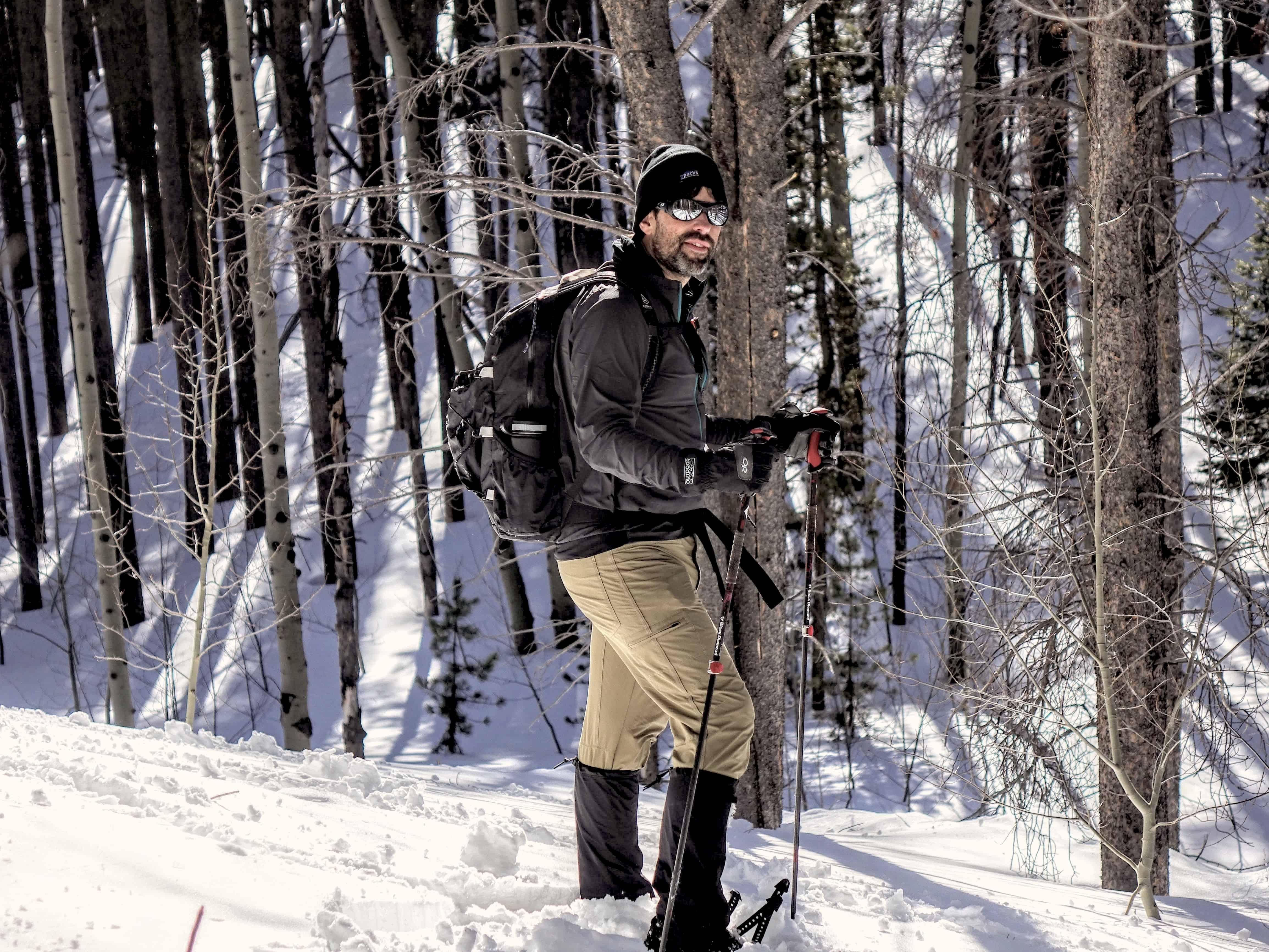
My field use of the Patagonia Airshed Pullover is limited to approximately 30 days of daily wear that includes snowshoeing and hiking in mountains of Southern Wyoming and the Medicine Bow National Forest. I’ve been a faithful wind shirt user for several years and I can’t recall any backpacking trips during the last decade where I haven’t taken and used a wind shirt.
My primary wind shirt of choice for the past three years has been the Patagonia Houdini Jacket (hooded). However, I’ve been experimenting recently with both the Patagonia Airshed Pullover and the ZPacks Ventum Jacket, so the latter two constitute my frames of reference for this review.
That said, without long term experience using the Patagonia Airshed Pullover, I’m unable to comment authoritatively on its durability and fabric wear nuances. In addition, my use has been limited to the dry weather (little to no precipitation), cool temperatures (20 to 45 degrees F), and the reliably breezy winter winds of southern Wyoming. Without long term testing and use in other seasons and environments, this review has thus been classified as a Flash Review (i.e., a gear review meant to introduce the reader to new or otherwise untested gear).

Compared To…
I compared the Patagonia Airshed Pullover to the following:
- Patagonia Houdini Jacket – a full-featured (full-zip, hooded) wind shirt from Patagonia;
- Patagonia Houdini Pullover – a similar (pull-over style) wind shirt from Patagonia, as well;
- ZPacks Ventum Wind Shell Jacket – a full-zip, hooded wind shirt that represents one of the lightest available.

Patagonia Airshed Pullover vs. Patagonia Houdini Jacket
- Fabric
- 1.2 oz, 15 denier nylon fabric comprises the Patagonia Houdini Jacket, while 1.3-oz, 20-denier nylon makes up the Patagonia Airshed Pullover.
- Both fabrics have a similar DWR treatment (C6 DWR finish).
- The higher air permeability of the Airshed’s fabric (50-60 CFM; Source: email exchange between author and C. Simpson, Patagonia Inc.) makes it more breathable. It’s perhaps, less wind- and water-resistant. It has a faster dry time than the fabric of the Houdini (1-2 CFM; Source: ibid).
- There should be little if any noticeable difference in durability between these two fabrics.
- Fit
- When I compared the fit of the Patagonia Airshed Pullover to the Houdini Jacket, I found that the fit of the Airshed Pullover to be slightly more trim.
- The slightly stretchier fabric seemed to accommodate movement in the Airshed as well as in the Houdini Jacket.
- There is no meaningful difference in the center back length of the jackets for the size medium that I compared.
- Features
- The Patagonia Houdini Jacket has a full zipper and a hood. It should offer both better protection from the elements and more flexible ventilation options.
- The Patagonia Houdini Jacket features elasticized fabric cuffs and a drawcord-adjustable hem. The Patagonia Airshed Pullover, however, uses stretch woven fabric panels at the cuff and hem. Neither of which is adjustable.
- Weight
- The Houdini Jacket has a manufacturer-claimed weight of 3.6 oz vs. the Airshed’s claimed weight of 3.7 oz (note: the actual weight of my size M sample of the Airshed is 3.4 oz and the actual weight of my size M Houdini Jacket is 3.6 oz).
Patagonia Airshed Pullover vs. Patagonia Houdini Pullover
- Fabric
- The Patagonia Houdini Pullover and Jacket are made from the same 1.3-oz 20-denier nylon fabric (see comments above).
- Fit
- The Patagonia Houdini Pullover and Jacket have a comparable fit and center back length (see comments above).
- Features
- The Patagonia Houdini Pullover features a kangaroo-style hand pocket. The Patagonia Airshed Pullover, however, features a zippered chest pocket.
- While the Patagonia Houdini Pullover features half-elastic cuffs, the Patagonia Airshed Pullover features stretch-woven fabric cuffs. The Patagonia Houdini Pullover features a snap-up neck opening. On the other hand, the Patagonia Airshed Pullover features a zippered opening.
- The Patagonia Houdini Pullover features half-elastic cuffs, while the Patagonia Airshed Pullover features stretch-woven fabric cuffs.
- It also features an elastic drawcord adjustable hem. The Patagonia Airshed Pullover, however, features stretch-woven panels in the hem and no drawcord.
- Weight
- The Houdini Pullover has a manufacturer-claimed weight of 3.5 oz vs. the Airshed’s claimed weight of 3.7 oz (note: the actual weight of my size M sample of the Airshed is 3.4 oz).

Shown: Patagonia Airshed Pullover vs. ZPacks Ventum Wind Shell Jacket
- Fabric
- The ZPacks Ventum Wind Shell Jacket is made from 0.7 oz ripstop nylon with air permeability in the range of 6-7 CFM (source: email exchange between author and J. Valesko, ZPacks LLC). It is less breathable than the fabric used in the Patagonia Airshed Pullover (50-60 CFM).
- I can easily draw a breath through the Airshed fabric. However, I cannot do so without great difficulty through either the Houdini or Ventum fabric. I don’t notice much difference in the effort required to draw air through the Houdini vs. Ventum. The Ventum is a lighter and thinner material than used on the Airshed. It will likely be less durable in long term use and perhaps in seam strength.
- Both fabrics are DWR-finished. They resist moisture penetration well enough. The long-term durability of the DWR for both fabrics, however, is unknown.
- Fit
- The ZPacks Ventum Wind Shell Jacket has a significantly roomier fit (by at least one full size) and longer back length (by more than 1.5 in/3.8 cm) than the Patagonia Airshed Pullover.
- Features
- The ZPacks Ventum Wind Shell Jacket does not have a pocket, whereas the Patagonia Airshed Pullover features a zippered chest pocket.
- The ZPacks Ventum Wind Shell Jacket has a full zipper and a hood. It should offer both better protection from the elements and more flexible ventilation options.
- While the ZPacks Ventum Wind Shell Jacket features elastic cuffs, the Patagonia Airshed Pullover features stretch-woven fabric cuffs.
- The ZPacks Ventum Wind Shell Jacket features an elastic hem. The Patagonia Airshed Pullover, however, features stretch-woven panels in the hem.
- Weight
- While the ZPacks Ventum Wind Shell Jacket has a manufacturer-claimed weight of 1.9 oz, the Airshed’s claimed weight is 3.7 oz. (Note: My size S sample of the Ventum weighs 1.8 oz, and my size M sample of the Airshed weighs 3.4 oz.)
Comparison Summary Table
This table features horizontal scrolling to view additional columns.
| Fabric Breathability (Air Permeability) | Front Ventilation | Hood | Resistance to Precipitation | Weight | MSRP | |
|---|---|---|---|---|---|---|
| Patagonia Houdini Jacket | Lowest (1-2 CFM) | Full zipper | Yes | Medium | 3.6 oz (102.1 g) | $99 |
| Patagonia Houdini Pullover | Lowest (1-2 CFM) | Partial (snaps) | No | Medium | 3.5 oz (99.2 g) | $89 |
| ZPacks Ventum Wind Shell Jacket | Medium (6-7 CFM) | Full zipper | Yes | Highest | 1.9 oz (53.9 g) | $115 |
| Patagonia Airshed Pullover | Highest (50-60 CFM) | Partial (zipper) | No | Lowest | 3.7 oz (104.9 g) | $119 |
CFM values are reported by each manufacturer.
Commentary
The Patagonia Airshed Pullover is not the first wind shirt to use so-called ultra-breathable “air-permeable” fabrics. The Arc’Teryx Squamish and the Rab Windveil also come to mind. However, the Squamish and Windveil are both full zip hooded jackets that weigh 5-6 oz. The Airshed is a simpler pullover style that weighs 4 oz and may be a better option for those who are on the fence about asking the questions:
- Should I carry a wind shirt?
- Can’t I just use my rain jacket?
Let’s discuss both of these questions in some detail and see where the Patagonia Airshed Pullover fits in.
Should I carry a wind shirt?
A wind shirt offers the following advantages:
- It can be layered over a base/mid layer to provide wind-(and perhaps, intermittent rain/snow) resistance with more comfort (better breathability) than what a rain jacket offers.
- It can be layered under a mid layer to provide some evaporative cooling resistance (i.e., it behaves like a semi-permeable vapor barrier) in very cold conditions. This type of use mitigates the “flash-off” cooling effect (the use of body heat to evaporate accumulated perspiration in your clothing system) when you stop after a period of high output.
- It provides sun and biting insect protection.
Many lightweight backpackers believe that a wind shirt offers significant versatility to the layering system. Considering that a wind shirt usually weighs less than 4 oz, it’s hard to argue that point.
Others believe that a wind shirt is better off replaced by a light fleece layer, which provides more breathability while hiking. While true, it comes at a weight penalty. For example, my lightest fleece is a 100-weight pullover that weighs about 8 oz. There is also a loss of versatility. Fleece is so permeable to the wind. It’s not a great option for sun or insect protection in warm temperatures.
To Breathe or to Repel Weather?
The Achilles’ heel of a wind shirt has always been low fabric breathability. It has most often been made of ultralight fabrics that are heavily calendared to improve strength, water-resistance, and/or aggressive DWR treatments. In fact, many wind shirt proponents will do their best to wash out the DWR treatment to improve breathability using aggressive detergents. While this does help, it doesn’t solve the fundamental problem of increasing the air permeability of the fabrics.
That’s where the Patagonia Airshed Pullover comes in. It’s more air-permeable fabric should improve the comfort and versatility of the wind shirt not only for active wear but also for warmer temperatures. The wind shirt provides for protection from the sun and/or biting insects.
Of course, the increase in air permeability may come at a cost as well, for both wind and weather resistance.
Perhaps asking a wind shirt to perform the function of a rain jacket is asking too much.
Can’t I just use my rain jacket?
If a wind shirt provided a very high level of resistance to wind and rain, then its functionality might overlap some with that of your rain jacket. Of course, this violates one of the core tenets of ultralight backpacking philosophy (“don’t take more than one item that can perform the same function”).
Thus, for a wind shirt to provide unique functionality in your clothing system, it must be differentiated from your rain jacket in a meaningful way:
- A rain jacket provides extreme inclement weather protection (i.e., it’s impermeable to wind and precipitation) at the cost of breathability. The wind shirt, however, is there to provide extreme breathability (at the cost of weather resistance).
- A (waterproof!) rain jacket should keep outside moisture from penetrating your clothing system. The wind shirt, on the other hand, should maximize the transport of internally accumulated moisture (perspiration) to the outside.
Therefore, it makes sense, perhaps, that a wind shirt should be made of fabrics that are as breathable as possible while still providing the minimum possible protection from sun, wind, and bugs – especially for active conditions.
That said, I would personally welcome the trend for a wind shirt to be as breathable as possible, rather than as light as possible. The Patagonia Airshed Pullover is a step in the right direction. Now, if it only had a hood and a full zipper…
Where to Buy the Patagonia Airshed Pullover
Patagonia Airshed Pullover Review: Disclosure
The manufacturer provided a complimentary sample of this product to Backpacking Light with no expectation for a review.


Discussion
Become a member to post in the forums.
Jarred-thanks for the insight. I don’t own a wind shirt but I hear many people raving about the versatility, just trying to figure out where it would fit in.
Jarred- I’m using a Patagonia Level 4 windshirt for hunting- heavier denier/sturdier, not sure on cfm, but it’s encapsulated (vs a DWR) so pretty moisture resistant and stays that way
Mike
Mike,
Got it – thank you. Hard enough to find these in a medium that I gave up when looking for one last year.
Brad,
As a concrete point of data I used my Alpine Start on 1.5 hour run yesterday morning @ 9:15 minute miles. 36 degrees, before sunrise, 6mph wind, 48% humidity. Air felt noticeably nippy with a slight frost on the ground. I consider myself warm while moving. I wore nothing underneath the Alpine Start and was comfortable on the arms and torso – I did not need to vent at any point. With an Echo underneath I would have certainly needed to vent at some point.
Jarred-thanks. It’s starting to make sense. Your Alpine Start at 35cfm, would require less base layer than the Airshed-50-60cfm to perform equally. In your scenario a thin synthetic t-shirt under the Airshed may have yielded similar results?
Naw, the Alpine Start is higher CFM than that. Perhaps ~60.
https://backpackinglight.com/forums/topic/107471/
There are other sources for that. A little digging will provide CFM values for various peices although as consumers we are still largely left in the dark. Experientially I can say with confidence (having used both a Squamish and an Airshed) that the Alpine Start has a higher CFM than the Squamish (~50 I’m close but not exact on that number) and is similar to the Airshed. That is why I was using it as a point of reference in this discussion.
CFM values (again from a consumer standpoint) are vague. You would do best to consider them in increments of 10. Thus a Squamish at ~50 is slightly less air permeable than an Airshed/Alpine Start but significantly higher than a Tachyon (~20) or a current Houdini (~5). However the difference between, for example, 30-35 is not particularly significant. I hope this is good information.
Edit: I also do not mean to be monolithic. Just trying to paint as clear as picture as I can. I’m sure others could take umbrage with personal appraisal and in that there is more that I could learn.
Jarred-thank you. Very helpful. It is appreciated.
@Ryan:
Sure, but a wind shirt can be better than a rain jacket in light rain.
I live on the East coast. Drizzle and humidity are facts of life here. I find most rain gear miserable for hiking until the temperatures are low. A few degrees lower and the rain turns to snow, where a wind shell again wins.
(Of course, in heavy rain, then the real rain gear comes out. Or around camp/town.)
Agreed that breathability is perhaps the most important factor for wind garments. A wind shirt does not have to block ALL wind; it only has to tone it down a little.
The key is in finding the right balance between breathability and perhaps a little bit of water resistance for a given use case. This is where BPL has done a better job than most other sources of describing that balance and in finding a few garments that do the job.
Please keep up the good work. Specifically, I’d like to know CFM, HH, and MVTR for all (good) wind and rain garments.
Ha~! Everybody would like to know these measurements. Problem is, manufacturers change their lineup so frequently, by the time the testing is done, the figures will be practically out of date. Not to mention that amount of work and money it would take to acquire samples and then test them all.
In an ideal world, the manufacturers would just publish all that information themselves.
I was referring to future reviews here on BPL.
Just suggesting that a part of the review could include sending the garment to one of the member-owned labs for CFM, HH, and MVTR testing.
(Assuming, of course, that the scientist involved is interested in such testing.)
Hi Bill:
You mean something like this:
I have not tested any windshirts since 2021, because I stopped using them and started concentrating on WPBs. However, if someone is curious about a windshirt and wants to send it for testing, PM me. Note that my air permeability and water resistance numbers will be consistent with the industry standards. My MVTR is not. You can convert my MVTR values, roughly, to JSI 1099, B1. the standard that is typically used by manufacturers with the following formula: Perm Kettle MVTR=(.0308*(JSI 1099 B1 MVTR))+941.61
hmm- here’s what Black Diamond said concerning the Alpine Start, this was from 2014, maybe they changed it????
@crashedagain: Yes, that’s exactly what I was suggesting. Awesome! (and thanks)
Just my $0.02: WPB’s are interesting and it was great when you jumped on the new Columbia Outdry Ex Mesh. But windshirts work better for me in more kinds of weather. Part of that could be due to East vs West climate differences. Your chart above covers most of the usual suspects, which is excellent.
@MikeM: Wow, great report from BD. Is Nanosphere permanent, rather than DWR?
@crashedagain: While we are reconciling numbers, your CFM measurement for the Houdini is almost an order of magnitude lower than other test reports in the past. Do you know whether that is due to yet another change in fabric? Or just differences in the way various labs do testing?
Who knows. Somewhere, I have data on tests I did of several different years of Alpine Start jackets and they all had similar results, as I recall, but I don’t know where those results are hidden away. I did conclude that the fabric has been consistent over the years. It is possible, from the information in your post that they stretched it during testing air permeability testing. This is not something I would have done. As for the hydrostatic head, I tested well-used jackets sent to me by a BPL member. They could easily have lower HH than a new, never used piece of fabric.
Mike,
I also wrote BD about the Alpine Start, twice, and got similar numbers from them. I would trust Stephen’s numbers. At one point, he verified his air permeability measurements against those from two independent labs and got good agreement. Company spec is one thing, lab tests of actual product another.
My experience (which is worth far less than lab results) would agree with Stephen’s 13.2 CFM figure. From my point of view, that’s a good thing. CFM above 15-20 lets in too much wind to keep one warm, especially in winter. I think relatively low CFM to protect from the wind, combined with high MVTR to allow water vapor to escape, is where it’s at with wind shirts. High HH is a bonus. Windshirts that have all three of these qualities are the bee’s knees, and the BD Alpine Start is one of the few that does.
I think there is a place for high-CFM windshirts, and I have a couple, but I don’t use them that much. I’ve tried using high-CFM as a bug shirt, which works great against bugs, but when the bugs are out it’s usually too warm even for 60 CFM. I prefer lower-CFM shirts, and if I need more ventilation, I open the zip.
I also think that using Polartec Alpha with low/moderate-CFM shirts works extremely well. The Alpha is so ridiculously permeable that you want to block all or most of the wind, but that permeability also allows for extremely effective venting (of moisture, or heat, or both) by opening a window (a zipper).
I have a 2017 Arcteryx Squamish, which Stephen tested to have about the same MVTR as an Alpine Start (~3500), but three times the air permeability (~40 vs ~13). I wear the Squamish quite a bit, as it’s my best-fitting windshirt, but if I’m going to be out all day or for multiple days, I never take it. I do not think it breathes better than the Alpine Start (despite its high air permeability), but it definitely lets far more wind through (due to its high air permeability).
Hi Bill:
You will see some variance, sometimes substantial, between some of my test results and some of the information previously published on BPL. As a result, I paid to have 3rd party testing done to investigate these issues. My results are in good agreement with all the independent testing I had done. I had my 2018 Houdini, listed above, tested by Frazier Instruments. They manufacture the most widely used air permeability test instruments. They got .32 vs my .65. .65 is about as low as I can go. Patagonia regards anything lower than 5 CFM as impermeable. I would agree with that. I have never succeeded in obtaining any old Houdini jackets for testing. If you have any with the claimed higher permeability, I would like to test it. Also, I received and responded to your PM.
Bill, Nanosphere is a very durable DWR, but it’s not permanent, despite marketing language from Schoeller that might suggest it is. Abrasion is the bane of DWR, including Nanosphere. However, I found Nanosphere to be the most effective DWR that I’ve tried, and possibly also the most durable.
I once did some shower testing comparing a brand new Alpine Start against two other wind shirts with slightly higher water-resistance (hydrostatic head, HH). The Alpine Start actually let a little mist through in the shower, but the fabric did not wet out. It was bone dry after allowing a little mist to explode through the pores in the fabric. The other two didn’t let water through, but wet out very quickly. This was an example of how water resistance and water repellency are not tightly correlated. The former is a function of the fabric itself (pore size, weave density, etc.) and the latter a function of the DWR chemical treatment and how it interacts with the surface of the fabric.
For a long time, I tried to make wind shirts with good DWR and high hydrostatic head work as raingear in light and medium rain. This can work, but the limiting factor is the DWR. I’ve never found a DWR that lasts long enough to prevent the fabric from wetting out. Brand new it can be pretty great. But once some abrasion from pack straps and brush have worked on the fabric some, it will start to wet out in those areas. Once wet out, water from the saturated fabric will start to infiltrate your inner layers. For done in a day activities, this can still be OK, but it sucks pretty bad if you’re spending the night outside in the cold.
BTW, Black Diamond stopped using Nanosphere a couple years ago. They now use a wax-based DWR called Ecorepel that is far less effective and durable. I suspect the reason for that is that Nanosphere in its most recent iterations was a fluorocarbon-based treatment. And those chemicals are in disfavor. The original Nanosphere was actually silicone-based. It worked well, but it did not repel oil, so body and plant oils could foul the surface treatment and render it useless. This is the same problem that Epic by Nextec, another silicone-based DWR, faced.
Stephen: OK, that’s all we can ask. Thank you. Sorry, I do not have an older Houdini. I do have a PCU L4 from Patagonia that I could send.
Stumphges: Right. When BD said, “treated… but not coated”, I envisioned something like EPIC encapsulation: A treatment that happens when the fabric is made.Thanks for clarifying.
Too bad about the Ecorepel.
It’s interesting how everyone reacts differently. I have always preferred wind shells in light rain, regardless of DWR. Somehow I find slightly-damp-from rain to be more acceptable than slightly-damp-from-sweat-that-cannot-escape-a-rain-jacket. If “wet is wet”, then maybe it’s more about cooling? In any case, the wind shell tends to dry faster than a rain shell when the rain stops.
“It’s interesting how everyone reacts differently. I have always preferred wind shells in light rain, regardless of DWR. Somehow I find slightly-damp-from rain to be more acceptable than slightly-damp-from-sweat-that-cannot-escape-a-rain-jacket. If “wet is wet”, then maybe it’s more about cooling? In any case, the wind shell tends to dry faster than a rain shell when the rain stops.”
Oh, I much prefer a windshell. That’s why I worked that strategy for five or six years. But it just doesn’t work unless the DWR is pristine and the windshell has top-10% HH. If damp from outside equals damp from inside, sure, that is the use case for windshell over rain shell in light or medium rain. But all it takes is for the rain to get a little heavier, or for your DWR to give it up during a long hike or trip, and the strategy fails. And when that happens, wet from cold rain is conspicuously, dangerously worse than damp from warm sweat. And then you have to dry those layers, or put them on in morning. I still do it on day hikes, but would not rely on it for backpacking, and DWR fragility is the biggest reason.
I don’t see heavier rain as failure for a wind shell; I just see it as time to put on the poncho.
+1 for BB
I’d be interested to see that :)
Looking at all three components, it does seem the Alpine Start does pretty well comparatively :)
That is my approach for cross country skiing. While going up hill I sweat a lot. I ski in the Northwest, where temperatures are often right around freezing. Often fleece is enough, but it can get too damp. A windshirt helps quite a bit. As I gain altitude I usually get into colder, dryer temperature. The wind shirt may be soaked. Mainly it prevented the fleece from getting soaked (with either my sweat or the rain/snow mix). If I’m still skiing, I don’t need the wind shirt, and can set it aside (although it usually isn’t that wet). If I’m stopped, I put on my down jacket. Going downhill I just wear the down. It might rain on me at the bottom, but by then I’m close to the car. If I was camping, I would probably carry a rain jacket as well (to put over the down jacket when the temperatures drop, to protect it). Instead I just let the jacket dry out at home.
Hi Mike:
Thank you for the offer. One is already on the way. I will post the test results.
That’s great Stephen- thanks!
Regarding Patagonia Houdini–there was an in depth discussion about this windshirt some years back on this forum. If I’m remembering correctly, the Houdini pre 2012 had a measured (by Nisley) CFM of around 30 to 35 which he considered the optimal CFM range for balancing moisture movement against wind protection whilst backpacking on hilly, up and down type terrain/trails.
Pre 2012, it also had an EPIC like, silicone based DWR. Around 2012, both the weave and DWR were changed and the Houdini became much less air porous (“breathable”). I haven’t looked for any links yet, but I’m sure if you did a search of 2012 Houdini Nisley or the like, something would eventually come up.
Btw, the way to refresh silicone DWR is a combo of the following: Hot water combined with plenty of agitation and most importantly, a high pH cleanser of some kind. This could be washing soda or the like. The high pH (needs to be at least 10 pH) cleanser helps to emulsify and break up any surface oils that may be impairing its DWR function.
This, btw, is perfectly doable on a backpacking trip. Make a fire, once cooled, put some of the ash in water, let it sit for awhile, strain off the clear water off the top. You now have a form of lye–a high pH cleanser that will emulsify oils/fats. Obviously be careful with this and handling (depending on how concentrated you made it, it can chemically burn the skin or at the very least strip the oils from the skin). If you have one of those collapsible, portable, relatively light kitchen sinks, you can heat up the water and throw the windshirt in there and swish it around, and then rinse it well with regular water. It would be easier to do all this at home, but it can technically be done in backcountry if really needed. I could only see this as necessary on a longer trip–particularly with a lot of bushwhacking.
The good thing about silicone coating DWR’s is that they tend to be much thicker than other DWR’s and for that reason primarily, tend to be much more durable and longer lasting. But over time with use, will need to be refreshed in the above manner. Occasionally spraying with a silicone spray after a deep cleanse, can also be helpful after a lot of time. The silicone should readily bond with the silicone coating. It is different than spraying silicone on an uncoated fabric–in that case, the silicone DWR will come off quite fast and easily in comparison to spraying on an already silicone coated fabric. The silicone spray will NOT increase the HH at all though. It is just too thin of a coating. You could do the old thinned silicone caulk trick to do that, but you would have to have the ratio of thinner/solvent to silicone down perfect to not overly impede air porosity. Not likely without a lot of testing and trial and error.
Become a member to post in the forums.