


Introduction
This is a story about a 40-day backpacking trip in the Far East (Russia) where I started with a pack that weighed 95 lb (43 kg).
For some, ultralight backpacking is all about carrying the bare minimum. For others, it’s a mindset or framework.
Not everyone wants to pack ultralight, whether it is for comfort or because of the kind of trip, but I am sure that most people can appreciate lightening their load. Ultralight gear is about shaving weight down for any trip. With good weather you could easily spend a weekend in the mountains with 15 lb (6.8 kg) or less on your back, or you could go out for another week and double that weight. Continuing advances in gear design mean that in 2019 you can get a 2 person tent that weighs less than 1 lb (0.45 kg) and a 0F (-18C) sleeping quilt at only a pound and a half (0.7 kg)
This summer a friend of mine and I decided to make our ultralight gear seem a little ironic and carry 95 lbs (43 kg) on our backs. This wasn’t just as a joke or some bizarre industry commentary though, we had good reason, and we were still light on food and gear by the end of our trip. As much as ultralight gear can make for light packs it can also afford other opportunity. Nearly 100 lbs (45 kg) may seem a bit nonsensical until you look at what we were doing. We were out for 40 days unsupported in Far-Eastern Russia. That means we had 40 days of food on our backs in addition to our gear.
This presents an interesting if perhaps seemingly niche side of ultralight backpacking. Instead of the desire to carry less and go further, the desire to carry more and go longer. Were we actually backpacking ultralight? Perhaps not. Were we cutting every ounce we could from our packs? We certainly made an effort to. This is a bit of a different perspective and approach than what is more conventional. Instead of shaving weight to have the lightest pack possible, you choose the heaviest pack you’re willing to carry and go backwards from there to see how many days you can spend in the wilds. We ended up carrying more than we probably should have (I don’t know if anyone has ever enjoyed a 95 lb (43 kg) pack) but only because of how long we wanted to spend in the backcountry.
Expectations also change for things like distance and rest. Day after day of hiking for 20 miles (32 km) or even to hike every single day become something approaching impossible. Movement is often slow and distances are often grueling.
In a world where trails like the Sunshine Coast Trail – 112 miles (180 km) – in British Columbia are run in under 35 hours and the 310-mile (500 km) Superior Hiking Trail saw four new speed records in 2019 there is an obvious propensity for travelling light and fast and far. So why on earth would someone carry 95 lbs (43 kg) and cover a fraction of the distance? To explain myself I’d like to try to capture what actually happened over those 40 days.
About The Trip
For long sections of trail, self-supported or supported trips are often possible. This helps to alleviate the necessity of carrying consumables like food and fuel for an entire trip. Thru-hikes are well known for this type of travel, often with frequent resupplies (typically every 3 to 7 days) of the day to day necessities. There were a number of reasons we did not employ this approach on our trip this summer. In addition to any desire we might have had to be unsupported, the realities of remote off-trail hiking also made it our only option.
Planning an international expedition without any intention to follow a known route or trail system requires a certain level of self-sufficiency. We prepared ourselves to be absolutely on our own for up to 40 days at a time, and we ended up doing just that.

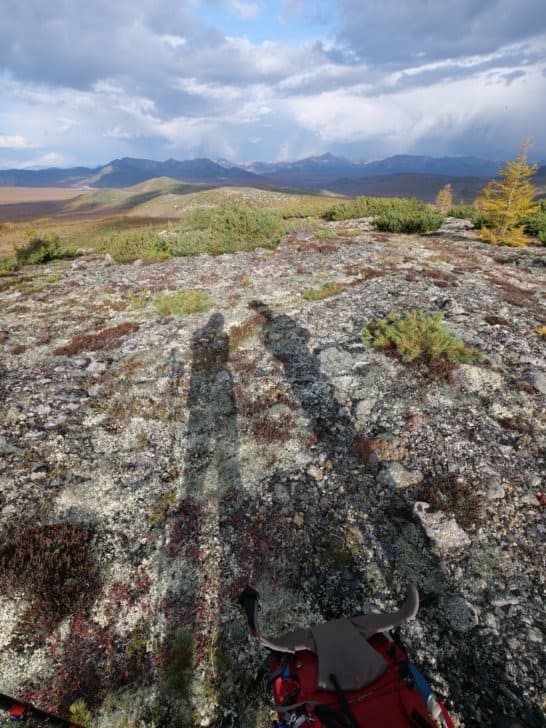
We hiked into the mountains of Magadan Oblast (Магаданская область) at the beginning of August and exited about midway through September. In that time we committed ourselves to an existence that flowed through time and space in synchronicity with our bodies and the landscape. We were lucky enough to see one of the most amazing changes of seasons that I have ever experienced and to revel in sun rain and snow, truly at a pace that followed the mountains around us.

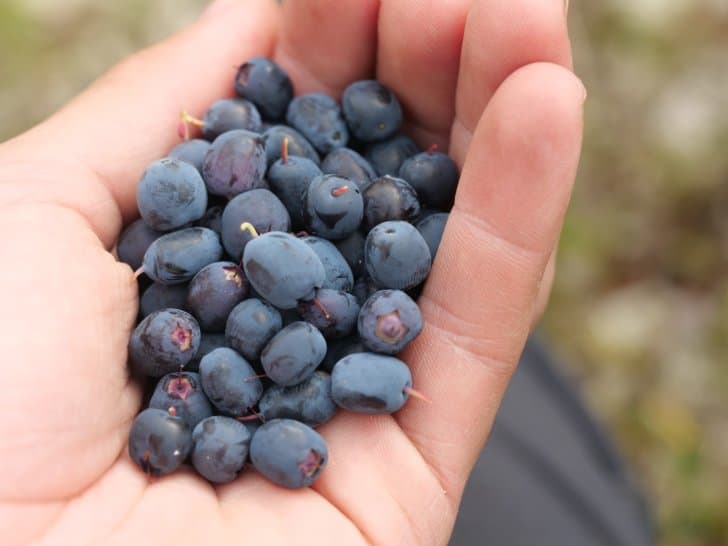
At 63 degrees North days are long in August. We only used headlamps once over the course of 40 days and that was at the end of the day after reaching a summit at 6pm. The larches and the tundra framed microcosms and macrocosms of stunning plants and animals and rocks and water. We saw snow sheep and a brown bear and foxes and loons and countless insects and spiders. It seemed that at each turn there was more magic awaiting us.
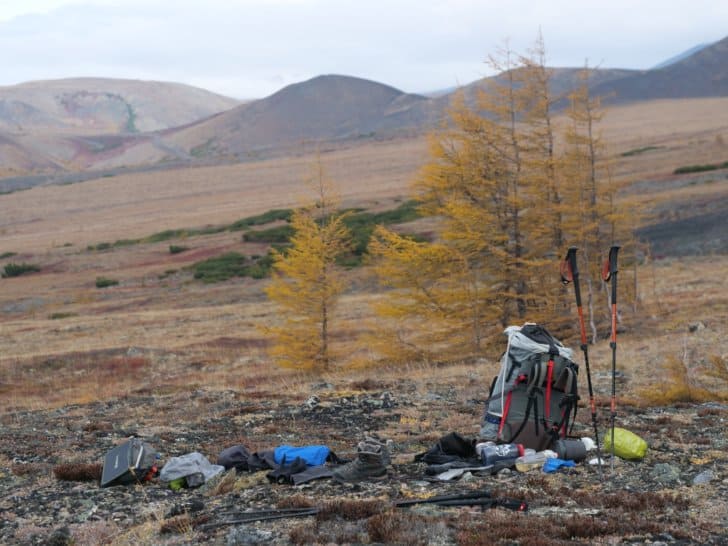
Our day to day wasn’t dissimilar to what you might expect from any other backpacking trip. We found both routine and novelty in each day. Our isolation allowed us to focus, whether that be on our feet across slick talus or in the immersion of a reader absorbed by a well-written book. Things were simplified and this revealed some of the complexities of each tiny piece of the world around us and of ourselves. In lieu of a novel to describe the momentous character of this trip I will let the pictures here reveal what they can to you.

What’s challenging about an unsupported, 40-day trek?
Pain. Carrying 95 lbs (43 kg) hurts – a lot. Every day, the pack gets lighter but a heavy pack takes a toll on the body. Even a light pack can press heavily on the body as the miles and the days build. Over the course of weeks the body fights back, bruises and cramps and stiff joints can be discouraging feedback and morning stretching can only appease so much.
Patience. Moving slowly is surprisingly taxing, not only on the body but on the mind. One of the beautiful things about spending weeks on end in the mountains is the ability to settle into routines but also stay present in response to surprising and changing details. This takes some patience to settle into. If you are focused on a constant sense of movement or of accomplishment, it does nothing but distract from the immersion of calm moments and the breaks that the body needs.
Hunger. I think a lot of backpackers, particularly ultralight hikers, bring less food than they might eat in their kitchens at home. Over the course of a few days or even a week this works well, just enough things missing to make the first meal back extra tantalizing. Skimming ounces off of the top of 40 days of food to save weight makes for a different story. Over the course of almost six weeks hunger can become a real nuisance. With any long unsupported backpacking trip it must be balanced with what can become a back crushing load.
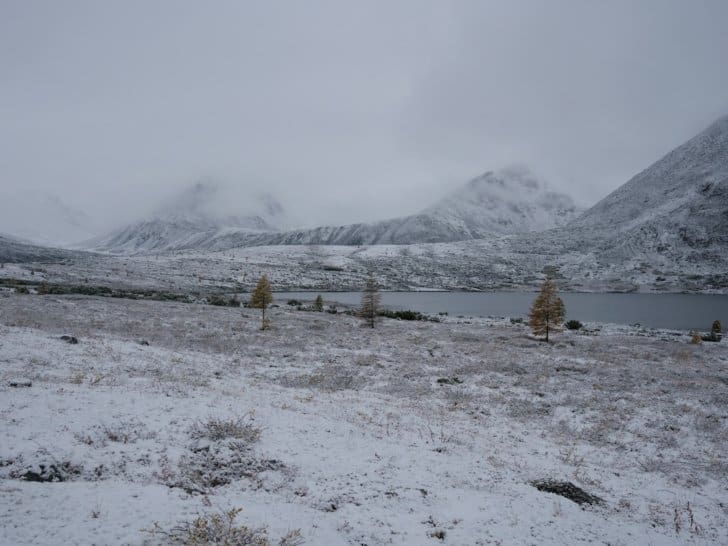
Constant Exposure. You are exposed to it all. When you spend almost a month and a half out in the backcountry you can’t plan for weather. Sometimes you can anticipate it and sometimes even take refuge from it, but you certainly cannot avoid it. On our trip we were rained on for almost a week straight. We ended our trip with four days of snow and our last day we woke to frozen water bottles. Cold and wet happen, and sometimes they stick for a little too long.
Conclusion: Why?
With all that struggle looming over you it should probably take a lot of convincing that this style of backpacking is worthwhile at all. I know there will be some people that will be instantly on board with the idea of spending so long in the backcountry, the love of it came naturally for me. However, I want to leave the more reasonable reader with something meaningful as well.
Maybe you have to be a bit crazy to want to carry almost three quarters of your body weight just to have five and a half weeks in the mountains. However, I think that more people will see the charm of going into the wilderness unsupported for three weeks with under 50 lbs (23 kg) on your back. I hope that this presents another way to look at limits. We all have different goals in our adventures. Some of us want to move fast, some far, some light. I’ve found that one of the things I value most is the time I spend in the mountains and the woods and even a tent. Sometimes that means packing differently and sometimes that means working hard and slow and pausing to let it all soak in.
Appendix: Selected Gear
Here’s some of the gear I (very carefully) selected as part of my 95-lb kit for a 40-day trip in Russia.
| item | brand/model | weight |
|---|---|---|
| backpack | CiloGear 75L WorkSack | 4.8 lb (2.24 kg) |
| quilt | Enlightened Equipment Revelation 0F | 27 oz (0.76 kg) |
| pad | Therm-a-rest NeoAir Xtherm | 15 oz (0.43 kg) |
| shelter | Tarptent Stratospire Li | 28 oz (0.79 kg) |
| cook shelter | Mountain Laurel Designs Supermid | 26 oz (0.74 kg) |
| trekking poles | Black Diamond Trail Trekking Poles | 17 oz (0.48 kg) |
| stove | MSR Pocket Rocket | 3.1 oz (0.09 kg) plus fuel canisters |
| pot | Toaks Titanium 1300 ml Pot with Pan | 6 oz (0.17 kg) |
| bear bags | 2 x Ursack Major XL + 4 x odor-proof bags | 21.6 oz (0.61 kg) |
DISCLOSURE (Updated April 9, 2024)
- Backpacking Light does not accept compensation or donated/discounted products in exchange for product mentions or placements in editorial coverage. Some (but not all) of the links in this review may be affiliate links. If you click on one of these links and visit one of our affiliate partners (usually a retailer site), and subsequently place an order with that retailer, we receive a commission on your entire order, which varies between 3% and 15% of the purchase price. Affiliate commissions represent less than 15% of Backpacking Light's gross revenue. More than 70% of our revenue comes from Membership Fees. So if you'd really like to support our work, don't buy gear you don't need - support our consumer advocacy work and become a Member instead. Learn more about affiliate commissions, influencer marketing, and our consumer advocacy work by reading our article Stop wasting money on gear.


Discussion
Become a member to post in the forums.
I used to carry 70 lb in the mountains when I was young (at Uni). I needed help to stand up, but then I was OK. Today, at 74, I definitely do NOT want to carry that much!
But the long length of the trip – too right. We (Sue & I) have done many 2-month trips on the tracks in Europe, and one 3-month trip. Coming home is always a bit of a psychological let-down.
https://backpackinglight.com/caffins_4_month_gear_list/
https://backpackinglight.com/caffin_gear_list_revisited/
However, in Europe we had the chance to buy food as we went. Fresh French bread and cheese – oh yeah! Even, sometimes, red wine …
Cheers
“I used to carry 70 lb in the mountains when I was young (at Uni). I needed help to stand up, but then I was OK. Today, at 74, I definitely do NOT want to carry that much!”
+1
Which all goes to show why G.B Shaw once commented that “youth is wasted on the young”.
Fantastic trip and photos. Alaska-like, but different.
Photos of the Cilo 75 look painful. Drastic sag, neither the belt complex nor the frame are up to the task.
I’ve done 2 consecutive days of 18 miles (12 loaded) carrying ~120+ pounds (solo 12 mile elk packout, ferrying everything in 2 loads). Physically I was crushed at the end of that but had no blisters, bruising, chafing or anything from boots or pack or clothing. This suggests that one could train to sustain that effort for longer.
The various Arctic 1000 reports (esp Roman’s postmortem) tell a lot about how big loads influence performance over multiple weeks.
“I used to carry 70 lb in the mountains when I was young (at Uni). I needed help to stand up, but then I was OK. Today, at 74, I definitely do NOT want to carry that much!”
I think there’s a law of nature that applies here:
Age (in years) + Weight Carried (in pounds) = Constant.
How utterly ridiculous.
Does back of envelope sums for self …
Oh . . . .
Cheers
Absolutely incredible trip. I am insanely jealous.
A wile back I got to live in Novosibirsk and Krasnoyarsk. I would love to take a three month trip in that neck of the woods!
Seeking retirees (or aspiring retirees) for long adventures? I don’t retire till 2024, but am interested in longer trips. I get 5 weeks leave per year and may be interested in a 1-2 week adventure if you are looking for a similarly-aged partner.
Dear Tully
I would love to read the full story of this inspiring trip. „www.summerinchukotka.com“ seems to not work anymore. Is there any other chance to read your story and see the pictures?
Best from Austria, Christian
Become a member to post in the forums.