



Introduction
This Nitecore NB10000 review (5.3 oz / 150 g, MSRP $59.95) covers a lightweight entry into a crowded portable battery charger market. The Nitecore NB10000 features 10,000 mAh of nominal capacity at full charge, carbon fiber frame and panels, USB-A and USB-C outputs, a single multi-functional button, blue and white LED indicators, and pass-through charging capability.
The outstanding feature of this power bank is its high capacity-to-weight ratio. For a weight that is little more than that of a typical 5,000 mAh battery pack, you get twice the power. That’s an attractive proposition for any backpacker who carries electronics on multiday trips. I put the NB10000 through its paces at home and in the field to see if it delivers on its promise.

Watch Video: See our Member Q&A How to Manage Electronics and Batteries in the Backcountry.
Highlights
• 10,000 mAh at 3.85 V (38.5 Wh) nominal capacity
• 5.3 oz / 150 g
• 4.8 x 2.3 x 0.4 inches (12 x 5.8 x 1.0 cm)
• input: USB-C – 5 V @ 2.4 A (12 W) / 9 V @ 2 A (18W)
• output 1: USB-C – 5V @ 3 A (15 W) / 9 V @ 2 A (18 W) / 12 V @ 1.5 A (18 W)
• output 2: USB-A – 5 V @ 3 A (15 W ) / 9 V @ 2 A (18 W) / 12 V @ 1.5 A (18 W)
• carbon fiber frame and panels
• 3-level LED indicator for remaining power and charging status
• one-touch low current mode
• USB-A to USB-C cable included
• IPX5 rated (water resistant against sustained, low pressure water spray, dust protection not rated)
• operating temperature: 14 to 104 °F (-10 to 40 °C)
• storage temperature: -4 to 140 °F (-20 to 60 °C)
Testing context
I ordered the Nitecore NB10000 from Nitecore through Garage Grown Gear in February 2022. I performed quantitative testing at my home under typical indoor ambient conditions unless otherwise specified. I mostly followed the testing rubric described by Rex Sanders in BatteryBench: A Protocol for Testing Portable Battery Chargers and Electronic Devices for Backpacking. Rex’s fine article defines all the terms used here; if any are unfamiliar, please follow the link above.
I ran tests using the MakerHawk model QC2.0/3.0/4.0 MTK USB multimeter. For a load tester, I used the UCTRONICS Electronic USB Load Tester. The multimeter looks much the same as the one Rex used, but I found that I could not power the meter independently of the current being tested. My measurements, therefore, include some loss due to the power needed to operate the meter. The LED screen shuts off after 30 seconds, so I expect the power loss at the meter is only a few percent. The result is that my measurements of power delivered are low by a few percent.
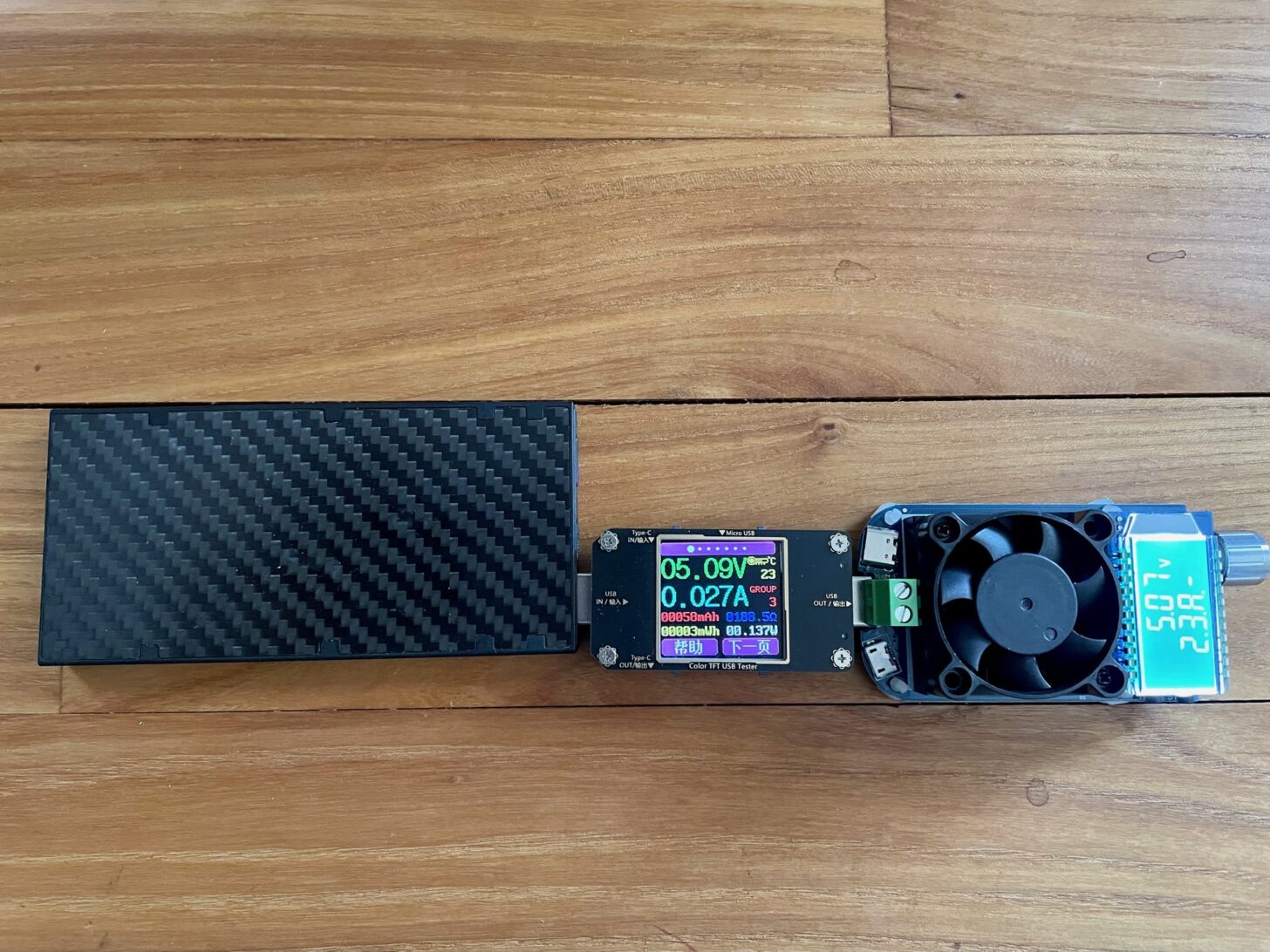
For the energy loss measurements, I measured the power needed to fully recharge the phone, rather than the power remaining in the phone, as Rex did. My rationale is that when little power is lost, comparing small differences between large numbers is unreliable.
I also skipped the drop test, as I bought this item with my own money and didn’t want to risk breaking it, even in the name of science.
Editor’s Note: It’s worth mentioning that in yet-to-be-published research conducted by Rex Sanders, this product performed poorly in the drop test. Rex’s thoughts – “Good battery. Just don’t drop it.”
Field testing was performed on a week-long section hike of the Desert Trail between Halloran Summit on I-15 and Badwater in Death Valley, in March and April, 2022. Conditions were generally dry and windy, with temperatures of 35 to 100 °F (2 to 38 °C).
First impressions
Physical attributes and feature set
The Nitecore NB10000 is light. And small. Smaller than a typical phone. The measured size and weight agree with the manufacturer’s specs.

The design is minimalist. There are just the two ports and a level indicator panel that also serves as an on-off/change-mode switch. There is no flashlight or any other functionality. All corners are squared, not rounded or otherwise streamlined.
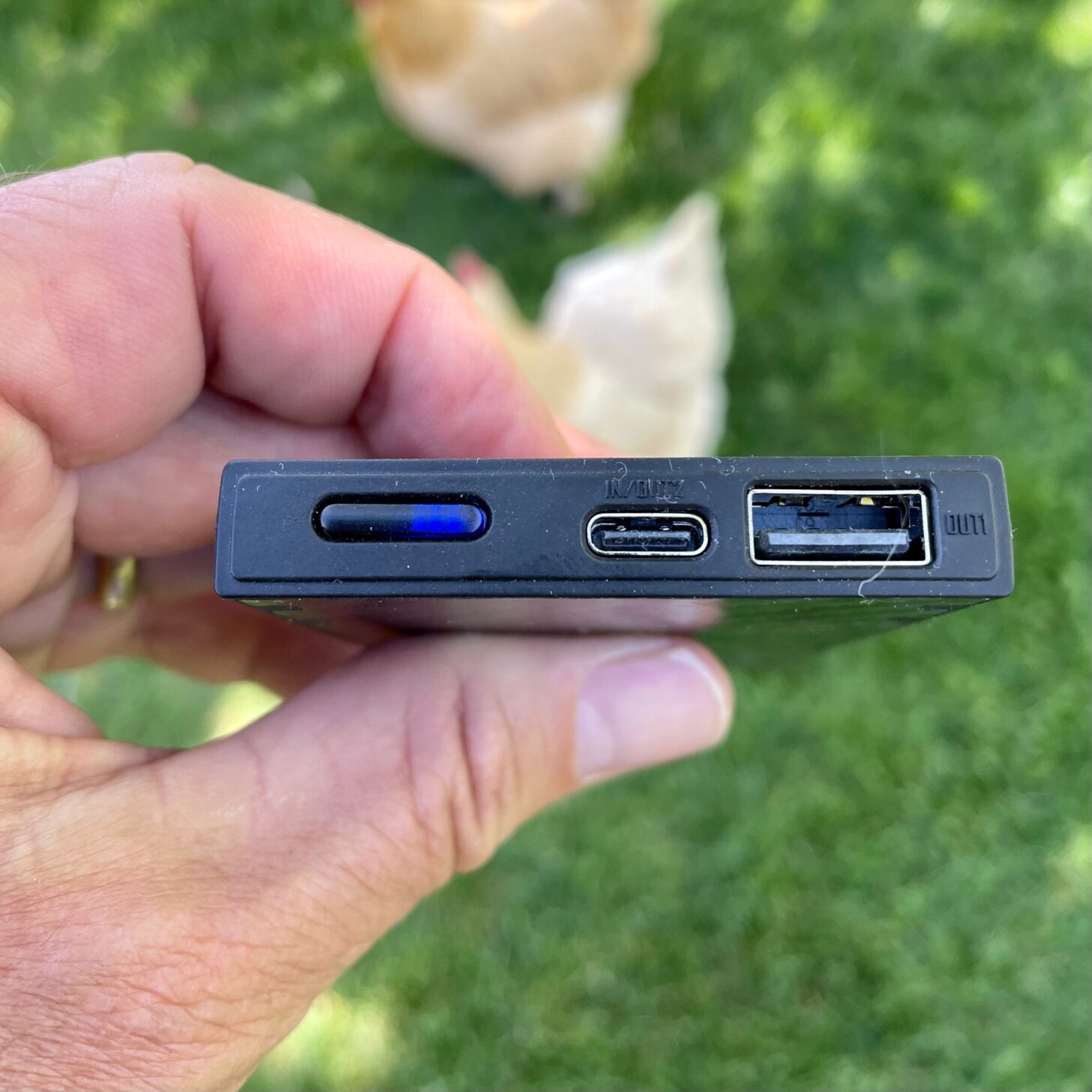
Construction and quality
The carbon-fiber panels are pressed onto the carbon-fiber frame, aligned and held in place by four tabs on each edge. The fit of the panels is tight and even, but not invisible. The ports feel stable and solid when plugging and unplugging cables. The power button feels solid when pressing it. I own one other Nitecore product, a USB-rechargeable headlamp, and it has functioned flawlessly for several years now. This battery pack appears to be made to the same level of quality.
In the Forums: See what the Backpacking Light community has to say about batteries and electronics.
Test results
The essentials
The parameters most important to hikers are:
- getting the most delivered energy for the least weight,
- and recharge time.
Delivered Energy – This is the amount of power that a battery pack can actually deliver to your small devices. I measured the output of the Nitecore at 29.6 Wh (@ 5 V x 3 A) or 5920 mAh. You’ll note that this is about 60% of the capacity specification. Capacity is how much energy is in the battery. Delivered energy is how much energy actually is available to the device being charged.
Member Exclusive
A Premium or Unlimited Membership* is required to view the rest of this article.
* A Basic Membership is required to view Member Q&A events


Discussion
Become a member to post in the forums.
Companion forum thread to: Nitecore NB10000 Review
The Nitecore NB10000 is a simple portable battery charger built around a carbon-fiber platform for maximum weight savings.
I have 2 of these and also had the 20k version for a bit.
The 20k was from the very first batch last year and I sent it back because it would not fast charge my phone. I think there was a minor issue with the charge sensing circuit. Also it was an 11oz brick. The only advantage to the 20k over 2x10k is that the 20k can do a 45w discharge which will power medium size electronics like an IPad. Also the 20k was slightly heavier than 2x10k per nitecore’s stated weights.
The 10k only lasts me 3 days on the trail while hiking around 10mi/day and using Alltrails to fully track my routes on my S10+. The continuous tracking adds significant battery drain. Also I take a lot of pics and sometimes play music via wired earbuds during boring stretches of trail, so phone usage is rather high during short trips when battery conservation is not very important.
One of my 10k banks just failed after about 1 year but less than 50 charge cycles. i baby my banks making sure they are not too hot, cold, or over/under charged. When stored for a long period i let them discharge to around 50-70% best as i can estimate.
The failed bank would show fully charged after only 30 mins, then fail to turn on less than 1 hour later. (I let it charge 6 hrs so I know it should be fully charged)
Nite core is replacing it no questions asked which I am very pleased with. Their customer service has been very responsive and they have offered a refund or replacement on both banks i had issues with. Even though I had a minor and major issue with 2 of their banks, I will buy again because their customer service is great IME.
One reason to get 2x10k instead of 1x20k – 2x10k provide redundancy. Aldo you can charge both in parallel (assuming you have a 2 port 36w minimum output charger) and you can Select-a-capacity/weight based on your trip length by bringing 1 or 2 as needed.
Overall I’m very happy with them and recommend all things nitecore. The NU25 is the best damn headlamp around as well.
Interested if there are any mobile OS software engineers that could comment on the overnight phone charging drain that has been discussed here and on the podcast. I’ve assumed that this is not a charging issue, but is instead the phone sensing that it’s plugged in and running maintenance routines in the background. Things like indexing, photo processing, etc that chew through the battery when there isn’t an expectation of power sacristy. I assume that by unplugging when at 90ish percentage charge the phone just never slips over into running these high-power background routines when the battery is fully charged. Keen for any evidence that this is or isn’t the issue we’re seeing. But regardless, Rex’s initial observations have certainly changed by charging habits!
I’ve experienced the “vampire” issue for my iPhone 8 and 12 Pro. I even plugged the phone in, and then turned off the iPhone. In the morning the iPhone was still being charged. I’d be curious to see if Android phones have the same issue.
The Wh should be calculated with nominal cell voltage of 3.7V and not with 5V
I’ve had the Night core 10000 for over a year with no problems. I only charge my Android s8+ while I’m cooking (back up to 100% each night). I mainly use Avenza maps (not recording) and keep the phone in aeroplane mode when I can. I check messages, news etc when in range, not many calls. I get a week of top ups (about 3 full charges) and never run out of electrons. I’m in Australia so temperatures are pretty mild and I’ve never dropped it. I recommend it, mostly for its weight and capacity.
u/ormagon on reddit put out this “Hiking power bank comparison 2022” a couple months ago.
https://docs.google.com/spreadsheets/d/1-AL_bU5yGwcGXiqpIQ8qeoi4_XGkkug8HGxDbnnkkQc/edit?usp=sharing
@Ari – I’m curious as to why Wh should be calculated at 3.7V. Since the battery charges my phone and other devices at 5V, this seems like the relevant voltage. After all, we want usable power, not theoretical power.
@Drew Capacity on different cell topologies and separating switching circuitry efficiency. If we talk about 10Ah capacity, it is defined at certain voltage… Here 3.7V.
yeah, it’s just convention for USB power bank sellers to spec the capacity (mAh) of the internal lithium battery which is nominally 3.7 volts
since all manufacturers spec it the same, it’s a good comparison between manufacturers
the number isn’t really intuitive to most users whether it’s mAh of the Lithium battery, mAh of USB voltage, Wh, or whatever.
they also spec how many times it will charge specific phones which is more intuitive
Wh is also convenient figure for travellers as eg. FAA defines Hazmat Li-Ion/Li-Poly batteries by their capacity in Wh… Which reflects roughly the amount of lithium present in battery. https://www.faa.gov/hazmat/packsafe/more_info/?hazmat=7
Nice review Drew. It seems that the power to weight ratio of 18650 batteries is similar to or slightly better than the NB10000. Furthermore I can use the 18650 directly in my zebralight flashlight, can just carry more 18650s if more power is required, I like using standard batteries in that a battery failure is a minor event, just replace the single battery rather than the whole unit. So I’m not switching yet. Thanks.
I got the Nitecore NB5000 when it first came out. Worked great until I forgot to take out of my car before work on a hot August day. I found it with a huge swollen bulge and quite dead. It was about 18 mo old so I didn’t even attempt a “dumb customet” warranty claim. My trusty Anker 10000 only weighs about an ounce more and has survived more than a few hot Georgia summer days. Still, best to not subject a Li battery to extensive heat.
So I got the nb20000 and have a weird issue the manufacturer hasn’t been able to clarify honestly. I’ve tried numerous cables and chargers and it’s unable to fully charge via fast usb c to usb c charging. It ends up just blinking 3 or 4 lights for days. It charges normally via slower usb a to usb c cables. The output usb c also works fine. Anyone run into this?
@Todd G you are the 3rd person I have heard have an issue like that. My advice is to warranty the battery and replace it with 2 NB10000. There is some design flaw with the 20000 bank that I am not sure has been fixed yet.
Also, I wish Nitecore would change the status LEDs on these banks. It’s the banks worst traits-the blue LEDs are so small and close together you can’t easily differentiate them in daylight. The blue color also makes them bleed together to my eyes. Really needs 4 lights as well.
Brad, that’s what I did – returned the 20k and got 2x 10k. This is better IMO anyways because you can select-a-weight/capacity based on trip length.
The only advantage to the 20k is the ability to 45w charge (which is only relevant to mid sized electronics like an Ipad, and I dont think we’re carrying many ipads in this group)
Apparently there is now a Gen 2 of the Nitecore NB10000 that at addresses a few issues – at least the LCD lights. The weight and rest of the specs remain the same.
The Nitecore seems to be about an ounce lighter than the Anker PowerCore 10K. I assume the battery cells inside are similar, is the weight savings from the case?
@ Brad Rogers that is great that they fixed those lights. I assume the case and less robust ports are the weight savings. I am seeing lots of issues on forums regarding the Usb-C port becoming loose after a short time. I wonder if that was upgraded as well.
The new Gen 2 is supposed to fix the issue of the loose ports as well.
I’ll be honest. I wish I hadn’t wasted $100 on the Nitecore NB20000.
I’ve purchased two Anker power banks before (10,000 and 13,000 mAh models) but when I wanted a single, higher-capacity bank (20,000 mAh) I admit I foolhardily went along too quickly with the recent Nitecore forum fad and lighter-carbon pitch.
The major problem with the Nitecore is that it “times out” when charging things like my Apple iPhone, Garmin inReach mini, Garmin Fenix watch, and Petzl headlamp.
I want to come into camp and plug in a couple of devices and then go about setting up the tent, filling an air mattress, lofting my quilt, making water, etc. Later I want to check and see if those devices are done charging and then plug in another (if necessary) while making dinner … but unfortunately the Nitecore has timed out and the first two devices are only two-thirds to three-quarters charged!
So you restart the Nitecore and TEND IT to make sure your most important devices (typically iPhone and inReach) are FULLY charged. Then, you can re-start and repeat to top up anything else you want charged (watch or headlamp).
When I called Nitecore to see if I had a faulty unit they said, “No, that’s within the design specification.” Their detailed email response was, “When a low current device is connected, the power bank sends out a charge for a few seconds and then stops because it is not able to detect the presence of any battery due to its small size.”
Ouch! Isn’t that what backpackers carry? Low current devices like smartphones, sat communicators, watches, and headlamps?
The Anker 525 PowerCore 20K sells for $70 and weighs 12.32 ounces. It is designed with a trickle-charging mode to “provide optimized charging to low-power devices.” The Nitecore NB20000 sells for $100 and weighs 11.45 ounces.
https://www.nitecorestore.com/Nitecore-NB20000-Power-Bank-p/bat-nite-nb20000.htm
In hindsight, isn’t a 20,000 mAh bank, that costs $30 less, and trickle-charges and tops up devices UNATTENDED, worth 0.87 ounces of carry?
For me, yes. If I had researched it more carefully versus impulse purchasing I could have done that math myself and would have read more reviews and found others who had ended up just as disappointed as I am now.
The Nitecore also has a low-power mode. Just click the power/mode button twice (you should see a white light come on). I think it’s pretty much the same operation with the 525.
“It is not clear to me what low-power mode actually does, if anything.”
My obsolete Anker will charge a low power device like earbuds.
After a while the Anker thinks there’s nothing charging so it just turns off.
So, to charge earbuds I’ll have to push the power button a number of times before the earbuds are charged.
Maybe that’s what the low power mode on Nitecore does, not turn off when charging a low power device like earbuds
Maybe that’s what the low power mode on Nitecore does, not turn off when charging a low power device like earbuds
That is my understanding and experience. As the small battery devices get close to topping off, the draw on current becomes undetectably low and the standard mode is designed to shut off when no draw (or supper low draw) is detected. That’s usually a good thing. But for small devices that have a low draw to begin with or in some cases lowers as their battery nears full, it’s a problem. So, in low power mode the auto shut-off is disabled. I think that is all. In measuring actual output, I don’t see a difference in draw.
And modern smartphones do lower the draw significantly or just stop as they approach full. Intended to improve battery life. With an iPhone (iOS 13+) it has a feature that will delay charging beyond 80%. The key word there is delay – so it tracks your normal pattern of charging and tries to predict when to top off so that it isn’t sitting on a charger for a long time at 100% (which apparently isn’t good for the battery). I am guessing it will determine, for example, that if you plug in every night for 8 hours, if it gets to 80% in the first hour it can just hold for a few hours and then resume charging.
You can see this in the graph of the charging history on my phone here. Notice that I put it on the charger around 9 pm last night and it climbed to about 80% and then held flat until about 2 am and then it resumed charging, reaching 100% a short time later.
BTW, you can disable Optimized Battery Charging to see if it makes a difference. You’ll find it in Settings > Battery > Battery Health.
I would expect Anker and Nitecore have pretty similar behaviors and functions. Maybe different thresholds but I think they are both fundamentally doing the same thing and have similar capabilities for low draw shut-off and the ability to enable a low power mode. What might be happening here (MarkD’s post) is maybe just a function of the device features for protecting their own batteries coming into play or differences in detection thresholds or a combination of the two.
Brian
that’s what I thought – don’t turn off low current device before it’s charged
this is not a problem with a phone, it will continue to draw enough power so the charger stays on even when phone is 100% charged
interesting your iphone will stop charging at 80% (at least for a while). In one of Rex’s articles he said that phone batteries lifetime is increased if you only charge to 80%. It would be nice to be able to do that normally. Only charge to 100% if you’re going to be using your phone all day and might run out.
Samsung Galaxy has a setting to stop charging at 85%
I don’t think it starts up charging again after a few hours and then goes over 85%…
Become a member to post in the forums.